Table of Contents >> Show >> Hide
Some people get excited for vacation season. I get excited for “new notebook” season.
There’s something deeply satisfying about resetting a desk: a clean surface, a sharp pair of scissors,
one ridiculously beautiful tray that makes your paper clips feel like they deserve their own agent.
If that sounds like your love language, welcome.
This guide dives into 12 stylish desk accessories from Wms & Co. and shows you how to use them
like a grown-up creative directornot a person drowning in three mystery chargers and one dried-out highlighter.
You’ll get practical styling tips, productivity-minded setup advice, and realistic examples for people who
actually work at their desks (not just photograph them). The vibe: polished, useful, and just playful enough
to keep Monday from feeling like a tax form.
Why Wms & Co. Works for Real Life, Not Just Pretty Photos
Wms & Co. has built a reputation around tools that are both practical and design-forwardpieces that feel
curated, tactile, and intentional. That matters because stylish office supplies aren’t just decorative.
A thoughtfully equipped desk can reduce visual noise, speed up small tasks, and support better work rhythms.
Translation: fewer “Where did I put that?” moments, more “Oh wow, I’m already done?” moments.
In broader home-office trends, top design and productivity editors keep landing on the same idea:
the best desk accessories blend function with personality. In other words, if your desk setup feels like a dentist’s waiting room,
your brain probably won’t RSVP enthusiastically to deep work. Style isn’t fluff hereit’s part of your workflow strategy.
The 12 Stylish Desk Accessories from Wms & Co. Worth Your Desktop Real Estate
1) Stainless Task Roller
Think of this as your “quick-capture runway.” The Stainless Task Roller is ideal for fleeting tasks:
phone numbers, grocery reminders, one-line meeting action items, or your brilliant 11:47 p.m. idea that would otherwise vanish.
The stainless finish gives it an archival, almost industrial charm, while the format nudges you toward concise thinking.
Best use case: place it on your dominant-hand side and use it as your daily “must-do” strip.
Once completed, tear and file (or ceremoniously toss for dopamine).
2) Oak Nesting Trays
The Oak Nesting Trays are like tiny stage platforms for your essentials. Use the largest tray as a portable desk layer
for laptop + notebook, medium for incoming paper, and small for pocket dump (watch, rings, key fob).
The natural oak softens digital-heavy setups and introduces visual warmth.
If your desk is in a living room or bedroom, these trays help your workspace disappear on demand:
pick up, relocate, done. Minimal chaos, maximal elegance.
3) Everyday Scissors
Ultra-thin, Japanese-inspired Everyday Scissors prove that mundane tools can still be gorgeous.
Keep them visible, not buried; if a tool is easy to reach, you use it quickly and put it back.
They’re perfect for opening mail, trimming labels, and gift wrap rescue missions.
Styling tip: pair them with neutral paper goods and a metal ruler for an “editorial desk” look.
Function tip: assign one zone for all cutting tools so they never wander into the kitchen junk drawer.
4) Mono Portable Lamp
The Mono Portable Lamp is a desk lamp for people who refuse to choose between ambience and utility.
Cordless, rechargeable, and dimmable with a rotating head, it can move from focused task lighting to soft evening glow.
Use brighter settings for writing, admin, and detailed work; dim it down for reading and planning sessions.
If your desk doubles as a dining table or studio corner, portability is a superpower.
Also, yesbeautiful lighting makes your Zoom camera kinder. We all deserve that.
5) Self-Inking Custom Rubber Stamp
This is where personality enters like a very organized main character.
A Self-Inking Custom Rubber Stamp can brand envelopes, books, packaging inserts, and project folders.
For freelancers, makers, or anyone sending physical mail, it’s a fast way to look polished without extra effort.
If you’re not running a business, use a custom “From the Desk Of” stamp for journals, lending libraries, or recipe cards.
It turns routine admin into a tiny ritualand tiny rituals are how order sticks.
6) Norr Magazine Rack
The Norr Magazine Rack pulls active reading material off your desktop while keeping it visible.
Use it for current client files, reference books, tear sheets, or your “read this week” stack.
This accessory is especially useful for visual thinkers: out-of-sight can become out-of-mind.
Keep just three to five active items inside, then rotate weekly.
Rule of thumb: if it hasn’t moved in two weeks, archive it or recycle it.
Your desk gets breathing room; your brain gets a clearer runway.
7) Hmm Utility Knife
A utility knife might sound basicuntil you use one that feels this precise.
The Hmm Utility Knife handles boxes, packaging tape, cardstock, and stubborn shipping labels with satisfying control.
It’s also a good reminder that a beautiful desk still needs real tools for real tasks.
Keep it on a tray with your scissors and tape dispenser to create a “shipping + opening” station.
Pro move: process all deliveries in one short daily batch instead of turning every package into a productivity detour.
8) Desktop Hourglass
The Desktop Hourglass is analog time management with zero notifications and zero guilt.
Use a 30-minute glass for focused sprints, then stand, stretch, and reset.
If you struggle with context-switching, visual time can feel gentler than digital timers.
A smaller five-minute hourglass is perfect for inbox triage, desk resets, and “just start” moments.
It also looks like decor, which means your productivity tool doesn’t make your desk look like a call center.
Form and function, happily married.
9) Coccoina Glue
Coccoina Glue brings nostalgic charm to practical desk life.
Great for mood boards, planning boards, project mockups, school work, and creative notebooks,
it offers a tactile break from all-screen workflows.
If your work includes ideation, hand-assembled references can unlock different thinking patterns than digital boards.
Keep a small “creative caddy” with glue, scissors, and index cards for quick concepting sessions.
Bonus: it’s the accessory equivalent of a warm espresso on a cold morning.
10) Karst Desk Trays
Karst Desk Trays are excellent for micro-zoning: one tray for daily carry, one for active tools.
Their clean geometry and recycled aluminum construction make them feel contemporary without being loud.
Use the first tray for phone, earbuds, lip balm, badge; second for pen, sticky tabs, and correction tape.
This setup eliminates the endless “shuffle everything to find one cable” dance.
If your desk is small, trays act like invisible boundariesenough structure to stay tidy,
but not so much that your workspace feels rigid.
11) Cast-Iron Tape Dispenser
The Cast-Iron Tape Dispenser is heavy enough for one-handed use, which sounds minor
until you’re wrapping packages while holding labels and receipts in the other hand.
The sculptural form makes it feel like a desk object, not office clutter.
It pairs beautifully with neutral wrapping paper, kraft tags, and metal scissors if you ship products,
send gifts, or just love organized presentation.
For a warmer aesthetic, brass alternatives also existbut cast iron wins on pure “stays put” practicality.
12) Form & Refine Square Pinboard
The Square Pinboard is your command center in vertical form.
Use it for project timelines, visual references, monthly priorities, and “waiting on” trackers.
The integrated shelf can hold a small vase, clock, or frequently referenced booklet.
Best practice: keep the board curated, not chaotic.
Divide it into three columnsNow, Next, Laterso your eyes can scan priorities instantly.
When your desk is physically clear and your plan is visibly anchored, focus arrives faster.
This is one of the smartest style-meets-structure upgrades you can make.
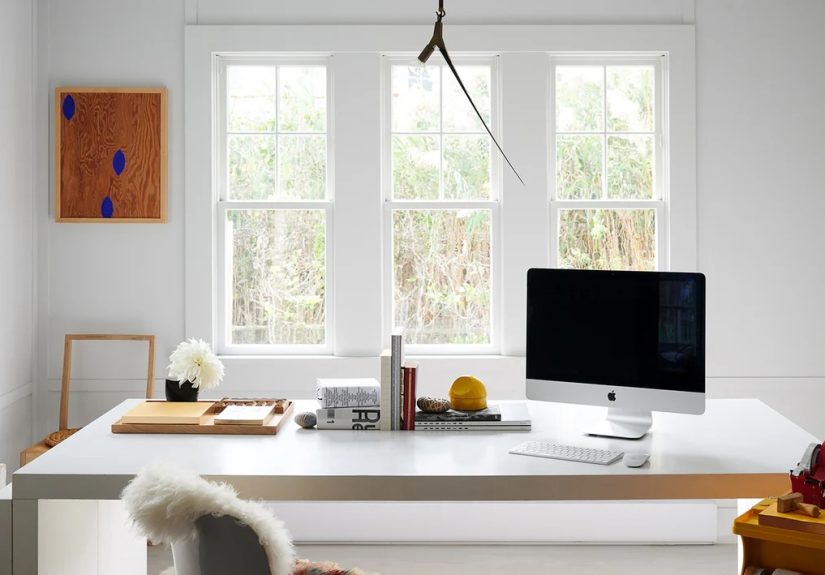
How to Turn These 12 Pieces into a Desk System That Actually Helps You Work
Zone 1: Focus Core
Put your lamp, timer, primary writing tool, and active task list in your immediate reach zone.
Your monitor and keyboard should be positioned for comfort: screen at or slightly below eye level,
with easy reach to avoid awkward shoulder and wrist positions.
Stylish is great; pain-free is mandatory.
Zone 2: Action + Admin
Group scissors, utility knife, tape dispenser, stamp, and mail tools together.
This prevents micro-mess from leaking into your focus area.
If you process deliveries, invoices, or outgoing mail, this zone will save more time than any app you’ve downloaded this year.
Zone 3: Visual Planning
Use the pinboard, magazine rack, and trays to hold active references.
Keep the number of visible projects intentionally limited.
Clean desk culture isn’t about empty surfacesit’s about clear decisions.
If you don’t know where something lives, you’ve created a scavenger hunt, not a workspace.
Zone 4: Daily Reset Ritual
End each workday with a 5-minute reset: clear cups, file loose paper, toss trash, refill paper roller,
and return tools to their zones. A tiny nightly reset gives tomorrow-you a better start than tomorrow’s extra coffee.
(Keep the coffee too, obviously. We’re not monsters.)
500-Word Experience Notebook: What This Setup Feels Like in Real Life
Let’s talk about lived workflownot showroom perfection. Over a typical workweek, a desk equipped with these 12 accessories
creates a subtle but noticeable shift in how work feels. On Monday morning, the impact is mostly visual.
Instead of staring at a flat table with random objects, you see defined zones. The trays catch your phone and keys immediately,
so your desk doesn’t become a landing strip for everything in your pockets. The task roller gives you one obvious place
to write your top priorities, which sounds tiny but reduces decision fatigue before your first meeting.
By Tuesday, the benefits become behavioral. Because the scissors, utility knife, and tape dispenser are grouped,
admin tasks happen faster and with less friction. You open packages, trim labels, and move onno rummaging, no derailment.
The cast-iron tape dispenser especially pulls its weight here; one-handed operation is oddly satisfying and surprisingly efficient.
Meanwhile, the lamp starts doing emotional heavy lifting. Bright mode during deep work. Warmer mode when you’re reading, planning,
or wrapping up email. It quietly changes the atmosphere from “office fluorescent survival” to “intentional workspace.”
Midweek, the hourglass becomes the surprise MVP. A 30-minute visual sprint makes focus feel finite and approachable.
You stop negotiating with yourself and simply begin. If your attention drifts, the sand is still moving, which gives your brain
a gentle nudge back to the task. Pair this with the pinboard and you get an excellent combo: timer for execution, board for direction.
You always know what matters now versus later. The magazine rack helps tooactive references stay visible but off your main surface,
so you can think without drowning in paper.
Thursday is where the aesthetic argument proves itself. By now, you’ve handled repetitive tasks dozens of times:
grabbing scissors, stamping mailers, checking your queue, capturing quick notes. When the tools are attractive and tactile,
you’re more likely to return them to their place. That means your system survives contact with reality.
Pretty objects don’t automatically improve productivity, but objects you enjoy using tend to create consistent habits.
Consistent habits are productivity.
Friday brings the weekly reset. You use the five-minute hourglass, clear the trays, archive old notes, and refresh the board.
The desk is ready for next week in under ten minutes. The real win isn’t just neatness; it’s cognitive closure.
You end the week with fewer open loops and less visual residue. And if you’re a creative, that matters even more:
a calm desk can hold big ideas better than a noisy one.
The overall experience is this: your desk stops being a passive surface and becomes an active tool.
These 12 accessories don’t promise magic. They do something better. They make good work easier to repeat.
And in a world of endless tabs, pings, and distractions, repeatable calm might be the most stylish upgrade of all.
Final Takeaway
If you want a workspace that looks elevated and supports real output, the Wms & Co. approach is a smart model:
fewer but better tools, each with a clear role. Start with one capture tool, one lighting upgrade, one tray system,
and one visual planning surface. Then layer in personality through materials, color, and custom details.
You’re not building a museum. You’re building a desk that helps you finish thingswith style.