Table of Contents >> Show >> Hide
- Why Surf Dogs Are More Than a Cute Gimmick
- How Surf-Dog Fundraisers Typically Work (No, Your Dog Doesn’t Need a Sponsorship Deal)
- The 23 Surf Dogs Who Make Waves for a Good Cause
- Safety First: How Surf Dogs Stay Safe (and Actually Enjoy It)
- How You Can Support the Cause (Even If You’re Landlocked)
- What It’s Like to Experience Surf Dogs for Charity (Extra 500+ Words of Pure Beachy Joy)
- Conclusion: Let the Dogs SurfSo More Dogs Can Thrive
If you’ve ever looked at the ocean and thought, “This would be better with a dog on a surfboard,” congratulations:
you’re emotionally healthy, scientifically correct, and one beach day away from becoming that person with
900 photos of a Labrador “hanging ten” on your camera roll.
Dog surfing isn’t just internet fuelit’s become a legit, crowd-drawing, tail-wagging way to raise money for animal
shelters, rescues, and community nonprofits. Events like the Surf Dog Surf-A-Thon in San Diego County and the World
Dog Surfing Championships in Pacifica bring people together for a reason bigger than bragging rights: helping animals
(and the humans who love them) thrive.
Why Surf Dogs Are More Than a Cute Gimmick
The headline is obvious: dogs riding waves is adorable. But the why is what makes it special.
Many surf-dog events are structured as fundraisersregistration fees, sponsorships, raffles, and donations go toward
pet-welfare programs, animal shelters, and rescue groups. In other words: the dogs aren’t just shredding waves.
They’re shredding the idea that a charity event has to be boring.
Even better? These competitions often spotlight rescue dogs and adoption programs. The vibe is “community festival”
meets “sports event” meets “I’m crying because that bulldog is wearing a life vest.” The result: real dollars raised,
real awareness built, and a lot of happy, sandy paws.
How Surf-Dog Fundraisers Typically Work (No, Your Dog Doesn’t Need a Sponsorship Deal)
Most dog surfing competitions keep the structure simple and safety-forward:
- Size categories: Small, medium, large/extra-large divisions so dogs compete fairly.
- Time-based heats: Dogs get a short window to catch waves and show stability and style.
- Judging criteria: Balance, confidence, time on the board, and sometimes little “tricks” like turns.
- Safety requirements: Life jackets, appropriate boards, and handlers right there in the water.
The most important “rule” is rarely printed on a banner, but everyone knows it:
the dog’s comfort comes first. Judges and organizers consistently emphasize that the dog should look
safe and happynot stressed, forced, or overwhelmed. Think “summer camp energy,” not “Olympic trials.”
The 23 Surf Dogs Who Make Waves for a Good Cause
The dogs below are all connected to real surf-dog eventssome are champions, some are crowd favorites, and some are
the kind of fearless beach weirdos who treat a surfboard like it’s a moving couch. Each one highlights what makes this
scene so lovable: community, charity, and pure canine joy.
1) Abbie Girl
Abbie Girl is basically dog surfing royaltyan Australian Kelpie who helped put Pacifica’s world-stage surf-dog scene
on the map. Her story is a perfect example of how rescue dogs can become confident athletes with patient training and
the right outlet for their energy.
2) Brandy
Don’t let the small-dog package fool you: Brandy proved that big wave confidence can come in pug-sized form.
She’s part of the early Northern California surf-dog era that helped turn a quirky idea into a fundraiser-friendly tradition.
3) Wes
Wes, a Yorkie/Jack Russell terrier mix, represents the “first-timer courage” categorythose dogs who wipe out,
climb back on, and somehow still look like they’re having the time of their lives. Events love dogs like Wes because
they remind everyone it’s about fun and participation, not perfection.
4) Bentley
Bentley (one of the Dalmatians often seen with surf instructor Scott Owens) is known for entertaining crowdsbecause
apparently even dogs have performance arcs. Surf-dog fundraisers thrive on that crowd energy: people show up, donate,
and leave convinced their own dog is “one lesson away” from fame.
5) Bailey
Bailey, Bentley’s Dalmatian teammate, is another example of how surf-dog culture blends training with community
spectacle. Watching dogs learn ocean skills in a controlled, safety-minded way is part of what makes these events
both heartwarming and responsible.
6) Cacau
Cacau, the chocolate Labrador from Brazil, is proof that dog surfing is an international-language kind of joy.
Big crowds gather to watch champions like herbecause nothing says “support local charities” like cheering for a Lab
riding a wave with total main-character confidence.
7) Coconut
Coconut brings the “team sport” vibe: surfing dogs don’t always do it alone. In Pacifica, handlers help dogs get
positioned safely through the breakersthen the dog does the fun part (and the humans do the panicking).
8) Iza
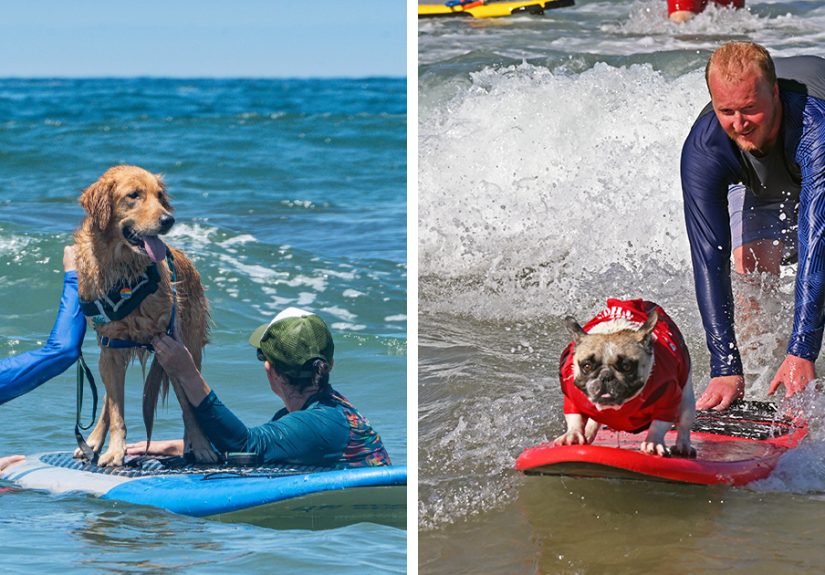
Iza, a French bulldog, is the kind of story that makes a beach crowd go silent for half a secondthen roar.
She’s competed and won in her division, and her team’s story highlights inclusion and defying expectations:
a “non-sporting” breed doing something wildly athletic and joyful.
9) Faith
Faith is a beloved name in surf-dog circlesan American pit bull terrier who has competed at Pacifica and placed highly.
Dogs like Faith also challenge stereotypes in the best way possible: athletic, focused, and clearly thrilled to be out there.
10) Carson
Carson shows how competitive this can getwithout losing the charity-first spirit. In Pacifica’s results,
Carson appears among the top overall finishers, proving that small dogs can absolutely dominate when balance and confidence click.
11) Delilah
Delilah is part of the small-dog spotlight: the division where waves look enormous, boards look tiny, and the crowd
cheers like it’s a stadium. Dogs like Delilah make the case that courage is not a size category.
12) Samson
Samson is a recurring competitor name across results listsone of those dogs who shows up like, “Yes, I do this.”
In a fundraiser setting, repeat competitors matter because they build traditionand tradition brings donors back every year.
13) Cherie
Cherie, a French bulldog champion, became famous for proving that stocky bodies can still find balance on a moving wave.
Her success helped broaden public interest, drawing in people who might otherwise assume only Labs and shepherds could surf.
14) Lil Man
Lil Man’s name alone feels like an audience chant waiting to happen. In surf-dog events, the small-to-medium dogs often
create the loudest crowd reactions because the effort-to-size ratio is off the charts.
15) Ava
Ava represents the strong large-dog classwhere the rides can be longer, the boards bigger, and the dogs look like they’re
casually commuting to work on a wave.
16) Ranger
Ranger is another large-division standout from results coverage. Dogs like Ranger make competitions exciting because they often
have the power to stay stable through choppier waterespecially when trained gradually and safely.
17) Derby
Derby’s name appears in multiple categories, including tandem formats. That versatility is part of the appeal:
surf-dog events aren’t just “dog stands on board.” They’re creative, community-driven showcases of teamwork.
18) Charlie
Charlie (including “Charlie Surfs Up” in Pacifica coverage) is known for one of the most relatable dog traits ever:
loving surfing so much the humans sometimes have to hide the board to keep him from sprinting into the ocean.
That enthusiasm is basically the fundraiser’s marketing plan.
19) Rosie
Rosie, a yellow lab seen competing in multiple heats, embodies the “stoked” post-surf glow that makes spectators believe
in happiness as a real, scientific phenomenon. Dogs like Rosie keep crowds engagedand engaged crowds donate.
20) Carlson
Carlson pops up in tandem categories, reminding everyone that surf-dog culture is often about teamsdogs with dogs,
dogs with humans, and sometimes dogs with humans who are doing their best not to faceplant in waist-deep water.
21) Kentucky
Kentucky appears in human/dog tandem resultsanother format that keeps competitions fun, varied, and accessible.
Tandems are crowd magnets, and crowd magnets are donation magnets. It’s simple beach economics.
22) Skyler
Skyler is a notable winner name in Pacifica history and shows up in results and coverage as a top competitor.
Dogs like Skyler help keep an event “sticky” year to year: fans return hoping to see a favorite champion back on the water.
23) Homer
Homer appears alongside Skyler in tandem human/dog contextsan example of how these events celebrate partnership.
The handler sets the dog up for success, and the dog delivers the moment everyone came for: a clean ride and a happy face.
Safety First: How Surf Dogs Stay Safe (and Actually Enjoy It)
Surf-dog organizers don’t treat safety like an afterthoughtit’s the entire foundation. Across major events, you’ll see
life vests, handlers in the water, and boards chosen with dogs in mind. Many teams practice in pools first, teaching
balance on a stationary board before ever meeting the chaos of real waves.
Smart, dog-first training basics
- Start on land: Let your dog explore the board (treats help; yes, bribery is ethical here).
- Move to calm water: Pool or shallow bay practice builds confidence without scary surf.
- Use a properly fitted life jacket: Even strong swimmers benefit from flotation in unpredictable water.
- Keep sessions short: Dogs can get tired, cold, or overstimulatedend on a win.
- Watch stress signals: If the dog isn’t into it, don’t force it. The goal is joy, not a trophy.
In other words, if your dog’s vibe is “I don’t trust the ocean,” the best charity move is to let them support from shore
like a tiny furry volunteer. There is no shame in being a beach supervisor.
How You Can Support the Cause (Even If You’re Landlocked)
You don’t need a surfboardor a dog who’s auditioning for an action movieto help. Here are easy, real-world ways to support
surf-dog fundraising events and the nonprofits behind them:
- Donate directly to the hosting shelter or partner rescues.
- Attend the event if you’re localticket sales, raffles, and merch matter.
- Volunteer (events need everything from setup crews to adoption booth support).
- Foster or adoptmany competitions shine a spotlight on adoptable dogs and rescue programs.
- Share responsiblypost about the cause, not just the cute clip.
What It’s Like to Experience Surf Dogs for Charity (Extra 500+ Words of Pure Beachy Joy)
Picture this: you arrive at the beach thinking you’re just going to “check it out for a minute.” Two hours later,
you’ve bought a raffle ticket, donated to a rescue booth, learned the difference between “medium dog category” and
“extra-large dog category,” and you’re emotionally invested in a French bulldog’s wave selection like you’re a surf coach.
The first thing you notice isn’t even the surfingit’s the energy. It feels like a small-town festival that
accidentally wandered onto the sand. There are volunteers with clipboards, families carrying beach chairs, and handlers
in wetsuits doing that careful, focused walk into the water that says, “I love my dog and I also respect the ocean.”
Dogs are everywhere: some hyped, some calm, some wearing life vests that make them look like tiny nautical professionals.
Then the heat starts. The crowd shifts from casual chatter to a kind of collective “Oooooh!” as the first board hits the water.
You see what’s really happening behind the scenes: the humans aren’t launching dogs like furry torpedoesthey’re guiding them,
stabilizing the board, and choosing safe moments to go. The best teams look less like “person controlling dog” and more like
“two friends doing something weird and delightful together.”
And the dogs? The dogs are the entire emotional range of humanity in motion. One dog stands tall like a seasoned athlete,
staring down the horizon with the confidence of someone who has never once paid rent. Another sits low, paws planted,
eyes wide, clearly thinking, “I am unsure, but I trust you.” When a wave catches and the board glides forward, you can
actually feel the crowd riselike everyone’s breath syncs for a second. It’s absurd and sincere at the same time.
The best moments aren’t always the longest rides. Sometimes it’s the wipeout followed by a quick check-inhandler steady,
dog safe, both heading back to shore like, “No worries, we’ll try again.” Sometimes it’s a dog who nails a short run,
hops off, and swims back with what can only be described as a victory grin. People cheer for the effort as much as the outcome,
which is exactly why these events work as fundraisers: you leave feeling connected to strangers, to the cause, and to the idea
that communities can rally around something joyful without forgetting what matters.
On the sand, between heats, you’ll see the “good cause” part in action. There are booths explaining where the money goes,
rescue groups sharing success stories, and volunteers answering questions from people who are clearly one cute moment away from
adopting a dog. You overhear conversations like, “We started fostering after last year’s event,” or “That dog was a rescuecan
you believe it?” That’s the secret sauce: surf dogs grab attention, but the mission keeps it.
By the time you leave, the beach feels different. Not because the ocean changed, but because your perspective did.
You didn’t just watch a dog surf. You watched a community show upfor animals, for shelters, for rescue work, and for the kind
of happiness that makes people generous. Also, yes, you definitely told at least one stranger, “That dog is a natural.”
Because it’s true. Obviously.
Conclusion: Let the Dogs SurfSo More Dogs Can Thrive
“23 adorable dogs riding waves” is fun on the surface (pun fully intended), but the real magic is the mission underneath.
These events turn viral-level cuteness into tangible support for rescues, shelters, and nonprofits. Whether you’re cheering
from the sand, donating online, or sharing the cause with your community, you’re part of what makes the next wave possible
for the dogs on the boards and the dogs still waiting for their second chance.