Table of Contents >> Show >> Hide
- Before You Contact WHO, Pick the Right Target (It Saves Everyone Time)
- Way 1: Use WHO’s Official Website Contact Pathways (Best for Routing to the Right Team)
- Way 2: Contact WHO Headquarters Directly (Phone or Mail for Formal or Time-Sensitive Needs)
- Way 3: Contact the Right Regional or Country Office (Often the Fastest for Location-Specific Questions)
- How to Avoid Fake “WHO” Messages (Because Scammers Love Authority)
- Make Your Message Easier to Answer: 7 Pro Tips That Get Replies
- Frequently Asked Questions
- Real-World Experiences: What It’s Like to Reach WHO (and What People Wish They’d Known)
- Experience 1: “I just need one quote for a story… by noon.” (Media inquiries)
- Experience 2: “I want to reuse one chart. Why is this taking so long?” (Permissions/licensing)
- Experience 3: “We have a project in-countryWHO must have a local office, right?” (Regional/country offices)
- Experience 4: “I think this email is fake… but it looks official.” (Scam avoidance)
- Conclusion
If you’ve ever tried to “just email WHO real quick,” you’ve probably learned a universal truth:
global public health is not run like your group chat. The World Health Organization (WHO) is a massive
international organization with different teams, offices, and intake channelsso the fastest way to get a real
response is to contact the right part of WHO the right way.
This guide breaks down three practical, reliable ways to contact WHOplus pro tips to make your message easier
to answer and a scam-proof checklist so you don’t accidentally email “wh0-support-dot-real” and wonder why
they want gift cards.
Quick note: WHO generally does not provide individual medical advice or emergency services.
If you have a medical emergency, contact local emergency services. If you’re in the United States and your
question is U.S.-specific (vaccines, travel health, outbreaks, guidelines), you’ll often get a quicker answer
by contacting your state/local health department or CDC.
Before You Contact WHO, Pick the Right Target (It Saves Everyone Time)
WHO isn’t one inboxit’s more like a city with different neighborhoods. Your first job is to choose which
“neighborhood” fits your question. Doing this one step well can cut days off the back-and-forth.
Common reasons people try to contact WHO
- General information about WHO’s work, policies, or global health topics
- Media requests (interviews, statements, press clarifications)
- Careers (jobs, internships, application troubleshooting)
- Publications (finding, ordering, or requesting materials)
- Permissions/licensing (reusing WHO figures, charts, or text)
- Country or regional work (programs in a specific region or country)
- Health emergencies (technical coordination or emergency program contactsnot personal emergencies)
Once you know which bucket you’re in, choose one of the three contact methods below.
Way 1: Use WHO’s Official Website Contact Pathways (Best for Routing to the Right Team)
The simplest, most “gets you to the right desk” option is WHO’s official contact hub and its topic-specific
pathways. Think of it as the organization’s traffic controller: it helps sort media inquiries from careers
questions from website issues so your message doesn’t get lost behind 4,000 other messages that begin with
“Hello respected sir/madam…”
How to do it
-
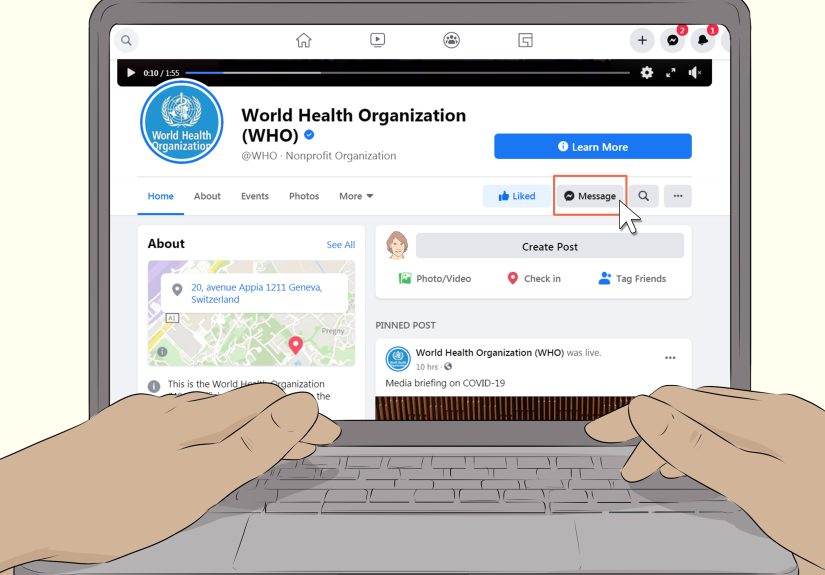
Start at the WHO “Contact us” page and scan the categories that match your reason for reaching out.
WHO provides a general headquarters address and phone, plus directions to specialized channels (media, careers,
publications, permissions/licensing, and website issues). -
Use the specific pathway when available:
- Media: Use the designated media contacts route (instead of emailing random staffers).
- Employment: Use the careers site and job portal for application-related questions.
- Publications: Use the publications pages for finding or ordering materials.
- Permissions/licensing: Use the permissions/licensing guidance for reuse requests.
- Website issues: Use the website feedback/technical form for broken pages, bugs, or access problems.
- Write your message like a helpful human (more on that below), then submit it through the recommended channel.
What to include so you don’t get the dreaded “Please clarify” reply
- One-sentence summary of what you need (what decision are you trying to make?)
- Who you are (journalist, researcher, student, nonprofit, business, member of the public)
- Where you are (country/region matters for WHO routing)
- What you already checked (e.g., you read the FAQ or searched the relevant WHO topic page)
- A clear ask with a deadline if it’s real (and not “ASAP because vibes”)
- Safe contact info (avoid sending sensitive personal data unless the channel specifically requests it)
Example: a strong, specific web-submitted request
Subject/Topic: Permissions request for reuse of a figure
Message: “I’m producing a public health training slide deck for a university course in California. I’d like permission to reuse Figure X from [WHO publication name/year] in a non-commercial classroom presentation. Can you confirm the correct licensing terms and attribution language?”
Why this works: It’s clear, scoped, and already points to a specific publicationso the team doesn’t have to play
“Guess Which Chart” for three emails.
Way 2: Contact WHO Headquarters Directly (Phone or Mail for Formal or Time-Sensitive Needs)
Sometimes you need the classic “talk to a person” approach. WHO provides headquarters contact details in Geneva,
including a main telephone number and a mailing address. This method is most useful when:
When calling or mailing makes sense
- Formal correspondence that requires a physical address (institutions, legal notices, official letters)
- Time-sensitive clarification where a phone call can route you faster than email ping-pong
- Accessibility issues when online forms aren’t working for you
- You’re being bounced between departments and need help identifying the correct office
Practical tips before you call
- Mind the time zone: Geneva operates on Central European time, not your local time.
- Have a 20-second script: who you are, what you need, and where to route you.
- Ask for the correct channel: “Is there a dedicated email or form for this request?” is a power move.
- Keep it professional: A calm, concise call beats a dramatic monologue every time.
Sample phone script (steal this, it’s free)
“Hi, my name is [Name]. I’m a [role/organization] in [country]. I’m trying to reach the correct team for
[topic: media inquiry / publications / permissions / emergency program coordination]. Could you tell me the best
email address or page to submit this request?”
If your request is media-related, WHO also lists a dedicated media inquiry route (including an email address and
an “urgent” phone option) on its media contacts page. Use that instead of sending press questions into the general
inquiry void.
Way 3: Contact the Right Regional or Country Office (Often the Fastest for Location-Specific Questions)
WHO’s work is organized through regional offices and country offices. If your question is about activities,
programs, partnerships, training, or implementation in a specific part of the world, contacting the regional
office (or the country office) is often more effective than starting with headquarters.
How to choose the right office
- Regional office: Best for region-wide initiatives, communications, and coordination.
- Country office: Best for in-country programs, local partnerships, and national health priorities.
WHO regional sites typically provide “Contact us” pages with inquiry forms, phone numbers, and general email
addresses. WHO also maintains a directory of country offices so you can find the right local presence.
Example: In the Americas, contact PAHO/WHO (Washington, D.C.)
For many inquiries tied to the Americas, WHO’s Regional Office for the Americas is the Pan American Health
Organization (PAHO), headquartered in Washington, D.C. PAHO provides an inquiries page with instructions for
contacting headquarters by mail or telephone and a media contact email.
Example: Regional office contact pages (how they’re usually structured)
Regional contact pages commonly include:
- A general inquiry email (often formatted like [region][email protected] or a web form)
- Media inquiry options specific to that region
- Mailing address and telephone/fax numbers
- Links to country office pages
If you’re contacting a regional office, treat it like you’re emailing a busy, well-meaning librarian:
include the exact resource you’re referencing, the country/region, and what you’re requesting in one clear ask.
How to Avoid Fake “WHO” Messages (Because Scammers Love Authority)
Unfortunately, well-known institutions attract impersonators. Scam messages may use WHO’s name (or a similar-looking
email/website) to request money, personal information, or “urgent action.” U.S. consumer protection and law
enforcement agencies consistently recommend a simple rule: don’t use the contact information provided in an
unexpected messageverify independently using a known, official source.
Scam-proof checklist
- Verify the domain: WHO’s primary domain is who.int. Be cautious with lookalikes.
- Don’t click surprise links: Navigate manually to official pages instead of trusting a random URL.
- Watch for pressure tactics: “Pay immediately,” “keep this secret,” or “you’ll be arrested” = big red flag.
- Be skeptical of payment requests: Especially gift cards, crypto, wire transfers, or overseas bank instructions.
- Confirm through official channels: If it might be real, contact WHO using the numbers/emails listed on official pages.
- Report suspicious messages: If you believe you’ve received a phishing or impersonation attempt, report it through appropriate U.S. reporting channels.
If your goal is legitimate supportmedia, publications, permissions, careersthe official WHO pages will point you
to the right path. Scammers don’t like official paths because official paths don’t send money to scammers.
Make Your Message Easier to Answer: 7 Pro Tips That Get Replies
Even the correct inbox can’t help if your message is vague. Here’s how to write a request that’s easy to route,
easy to understand, and hard to ignore.
1) Use a subject line that tells the truth
Good: “Media inquiry: request for comment on [topic] by [date]”
Not-so-good: “HELLO” (this is not a 2009 Facebook wall post)
2) Put the ask in the first two sentences
Lead with what you need and by when. Background comes after.
3) Give context, but keep it relevant
Include your organization, location, and why WHO is the right contact. Skip your entire life story, unless it
directly affects routing (it usually doesn’t).
4) Ask one main question
If you have five questions, prioritize one and list the rest as optional bullets. Inbox triage is real.
5) Provide identifiers
For publications: title, year, figure number. For programs: country, project name, page link title. For jobs:
requisition number and the email used in your application.
6) Be careful with personal data
Don’t send sensitive personal health details. WHO is not your doctor, and your inbox is not a secure medical record.
7) Close with an easy next step
“If this isn’t the right office, could you point me to the correct contact channel?” is polite, practical, and
surprisingly effective.
Copy-and-paste email template (adapt as needed)
Subject: [Topic] inquiry – [Country/Region] – response requested by [Date]
Hello,
My name is [Name], and I’m a [Role] at [Organization] in [Country/State]. I’m contacting WHO regarding
[one-sentence purpose]. Could you please advise on [clear ask]?
Relevant details:
• Topic/program/publication: [Name/Title/Link title]
• Region/country involved: [Country/Region]
• Intended use (if permissions/publications): [Non-commercial, educational, media, etc.]
• Deadline (if applicable): [Date/Time zone]
Thank you for your time. If another office is better suited for this request, I’d appreciate a pointer to the
correct contact channel.
Sincerely,
[Name]
[Organization]
[Preferred contact info]
Frequently Asked Questions
Can I contact WHO for personal medical advice?
Generally, no. WHO publishes global guidance and technical resources, but it typically doesn’t function as an
individual medical advice service. For personal medical decisions, contact a licensed clinician. For urgent
concerns, use local emergency services.
I’m in the U.S. Should I contact WHO or someone else?
If your question is about U.S.-specific health guidance, regulations, or services, you may get faster results by
contacting CDC or your state/local health department. WHO is best for global guidance, international health
standards, and worldwide program information.
What if I don’t know which WHO office applies to me?
Start with WHO’s official “Contact us” page for routing, or use the regional/country office directory to find the
office connected to your location or project.
Real-World Experiences: What It’s Like to Reach WHO (and What People Wish They’d Known)
You don’t need a backstage pass to contact WHObut it helps to understand what the process feels like in
real life. Below are common experiences people report when trying to reach WHO, written as realistic scenarios
(not personal anecdotes). If you recognize yourself, congratulations: you are officially having a normal day in
global bureaucracy.
Experience 1: “I just need one quote for a story… by noon.” (Media inquiries)
Journalists often assume a general contact email will route them to a press officer automatically. Sometimes it
does, but often it doesn’tespecially if the message reads like a generic blast. The most successful media
requests tend to use the dedicated media contacts pathway, clearly identify the outlet, specify the topic, and
include a firm deadline with time zone. A common lesson: don’t bury the ask. Put it up front (“Request for WHO
comment on X by 11:00 a.m. ET”) and keep background short. If a press officer can answer quickly, they will. If
the question requires internal coordination, your best friend is claritybecause “can you explain everything
about global health” is not a question with a two-sentence answer.
Experience 2: “I want to reuse one chart. Why is this taking so long?” (Permissions/licensing)
Researchers, teachers, and nonprofits frequently need to reuse a figure or excerpt from a WHO publication. The
friction usually comes from missing details. People who get faster responses typically include the publication
title, year, exact figure number, and the intended use (commercial vs. non-commercial, public vs. internal,
translation planned or not). Another common surprise: “educational” doesn’t always mean “no permission needed.”
Licensing can depend on the specific resource and how it will be distributed. The best approach is to ask for the
correct licensing terms and attribution language in one message. That turns a vague request into a solvable task.
Experience 3: “We have a project in-countryWHO must have a local office, right?” (Regional/country offices)
Organizations planning health projects often reach out to headquarters first, then discover that regional or
country offices are better positioned to answer practical questions. Common wins come from contacting the office
tied to the geography of the work and writing in a way that respects local context: country, partners involved,
project goal, and what you’re asking WHO to do (introductions, guidance, coordination, data pointers, etc.). A
common pitfall is asking for a partnership without stating capacity or scope. A better request is concrete:
“We’re coordinating a training for community health workers in [country] and would like to know if WHO has
existing materials or recommended standards we should follow.” That’s specific, helpful, and much easier to route
than “We want to collaborate.”
Experience 4: “I think this email is fake… but it looks official.” (Scam avoidance)
People are often surprised by how convincing impersonation attempts can looklogos, signatures, even copied
language. The difference between getting scammed and staying safe usually comes down to one habit: verifying
independently. Instead of replying or clicking, people who avoid trouble typically navigate directly to official
sites (like WHO’s contact pages) and use the contact information listed there. If the message demands secrecy,
urgency, or unusual payment methods, that’s another common “aha” moment. The takeaway is simple: official
organizations have official pathwaysand those pathways don’t ask you to pay a fee via gift cards because
“the finance team is unavailable due to a high-level meeting.”
Bottom line: contacting WHO is absolutely doable, but it works best when you route correctly, write clearly, and
verify that the channel is legitimate. The world may be complicated, but your message doesn’t have to be.