Table of Contents >> Show >> Hide
- Why Lying-Down Lower Back Stretches Work So Well
- How to Stretch Safely Before You Begin
- 1. Knee-to-Chest Stretch
- 2. Supine Spinal Twist
- 3. Pelvic Tilt
- How to Turn These 3 Stretches Into a Quick Routine
- Who May Benefit Most From These Lower Back Stretches
- When to Stop and Get Medical Advice
- Final Thoughts
- Extended Experience Section: What These Stretches Feel Like in Real Life
When your lower back feels tight, grumpy, or as if it filed a formal complaint after a long day of sitting, lying-down stretches can be a wonderfully low-drama way to loosen things up. They are simple, beginner-friendly, and easy to do on a mat, carpet, or even a firm bed. Better yet, they let your body relax while you work on mobility instead of turning the whole thing into a fitness audition.
If you are looking for gentle ways to stretch your lower back while lying down, this guide covers three of the best options: the knee-to-chest stretch, the supine spinal twist, and the pelvic tilt. These moves are popular because they are approachable, effective, and easy to adjust for different comfort levels. They may help reduce tension, improve mobility, and make your back feel less like a rusty door hinge.
Before you start, one important rule: stretching should feel like relief, not revenge. Mild tension is fine. Sharp pain, tingling that worsens, or symptoms shooting down your leg are not. If your back pain follows a fall, comes with fever, trouble controlling your bladder or bowels, worsening weakness or numbness, or pain that is severe at night or worse when lying down, skip the DIY heroics and contact a medical professional.
Why Lying-Down Lower Back Stretches Work So Well
There is a reason physical therapists and orthopedic guides keep recommending stretches in a lying-down position. When you are on your back, the floor supports your body, which means your muscles can stop trying to do six jobs at once. That support helps reduce strain and makes it easier to move with control. In plain English: your back gets a chance to chill out.
Lying-down stretches may also help target nearby muscles that influence low back comfort, including the hips, glutes, hamstrings, and deep core muscles. That matters because the lower back rarely throws a tantrum all by itself. Tight hips, stiff glutes, and weak abdominal support often join the party uninvited.
These stretches are especially handy for people who sit a lot, wake up stiff, recover from long drives, or simply want a gentle mobility routine that does not involve balancing like a flamingo.
How to Stretch Safely Before You Begin
Set yourself up for success
Use a yoga mat, exercise mat, or carpeted floor. A firm bed can work in a pinch, though the floor usually gives better support. Wear comfortable clothes and move slowly enough that your body never feels yanked or forced.
Use the “easy tension” rule
You want a gentle pulling sensation, not a dramatic scene. If you cannot breathe normally during the stretch, you have probably gone too far. Your lower back is asking for kindness, not a wrestling match.
Keep breathing
Try slow, steady breaths. Inhale through your nose, exhale through your mouth, and let the exhale help you soften into the movement. Holding your breath during a stretch is surprisingly common and remarkably unhelpful.
1. Knee-to-Chest Stretch
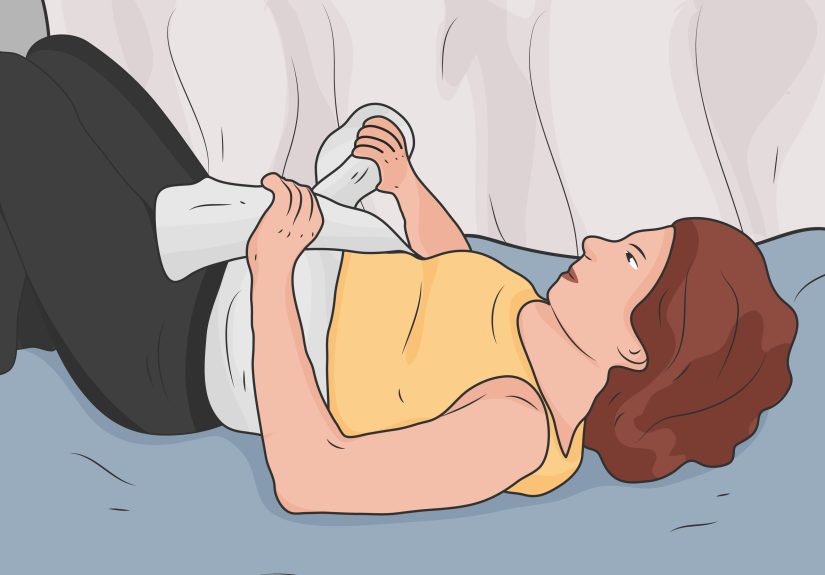
The knee-to-chest stretch is one of the most familiar and effective ways to stretch your lower back while lying down. It gently flexes the lumbar spine and can help release tension in the lower back, hips, and glutes. It is simple, forgiving, and does not require flexibility worthy of a circus poster.
How to do it
- Lie on your back with both knees bent and your feet flat on the floor.
- Bring one knee toward your chest.
- Hold the front of your shin or the back of your thigh with both hands.
- Gently pull until you feel a comfortable stretch in your lower back and hip.
- Hold for 15 to 30 seconds.
- Return to the starting position and switch sides.
- Repeat 2 to 4 times per side.
Want a deeper version?
After you try one leg at a time, you can pull both knees toward your chest together. This can feel especially good after a long day of sitting or standing. Just move slowly and avoid curling up so aggressively that you feel strain in your neck.
Why it helps
This stretch can reduce tightness along the lower back while also opening the hips and glutes. It is often recommended in back-care programs because it is gentle enough for many beginners yet effective enough to become a long-term favorite.
Common mistakes
Do not yank your leg in with brute force. Do not flatten your neck into the floor like you are trying to disappear. And do not treat the hold like a speed challenge. Gentle and steady wins here.
2. Supine Spinal Twist
If your back feels stiff rather than intensely sore, the supine spinal twist can be a lovely choice. This stretch, sometimes called a lower trunk rotation, helps encourage movement through the lower back and torso while also stretching the outer hips and glutes. It sounds fancy, but it is really just a controlled twist while lying on your back.
How to do it
- Lie on your back with your knees bent and feet flat on the floor.
- Stretch your arms out to the sides in a T-shape for support.
- Keep your shoulders relaxed against the floor.
- Let both knees slowly fall to one side.
- Turn your head gently in the opposite direction if that feels comfortable.
- Hold for 15 to 30 seconds, then return to center.
- Repeat on the other side.
- Do 2 to 4 rounds per side.
Why it helps
The lower back is built for stability but also benefits from gentle rotation. This stretch may ease stiffness in the lumbar area and help relax surrounding muscles that get tight from too much sitting or too little movement. Many people also like it because it feels calming, almost like the mobility version of taking a deep breath.
Make it easier
Place a pillow, folded blanket, or yoga block under your knees so they do not have to drop as far. This can make the stretch more comfortable, especially if your hips are tight or your back is feeling extra sensitive.
Common mistakes
Do not force your knees to the floor if your shoulders start lifting up. The goal is a smooth twist, not a dramatic floor-landing. Your body is stretching, not auditioning for a pretzel commercial.
3. Pelvic Tilt
The pelvic tilt is less flashy than the other two stretches, but it deserves a standing ovation anyway. It gently mobilizes the lower back and activates the abdominal muscles that help support the spine. In many routines, it pulls double duty as both a stretch and a basic core exercise.
How to do it
- Lie on your back with knees bent and feet flat on the floor, hip-width apart.
- Let your spine rest in a neutral position first.
- Gently tighten your abdominal muscles.
- Flatten your lower back toward the floor by tilting your pelvis slightly upward.
- Hold for 5 to 10 seconds.
- Relax and return to the starting position.
- Repeat 8 to 12 times.
Why it helps
Pelvic tilts can improve awareness of spinal position and help reduce low back tension caused by poor posture or prolonged sitting. They are also a useful gateway movement for people easing back into exercise because they teach gentle control rather than brute effort.
How it should feel
You should feel your lower back lightly pressing into the floor and your abdominal muscles waking up. Think “subtle and controlled,” not “crunch so hard you meet your ancestors.”
Common mistakes
Avoid pushing through your feet so hard that you lift your hips into a bridge. That is a different exercise. For this move, the pelvis tilts, the back gently presses down, and the rest of the body stays relaxed.
How to Turn These 3 Stretches Into a Quick Routine
If your goal is daily back relief, combine these three movements into one short lying-down routine:
Simple 8-minute lower back stretch routine
- Knee-to-chest stretch: 2 rounds per side, 20 seconds each
- Supine spinal twist: 2 rounds per side, 20 seconds each
- Pelvic tilt: 10 slow repetitions, holding each for 5 seconds
You can do this routine in the morning to loosen up stiffness, after work to unwind, or before bed if your lower back likes to complain after a long day. Consistency matters more than intensity. A few minutes most days usually beats one heroic stretch session followed by four days of pretending your mat never existed.
Who May Benefit Most From These Lower Back Stretches
These lying-down lower back stretches may be especially helpful for office workers, students, drivers, parents of tiny humans who insist on being carried like royalty, and anyone who spends too much time in one position. They may also be useful for people easing into gentle exercise or trying to build a better mobility habit without overcomplicating things.
That said, not every kind of back pain should be stretched the same way. If you have a known spinal condition, recent surgery, osteoporosis, severe sciatica, or pain that keeps getting worse, it is smart to check with a healthcare professional before starting a new routine.
When to Stop and Get Medical Advice
Gentle stretching is usually a reasonable place to start for mild stiffness, but it is not the answer to every type of back pain. Contact a clinician if your pain is severe, follows an injury, spreads below the knee, comes with fever, unexplained weight loss, numbness, weakness, changes in walking, or trouble with bladder or bowel control. Those symptoms deserve more than a mat and good intentions.
Final Thoughts
If your lower back feels stiff, tight, or cranky, these three lying-down stretches can be a practical place to begin. The knee-to-chest stretch helps release tension, the supine spinal twist improves mobility, and the pelvic tilt teaches gentle support and control. Together, they make a simple routine that is easy to learn and even easier to keep coming back to.
The real secret is not finding the “perfect” stretch. It is finding a few safe, effective movements you will actually do. Your lower back does not need a miracle. It usually just needs a little movement, a little patience, and a lot less dramatic slouching.
Extended Experience Section: What These Stretches Feel Like in Real Life
Let’s be honest: most people do not search for “3 ways to stretch your lower back while lying down” because life is going wonderfully and their body feels like a cloud. Usually, they search because something feels off. Maybe they sat through a workday that somehow lasted 19 hours. Maybe they cleaned the house like they were training for a reality show. Maybe they picked up a laundry basket with the confidence of an action hero and the spinal planning of a raccoon.
That is why lying-down stretches are so appealing in real life. They meet people where they are: tired, stiff, and not particularly interested in advanced yoga vocabulary. The knee-to-chest stretch often becomes the first favorite because it feels immediately understandable. You pull your knee in, your lower back softens a bit, and your body says, “Oh, so this is what relief feels like.” It is not flashy, but it is dependable. Like the friend who shows up with snacks and never makes you move furniture.
The supine spinal twist tends to be the stretch people underestimate. At first glance, it looks too easy to matter. Then you try it after sitting all day and realize your torso has apparently been stored in one position since breakfast. The twist can feel like gently wringing tension out of the lower back, hips, and waist. Many people notice that one side feels smooth and the other side feels as if it has been personally offended by movement. That imbalance is common, and it is one reason this stretch can be so useful.
The pelvic tilt is the move that often earns respect later. At first, it seems too subtle. There is no huge dramatic stretch, no big “wow” moment, no instant soundtrack of wellness. But after a few careful repetitions, people begin to notice something important: they can feel their core supporting the low back in a more intentional way. That tiny movement teaches body awareness, and body awareness is often the missing link for people whose backs get irritated by posture, sitting, or repetitive daily habits.
In everyday experience, these stretches work best when they become part of a pattern instead of a one-time rescue mission. A person with morning stiffness may do knee-to-chest and pelvic tilts before getting out of bed. Someone whose back tightens after commuting may use the twist and a few pelvic tilts in the evening. Another person might rotate through all three after exercise to cool down more comfortably. None of this is glamorous, but it is practical, and practical tends to win over time.
There is also a mental side to these movements. Lying on the floor for a few minutes with slow breathing can be surprisingly calming. For some people, the routine becomes less about “fixing” the back and more about checking in with the body before tension piles up. That shift matters. When people stop treating every ache like a five-alarm emergency, they often move with less fear and more consistency.
Of course, experience also teaches boundaries. Sometimes a stretch feels great. Sometimes it feels wrong immediately. Learning the difference is part of the process. The goal is not to force your body into textbook positions. The goal is to find safe, repeatable movements that help you feel looser, steadier, and a little less likely to make dramatic noises every time you stand up from the couch.
In the end, these three stretches are popular for a reason. They fit real life. They do not require expensive gear, athlete-level flexibility, or a spiritual commitment to foam rolling. They just ask for a few minutes, a flat surface, and a willingness to move gently. For a lot of people with everyday low back tightness, that is more than enough to make a noticeable difference.