Table of Contents >> Show >> Hide
- Why Scar and Birthmark Cover-Ups Feel Like “Magic” (But Aren’t)
- Scars vs. Birthmarks: What Matters Before Anyone Touches a Needle
- How Artists Actually Pull Off Scar and Birthmark Cover-Ups
- 50 Cover-Up Transformations People Can’t Stop Smiling About
- The Consultation: Where “Couldn’t Be Happier” Usually Starts
- Safety Matters: Ink Is Art, But It’s Also a Skin Procedure
- How to Pick the Right Artist for Scar or Birthmark Cover-Up Work
- FAQ: Quick Answers People Usually Google at 2:00 a.m.
- Real-World Experiences: What People Say After Scar and Birthmark Cover-Up Tattoos (Extra )
- Conclusion
There are tattoos that say, “I like dragons.” And then there are tattoos that say, “I’m done letting this one patch of skin
narrate my whole life.” That’s the vibe behind scar and birthmark cover-up tattoosthe kind of before-and-after photos that
make you blink twice, zoom in, and whisper, “Okay… that’s actually incredible.”
For a lot of people, scars and birthmarks aren’t “ugly.” They’re just loud. They can grab attention in a way you didn’t
ask forduring a handshake, at the pool, in dressing rooms with the world’s most judgmental lighting. A skilled tattoo artist
can’t erase skin texture or rewrite biology, but they can do something surprisingly powerful: help you decide what the eye sees
first. Suddenly, that scar isn’t the headline. It’s the plot twist. The tattoo? That’s the new cover art.
Why Scar and Birthmark Cover-Ups Feel Like “Magic” (But Aren’t)
A successful cover-up isn’t about slapping ink on top of a mark and hoping for the best. Scar tissue can be thicker, thinner,
shinier, more sensitive, or oddly numb. Some scars are flat like a pencil line; others are raised or ropy. Birthmarks vary
wildly toosome are faint, some deeply pigmented, some vascular, some textured.
That’s why cover-up work tends to look “magical” to outsiders: the artist is solving a design puzzle using real skin, real
anatomy, and real healing behaviornot a perfect, smooth digital canvas. When it’s done well, the design looks intentional,
not like an apology.
Scars vs. Birthmarks: What Matters Before Anyone Touches a Needle
Scar timing: “Healed” is not the same as “ready”
The golden rule is that scar cover-ups work best on mature scarsmeaning the scar has finished most of its
remodeling. In normal healing, scar tissue can keep changing for many months. Fresh scars may still be pink or red, more
reactive, and more likely to behave unpredictably when tattooed. Waiting isn’t just a patience test; it’s a quality control move.
If you’re someone who forms raised scars (hypertrophic scars) or keloids, that matters a lot. These scars involve an
overactive healing response, and extra trauma to the skin can sometimes worsen the raised texture. That doesn’t mean “never,”
but it does mean “slow down and plan carefully”often with input from a dermatologist.
Birthmarks: color, depth, and health monitoring
“Birthmark” is an umbrella word. Some are pigment-based; others are vascular; some are flat; some are textured. From a
safety standpoint, a major issue is visibility for skin checks. Tattooing over pigmented lesions (like moles)
can make it harder to notice changes over timechanges that could be medically important. Many dermatology experts recommend
avoiding tattoos directly over moles or suspicious spots.
Translation: a talented artist can work around certain marks beautifully, but you don’t want a tattoo to become a
camouflage net over something you should be monitoring.
How Artists Actually Pull Off Scar and Birthmark Cover-Ups
They design with the skin, not against it
Great cover-ups often follow the natural lines of the body. An artist may place a stem along the direction of a linear scar or
use petals, scales, feathers, or geometric shading to break up the “straight-line effect.” On textured areas, they may choose
styles that don’t rely on razor-sharp linesbecause scar tissue can hold ink differently than surrounding skin.
They use contrast, not just “coverage”
Here’s a secret: hiding a mark is often less about burying it and more about redirecting the eye. Strategic
contrast (dark-to-light transitions), pattern density, and flow can draw attention to the overall piece instead of a specific
patch of skin.
They choose between two main approaches
-
Decorative cover-up tattoos: The mark becomes part of a larger design (florals, animals, abstract, etc.).
The goal is not invisibilityit’s transformation. -
Scar camouflage / paramedical tattooing: A specialized technique that aims to blend a scar or stretch marks
closer to surrounding skin tone using pigment. It’s more “makeup logic” than “art gallery logic,” and results vary by scar type and skin tone.
50 Cover-Up Transformations People Can’t Stop Smiling About
You’ve seen those compilations where someone walks in with a scar or birthmark and walks out with a masterpiecelike their skin
just got a confidence upgrade. Here are 50 real-world-inspired cover-up concepts and transformations that show
how artists think (and why clients often end up thrilled).
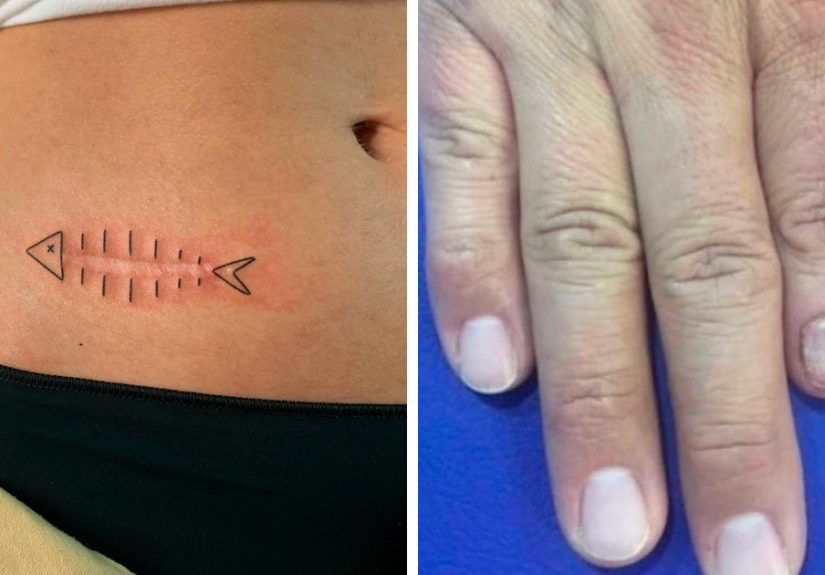
- A vine of ivy that “climbs” a linear scar so naturally it looks like it grew there.
- A peony bloom placed where the eye used to lock onto a pale patchnow it locks onto the petals.
- A koi fish whose scales create a pattern that breaks up uneven texture.
- A constellation map where tiny stars scatter attention away from one obvious line.
- A watercolor splash that turns color variation into a deliberate artistic gradient.
- A phoenix wing that uses layered feathers to disguise a sharp boundary.
- A mountain range silhouette that turns a long scar into the horizon line.
- A botanical sleeve that makes “where the scar is” impossible to pinpoint quickly.
- A geometric mandala whose repeating shapes distract the eye like visual jazz.
- A butterfly with patterned wings that makes texture read as “detail,” not “damage.”
- A jellyfish with flowing tentacles that cleverly follows the body’s natural curve.
- A snake coiled along a scar so the scar becomes the snake’s pathnot the story.
- A bouquet where darker leaves sit exactly where coverage needs the most help.
- A storm cloud and lightning concept that turns a line into the lightning bolt (on purpose).
- A galaxy swirl that uses speckling to make small tone differences disappear.
- A dragon whose scales and shading create instant camouflage in textured areas.
- An octopus whose suction cups create a repeating pattern that “resets” the eye.
- A fern frond that uses delicate repetitionbusy enough to distract, calm enough to feel elegant.
- A compass rose that makes the old focal point a centered design element.
- A hummingbird hovering where people used to starenow they stare for better reasons.
- A blackwork floral that uses bold negative space so the whole piece reads crisp.
- A cherry blossom branch where blossoms land precisely along a scar line like intentional accents.
- A wolf portrait framed with smoke shading that softens harsh transitions underneath.
- A patchwork “sticker” style collage that makes everything feel playful and personal.
- A wave pattern where foam highlights pull attention away from unevenness.
- A classic rose-and-dagger (yes, still undefeated) where the dagger line hides a line.
- A minimalist line art face that cleverly places the scar as a shadow line.
- A sunflower whose textured center makes texture feel like part of the plan.
- A Japanese maple leaf cluster that turns scattered marks into a fall breeze.
- A honeycomb pattern that disguises boundaries through repetition.
- A crane in flight, using wings to cover space while keeping the piece airy.
- A sea turtle whose shell pattern provides natural camouflage.
- A “lace” ornamental design that uses fine symmetry to make the eye glide past old focal points.
- A retro comic panel piece where the bold outlines control what reads first.
- A musical staff where the scar becomes the staff linesubtle, nerdy, and kind of brilliant.
- A waterfall that turns a vertical scar into the water stream (so it looks like intention).
- A tree of life whose trunk covers a central line and branches distract outward.
- A pair of koi circlinga composition trick that keeps attention moving.
- A patch of wildflowers where varied petals hide color variation gracefully.
- A feather that sits along a scar like it was placed there by physics.
- A mosaic tile pattern that makes “imperfection” feel like handcrafted art.
- A mermaid scale gradient that turns texture into shimmering effect.
- A bold black panther (classic cover-up hero) that provides solid coverage and drama.
- A soft-shaded lotus that uses calm symmetry to create a new focal center.
- A topographic map design that makes lines look like terrain contours.
- A pair of hands holding flowerssymbolic, personal, and visually complex in the best way.
- A crescent moon with stars where sparkle highlights pull attention away from uneven tone.
- A ribbon banner with meaningful text framed by shading that minimizes what’s underneath.
- A koi pond scene where ripples “erase” hard boundaries through movement.
- A minimalist branch tattoo that’s placed strategically so the mark sits in negative space, not under ink.
- A full composition that doesn’t hide a mark so much as it makes the mark irrelevantbecause the whole piece is the point.
The Consultation: Where “Couldn’t Be Happier” Usually Starts
People often think the tattoo appointment is the main event. For scar and birthmark cover-ups, the consultation is the real
superstar. This is where expectations get calibrated and the design gets smarter.
What a good artist will ask (and why it’s a green flag)
- How old is the scar? Older scars are often more predictable.
- How does the area feel? Some spots are extra sensitive; others are numb.
- Any history of raised scarring? This can affect whether tattooing is a good idea and what style works best.
- What’s the goal? Blend, transform, distract, or celebrate?
- How do you feel about bold vs. subtle? “Invisible” and “beautiful” can be two different targets.
A thoughtful artist might suggest a larger design than you expected, not because they’re trying to upsell you, but because
bigger compositions give them room to control focal points and transitions. Small tattoos can accidentally spotlight a mark.
Larger pieces can make the mark vanish into the story.
Safety Matters: Ink Is Art, But It’s Also a Skin Procedure
Cover-up tattoos can be life-changing, but they’re still tattoosmeaning your skin is being punctured many times, and proper
hygiene is non-negotiable. There have been real-world issues with contaminated inks and recalls, which is why reputable studios
take sterilization and sourcing seriously.
Studio and artist checklist (the non-glamorous stuff that protects you)
- Single-use needles and disposable barriers where appropriate
- Clean workstation setup (not “wiped with vibes,” wiped with disinfectant)
- Clear aftercare instructions that don’t sound like a shrug
- Willingness to answer questions without getting defensive
Aftercare basics that keep the result looking amazing
Most dermatology-aligned guidance boils down to: keep it clean, moisturize appropriately, and protect it while it heals. That
includes avoiding soaking (pools, hot tubs, lakes) until your tattoo is fully healed, and minimizing sun exposure early on.
Once healed, sunscreen helps preserve color and clarity.
Watch for warning signs like worsening redness, increasing pain, heat, swelling, or unusual discharge. If something feels
“off,” get medical advice promptly. It’s always better to be the person who overreacted than the person who waited.
Skin reactions can happeneven later
Some people develop irritation or allergic-type reactions to certain pigments, and reactions can show up quickly or even much
later. If your tattooed skin changes in a way that concerns youespecially if there’s persistent itching, bumps, or rashcheck
in with a dermatologist.
How to Pick the Right Artist for Scar or Birthmark Cover-Up Work
This isn’t the moment to choose an artist based solely on who has the funniest studio TikTok. Look for evidence of experience
with texture, tone variation, and healed resultsnot just fresh photos taken under flattering lights.
Questions worth asking
- Do you have healed photos of scar or birthmark cover-ups (not just “day of” pics)?
- Have you worked on raised scars or areas with texture before?
- What styles tend to hold up best on this kind of skin?
- Should I consult a dermatologist first (especially if there are pigmented spots)?
- How many sessions might this take, including touch-ups?
A quality cover-up artist is part designer, part technician, part human-who-knows-you’re-trusting-them-with-something-personal.
If you feel rushed or dismissed, that’s your cue to keep looking.
FAQ: Quick Answers People Usually Google at 2:00 a.m.
Will a cover-up tattoo make the scar totally invisible?
Sometimes it becomes hard to notice, especially at a glance. But scars can have texture that ink can’t flatten. The best goal
is usually “not the first thing you see,” not “gone forever.”
Does tattooing over scars hurt more?
It depends. Some scar tissue is more sensitive; some areas feel less because nerve endings changed during healing. This is
exactly why an experienced artist matters.
Can tattoos cover birthmarks completely?
Some can be integrated beautifully, but results depend on the type of birthmark and the skin’s characteristics. For pigmented
lesions, it’s often safer to design around areas that should remain visible for monitoring.
Are touch-ups normal?
Very. Scar tissue can hold ink differently, and a second session is common for refining color, smoothing transitions, or
boosting saturation.
Is “scar camouflage” the same as a decorative tattoo?
Not exactly. Scar camouflage aims to blend with surrounding skin tone; decorative tattoos aim to transform the area into an
artwork. Some people combine both approaches.
Real-World Experiences: What People Say After Scar and Birthmark Cover-Up Tattoos (Extra )
Ask people why they get scar or birthmark cover-up tattoos and you’ll rarely hear, “I wanted to be trendy.” The stories tend to
be more human than thatquiet, specific, and sometimes surprisingly funny. One common theme: the decision often takes a long time,
but the relief hits fast.
A lot of people describe the first consultation as a strange mix of excitement and awkward vulnerability. You’re basically saying,
“Hi, I’d like to turn this part of my skin into something else,” and that can feel deeply personal even if you’re confident.
The best artists handle that moment like pros: they don’t overreact, they don’t pity you, and they don’t treat your skin like
a problem to be fixed. They treat it like a design challengeand you like a collaborator.
On appointment day, nerves are common. People often worry about three things: pain, outcome, and whether they’ll regret choosing
a design that’s too bold (or too subtle). Many describe a turning point about 20 minutes in, when the stencil goes on and they see
the concept mapped to their body. That’s when the “maybe” starts turning into “oh, this could actually be amazing.”
Then comes the moment people talk about most: the reveal. Even clients who arrive trying to be coolarms crossed, “I’m fine” voice
tend to soften when the mirror comes out. They’ll say things like, “Wait… that’s on me?” or “I can’t even find it anymore,” meaning
the mark that used to command their attention. Some laugh because the transformation feels unreal; others get quiet because it’s
emotional in a way they didn’t expect. Not because a tattoo solved every insecurity on earth, but because it shifted control back
into their hands.
Healing is where the grown-up part of the story begins. People who are happiest long-term usually followed aftercare carefully:
gentle cleaning, appropriate moisturizing, avoiding soaking, and being patient when peeling happens. A common experience is the
“panic phase” around day three to day sevenwhen the tattoo looks dull, flaky, or uneven. Artists warn about this for a reason:
it’s normal. Clients who were prepared for the ugly-healing phase tend to stay calm and let the skin do its job.
Another real-world detail: some cover-ups take more than one session, and many people end up grateful for that. A follow-up
appointment can refine color, smooth transitions, and boost areas where scar tissue didn’t hold ink as strongly. Instead of feeling
disappointed, clients often treat touch-ups like finishing toucheslike tailoring a suit so it fits perfectly.
Months later, the stories get even better. People often say the tattoo didn’t just change how others look at themit changed how
they move. They stop adjusting sleeves. They stop bracing for questions. They wear what they want without planning an
escape route. And the funniest part? Many report forgetting the tattoo is “covering” anything at all. It becomes just… their art.
Their skin. Their choice. That’s when “couldn’t be happier” stops being a caption and starts being a lived experience.
Conclusion
Scar and birthmark cover-up tattoos aren’t about pretending the past didn’t happen. They’re about choosing what gets the spotlight.
The best results come from the right timing, the right design strategy, and the right artistsomeone who understands both the art
and the reality of tattooing on textured or visually distinct skin. When those pieces click, the outcome can feel like a small
miracle: not because the mark vanishes, but because it finally stops being the first thing you see.