Table of Contents >> Show >> Hide
- Before We Decode Anything: A Respectful Quick Note
- Worldview and Community Symbols
- 1) The Circle (Sacred Hoop)
- 2) The Four Directions
- 3) The Medicine Wheel (Multiple Traditions)
- 4) Four Colors (Context-Specific)
- 5) The Spiral
- 6) The Path or Journey Line
- 7) The Handprint
- 8) Footprints and Tracks
- 9) Petroglyphs (Carved Rock Images)
- 10) Pictographs (Painted Rock Images)
- 11) Winter Counts (Pictographic History Records)
- 12) Wampum Belts
- 13) Totem Poles (Northwest Coast Monumental Carving Traditions)
- 14) Clan Crests
- 15) The Drum (Community Heartbeat)
- 16) The Flute
- Sky, Weather, and Time Symbols
- Animal Symbols (Story-Carriers, Not Mascots)
- 27) The Feather
- 28) Eagle
- 29) Hawk
- 30) Owl
- 31) Raven
- 32) Crow
- 33) Hummingbird
- 34) Butterfly
- 35) Dragonfly
- 36) Spider (and Spider Woman Themes)
- 37) Snake
- 38) Turtle
- 39) Bear
- 40) Bear Paw Print
- 41) Wolf
- 42) Coyote
- 43) Fox
- 44) Deer
- 45) Elk
- 46) Bison (Buffalo)
- 47) Horse
- 48) Salmon
- 49) Whale
- 50) Frog
- 51) Beaver
- 52) Ant
- Plants, Food, and “The Land Feeds Us” Symbols
- Objects, Motifs, and Cultural Figures (With Context!)
- 61) The Arrow
- 62) The Arrowhead
- 63) The Bow
- 64) The Spear or Lance
- 65) The Tipi (Plains Cultural Context)
- 66) The Canoe
- 67) The Pipe (Nation-Specific Sacred Contexts)
- 68) The Cradleboard
- 69) Dreamcatcher (Origin and Modern Spread)
- 70) Kachina / Katsina Figures (Hopi Context)
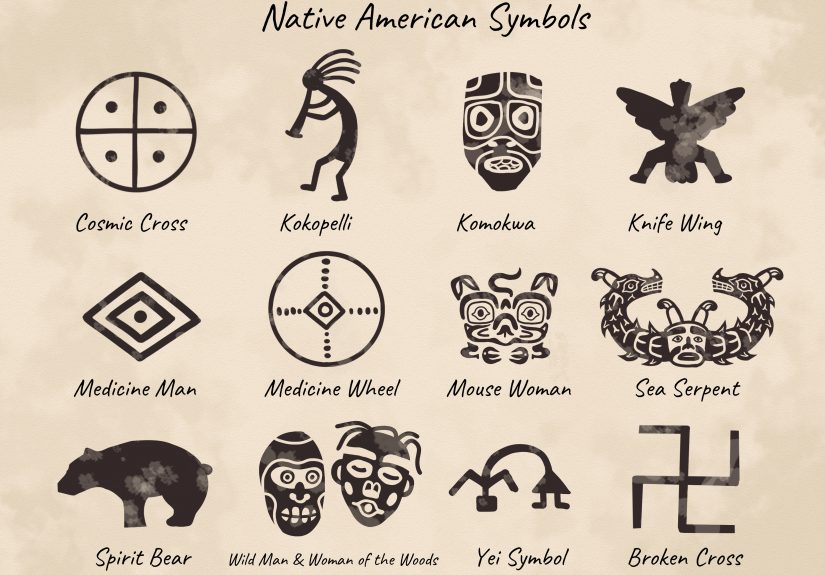
- 71) Kokopelli (Southwest Rock Art Figure)
- 72) The Whirling Log (Diné/Navajo Symbol with a Complicated Modern History)
- How to Use This Guide Without Accidentally Being “That Person”
- Conclusion
“Native American symbols” sounds like one tidy list… until you remember there are hundreds of distinct Native Nations in the United States,
each with its own languages, histories, and visual traditions. So here’s the deal: this guide shares common symbol themes you’ll see in
Indigenous art across many regionswhile being honest that meanings can shift by Nation, community, family, ceremony, and even the artist’s intent.
Also: some imagery is sacred, family-owned, or context-specific. A symbol can be “public” in a museum label and still be “not for copying onto a t-shirt.”
(Yes, culture is nuanced like that. No, the internet does not get a vote.)
Before We Decode Anything: A Respectful Quick Note
- Meanings vary. If you see a single “universal meaning,” treat it like a “one-size-fits-all” hat: suspicious.
- Context matters. A design in beadwork, a winter count, a sandpainting, or a clan crest can carry very different layers of meaning.
- Avoid “spirit animal” shortcuts. Animal imagery often connects to clan, kinship, and community storiesnot a personality quiz result.
- When in doubt, ask the source. Tribal museums, cultural centers, and Native artists are the best guides.
Worldview and Community Symbols
Many Indigenous symbol systems reflect relationshipsamong people, land, time, and the unseen. You’ll notice circles, directions, and story-recording
devices showing up again and again, because they’re incredibly practical (and also beautiful).
1) The Circle (Sacred Hoop)
Often represents the interconnectedness of lifecommunity, seasons, cycles, and balance. You’ll see circles in everything from dance spaces to
design motifs that emphasize continuity over sharp beginnings and endings.
2) The Four Directions
A directional cross (or four-part division) commonly points to East, South, West, and North. Teachings linked to directions can include seasons,
stages of life, responsibilities, or relationshipsdepending on the Nation.
3) The Medicine Wheel (Multiple Traditions)
“Medicine wheel” can refer to stone circles on the land, ceremonial/teaching frameworks, or modern pan-Indigenous teaching tools.
Many versions emphasize balance, health, and the cyclical nature of lifewhile details (colors, meanings, and layout) vary by tradition.
4) Four Colors (Context-Specific)
Some medicine wheel teachings use four colors to express directions, seasons, or stages of life, but the color order and meanings are not universal.
If a chart claims one “official” version, it’s likely oversimplifying living traditions.
5) The Spiral
A common rock art motif that can suggest movement, emergence, journeys, water, wind, or cycles. Spirals can be beautifully ambiguous on purpose
like a good story that rewards patience.
6) The Path or Journey Line
A winding line or “trail” motif can symbolize life’s journey, migration, learning, or a sequence of events. In some art, it literally represents travel;
in others, it suggests personal growth and experience.
7) The Handprint
Handprints in rock art can mark presence (“I was here”), identity, protection, or participation in a community event. It’s one of the most human symbols:
direct, simple, and impossible to fake with a fancy speech.
8) Footprints and Tracks
Tracks (human or animal) can reference travel, hunting, guidance, or spirit journeys. In storytelling contexts, tracks may act like visual verbsshowing
where the story goes next.
9) Petroglyphs (Carved Rock Images)
Petroglyphs are images carved into rock. They can be art, record-keeping, place-marking, or spiritual communicationsometimes all at once.
Many are site-specific, tied to the land and its stories.
10) Pictographs (Painted Rock Images)
Pictographs are painted onto rock surfaces. Like petroglyphs, they can carry layered meaning and may include abstract forms (lines, dots, spirals)
as well as recognizable animals or people.
11) Winter Counts (Pictographic History Records)
A winter count is a pictographic recordoften one image per yearthat helps communities remember and tell history. The power is in the combination
of image and oral tradition: the picture cues the story.
12) Wampum Belts
Wampum beltsmade from shell beadshave been used in some Northeastern nations as memory aids, diplomatic records, and community agreements.
Patterns are not “decorations”; they can encode relationships, events, and responsibilities.
13) Totem Poles (Northwest Coast Monumental Carving Traditions)
Totem poles on the Northwest Coast can commemorate ancestry, histories, and rights to clan crests. The carved figures often represent ancestors
or beings connected to lineage storiespublic records in wood, visible to the whole community.
14) Clan Crests
Crest imagery can function like a living emblem: identity, history, and responsibility. In many contexts, it’s not “a cool animal logo”it’s a sign of
belonging and the stories that go with it.
15) The Drum (Community Heartbeat)
Drums often symbolize community and continuity. In many settings, the drum’s rhythm supports song, dance, and gatheringreinforcing connection
rather than individual spotlight.
16) The Flute
Flute imagery can represent music, courtship stories, and cultural continuity. The flute is a reminder that art is not “extra”it’s a way of remembering,
teaching, and relating.
Sky, Weather, and Time Symbols
The sky is a library: sun, moon, stars, storms, and seasons all become visual shorthand for timing, renewal, and power. Many Indigenous designs use
these elements as both nature observation and moral storytelling.
17) The Sun
Commonly linked to life-giving power, warmth, growth, and renewal. Sun imagery can also symbolize directionality (sunrise/sunset) and the rhythm of
daily responsibilities.
18) The Moon
Often associated with cycles, timekeeping, seasonal changes, and night travel. Moon imagery can also connect to stories of balance and observation:
the world looks different when you slow down and pay attention.
19) Stars
Stars can symbolize guidance, ancestors, time, and navigation. Star motifs can appear in many art forms and may also relate to origin stories or
seasonal responsibilities.
20) The Morning Star
In some traditions, the Morning Star (often associated with Venus) can represent guidance, renewal, or ceremonial timing. Meanings are Nation-specific,
so treat “one meaning” claims with caution.
21) The Rainbow
Frequently symbolizes promise, connection between realms, or the arrival of rain and renewal. Like many nature symbols, it can also be a reminder:
beauty often follows storms.
22) Lightning
Often represents power, speed, transformation, or spiritual force. Lightning imagery can appear in rock art and regalia design, sometimes tied to
thunder beings or storm stories.
23) Clouds
Cloud motifs are especially common in arid and semi-arid regions, where rain is life. Clouds can symbolize blessing, fertility of the land, and the
relationship between people and weather.
24) Water (Wave or Flow Lines)
Water lines can symbolize life, cleansing, movement, and continuity. In some designs, water is depicted as repeating curves, stepped motifs, or
meander patternsvisual rhythm, like water itself.
25) Mountains
Mountain imagery often reflects homeland, protection, endurance, and sacred geography. Mountains can be physical landmarks and also moral
reminders: some things are meant to be respected, not conquered.
26) The Thunderbird
A powerful being in many Indigenous traditions (especially prominent in Northwest Coast and other regions), often linked with storms, thunder, and
spiritual authority. Depictions vary widely across cultures and stories.
Animal Symbols (Story-Carriers, Not Mascots)
Animals in Native American symbols and meanings are often tied to clan identity, creation stories, and community teachings.
They’re not interchangeable “traits” to borrow. Think: relationships and responsibilities, not buzzfeed vibes.
27) The Feather
Feathers can symbolize honor, prayer, connection to the sky, or achievementdepending on context. Because feathers may be tied to ceremony and
protocol, it’s best to treat them with special respect.
28) Eagle
Often associated with strength, vision, and closeness to the Creator or the sky world in many traditions. Eagle imagery can represent leadership,
protection, and responsibility.
29) Hawk
Commonly connected to keen sight, focus, and watchfulness. Hawk symbolism can reflect guardianship or alertnessseeing clearly and acting wisely
(a useful skill online, too).
30) Owl
Owl meanings vary widely: in some communities it can symbolize wisdom and protection; in others, it can be linked to warnings or the night world.
The “owl always means death” claim is oversimplified at best.
31) Raven
Raven appears in many stories, especially on the Northwest Coast, often connected to transformation, cleverness, creation narratives, or the bringing
of lightdepending on the tradition.
32) Crow
Crow symbolism can overlap with raven but is distinct in many traditions. It may represent intelligence, community, adaptability, or messenger roles.
(Crows do teamwork better than most group projects.)
33) Hummingbird
Often linked to joy, resilience, and energetic persistence. In some Southwestern traditions, hummingbird imagery can connect to beauty, healing,
and the return of life in the warm season.
34) Butterfly
Frequently symbolizes change, renewal, and the movement from one life stage to another. Butterfly designs are common in textiles and jewelry,
especially where seasonal transformation is central to local ecology.
35) Dragonfly
Often associated with water, motion, and transformation. In some contexts, dragonfly imagery connects to adaptability and gracemoving quickly
while staying balanced.
36) Spider (and Spider Woman Themes)
Spider imagery can symbolize creativity, patience, and the weaving of stories. In some traditions, Spider Woman is a teacher figure connected to
weaving and wisdomagain, Nation-specific and story-specific.
37) Snake
Snake symbolism can connect to transformation (shedding skin), water, fertility, guardianship, or dangerdepending on region and story tradition.
In rock art, snakes often appear as powerful, dynamic forms.
38) Turtle
Turtle is widely respected in many Native Nations, often linked to longevity, protection, and in some traditions, creation narratives tied to “Turtle Island.”
Meanings vary, but respect is consistent.
39) Bear
Bear commonly symbolizes strength, courage, healing knowledge, and protection. In some Northwest Coast crest traditions, bear imagery can also reflect
lineage stories and identity responsibilities.
40) Bear Paw Print
A paw print motif can emphasize protection, leadership, or the presence of powerful animal relatives. It’s a compact symbollike a signature that says,
“You’re not alone out here.”
41) Wolf
Often linked to loyalty, family bonds, teaching, and survival through cooperation. Wolf imagery can reflect social responsibility: strength that works
with others, not against them.
42) Coyote
In many traditions, coyote appears as a tricksterclever, chaotic, sometimes helpful, sometimes a warning. Trickster stories often teach consequences:
humor with a lesson baked in.
43) Fox
Commonly associated with cleverness, observation, and adaptability. Fox symbolism can overlap with trickster themes, but meanings depend on the
local cultural story landscape.
44) Deer
Often represents gentleness, attentiveness, and harmony with the land. Deer imagery can connect to hunting ethics, gratitude, and the relationship
between people and animal relatives.
45) Elk
Elk can symbolize endurance, strength, and seasonal movement. In regions where elk are central to livelihood and story, elk imagery often signals
respect for abundance and responsibility.
46) Bison (Buffalo)
In Plains contexts especially, bison can symbolize sustenance, survival, gratitude, and community resilience. It’s not just an animal; it’s a reminder
of reciprocal relationships with the natural world.
47) Horse
Horse imagery can represent travel, strength, partnership, and freedom of movementespecially in post-contact histories where horses became
central to mobility and cultural practice in many areas.
48) Salmon
In many Pacific Northwest cultures, salmon symbolizes renewal, abundance, and responsibilitybecause salmon returns are cyclical and deeply tied
to community wellbeing.
49) Whale
In coastal traditions, whales can represent guidance, kinship, and deep spiritual presence. Whale imagery often signals relationship with ocean
homelands and the responsibilities of stewardship.
50) Frog
Often associated with water, cleansing, rain, and transformation. Frog motifs may appear where wetlands and seasonal water cycles shape everyday
life and ceremonial timing.
51) Beaver
Commonly connected to building, persistence, and shaping the environment. Beaver symbolism can suggest industriousness and community planning
basically, “measure twice, chew once.”
52) Ant
Ant imagery can represent community cooperation, patience, and preparation. Small-but-mighty symbolism shows up across cultures because, frankly,
ants are extremely committed to teamwork.
Plants, Food, and “The Land Feeds Us” Symbols
Many Indigenous symbols highlight agriculture, medicines, and the ethics of harvest. These are not “rustic aesthetics”they’re knowledge systems
that kept communities thriving for generations.
53) Corn (Maize)
Corn often symbolizes life, sustenance, and community continuity. In many Indigenous traditions, corn is more than foodit’s a relative, a teacher,
and a reminder of gratitude.
54) Beans
Beans can symbolize nourishment, reciprocity, and support. In companion planting teachings, beans help feed the soilan agricultural metaphor for
how communities strengthen one another.
55) Squash
Squash imagery can represent protection and abundance. In garden teachings, broad squash leaves shade the ground, helping retain moisture and
reduce weedspractical protection turned symbolic.
56) The Three Sisters (Corn, Beans, Squash Together)
The Three Sisters represent cooperation and balance: corn provides structure, beans enrich the soil, and squash protects the ground. Beyond farming,
the trio often functions as a teaching about interdependence and respectful relationships.
57) Tobacco (Sacred Use Contexts)
In some traditions, tobacco is a sacred plant used for offering, gratitude, and communication in ceremony. This is distinct from commercial tobacco
products; the cultural meanings are not interchangeable.
58) Sage
Sage can symbolize cleansing, preparation, and clarity in some traditions. Because protocols differ across communities, it’s best to learn from local
cultural educators rather than copying “how-to” trends online.
59) Sweetgrass
Sweetgrass is often associated with kindness, welcome, and positive intention in some teachings. Its braided form is sometimes interpreted as a visual
metaphor for unity and careful care.
60) Cedar
Cedar can symbolize protection and purification in certain cultural teachings. Like other sacred plants, the “meaning” is connected to practice and
protocolnot just a definition in a list.
Objects, Motifs, and Cultural Figures (With Context!)
Some of the most recognizable Native American symbols and meanings are tied to specific regions or Nations. This section keeps the “where and why”
visible, so we don’t accidentally turn living culture into a trivia card.
61) The Arrow
Arrows can symbolize direction, protection, and purpose. An arrow’s meaning can shift depending on how it’s depicted: motion, readiness, or the idea
of moving forward with intention.
62) The Arrowhead
Arrowhead motifs often suggest strength, defense, and hunting knowledge. But remember: stone points are also historical technologies, not just symbols
each one reflects skill and local materials.
63) The Bow
The bow can represent skill, provision, and the responsibilities of hunting. In symbolic design, it may also suggest preparedness and focusaiming
carefully, not wildly.
64) The Spear or Lance
Often symbolizes protection and survival. Like other tool-symbols, it can also point to community responsibility: providing for others and defending
what must be safeguarded.
65) The Tipi (Plains Cultural Context)
Tipis (teepees) are closely associated with many Plains peoples and can symbolize home, mobility, and community organization. They are not a
universal “Native” homemany Nations have distinct housing traditions.
66) The Canoe
Canoe imagery can represent travel, trade, connection, and relationship with waterways. In many regions, waterways were highwaysso canoe symbols
can also suggest diplomacy and exchange.
67) The Pipe (Nation-Specific Sacred Contexts)
Pipes can be sacred in certain traditions and may symbolize prayer, agreements, or community responsibility. Because protocols are specific,
it’s important not to generalize this symbol across all Native Nations.
68) The Cradleboard
Cradleboards (in communities that use them) can symbolize protection, family care, and continuity. They represent practical design guided by deep
cultural values: safety, closeness, and belonging.
69) Dreamcatcher (Origin and Modern Spread)
Dreamcatchers originated in Anishinaabe (Ojibwe) contexts as protective charms and later spread widely through pan-Indigenous and commercial markets.
Today, they’re also a flashpoint for conversations about appropriation and respect.
70) Kachina / Katsina Figures (Hopi Context)
In Hopi tradition, katsina figures relate to spiritual beings and ceremonial teaching. Dolls carved in katsina likeness have been used to teach and bless
children, and also may be made for saletwo realities that can coexist.
71) Kokopelli (Southwest Rock Art Figure)
Kokopelli is often depicted as a humpbacked flute player in Southwestern rock art and related traditions, commonly linked to fertility, agriculture,
music, and the arrival of springwhile specific stories vary by culture.
72) The Whirling Log (Diné/Navajo Symbol with a Complicated Modern History)
The Whirling Log is a Diné/Navajo motif associated with wellbeing and creation-story themes in certain contexts. It resembles the swastika, which was
later appropriated by Nazis; as a result, some Native communities publicly renounced or reduced its use in the 20th century, while artists today may
discuss reclamation carefully and contextually.
How to Use This Guide Without Accidentally Being “That Person”
- Name the Nation when possible. “Hopi katsina” is more accurate than “a Native doll.”
- Treat symbols like stories, not stickers. Learn what they mean to the community, not just what they look like.
- Support Native artists. If you buy art, buy from Native makers or verified Native-owned businesses.
- Don’t copy ceremonial or clan-owned designs. Admiration is fine; duplication can be disrespectful.
- When visiting rock art sites, leave no trace. Photos are fine where allowed; touching and chalking are not.
Conclusion
Native American symbols and meanings aren’t a single dictionarythey’re living languages of place, relationship, and memory. A spiral might be a journey,
a direction cross might be a teaching, a wampum belt might be diplomacy, and an animal might be family history rather than “my vibe.” The best way to
understand these symbols is to keep the people and places attached to them: Nation, region, story, artist, and protocol.
Experiences Related to “55+ Native American Symbols and Their Meanings” (500+ Words)
One of the most meaningful ways to learn about Indigenous symbolism is through real-world, respectful experiencesthe kind where you
realize a “symbol” isn’t a trivia fact but a relationship. For example, walking through a museum exhibition curated by Native voices can feel like switching
from a blurry photo to high-definition: suddenly, an object label stops being “pretty pattern” and becomes “this design records a family story,” or “this
motif belongs to a specific lineage.” That shift changes how you look at everything from beadwork geometry to carved figures on poles. Instead of hunting
for a single “translation,” you start asking better questions: Who made this? For whom? In what setting? What responsibilities come with it?
Another common experience is visiting a National Park or cultural site with petroglyphs and pictographs. If you go with patience (and a good hat),
you notice how many designs are tied to the landscape itself. A spiral can echo wind and water movement; animal tracks can make sense near a travel
corridor; a handprint can feel like a signature across centuries. The experience teaches a quiet lesson: some symbols aren’t meant to be ripped out of
their environment and pasted into a mood board. They’re part of a place-based conversationbetween people, rock, water, sky, and memory.
That’s why “leave no trace” isn’t just a rule; it’s respect for a message still being held by the land.
Food traditions can be another doorway. Planting a small “Three Sisters” garden (even in a raised bed) is a hands-on way to understand symbolism through
practice. Watching corn become the support, beans return nutrients, and squash shade the soil makes the teaching feel obvious in the best way:
cooperation isn’t an abstract virtueit’s how you survive and thrive. Many people find that once they’ve seen that system work, they understand why corn,
beans, and squash show up as more than ingredients. They become a living metaphor for community: different strengths, shared success.
If you’ve ever attended a public cultural eventlike a museum demonstration, a talk by Native educators, or an art market featuring Native artistsyou’ve
probably felt the difference between learning and collecting. Learning sounds like, “What does this symbol mean in this
artist’s community?” Collecting sounds like, “Cool, I’m going to use this for my brand.” The first approach leads to richer understanding and better
relationships; the second tends to lead to awkward apologies. Supporting Native artists is also an experience in itself: you learn that designs can carry
protocols, that some pieces are made for public sale while others aren’t, and that authenticity isn’t just about “style”it’s about responsibility,
community, and narrative.
Finally, there’s the experience of unlearning. Many people grew up hearing oversimplified claims: “This animal always means X,” or “This symbol is the
Native American symbol for Y.” Encountering accurate, Nation-specific information can feel like getting gently corrected by a wise auntie (or a museum
educator with very patient eyes). It’s humblingand helpful. The best outcome isn’t memorizing 72 definitions. It’s developing the habit of approaching
Indigenous symbolism with curiosity, accuracy, and respect, so your understanding gets deeper over time instead of louder.