Table of Contents >> Show >> Hide
- Interchange vs. Intersection: Quick Road Nerd Moment
- 1) Place Charles de Gaulle (Arc de Triomphe), Paris, France
- 2) Shibuya Scramble Crossing, Tokyo, Japan
- 3) The Magic Roundabout, Swindon, England
- 4) Gravelly Hill Interchange (“Spaghetti Junction”), Birmingham, England
- 5) The High Five Interchange, Dallas, Texas, USA
- 6) Judge Harry Pregerson Interchange (I-105/I-110), Los Angeles, California, USA
- 7) Gibraltar’s Runway Crossing / Airport Access Junction, Gibraltar
- What These Wacky Junctions Actually Teach Us
- Extended Experience Section (Approx. ): What It Feels Like to Encounter These Places
- Conclusion
Some roads are polite. They have one lane, one light, and just enough drama to keep you awake until the next coffee stop. And then there are the places in this listthe giant roundabouts, mega-stacks, scramble crossings, and road-runway mashups that look like a traffic engineer spilled spaghetti on a blueprint and said, “Perfect. Build it.”
But here’s the twist: many of the world’s wackiest interchanges and intersections are not disasters. They’re often clever responses to impossible conditionshistoric city layouts, huge traffic volumes, tight land constraints, rail integration, or geography that refuses to cooperate. In other words, they look chaotic because they’re solving chaotic problems.
In this guide, we’ll tour seven of the most unusual traffic junctions on Earth, explain what makes each one so strange, and unpack the engineering logic hiding beneath the visual madness. If you love road design, urban planning, or simply enjoy saying “absolutely not” while looking at aerial photos, this one’s for you.
Interchange vs. Intersection: Quick Road Nerd Moment
Before we jump in, a quick distinction helps:
- Intersection usually means roads cross at grade (same level), often managed by signals, stop signs, or roundabouts.
- Interchange usually means roads cross using ramps and grade separation (bridges/flyovers), so traffic flows without stopping.
This list includes bothbecause sometimes the weirdest road experiences happen at street level, and sometimes they happen 12 stories up on a concrete ribbon in the sky.
1) Place Charles de Gaulle (Arc de Triomphe), Paris, France
Why it feels wacky
Picture a famous monument in the middle of a giant circular plaza, then add a starburst of major avenues pouring traffic in from multiple directions. That’s the Arc de Triomphe roundabout area at Place Charles de Gaulle: iconic, photogenic, and enough to make a cautious driver negotiate with the universe.
The visual effect is pure urban theater. Cars orbit the Arc while streams of vehicles enter and exit from different points, and the whole scene feels less like a “lane-by-lane” experience and more like a moving school of fish. If your internal GPS says, “Please proceed carefully,” it is not being dramatic.
What makes it work
The geniusand the challengecomes from geometry and flow. The plaza sits at the center of a circular space with radiating avenues, which makes it a major distribution node in Paris. It’s not weird by accident; it’s weird because it is trying to handle an enormous amount of directional choice in one unforgettable place.
It also proves a larger point: some “wacky intersections” are really historic city planning artifacts that modern traffic has learned to live with. Beautiful? Absolutely. Intimidating? Also absolutely.
2) Shibuya Scramble Crossing, Tokyo, Japan
Why it feels wacky
Shibuya Scramble Crossing is the opposite of a giant freeway interchangeand somehow just as mind-bending. Instead of ramps and flyovers, the spectacle here is human movement. When the signal changes, pedestrians flood the intersection from multiple directions at once, weaving past each other in what looks like organized chaos.
It’s one of those places that makes first-time visitors stop dead (on the sidewalk, hopefully) and stare. The crossing is so famous that it has become shorthand for “Tokyo energy”: neon, motion, density, timing, and a tiny miracle of social choreography.
What makes it work
Scramble crossings are designed to separate pedestrian phases from vehicle phases. Rather than forcing people to cross in small, competing groups while cars turn through them, the signal system creates a moment when pedestrians get broad priority and can move across in several directions. The result looks chaotic, but the rules are actually very clear.
In short, Shibuya is “wacky” in appearance but highly intentional in design. It’s not random. It’s a precision-timed people machine.
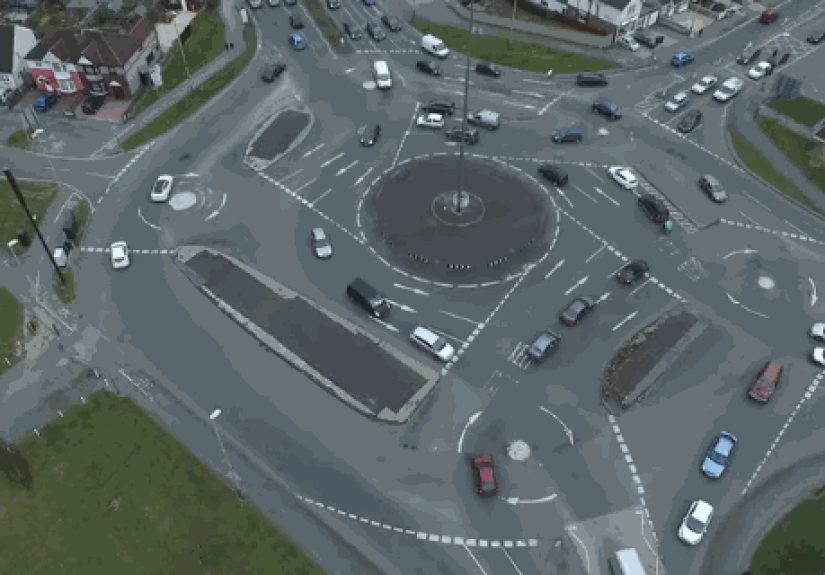
3) The Magic Roundabout, Swindon, England
Why it feels wacky
The Magic Roundabout is the road network equivalent of a brain teaser someone hands you before breakfast. Instead of one roundabout, you get a cluster: multiple mini-roundabouts arranged around a central circle. Drivers can move through it in more than one way, which sounds innovative when reading about it and mildly existential when approaching it in real life.
The layout is famous for making newcomers grip the steering wheel a little tighter, mostly because it appears to violate every “simple roundabout” instinct they’ve ever learned. It’s a junction that says, “Yes, there are rules. No, you may not feel them yet.”
What makes it work
Counterintuitively, the multi-roundabout setup can distribute traffic across several decision points rather than bottlenecking everything into one giant circle. That can improve throughput and reduce certain conflict patterns when drivers understand the layout.
It’s also a reminder that “intuitive” and “effective” are not always the same thing in road design. The Magic Roundabout may look like a practical joke, but it was built to move real traffic through a complicated crossroads efficiently.
4) Gravelly Hill Interchange (“Spaghetti Junction”), Birmingham, England
Why it feels wacky
If aerial photos had flavor, Spaghetti Junction would be marinara. The nickname is perfect: layered ramps, looping links, elevated sections, and a bowl-of-noodles silhouette that has become one of the most recognizable interchange forms in the world.
To the untrained eye, it looks impossible to navigate. To the trained eye, it still looks complicatedbut in a deeply impressive, “someone really had to solve this” kind of way.
What makes it work
Spaghetti Junction is a classic case of large-scale interchange engineering built to connect major routes without forcing everything through traffic signals. Multi-level design allows streams of traffic to separate, merge, and continue moving with fewer stop points.
The result is visually wild but functionally powerful: an infrastructure landmark created to handle serious demand in a constrained, already-developed region. It may look like abstract art, but it’s really a giant machine for sorting movement.
5) The High Five Interchange, Dallas, Texas, USA
Why it feels wacky
Dallas’s High Five Interchange looks like a freeway system trying out for a superhero movie. Huge stacked ramps soar overhead at the junction of U.S. 75 and I-635, creating a skyline of concrete that feels as architectural as it is automotive.
The “wacky” factor here is vertical scale. Many interchanges are complex in plan view; the High Five is complex in three dimensions. You don’t just choose an exityou choose a layer of the atmosphere.
What makes it work
Mega-interchanges like this are built where traffic volumes are massive and conventional designs run out of capacity. By stacking movements, engineers can preserve flow for multiple directions at once and reduce the conflict points that would choke a flatter design.
It’s a practical response to a very Texas problem: a lot of people, a lot of vehicles, and not much tolerance for a junction that behaves like a parking lot at rush hour.
6) Judge Harry Pregerson Interchange (I-105/I-110), Los Angeles, California, USA
Why it feels wacky
Los Angeles is not exactly shy about freeway drama, but the Judge Harry Pregerson Interchange stands out because it isn’t “just” a stack of roads. It’s a transportation mashup that integrates freeway traffic with transit movement in a way that feels ambitious, layered, and very Southern California.
From a design perspective, it’s the kind of junction that makes you realize an interchange can be more than an interchange. It can be a multimodal transfer ecosystem in concrete form.
What makes it work
The standout idea is intermodality: different kinds of travelers (drivers, carpools, buses, rail riders) are being accommodated within one integrated system. That’s a much harder design problem than simply routing cars over and under one another.
The visual complexity reflects that mission. This is road infrastructure designed not only for speed, but for transfer, access, and network connectionmessier to look at, smarter in purpose.
7) Gibraltar’s Runway Crossing / Airport Access Junction, Gibraltar
Why it feels wacky
Most roads cross other roads. Some roads cross rail lines. Gibraltar’s famous setup crossed an airport runway. For years, the road connection near Gibraltar International Airport became legendary because barriers would stop traffic so aircraft could take off or land. Yes, your commute could pause for a plane.
If that sounds made up, it is not. It was one of the world’s great “wait, that’s legal?” transportation experiences.
What makes it work (and how it changed)
What made the arrangement so unusual was geography: Gibraltar is compact, constrained, and intensely built around critical access routes. The runway-road relationship was less a design flourish and more a hard compromise.
Today, the setup has changed significantly for vehicles thanks to the airport tunnel, which now handles regular vehicular traffic. That shift improves reliability and reduces the famous runway-related traffic stoppages for most drivers. Even so, Gibraltar remains an iconic example of how infrastructure sometimes evolves from “astonishing workaround” to “modernized solution.”
What These Wacky Junctions Actually Teach Us
It’s easy to laugh at weird intersections and interchanges from aerial photos. But once you look closer, the story gets more interesting. These places reveal how transportation design is often a balancing act between:
- Capacity (move more people and vehicles)
- Safety (reduce severe conflict points)
- Land constraints (fit into existing cities and geography)
- Network integration (connect roads, transit, and local access)
- Human behavior (make systems understandable enough to use under pressure)
In other words, “wacky” often means “highly optimized for a weird real-world problem.” A junction may look bizarre in a drone shot, yet perform brilliantly because every odd ramp, merge, and signal phase exists for a reason.
And that’s the most fun part of road infrastructure: the best designs are sometimes the ones that look the least normal. They remind us that engineering is not only about straight linesit’s about making movement possible when straight lines stop working.
Extended Experience Section (Approx. ): What It Feels Like to Encounter These Places
Looking at photos of these interchanges and intersections is one thing. Experiencing themwhether from a taxi window, a pedestrian corner, a bus seat, or an overpass viewpointis something else entirely. The first thing most people notice is not the geometry. It’s the tempo. Each place has a rhythm.
In Paris at the Arc de Triomphe, the rhythm feels fluid and theatrical. Vehicles circle the monument in an almost continuous stream, and the experience can feel more like entering a current than joining a line. You don’t simply “take your turn”; you read motion, anticipate gaps, and commit. It can be unnerving, but it also reveals how experienced drivers adapt to high-density movement through pattern recognition rather than strict, beginner-friendly simplicity.
In Tokyo’s Shibuya, the rhythm flips completely. Instead of engines, you notice footsteps, signal timing, and crowd behavior. When the crossing opens, people pour in from multiple sides, yet collisions are surprisingly rare because everyone is constantly micro-adjusting. It feels chaotic for about three secondsthen your brain catches up and realizes it’s a system. A loud, bright, human system, yes, but a system all the same.
Swindon’s Magic Roundabout creates a different kind of experience: cognitive load. Newcomers often describe it as overwhelming because you’re making rapid decisions while trying to decode a layout that doesn’t resemble the roundabouts taught in beginner diagrams. But once the pattern clicks, the fear often gives way to respect. Many drivers end up saying some version of, “I hated that… and also, weirdly, it worked.”
Massive interchanges like Birmingham’s Spaghetti Junction, Dallas’s High Five, and Los Angeles’s Pregerson Interchange create a more cinematic sensation. You feel the scale in your stomach as ramps lift and curve, layers stack overhead, and the city appears in fragments between columns and barriers. These are places where infrastructure becomes landscape. You’re not just driving through a junctionyou’re moving through a built environment designed to sort motion at speed.
Gibraltar’s runway crossing (and now the transition to tunnel-based vehicle access) adds another emotional ingredient: novelty. The idea that daily movement could be shaped by aircraft operations makes ordinary commuting feel suddenly dramatic. Even after modernization, the place retains that “only here” feeling that defines many unusual transport systems around the world.
What ties all these experiences together is a lesson most travelers don’t expect: the strangest traffic spaces are often the most memorable because they make invisible systems visible. You can feel urban planning, traffic engineering, and compromise happening around you. And once you’ve experienced that, you never look at a boring four-way stop the same way again.
Conclusion
The world’s wackiest interchanges and intersections are more than internet-famous traffic oddities. They’re real, working solutions to hard problemsdense cities, giant traffic volumes, multimodal networks, and stubborn geography. Whether it’s the elegant chaos of Shibuya, the noodle-bowl engineering of Spaghetti Junction, or the legendary runway-road drama of Gibraltar, each site tells a story about how humans design movement under pressure.
So the next time you spot an aerial photo of a road junction that looks like a sketch made during a caffeine emergency, take a second look. It might be weird. It might be intimidating. It might also be brilliant.