Table of Contents >> Show >> Hide
- Why Backyard Caterpillars Matter
- 1. Monarch Caterpillar
- 2. Black Swallowtail Caterpillar
- 3. Woolly Bear Caterpillar
- 4. Spicebush Swallowtail Caterpillar
- 5. Hickory Horned Devil
- 6. Io Moth Caterpillar
- 7. Saddleback Caterpillar
- 8. Tomato Hornworm
- How to Spot More Caterpillars in Your Backyard
- Final Thoughts
- Backyard Caterpillar Encounters: What the Experience Really Feels Like
- SEO Tags
Backyards get a bad rap. People act like they are just patches of grass, a grill, and that one chair nobody throws away because it is “still good.” But if you slow down and actually look, your yard may be hosting some of the wildest little creatures in North America. And no, I do not mean the squirrel that keeps filing noise complaints against your bird feeder. I mean caterpillars.
Some look like tiny dragons. Some dress like warning signs. Some are so dramatically fuzzy they seem designed by a costume department with no budget limit. Depending on where you live, the plants you grow, and whether your yard includes trees, shrubs, herbs, or native flowers, you might spot an amazing lineup of caterpillars right outside your door.
This is where things get fun: not every chewed leaf is bad news. In many cases, a nibbled parsley stem or ragged milkweed leaf is evidence that your yard is supporting butterflies and moths through the most important stage of their lives. Caterpillars are eating machines because they have one major job before metamorphosis: bulk up, molt, and prepare for a total body makeover. In other words, they are nature’s hungriest little construction crews.
Below are eight of the coolest caterpillars you could find in a backyard setting in the United States. You probably will not see all eight in one yard unless your landscaping doubles as a lepidopterist’s dream, but these are real possibilities in gardens, suburban landscapes, and tree-filled neighborhoods.
Why Backyard Caterpillars Matter
Before we meet the stars, one quick reality check: caterpillars are not random leaf-munching chaos noodles. Most species rely on specific host plants. That means if you want monarch caterpillars, you need milkweed. If you want black swallowtails, parsley-family plants like dill and fennel help. If you want a caterpillar-filled yard, you do not just plant pretty flowers for adult butterflies. You also plant the food their babies actually eat.
That is the secret sauce of a wildlife-friendly yard. Nectar flowers bring in the adults, but host plants keep the life cycle going. It is a little like setting out snacks for party guests and then realizing they also brought children with very strong opinions about the menu.
1. Monarch Caterpillar
The black, white, and yellow icon
If backyard caterpillars had a celebrity section, the monarch caterpillar would be on the cover every time. It is boldly striped in black, white, and yellow, and it has that polished, unmistakable look that says, “Yes, I know I am photogenic.”
Monarch caterpillars are tightly linked to milkweed. That is not a preference. That is a dependency. If you grow milkweed in a sunny bed, pollinator patch, or even a slightly rebellious corner of the yard, you may eventually find monarch eggs and caterpillars on the leaves. Once they hatch, they feed with impressive dedication, which is excellent for nature and mildly emotional for gardeners who just wanted the plant to look perfect for five consecutive minutes.
The payoff is worth it. A milkweed plant with bite marks is not ruined. It is doing its job. If you are hoping to support monarchs, that leaf damage is basically a standing ovation.
2. Black Swallowtail Caterpillar
The dill thief with excellent manners
If you grow dill, parsley, fennel, or even celery, you may meet the black swallowtail caterpillar, sometimes called the parsley worm. Early on, the young caterpillars can look a bit like bird droppings, which is not exactly flattering but is an effective survival strategy. Later, they become bright green with black bands dotted in yellow or orange.
This caterpillar is a backyard classic because it shows up where people actually garden. Herb beds are basically a catered event for black swallowtails. And when the caterpillar feels threatened, it can pop out a bright orange defensive organ called an osmeterium from behind its head. It looks dramatic, smells unpleasant to predators, and sounds like something a wizard would keep in a cabinet.
If you love both cooking and butterflies, the smartest move is simple: plant extra dill and parsley. One patch for your pasta, one patch for the caterpillars, and one patch for the inevitable moment when everybody gets greedy.
3. Woolly Bear Caterpillar
The fuzzy fall wanderer
The banded woolly bear is one of the most recognizable caterpillars in the country. It is the fuzzy black-and-rust one you often see crossing sidewalks, driveways, or garden paths in late summer and fall as if it has somewhere extremely important to be. Maybe it does. It is often on the move looking for a place to overwinter.
Woolly bears are the larvae of the Isabella tiger moth, and they have achieved rare insect fame thanks to weather folklore. Plenty of people grew up hearing that the width of the brown band predicts how severe winter will be. Charming? Yes. Reliable? Not really. The banding reflects growth conditions more than a magical long-range forecast.
Still, the woolly bear earns its fame honestly. It is hardy, memorable, and one of the best gateway caterpillars for turning backyard curiosity into real nature observation. Once you spot one, you suddenly start scanning the ground like an amateur detective with a very specific case file.
4. Spicebush Swallowtail Caterpillar
The tiny snake impersonator
This one is outrageous in the best way. Young spicebush swallowtail caterpillars start off disguised like bird droppings, because nature loves practical jokes. As they grow, they turn green and develop huge false eyespots that make them look like tiny cartoon snakes. It is one of the great visual fake-outs in the backyard world.
You are most likely to find them where spicebush or sassafras is growing. They also create little leaf shelters by folding leaves together and lining them with silk, which makes them seem both theatrical and weirdly organized.
If you have ever wanted your shrub border to feel slightly more alive and slightly more dramatic, this caterpillar delivers. It is one of the best examples of how a common backyard plant can host something that looks almost tropical.
5. Hickory Horned Devil
The giant monster that is actually harmless
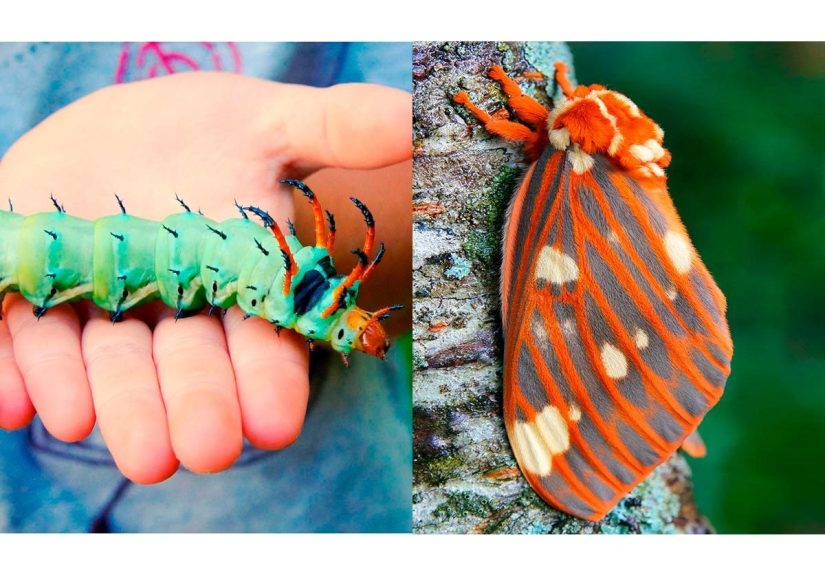
The hickory horned devil sounds like a villain and looks like a special effects test. It can grow to nearly six inches long, with a dark green body, dramatic orange-and-black horns near the front, and enough attitude in its appearance to make even confident adults take one respectful step backward.
And yet, despite the terrifying look, it is harmless to people. That is one of the best plot twists in backyard entomology. This caterpillar becomes the regal moth, which is equally impressive. You may find hickory horned devils on hickory, walnut, sweetgum, persimmon, and related trees, especially in yards with mature shade trees.
Spotting one feels like finding a creature from an alternate universe parked on a branch in suburbia. It is big, bold, and impossible to forget. If your yard hosts one, congratulations: your trees are part-time science fiction.
6. Io Moth Caterpillar
The beautiful green one you should admire, not touch
The io moth caterpillar is gorgeous. It is green, neatly striped, and almost elegant enough to fool you into thinking it would be a good idea to pick it up.
Do not do that.
Its body is covered in venomous spines that can cause a painful sting. So yes, it is one of those classic “look with your eyes, not your hands” backyard creatures. Depending on region, io caterpillars can feed on a wide variety of plants and trees, including redbud, willow, blackberry, cherry, elm, hackberry, and more. In some areas they are easy to miss because their green coloring blends beautifully with leaves. They are basically armed shrub decorations.
The adult io moth is famous for its large eyespots, but the caterpillar deserves its own applause. It is a vivid reminder that some of the coolest backyard finds come with a firm no-touch policy.
7. Saddleback Caterpillar
The punk-rock slug caterpillar
If someone described a caterpillar as “a tiny green saddle with horns and bad intentions,” they would be talking about the saddleback. This species has a stubby, slug-like body and a bright green patch outlined in white across the middle that really does look like a saddle. It is flashy, weird, and impossible to mistake for an ordinary garden caterpillar.
It is also one of the caterpillars you absolutely should not touch. Saddlebacks have venomous, irritating spines, and they are famous for making human curiosity a regrettable decision. They can feed on a huge range of plants, so you might encounter them on ornamentals, shrubs, trees, or even backyard edibles in the eastern United States.
From a distance, though, they are fascinating. The shape, color, and posture make them look less like a standard caterpillar and more like a tiny biohazard sticker that learned to crawl.
8. Tomato Hornworm
The garden goblin hiding in plain sight
If you grow tomatoes, peppers, eggplant, or potatoes, sooner or later you may meet the tomato hornworm. It is huge, green, and surprisingly hard to see at first because it blends in so well with stems and leaves. Then one day you notice stripped foliage, missing chunks, and fruit damage, and suddenly the case becomes personal.
Tomato hornworms are impressive caterpillars, even when they are being obnoxious. They have bold white markings along the sides and a prominent horn at the rear. Later, they become large sphinx moths, also called hawk or hummingbird moths, which are strong fliers and surprisingly cool in their own right.
In a wildlife-friendly yard, the tomato hornworm is the complicated relative of the group. It is undeniably fascinating, but it is also the guest most likely to empty the refrigerator. If you grow nightshade crops, check plants regularly and decide how much sharing you are willing to tolerate before diplomacy breaks down.
How to Spot More Caterpillars in Your Backyard
Grow the right plants
Backyard caterpillar watching starts with host plants. Milkweed supports monarchs. Dill, parsley, and fennel attract black swallowtails. Spicebush and sassafras support spicebush swallowtails. Trees matter too. Mature yards with hickory, walnut, sweetgum, willow, cherry, elm, or hackberry can host species you would never see in a simple lawn-only landscape.
Stop demanding perfect leaves
If every leaf in your yard must look airbrushed, caterpillars are going to have a rough time. A wildlife-friendly yard has a little nibbling, a little raggedness, and a lot more life. Chewed leaves are often proof that your space is functioning as habitat, not just decoration.
Go easy on pesticides
Broad-spectrum insecticides do not politely remove only the bugs you dislike. They also wipe out the caterpillars, butterflies, moths, and other beneficial insects you probably want around. A backyard that supports caterpillars is, almost by definition, a backyard that gives insects a fighting chance.
Look slowly
This sounds obvious, but it is the best tip in the whole article. Look under leaves. Check herbs in the morning. Scan stems before sunset. Watch for rolled leaves, frass, missing leaf edges, and odd little shapes that do not quite look like part of the plant. Backyard caterpillar hunting is less like birding and more like playing hide-and-seek with creatures that majored in camouflage.
Final Thoughts
The phrase “backyard wildlife” usually makes people think of birds, rabbits, squirrels, maybe a raccoon with confidence issues. But caterpillars deserve much more attention. They are strange, colorful, useful, and often shockingly stylish. Some look cute. Some look ridiculous. Some look like they should come with theme music.
And that is exactly why they are so much fun. Once you start noticing them, the yard changes. Parsley becomes butterfly real estate. Milkweed becomes a nursery. Trees become apartment buildings. A fuzzy little insect crossing the driveway becomes the most interesting thing you saw all day.
So the next time you step outside, pause before you mow, prune, spray, or panic about a chewed leaf. Your backyard might be hiding one of the coolest creatures in the neighborhood, and it may be halfway to becoming a moth or butterfly worthy of a standing ovation.
Backyard Caterpillar Encounters: What the Experience Really Feels Like
There is something oddly addictive about looking for caterpillars once you start. At first, it feels like casual curiosity. You walk outside to water basil, check tomatoes, or pretend you are finally going to pull those weeds by the fence. Then you notice one leaf that looks chewed in a suspiciously artistic way. You lean in. You part a stem. Suddenly there it is: a caterpillar the color of a comic-book monster, calmly eating lunch as if your discovery means absolutely nothing. And honestly, that is part of the charm. Caterpillars are never performing for you. They are just busy being wildly themselves.
One of the most satisfying backyard experiences is finding a black swallowtail caterpillar on dill or parsley. It feels like your garden has quietly rewarded you for making decent plant choices. You start with herbs for the kitchen, and somehow you end up hosting striped future butterflies with tiny orange defense organs. It is a very “accidentally successful naturalist” moment. The same thing happens with milkweed. People plant it hoping for monarchs, but the first time you actually see a monarch caterpillar gripping the leaf with its little prolegs and chewing away with total commitment, the whole garden suddenly feels more alive.
Then there are the surprise encounters. The woolly bear crossing the patio. The tomato hornworm you somehow missed until it became the size of a small cucumber with ambition. The spicebush swallowtail caterpillar that makes you stop and say, “Why is this leaf staring at me?” Backyard caterpillar watching has a wonderful way of turning ordinary maintenance chores into mini wildlife expeditions. You go out to trim. You come back twenty minutes later having taken twelve photos of a leaf that appears to have grown eyes.
There is also a shift that happens in the way you think about plants. Leaves stop being just leaves. They become evidence. Missing edges, folded tips, dark droppings on the soil, and ragged stems all start to read like clues. Even people who do not consider themselves insect fans often get pulled in by the detective part of it. Where is it hiding? What is it eating? Is this one harmless, flashy, fuzzy, or secretly a tiny cactus with opinions? The search itself becomes half the fun.
And yes, backyard caterpillar experiences also come with humility. Sometimes you fall in love with biodiversity right as something is chewing the exact tomato leaf you were irrationally proud of. Sometimes you discover that the most beautiful caterpillar in the yard is the one you absolutely should not touch. Sometimes you realize your “perfect” garden looks much better once it starts functioning like habitat instead of a showroom.
That is probably the best part of the whole experience. Caterpillars make a backyard feel less staged and more real. They remind you that a good yard is not just tidy. It is alive. It hosts stories. It supports change. It gives you small moments of surprise on ordinary days. And in a world where people spend a lot of time looking at screens, there is something genuinely wonderful about being completely distracted by a leaf, a stem, and a tiny creature wearing better patterns than anything in your closet.