Table of Contents >> Show >> Hide
- The Before: When “Period Charm” Meets “Boarding House Energy”
- The Big Idea: Build a “Victorian Orangerie,” Not a Modern Glass Box
- Why Shaker Cabinets Are the Peace Treaty Between Victorian and Modern
- Old Meets New: The “Looks Like It’s Always Been There” Method
- Materials That Work Hard and Age Well
- Layout: A Pantry That Does the Heavy Lifting
- Lighting: A Bright Ceiling by Day, a Warm Glow by Night
- Design Details Worth Stealing
- The “American in London” Twist: Cross-Atlantic Choices That Make the Story
- Experiences: What It’s Like to Live Through (and Then Inside) This Kind of Renovation
Every so often, a kitchen remodel comes along that makes you want to do three things at once:
(1) applaud the designer, (2) immediately reorganize your spice drawer, and (3) whisper “respect the bones”
like you’re in a period dramaexcept the villain is bad lighting.
This week’s standout is a Victorian townhouse kitchen in London, reimagined by an American with a sharp eye for
vintage finds and an even sharper instinct for what makes old homes feel alive. The result? A bright “Victorian orangerie”
vibeShaker cabinetry, a fully glazed roof, and a joyful mix of old and new that looks like it has always belonged.
The Before: When “Period Charm” Meets “Boarding House Energy”
Victorian homes can be famously graceful from the streetornate trim, tall proportions, handsome brickwork
and then you walk into the back of the house and discover a kitchen that has lived approximately twelve different lives.
In this case, the home had been used as a boarding house, complete with chopped-up rooms and even a second kitchen upstairs.
The main kitchen? Let’s just say it had “potential” the way a soggy cardboard box has “structure.”
That messy starting point is common in old houses: layers of quick fixes, awkward layouts, and dim corners that feel like
they’re permanently set to “November at 4:12 p.m.” The trick isn’t to erase historyit’s to keep the Victorian soul while
giving the space modern function (and enough light that you can tell salt from sugar without an advanced degree).
The Big Idea: Build a “Victorian Orangerie,” Not a Modern Glass Box
The design concept started with one bold move: a kitchen placed under a fully glazed roof. Instead of a sleek,
ultra-modern conservatory look that might visually fight with the home’s original details, the goal was something that felt
period-adjacentlike a Victorian orangerie: bright, garden-connected, and romantic in the architectural sense
(not the “buy a beret and cry over croissants” sense).
Here’s why this idea works so well in a London Victorian: many terrace homes have darker rear spaces and limited daylight.
A glazed roof and generous windows change the daily experience of the room. Light becomes a building materialone that makes
even rainy, gray days feel soft instead of gloomy.
Smart daylighting is also about avoiding “glare traps.” Skylights and roof glazing work best when daylight can wash over
vertical surfaces and bounce around the room, instead of blasting one spot like an interrogation lamp. That’s why placement,
proportions, and interior finishes matter: pale walls, reflective surfaces in moderation, and thoughtful task lighting help
the room feel bright but not harsh.
Why Shaker Cabinets Are the Peace Treaty Between Victorian and Modern
If Victorian architecture is all about detail, Shaker cabinetry is the calm, organized friend who shows up with labeled bins.
Shaker doorsclean lines, simple rails-and-stiles, recessed center panelhave historical roots and a timeless look, which makes
them a natural bridge between period homes and contemporary living.
The real win is flexibility. Shaker fronts can lean traditional with classic knobs and warm materials, or feel crisp and modern
with sleeker pulls and pared-back styling. They play nicely with stone, wood, metal, and painted finishes. In other words,
they’re Switzerlandbut with better storage.
Old Meets New: The “Looks Like It’s Always Been There” Method
A Victorian renovation succeeds when the new work doesn’t scream “I arrived in 2026 with a mood board.”
It should feel quietly inevitablelike the house would have chosen it if it had a Pinterest account and a sensible budget.
Vintage doors, real texture, and the magic of reuse
One of the best moves in this kitchen is the use of vintage pantry doors sourced secondhand, then softly lightened with a
simple whitewash approach. The pantry itself was built to fit those doors, and older trim details were reused so the whole
composition reads as original, not “new cabinet pretending to be old cabinet.”
This kind of reuse does more than save money. Salvaged elements carry craftsmanship, patina, and proportions that are hard to
replicate. Plus, in historic homes, “matching the vibe” is often more valuable than matching the catalog.
A quiet rule for historic houses: compatible, but not fake
The best renovations respect what’s there while making it obvious (in a tasteful way) what’s new. In preservation terms, you
want additions and alterations that are compatible with the historic character, but you don’t want to create a confusing
historical mash-up that pretends nothing changed. This kitchen nails that balance: it’s clearly updated, yet it still feels
Victorian in spirit.
Materials That Work Hard and Age Well
Great kitchens are built on unglamorous truths: surfaces get touched constantly, floors get abused daily, and everything must
survive heat, water, crumbs, and the occasional “I’ll just set this here for a second” cast-iron moment.
Quartzite countertops with a leathered finish: elegant, not precious
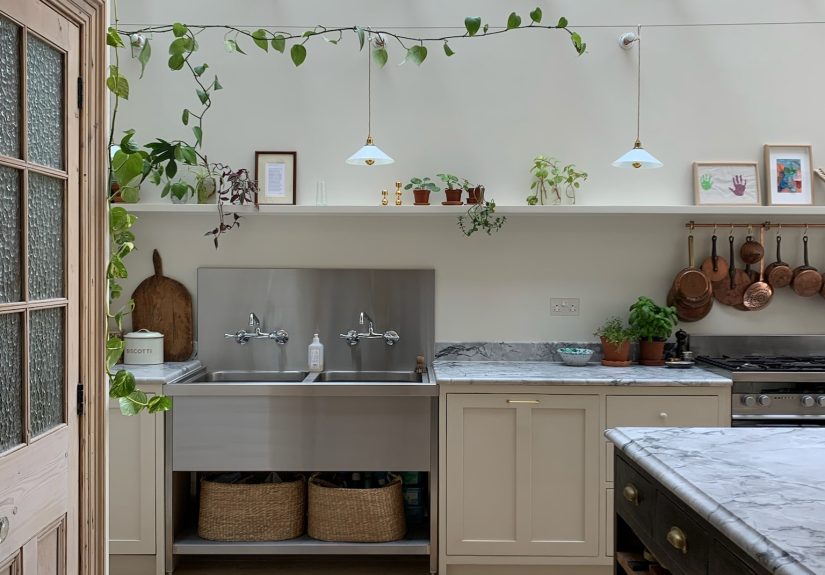
The counters and island are topped with a leathered-finish quartzitebeautifully textured, slightly matte, and forgiving in a
way that high-gloss surfaces rarely are. In a busy family kitchen, that finish helps hide fingerprints and everyday smudges
without looking dull. It’s the rare material choice that looks upscale while still saying, “Yes, you may live here.”
Engineered wood flooring plus underfloor heating: comfort without the clunky look
The floor is engineered French ash, paired with underfloor heating and finished with an “invisible oil” lookmeaning it reads
natural and warm, not plasticky or overly shiny. Underfloor heating is a particularly satisfying upgrade in older homes, where
drafts and cold floors can make even a gorgeous room feel uninviting. When done well, it’s the kind of comfort you stop
thinking about… until you visit someone else and realize your socks have been living a better life than theirs.
A custom sink and the case for “commercial calm”
The sink was custom-made by a commercial catering equipment companyan inspired choice that leans into durability and generous
proportions. Pair that with classic faucets and you get a workstation that feels quietly professional without looking like a
restaurant back-of-house. The vibe is “serious about cooking,” not “please place your order at the counter.”
Layout: A Pantry That Does the Heavy Lifting
If there’s one modern expectation old homes can struggle with, it’s storage. Victorian houses were built long before
countertop appliances multiplied like rabbits. The solution here is a pantry that functions like a back-stage area:
small appliances live inside as a breakfast station, clutter stays contained, and the main room remains visually calm.
This approach also supports how people actually use kitchens today. Instead of designing around a single “work triangle” idea,
you can create zones: prep, cooking, cleanup, coffee/breakfast, and storage. A good pantry strengthens those zones by
preventing the main counters from turning into an appliance parking lot.
Lighting: A Bright Ceiling by Day, a Warm Glow by Night
The glazed roof is the headline, but good kitchens win the long game with layered lighting. Overhead daylight is incredible
but you still need task lighting for evening chopping, soft ambient light for dinner, and a few “pretty lights” that make the
room feel like a place you want to linger.
Vintage milk-glass pendants bring a gentle, diffused glow and add period-friendly character without fuss. Wall lights in the
dining nook create warmth at eye level, which is the fastest way to make a big, bright kitchen feel cozy at night. The point
isn’t to make everything equally bright; it’s to make everything usable and flattering. (Your onions deserve this. So do you.)
Design Details Worth Stealing
- Start with one “north star” decision. Here, it was the glazed roof. One big idea can keep a renovation coherent.
- Use Shaker cabinetry as a style translator. It respects history without turning the kitchen into a museum.
- Let vintage pieces lead in small doses. Doors, lighting, a benchjust enough patina to feel grounded.
- Build storage that hides modern life. A pantry that swallows appliances is basically therapy.
- Blend appliances instead of battling them. If full integration is pricey, clever paneling and “boxing in” can help.
- Choose durable finishes that look better with time. Matte texture, warm wood, and natural stone age gracefully.
The “American in London” Twist: Cross-Atlantic Choices That Make the Story
Part of what makes this renovation so fun is the cross-cultural layer. An American renovating in London brings a different
sourcing rhythm and a different renovation vocabulary. You learn quickly that the same object can have two names (and neither
name will be “the thingy by the sink”).
The kitchen’s story includes small, wonderfully real moments: bringing affordable faucets from the U.S. in a suitcase because
you found the right look at the right price; discovering that a classic British “settle” bench can shape an entire dining nook;
and building custom pieces to fit vintage finds rather than forcing vintage finds to behave like modern stock sizes.
That’s the hidden superpower of renovating a Victorian home: you stop expecting everything to be standardized, and you start
designing like the house has opinions. Because it does. Loudly. With molding.
Experiences: What It’s Like to Live Through (and Then Inside) This Kind of Renovation
Renovating a Victorian kitchen in Londonespecially as someone who grew up with American home-improvement normsoften feels like
learning a new language where half the words are measurements and the other half are architectural details you never noticed
until you had to pay to fix them. One week you’re confidently choosing cabinet hardware; the next you’re debating whether a
particular bit of trim is “character” or “structural drama,” and why the answer is always “both.”
The early days can be emotionally chaotic in a strangely domestic way. You’re making coffee in a temporary setup, washing dishes
in a bathroom sink, and pretending the dust is “just a light patina” while you refresh your inbox for delivery updates.
Old houses don’t always cooperate with modern timelines, and London renovations tend to add their own plot twiststight access,
complicated logistics, and a calendar that seems to be partly controlled by weather and partly controlled by mystery.
Sourcing becomes a scavenger hunt with a passport stamp. You might scroll late-night listings for vintage doors, save thirty tabs
for milk-glass pendants, and learn to look at an imperfect piece and see potential instead of flaws. Secondhand shopping stops
being a hobby and becomes strategy. There’s a particular thrill in finding a pair of pantry doors that have survived a century
and realizing your new kitchen can be designed around them. You start to enjoy the idea that the kitchen won’t be perfectly
pristineand that’s the point. A little chipped paint isn’t failure; it’s continuity.
Then there are the practical, oddly satisfying rituals: measuring openings (again), checking clearances (again), and discovering
that nothing in an older home is perfectly square (again). People doing this kind of renovation often learn to love “custom”
even when it’s inconvenient, because custom is what makes the space feel native to the house. When you reuse existing trim, or
build cabinetry to fit salvaged pieces, you’re not only saving detailsyou’re building believability.
The moment the glazed roof (or the skylights) finally goes in can feel like a mood swingin the best way. A formerly dim back
room becomes bright enough to read a recipe without leaning into the window like a Victorian detective. On gray days, the light
becomes soft and spread out; on sunny days, you suddenly understand why plants look so smug in London conservatories.
At night, the experience shifts again: the room glows outward, and the kitchen becomes the warm heart of the house, especially
with layered lighting and cozy corners like a dining nook.
After the renovation, the best “experience” is how daily life changes. Breakfast is calmer when small appliances live in a pantry
station instead of on every available inch of counter. Cooking feels easier when work zones make sense and storage is where you
naturally reach for it. And comfort upgradeslike underfloor heatingturn the kitchen into a room you actually want to stand in,
even when it’s cold outside and the forecast looks like a gray spreadsheet.
Most of all, people who finish a renovation like this often describe a strange, satisfying sense of alignment: the new kitchen
fits their life, but it also fits the house. It doesn’t feel like a showroom dropped into a historic shell. It feels like a
Victorian home that finally got the light, flow, and practicality it always deservedplus a few smart, transatlantic hacks
(like suitcase-sized hardware imports) that make the story uniquely personal.