Table of Contents >> Show >> Hide
- What you’ll learn
- Menopause timing basics (and what “normal” means)
- How genetic is menopause age, really?
- Family history: the most practical “genetic test” you already have
- What genes and biology have to do with your ovaries’ retirement plan
- Non-genetic factors that shift the clock
- Can you test for menopause age?
- What to do if early menopause runs in your family
- Common myths (and the reality check)
- Final thoughts
- Experiences and real-life scenarios related to the topic
Short version: Yesgenetics plays a meaningful role in when you reach natural menopause, but it’s not a one-woman prophecy. Your family tree can nudge the timeline, while lifestyle, health conditions, and medical treatments can shove it around like a shopping cart with one wonky wheel.
In this article, we’ll break down what researchers know about the genetics of menopause timing, how much “mom’s menopause age” really matters, which medical conditions make genetics more obvious, and what you can do with this information (besides texting your siblings, “So… how old was Mom?”).
Menopause timing basics (and what “normal” means)
Menopause is officially defined as the point when you’ve gone 12 consecutive months without a menstrual period (and no other medical cause explains it). Many people reach menopause in their late 40s to early 50s. In the U.S., the average is around 51–52, and a typical range is roughly 45 to 55 (with plenty of perfectly healthy people outside that range).
Early vs. premature menopause: words matter
- Early menopause usually means menopause between 40 and 45.
- Premature menopause is menopause before 40. Clinically, many professionals use the term primary ovarian insufficiency (POI) rather than “premature menopause,” because ovarian function may fluctuate and sometimes periods can still occur.
Why the definitions matter: timing isn’t just trivia. Earlier menopause can affect long-term risks (like bone health and cardiovascular health), and it can shape family planning decisions. Later menopause can also come with its own considerations (for example, lifetime estrogen exposure is part of how clinicians think about certain cancer risks). This is why the “when” question isn’t shallowit’s strategy.
How genetic is menopause age, really?
Researchers have looked at menopause timing through family studies (mothers and daughters), twin studies, and large genetic studies. The big picture is consistent:
- Genes explain a meaningful chunk of the variation in age at natural menopause.
- Genes are not the whole story. Environment, health, and exposures also matter.
One widely cited estimate in mother–daughter research found that around 44% of the variation in natural menopause age could be attributed to heritable factors. Twin studies often report a rangesometimes higherbecause identical twins share more genetic similarity than parent–child pairs, and different methods produce different estimates. Translation: genetics is significant, but it isn’t destiny.
So… will you reach menopause at the same age as your mom?
Often, you’ll be in the same general neighborhood. But “same neighborhood” is not “same house.” Two sisters can share a mother and still have different menopause timing. Why?
- They didn’t inherit the exact same combination of genetic variants.
- They may have different lifestyles (smoking history is a big one).
- They may have different medical histories (autoimmune disease, surgeries, chemotherapy, etc.).
- Even with similar genetics and habits, biology has some natural randomness.
Family history: the most practical “genetic test” you already have
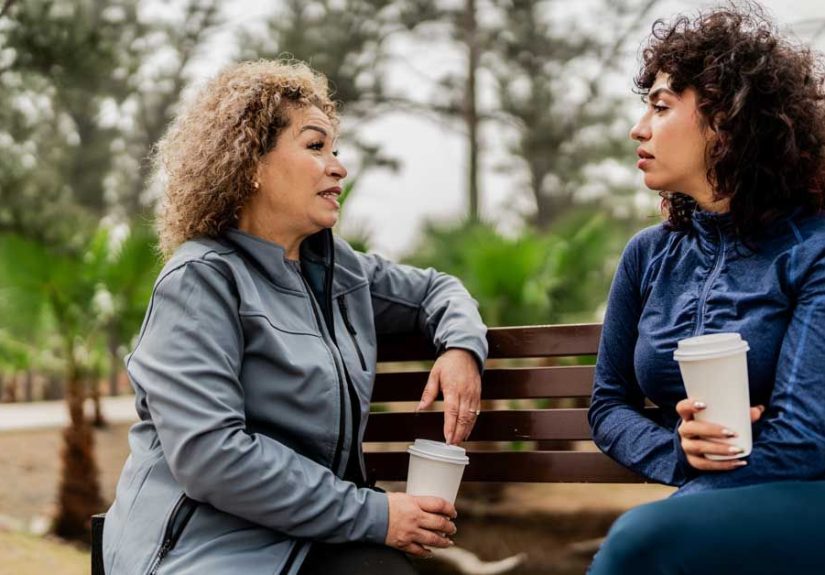
If you want a real-world, clinician-approved clue about your likely menopause timing, family history is usually step one. Many reputable U.S. women’s health resources explicitly suggest this: the age your mother reached menopause can offer a hint about your own timeline.
How to ask (without making it weird)
Try something like:
- “Do you remember around what age your periods stopped for good?”
- “Did you go through menopause early, like before 45?”
- “Was it natural, or was it after surgery like a hysterectomy or ovary removal?”
Important nuance: a hysterectomy (uterus removal) can stop periods, but if ovaries remain, it’s not the same as natural menopause. So the “what age did your period stop?” question needs the “was it surgery?” follow-up. (Family history is helpful, but it’s not a detective showdon’t forget basic facts.)
What genes and biology have to do with your ovaries’ retirement plan
Your ovaries have a finite pool of follicles (each containing an egg) that declines over time. Think of it as a savings account you’re born withexcept you didn’t get to choose the bank, the interest rate, or the customer service line.
Genetics influences menopause timing through several broad biological themes:
1) The “follicle budget” and the speed of follicle loss
Some people may start life with a different number of follicles, or experience faster follicle depletion. Over time, once ovarian function drops below a certain threshold, cycles stop permanently.
2) DNA repair and cellular maintenance
Large genetic studies have repeatedly pointed toward genes involved in DNA damage repair and cellular maintenance. Why does that matter? Because eggs are long-lived cells that need strong quality control systems. If DNA repair pathways are less efficient, the ovarian reserve may decline sooner.
3) Many genes with small effects (not one “menopause gene”)
For most people, menopause timing is polygenic: influenced by many genetic variants, each nudging the average by a little. Genome-wide association studies (GWAS) have identified multiple genomic regions associated with age at natural menopause. This is why two relatives can have similar timing but not an identical date on the calendar.
4) Cases where genetics is more direct: POI and certain conditions
Sometimes genetics isn’t just “a nudge.” It’s a neon sign. Examples include:
- Fragile X–associated primary ovarian insufficiency (FXPOI): linked to an FMR1 premutation, which can be associated with reduced ovarian function and earlier menopause-like changes.
- Turner syndrome (and other chromosomal differences): often associated with ovarian insufficiency.
- Family clusters of early menopause: multiple close relatives reaching menopause well before 45 can suggest stronger genetic contribution, though non-genetic family factors can also play a role.
There’s also ongoing research on how certain inherited cancer-risk mutations (such as BRCA1/2) may relate to age at natural menopause in some groups. The relationship is complex and not something you should self-diagnose from a headlinethis is squarely in “talk to a clinician/genetic counselor” territory if it applies to you.
Non-genetic factors that shift the clock
Even with strong genetic influence, real life still gets a vote. Here are some non-genetic factors that research and clinical guidance commonly associate with earlier or later menopause timing.
Smoking (the repeat offender)
If menopause timing had a “Most Wanted” list, smoking would be on the poster. Many studies show that people who smoke tend to reach natural menopause earlier than non-smokers, often by about 1–2 years on average. The effect may be stronger with heavier smoking.
Medical treatments and surgeries
- Chemotherapy and radiation can damage ovarian follicles and lead to earlier menopause or POI.
- Ovary removal (oophorectomy) causes an immediate menopause transition because the primary source of estrogen/progesterone production is removed.
- Hysterectomy without ovary removal may still influence ovarian function for some people, though it isn’t the same as natural menopause by definition.
Body weight, overall health, and social factors
Population studies suggest associations between menopause timing and factors like BMI, certain chronic conditions, and socioeconomic stressors. These links can be tricky to interpret because they can reflect a mix of biology, access to healthcare, and cumulative life exposures. In plain English: bodies live in environments, not in lab jars.
Other exposures (still being studied)
Researchers also investigate whether certain environmental exposures (including endocrine-disrupting chemicals) might influence reproductive aging. This area is evolving, and results can vary depending on the exposure measured, timing, and population studied. It’s a “watch this space” topicnot a “panic and replace your entire kitchen” topic.
Can you test for menopause age?
Not in a precise, fortune-teller way.
Here’s what’s realistic today:
- Family history remains one of the most useful clues for typical, natural menopause timing.
- Hormone tests (like FSH, estradiol) can help evaluate symptoms or possible POI in the right context, but they’re not a crystal ball for “you will reach menopause at 51.7.”
- AMH (anti-Müllerian hormone) can offer information about ovarian reserve, mostly used in fertility contexts, but it still does not reliably predict the exact age of menopause for an individual.
- Genetic testing may be appropriate when POI is suspected or when there’s a strong family history of certain genetic conditions. But broad genetic scores for menopause timing are not typically used in everyday care yet.
If someone online promises they can predict your menopause birthday down to the week, you should treat that the way you’d treat a “miracle detox tea” ad: with eyebrows raised and wallet closed.
What to do if early menopause runs in your family
If multiple close relatives had menopause before 45 (or especially before 40), it’s worth taking that information seriouslywithout assuming it’s guaranteed for you.
1) Bring it up at routine visits
Tell your clinician something specific: “My mother and older sister reached menopause at 43.” Specific beats vague every time.
2) If you want children, talk about timingnot panic
Family history can be a reason to discuss reproductive planning earlier. Options may include earlier evaluation of fertility, discussing egg freezing (if appropriate for the person and situation), or simply mapping out a plan with realistic timelines.
3) Protect bones and heart (especially with early menopause)
Earlier menopause can mean earlier changes in estrogen that affect bone density and cardiovascular risk over time. Clinicians may recommend steps such as:
- Bone health screening when appropriate
- Strength training and weight-bearing activity
- Calcium/vitamin D guidance tailored to the individual
- Managing blood pressure, cholesterol, blood sugar, and sleep
4) Don’t overlook POI signs
If someone under 40 has persistent irregular periods, missed periods, or symptoms that suggest ovarian function changes, that deserves medical evaluation. POI can have multiple causes (including genetic and autoimmune), and early identification can guide symptom care and long-term health planning.
Common myths (and the reality check)
Myth: “Menopause age is 100% genetic.”
Reality: Genetics is important, but smoking, treatments, health conditions, and other factors can shift the timing.
Myth: “If my mom had late menopause, I’m safe from early menopause.”
Reality: Family history is a clue, not a guarantee. Individual variation happens, and non-genetic factors matter.
Myth: “You can’t do anything about menopause timing.”
Reality: You can’t “choose” your menopause age, but you can influence certain risk factors (especially smoking), and you can absolutely influence how prepared you aremedically, emotionally, and practically.
Final thoughts
So, is the age at which you reach menopause genetic? Yespartly and meaningfully. If menopause timing were a recipe, genetics would be the flour. But lifestyle and medical history are the eggs, the heat, and the person who decides to open the oven every 30 seconds “just to check.” (Don’t do that. And don’t smoke, either.)
The most useful move is to treat menopause timing like a health planning tool: learn your family history, understand the factors you can control, and talk with a clinician if you have signs of early menopause or a strong family pattern. Information isn’t fatebut it is power.
Experiences and real-life scenarios related to the topic
Below are composite experiencesbased on common patterns clinicians and researchers describeshared to illustrate how genetics and real life can interact. These are not individual medical stories or personal advice.
Experience 1: “It happened early for everyone… until it didn’t.”
Danielle grew up hearing the same family refrain at every holiday dinner: “Women in our family are done by 44.” Her mom reached menopause at 43, her aunt at 44, and an older cousin at 41. So when Danielle hit 39, she started mentally setting an alarm clock for her ovaries. She didn’t panicbut she did something smart: she told her clinician her family pattern and asked what it might mean for future planning. Together, they focused on the practical steps: tracking cycles, reviewing symptoms, discussing reproductive goals, and keeping an eye on bone and heart health over time.
What surprised Danielle most? She didn’t follow the family script exactly. Her cycle changes started later than she expected, and she reached menopause in her late 40s. The takeaway wasn’t “family history is useless.” It was: family history can point you in the right direction, but it doesn’t write the ending. Genetics may load the dice, but other factorsand plain biological variationstill influence what you roll.
Experience 2: Sisters, same parents, different timelines
Two sisters, same household, same genes… right? Not quite. Alina and Beth share parents, but they don’t share identical DNA (only identical twins do). Alina never smoked, prioritized sleep (most of the time), and had fewer medical interruptions. Beth smoked in her 20s and early 30s, later quit, and went through treatment for a health condition that required medications affecting her cycle. In midlife, Beth’s perimenopause arrived earlier and felt more abrupt. Alina’s transition came later and felt more gradual. Their family history still matteredbut their individual experiences were shaped by different exposures and health histories layered on top of shared genetics.
Experience 3: When genetics becomes a medical conversation
Keisha was in her early 30s when her periods became irregular in a way that didn’t match her usual pattern. She also noticed hot flashes and sleep disruption that seemed “too early” compared with friends. Because her mother had reached menopause before 40, her clinician took the family history seriously and evaluated for possible primary ovarian insufficiency. The result wasn’t a dramatic “aha!” momentit was a careful process of ruling out other causes and considering whether genetic factors might be involved. Keisha learned that some genetic conditions (like Fragile X–associated primary ovarian insufficiency) can be relevant in certain families, and that testing is not for everyonebut can be important in the right context.
What helped most wasn’t a label. It was having a plan: symptom management, long-term health monitoring, and clear, calm counseling about what the results did (and didn’t) mean.
Experience 4: The “I thought it was stress” loop
Marisol assumed her cycle changes at 42 were stress-related: job pressure, family responsibilities, and the general chaos of being a human with a calendar. It took months before she considered perimenopause because she’d heard menopause “starts at 50.” When she finally asked her mother, she learned her mom’s menopause happened at 45information that instantly reframed Marisol’s timeline. The family clue didn’t diagnose her, but it gave her a better map. She tracked symptoms, discussed options with her clinician, and felt less blindsided by what her body was doing.
Experience 5: The power of preparation (and a little humor)
Tanya called her sister and said, “I’m building a family tree, but instead of names, I want ages and symptoms. This is my villain origin story.” They laughed, but then they compared notes. Their mother had early menopause, and several relatives had thyroid issues. Tanya brought that information to a routine visit and asked two simple questions: “What should I watch for?” and “How do I protect my long-term health if my timeline is earlier?” That conversation gave her a sense of control. She didn’t need a perfect predictionshe needed a plan.
Bottom line from these experiences: genetics often sets the stage, family history gives you practical clues, and your choices and medical history can still shift the timing. The best outcome is rarely “guessing the exact age.” It’s feeling informed, prepared, and supported.