Table of Contents >> Show >> Hide
Introduction There are two kinds of fashion statements: the intentional ones and the accidental linguistic trainwrecks. Pull on the wrong tee and you don’t just get a look you get a conversation, a double-take, and occasionally a polite restraining order from the Oxford comma. This collection celebrates 50 tees that set out to say something clever in English and came back with glorious nonsense instead. These picks are inspired by a recent Bored Panda compilation and other classic collections of translation and typography fails the kind of shirts people snap photos of, tag their friends in, then buy ironically on Etsy.
Why do t-shirts go wrong? (Short version)
There are a few repeat offenders when it comes to sartorial English failures:
- Direct machine translation or literal dictionary cuts that ignore grammar and idioms.
- Phonetic approximations and brand knockoffs that prioritize looks over letters.
- Designers who prioritize image composition (centered text, pretty fonts) more than meaning.
- Deliberate nonsense sold as “quirky” sometimes it’s a joke, sometimes it’s a production error.
Translation site histories and cultural analyses show these aren’t new problems they’re symptoms of globalized production, fast fashion, and sometimes, an odd confidence in Google Translate.
How this list was made
This roundup borrows heavily from the viral Bored Panda gallery of shirts that spectacularly mistranslated English, then pairs those examples with other internet-famous t-shirt fail roundups and storefront curiosities (Cheezburger, Etsy novelty collections, and the “lost in translation” accounts that curate the best ones). The captions here mix direct quotes (kept short and exact) and cheeky descriptions. If you’re looking for a laugh or a design cautionary tale you’re in the right place.
The List 50 Shirts That Tried to Speak English (and failed, gloriously)
- “AM I NAVING FUN YET? NOSMOKING” A punctuation hermit’s dream and a phrase that asks life’s big questions while giving a safety announcement. (Seen in the Bored Panda gallery.)
- “PARDA” When a brand wants to sound posh but loses two letters on the way there.
- “-I miss you? -no” Minimalist, devastating, and accidentally heartless.
- “Spinder-Man” Superhero homage, phonetic edition. Someone should tell him about the web.
- “Every Cool Girl Is Half A Boy.” A line that raises more philosophical questions than it answers. (Also on the Bored Panda list.)
- “Retierd and down to one Boss, MY WIFE” Retirement, capitalization, and marital hierarchy all in one.
- “ALL MEN ARE CREATED EQUAR ONLY THE BEST WRESTLE.” A patriotic sentiment wrestled into a typo.
- The Grammar Gym Tee Uses the word “equar” like it’s an exercise machine. (Concept approved by nobody.)
- The Poetic Non Sequitur A floral print followed by a sentence that sounds like it was written by a fortune cookie with stage fright.
- The Literal Translator A slogan taken word-for-word from another language that looked cooler than it read. (Classic Engrish category.)
- The Inspirational Glitch “Sun will rise and we will try again neyer bedepressed.” Optimism, plus keyboard mischief.
- The Brand-ish A shirt that tries to whisper “luxury” and instead screams “close enough.”
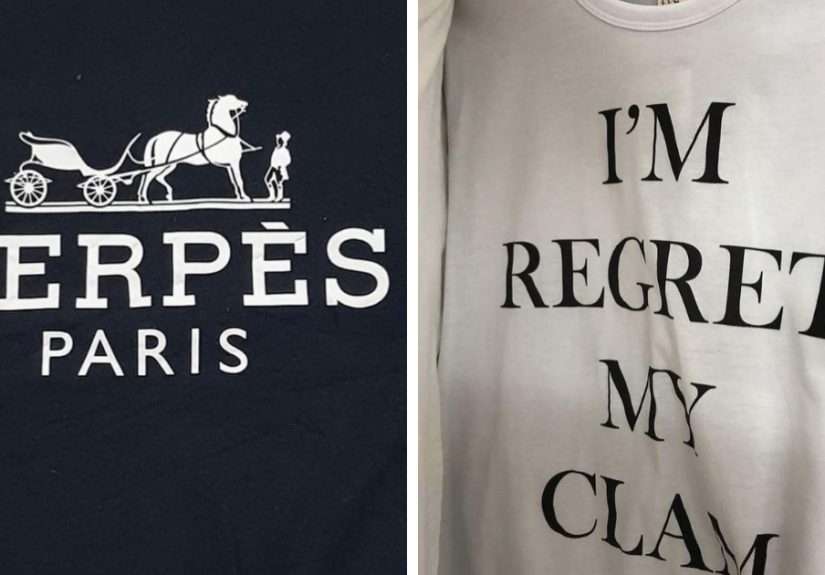
- The Knockoff Logan Famous-name homage: slightly wrong letters, full confidence.
- The Spelling Bee Dropout A shirt that brags about being perfect while misspelling “perfect.”
- The Punctuation Police Uses ellipses like a seasoning. Over seasons everything. (Culinary grammar.)
- The Paradox Tee Claims to be “subtle” in 48-point font.
- The Literal Metaphor Turns an idiom into an image and a legal dispute.
- The Offensive by Accident Crosses cultural lines with a phrase that’s harmless in one tongue and eyebrow-raising in another. (A reminder to run copy past a human.)
- The Lost Apostrophe It’s not “mens” or “womens” it’s a political statement about typography.
- The Emo Mashup Sad, poetic, and grammatically unconcerned.
- The Multi-Line Trainwreck Uses three different fonts and two unrelated metaphors; at least it’s busy.
- The Holiday Mash A Valentine’s reading like a technical manual.
- The Sports Misprint A motivational quote mangled into a clause fragment and team colors. (Because jerseys deserve grammar, too.)
- The Existential One-liner “Are we cool yet?” the tee that wants an answer and doesn’t care how you respond.
- The Tiny Text Trap Important legal copy printed in 6-point font across a chest. For those who like their disclaimers wearable.
- The Phrase Salad A salad of idioms tossed together with little dressing of sense.
- The Almost Famous Quote Sounds deep, reads vague, leaves your brain buffering.
- The Restaurant Menu Tee Lists items like a lunch special; confusing as clothing, delicious as irony.
- The Meme That Lost the Punchline You can see the setup; the joke fell out of the dryer. (A modern tragedy.)
- The DIY Translation Shop Uses a dictionary like a cocktail shaker. Outcome: sloppy.
- The Oops Brand “Guicc” or “Chalen” variants when brand spoofing becomes performance art. (Users love to name these.)
- The Political Ambiguity Tee Sounds like a manifesto but reads like a grocery list.
- The Romance Novel Cover Big font, bigger feelings, zero punctuation.
- The Straight-to-English Tee A love letter mistranslated via code and shipped worldwide. (Sourcing note: these often show up on tourist racks.)
- The Confidence Slogan “I am best at being me” and then the comma jumps ship.
- The ‘Cool’ Absurdist A shirt that leans into surrealism. Sometimes nonsense is intentional; sometimes it isn’t. That’s the fun.
- The Typo as Trademark Turns a typo into identity. There’s possibly a business plan here.
- The “Translation” Tagline A motivational fortune cookie that already regrets its life choices.
- The Aggressive Minimalist A single word on a shirt. It’s wrong, but decisive.
- The Romantic Non Sequitur A love phrase followed by a clause that belongs to a furniture catalog.
- The Instructional Fail Gives directions like “First cut, then assemble in heart.” Not helpful for furniture, but great for romance.
- The Proofreading Protest A shirt that proudly displays a typo as an act of defiance. (Or laziness.)
- The Meta Tee Calls out bad English while using the bad English it claims to hate. Very on brand.
- The Final One: “Every Cool Girl Is Half A Boy.” We come full circle, admire the audacity, and then buy a box of five for the internet.
The DIY Phonetics A phonetic attempt at an English phrase that looks like a cryptogram.
What we learn from 50 shirts gone sideways
Beyond the belly laughs are a few practical lessons for anyone designing or buying printed apparel:
- Run copy by a native speaker. Machine translators are helpful for rough drafts; they’re not a final proof. Professional proofreading is cheap relative to a global fashion-signal fail.
- Test at print size. What looks cute in a mockup can turn into an illegible punctuation salad once it’s printed and worn.
- Know your audience. What’s playful irony in one culture might be confusion or offense in another.
- Embrace the laughter. Not every shirt needs to be an advertisement for your brand’s grammar department. Some tees are simply for joy (or meme circulation).
Why people loveor hatethese shirts
There’s a human impulse here: to spot errors, chuckle, and share. Sites like Bored Panda and fail-curation accounts amplify both the silly and the instructive, turning single garments into viral moments. Curated galleries of Engrish and translation fails are a long-standing part of internet culture precisely because they’re relatable and unexpected.
Conclusion
These 50 shirts remind us that words matter especially when they’re printed across someone’s chest. Whether the mistake is accidental or intentional, the final product is usually delightful. Wear what makes you laugh, but if you’re designing for other people, invest in a human editor. Unless, of course, your brand is “beautifully broken English” in which case, carry on.
SAPO Short editorial teaser
From “AM I NAVING FUN YET?” to “Every Cool Girl Is Half A Boy,” this cheeky gallery of 50 hilariously mangled T-shirts celebrates the beautiful chaos that happens when design, translation, and confidence collide. Laugh along, learn why proofreading matters, and discover why these tees keep being shared around the internet.
Meta & SEO details
500-word personal experience & reflection on T-shirt translation fails
I’ve been the person holding a phone at a market stall in a foreign city, grinning at a rack of tees because the English on them read like a dream written by a very tired thesaurus. I’ve also been on the other side: a designer who watched a joke go flat because a misplaced comma took the punchline hostage. Those two perspectives make the phenomenon both charming and instructive.
At a tourist market in Tokyo I once bought a tee that translated to something like “temporary happiness guaranteed” a phrase so earnest and oddly comforting that I wore it until it faded. It wasn’t grammatically elegant, but it had heart. That’s an important distinction: some of these shirts are delightful errors that add personality, and others are avoidable slip-ups that suggest a better process was needed between idea and print.
Designers I know treat typography the way chefs treat seasoning a little goes a long way. But unlike seasoning, typos don’t dissolve away in one bite; they live on the chest, in photographs, and in the internet’s long memory. I remember helping a small brand proof their debut line; their “inspirational” tee used the phrase “more bether days.” We laughed, fixed it, and sold out. The brand later told me customers appreciated the care. That moment made the ROI of copyediting crystal clear.
Then there’s the delight of discovery. When you see a friend wearing a shirt that says “Spinder-Man” you don’t immediately judge you take a picture. You tag them. You invent a caption. Internet culture runs on these tiny moments of shared amusement. Shops know it too; curated fail accounts have millions of followers because they package joy into scrollable bites.
But there’s an ethical layer, too. Some translation fails touch on cultural or political content that might be anxiety-inducing or offensive in another context. As globalization accelerates, the responsibility grows for brands to respect nuance and context. The difference between a laughingshare-worthy typo and a problematic message can be a translator’s nudge or a single missing word.
For creators, the takeaway is simple: ask one more person to read it. For shoppers, the takeaway is to keep laughing but also to think is this shirt a sincere expression, ironic fun, or a symptom of rushed production? I love both wearing and curating these tees because they capture a messy, human moment in a way that clean, perfect marketing rarely can. They remind us that language is alive, imperfect, and occasionally hilarious especially when it tries to cross borders wearing a very loud font.
So the next time you spot a t-shirt that tried to speak English and didn’t quite make it thank the person wearing it for making your day, take the photo, and if you’re designing one yourself, maybe run the text past a friend who drinks coffee and knows commas. The world will be better for it. Or at least it’ll be funnier.