Table of Contents >> Show >> Hide
Some tattoos are beautiful. Some are meaningful. And some make people do that dramatic double-take usually reserved for magic tricks, parking tickets, and texts that begin with “we need to talk.” That is the power of a truly great 3D tattoo. When an artist uses light, shadow, negative space, and body placement like a stage illusionist with a needle, skin stops looking flat and starts looking alive. Suddenly, a butterfly seems ready to lift off your shoulder. A zipper appears to peel your arm open. A biomechanical design makes it seem like you are secretly 40% robot and 60% commitment issues.
3D tattoos have become one of the most mesmerizing corners of modern body art because they combine technical realism with pure visual mischief. They are not just tattoos; they are optical pranks with personality. The best ones fool the eye, flatter the body, and still hold up after the initial wow factor wears off. That last part matters, because a mind-bending design still has to age well, heal properly, and make sense on actual human skin rather than in a fantasy land where elbows never bend and nobody sweats.
Below, we are diving into what makes 3D tattoos so unforgettable, how to think about them before you book, and 70 wild design ideas that can twist minds, spark conversations, and make strangers stare just a little too long. Tastefully, hopefully.
What Makes a 3D Tattoo Look So Real?
The short answer is illusion. The longer answer is very disciplined illusion. A strong 3D tattoo uses gradients, contrast, perspective, and strategic negative space to trick your brain into seeing depth where there is none. In other words, it is not enough for the design to be cool. It has to be engineered. That is why these pieces are usually done by artists who specialize in realism, surrealism, optical illusion work, or highly refined black-and-gray shading.
Placement matters, too. A tattoo that wraps naturally around the forearm, shoulder, thigh, calf, or upper back often has a better chance of creating believable dimension than one forced onto a tiny or awkward area. Skin moves, stretches, and ages, so the design has to work with the body rather than fight it. A tattoo that looks incredible in a flat sketch can turn into visual mashed potatoes if it is scaled poorly or placed in the wrong spot.
That is why the smartest tattoo clients do not just bring a Pinterest board and vibes. They look for an artist whose healed work proves they understand depth, anatomy, and how tattoos change over time. When the design is complex, the portfolio matters more than your confidence level and far more than your cousin saying, “I know a guy.”
70 Crazy 3D Tattoos That Will Twist Your Mind
Animal Illusions That Look Ready to Move
- A hyper-real butterfly perched on the collarbone, complete with wing shadows.
- A black widow spider crawling over the shoulder blade like it pays rent there.
- A koi fish wrapping around the forearm as if it is swimming under the skin.
- A lizard clinging to the ankle with textured scales and tiny cast shadows.
- A hummingbird hovering near the wrist, frozen mid-flight.
- A snake weaving around the elbow with scales that seem to lift off the skin.
- A praying mantis on the hand for maximum “please do not touch me” energy.
- A beetle with a glossy shell that looks like it could scuttle away at any second.
- A wolf eye emerging from torn skin on the chest.
- A goldfish in a faux glass bowl illusion on the thigh.
Biomechanical Tattoos for Your Inner Cyborg
- Classic ripped-skin gears on the bicep, because apparently muscle is optional but machinery is forever.
- A robotic forearm panel with bolts, wires, and shadowed metal edges.
- A glowing “power core” in the chest created with layered shading.
- A broken skin window revealing circuit boards beneath.
- A spinal column transformed into a sleek mechanical backbone.
- A piston-and-gear knee tattoo that turns movement into theater.
- A cybernetic eye socket illusion at the temple or side of the head.
- A metallic hand plate effect over the top of the hand.
- An android heart peeking through a zipper tattoo.
- A full sleeve where veins gradually become cables.
Optical Illusion Tattoos That Mess With Reality
- A staircase tattoo that appears to descend into the arm.
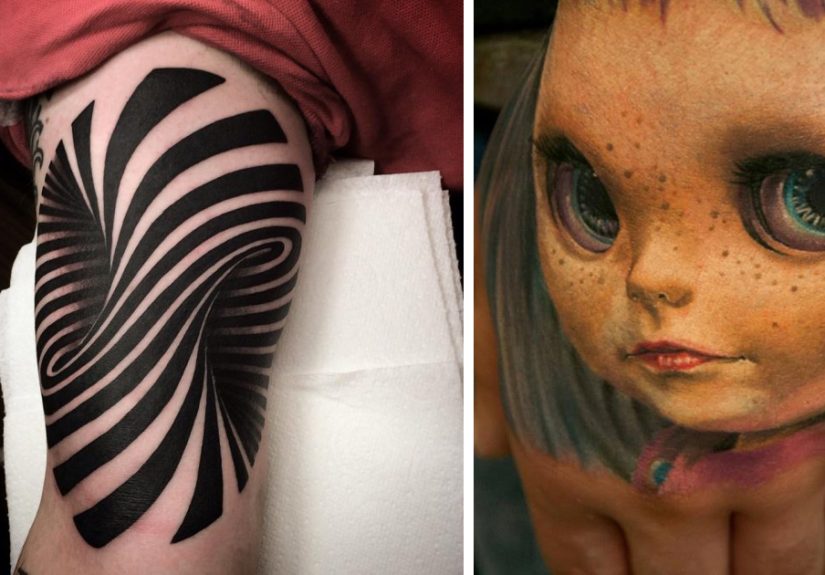
- A cube pattern that bends the skin into impossible geometry.
- A black hole illusion on the calf with rings of depth.
- A warped checkerboard that curves across the ribcage.
- A portal effect showing another landscape through a “cutout” in the skin.
- A floating sphere tattoo using perfect highlight placement.
- A cracked wall illusion that makes the arm look sculpted from stone.
- A folded ribbon design that seems woven through the skin.
- A shadow box illusion framing an eye or face.
- A Möbius-strip inspired design for people who enjoy confusing both math and strangers.
Horror-Inspired 3D Tattoos With Serious Drama
- A stitched-open skin tattoo revealing teeth underneath.
- A realistic eyeball peering through a torn patch of flesh.
- A skull appearing to push through the skin from below.
- A cracked porcelain doll face on the forearm.
- A claw-mark illusion across the chest or shoulder.
- A dripping candle embedded in the skin like gothic stage design.
- A raven bursting from a dark shadow pocket.
- A full-color monster mouth hidden beneath a zipper.
- A shattered mirror effect with distorted reflections.
- A ghostly handprint illusion on the back or ribs.
Nature Tattoos That Feel Almost Alive
- A dew-covered rose petal tattoo that looks wet to the touch.
- A mushroom cluster growing from a shadowed forest floor on the calf.
- A geode tattoo with sparkling depth and carved rock texture.
- A realistic feather casting a soft shadow down the arm.
- A wave curling around the shoulder like a frozen motion shot.
- A galaxy orb with layered stars and an illusion of glass.
- A tree hollow tattoo showing an entire tiny forest inside.
- A magnified dandelion seed scene that feels suspended in air.
- A moon crater design with enough detail to look sculpted.
- A frozen ice crack tattoo across the wrist or neck.
Pop Culture and Surreal 3D Concepts
- A floating hourglass with sand drifting across the arm.
- A chess piece tattoo that appears to stand above the skin.
- A camera lens illusion with reflective glass detail.
- A pocket watch “embedded” in the chest.
- A paper airplane that seems folded from the skin itself.
- A melting mask tattoo for pure surrealist chaos.
- A floating book with pages lifting off the forearm.
- A vinyl record illusion with subtle reflective highlights.
- A chessboard opening into a tunnel.
- A tiny astronaut walking across a moon-textured shoulder.
Small 3D Tattoos That Still Pack a Punch
- A ladybug on the wrist that looks uncannily real.
- A paperclip tattoo with a believable metal shine.
- A postage stamp illusion with curled edges.
- A small heart-shaped lock “pressed” into the skin.
- A gem tattoo with crisp facets and light bounce.
- A mini zipper behind the ear.
- A domino tile with a shadow that makes it hover.
- A raindrop illusion on the hand.
- A tiny key tattoo angled for depth on the ankle.
- A postage-label style patch tattoo with raised-thread embroidery illusion.
How to Choose a 3D Tattoo That Still Looks Smart in Five Years
A design can be jaw-dropping on day one and disappointing by year three if you ignore the practical stuff. 3D tattoos demand more planning than a simple symbol or script piece because the illusion depends on precision. Tiny details can blur. High-friction areas can soften faster. Hands and feet, for example, may look cool for social media, but they often need more touch-ups than lower-maintenance placements.
That is why scale matters. If you want a biomechanical arm panel, give it room. If you want a realistic spider, do not make it so tiny that the legs turn into mystery noodles after healing. Ask your artist what details will hold up, what shadows need to stay soft, and what can be simplified without losing the magic. The most successful 3D tattoos are not necessarily the busiest. They are the most believable.
You also want to think about lifestyle. Sun exposure, tight clothing, gym friction, and your job can all affect healing and long-term crispness. A fresh tattoo is not a decorative sticker; it is healing skin. Treating it carelessly is the fastest way to turn your epic illusion into a blurry life lesson.
Before You Book: The 3D Tattoo Checklist
- Study healed work, not just fresh tattoos. Fresh ink is the beauty filter of the tattoo world.
- Choose a specialist. Realism, optical illusion, and 3D work are skill-specific.
- Pick placement strategically. Forearms, thighs, shoulders, and backs often give the illusion room to breathe.
- Talk about aging. Ask what lines, textures, and highlights will still read clearly later.
- Follow aftercare like a grown-up. Clean hands, gentle washing, moisture balance, and patience are not optional.
- Avoid the usual healing villains. Too much sun, soaking, picking, and friction can sabotage the result.
- Watch for problems. Increasing redness, swelling, pus, fever, or a strange rash deserve real attention, not hopeful denial.
Why 3D Tattoos Continue to Fascinate People
There is something deeply satisfying about art that can fool the eye while still carrying emotion or symbolism. A 3D tattoo can be funny, creepy, elegant, futuristic, romantic, or downright absurd. It can honor nature with a lifelike butterfly, show resilience with armor under skin, or lean into fantasy with portals, robots, and impossible geometry. In a world full of fast images and short attention spans, a well-done 3D tattoo still makes people stop. That alone gives it staying power.
And maybe that is the real reason these tattoos endure. They let people wear spectacle without giving up meaning. They are personal art pieces that also happen to perform a tiny visual magic trick every time someone looks at them. Honestly, there are worse things to wear forever.
What It Feels Like to Experience 3D Tattoos in Real Life
Seeing a 3D tattoo online is one thing. Seeing one in person is a completely different experience, and usually a much stranger one. Photos can capture the design, but they do not always capture the way the tattoo changes when the person moves, laughs, crosses their arms, or turns in the light. A great 3D piece feels almost interactive. It does not just sit on the skin; it performs. The highlights shift. The shadowing seems to deepen. The placement suddenly makes perfect sense. Your brain knows it is ink, but part of you still wants to reach out and verify that no, there is not actually a beetle perched on someone’s shoulder.
That is one reason people with strong 3D tattoos often talk about them differently than people with simpler designs. These pieces create reactions. Friends stare. Cashiers do a polite double-take. Family members either say, “That is incredible,” or “Why does your arm look unzipped?” There is usually no middle ground. The tattoo becomes a conversation starter, a tiny performance piece, and occasionally a social experiment in how observant other people really are.
There is also the experience of sitting for one. Because 3D tattoos rely on careful shading and tiny transitions, the process can feel slower and more meticulous than people expect. It is not just about getting through pain; it is about trusting the artist while they build the illusion one gradient at a time. Many clients describe the session as oddly suspenseful. Early in the appointment, the design may look unfinished or even a little confusing. Then a few shadows go in, a highlight gets placed, the negative space opens up, and suddenly the whole thing snaps into focus. It is like watching a flat sketch wake up.
After healing, the relationship changes again. A 3D tattoo teaches you that skin is not paper. The illusion looks different in morning light than it does under restaurant lighting. It looks different when your arm is relaxed than when you are carrying groceries and regretting your life choices. If the artist did the job well, the tattoo still reads beautifully in all those situations. In fact, many of the best 3D pieces become more interesting over time because the wearer learns which angles make the illusion pop the hardest.
There is a confidence factor, too. People often choose these tattoos because they do not want something quiet. They want art that feels bold, playful, cinematic, or a little rebellious. A 3D tattoo says you are not interested in blending into the wallpaper. It says you appreciate technique, maybe a bit of drama, and definitely the joy of making people look twice. That is not vanity; it is participation in visual storytelling.
At the same time, the experience can be surprisingly personal. A butterfly that looks ready to lift off might represent change. A biomechanical rip might symbolize resilience or surviving a rough chapter. A 3D nipple tattoo after reconstruction can carry profound emotional weight and help restore a sense of wholeness. So while the style is flashy, the meaning underneath can be deeply human. That contrast is part of what makes 3D tattoos so compelling. They can be spectacular on the surface and intimate underneath.
In the end, living with a 3D tattoo is a little like living with wearable illusion art. It keeps surprising people. Sometimes it even keeps surprising you. And when a piece still makes you grin months later because the shadowing looks impossible in the mirror, that is when you know it was more than a trend. It was the right design, in the right place, by the right artist, doing exactly what great body art should do: making skin unforgettable.
Conclusion
The wildest 3D tattoos do more than show off technical skill. They create a full-on visual experience. Whether you love creepy realism, futuristic biomech, elegant nature pieces, or optical illusions that make people question their eyesight, the best designs balance shock value with smart execution. Choose an artist who understands depth, placement, and longevity, and your tattoo will do more than twist minds. It will keep doing it for years.