Table of Contents >> Show >> Hide
- How to Choose the Best Portable Air Compressor in 2024
- The 10 Best Air Compressors in 2024
- 1. Makita MAC2400 2.5 HP Big Bore Air Compressor – Best Overall Workhorse
- 2. PORTER-CABLE C2002 6-Gallon Pancake – Best Budget All-Rounder
- 3. DEWALT DWFP55126 6-Gallon Pancake – Best Pancake for Pros
- 4. California Air Tools 8010 Ultra Quiet 8-Gallon – Best for Quiet Operation
- 5. Husky 4.5-Gallon Portable Silent Air Compressor – Best Compact “Silent” Shop Unit
- 6. Bostitch BTFP02012 Pancake – Best Value for Finish & Trim Work
- 7. Craftsman CMEC6150K 6-Gallon Pancake Kit – Best Starter Kit
- 8. EPAuto 12V DC Portable Air Compressor Pump – Best Glovebox Tire Inflator
- 9. AstroAI Portable Tire Inflator / Air Compressor – Best Programmable Tire Inflator
- 10. Ryobi ONE+ 18V Cordless 1-Gallon Air Compressor Kit – Best Battery-Powered Option
- Tips for Using Portable Air Compressors Safely and Efficiently
- Real-World Experiences with Portable Air Compressors (500+ Words)
- Conclusion
If you’ve ever tried to drive a framing nail with a hammer, inflate a half-flat SUV tire by hand, and blow sawdust out of your garage… all in the same afternoon, you already know why a good air compressor feels like a cheat code. The right portable air compressor lets you power nailers, impact wrenches, paint sprayers, and tire inflators without breaking a sweat or your budget.
But walk into any home center (or scroll Amazon for 30 seconds), and you’ll see pancakes, hot dogs, cordless inflators, “quiet series,” and mysterious specs like PSI, CFM, and duty cycle. Choosing the best portable air compressor in 2024 can get confusing fast.
This guide breaks everything down in plain English and highlights 10 of the best air compressors in 2024, from serious shop workhorses to glovebox-sized tire inflators. We’ll look at what each one does best, who it’s for, and what you should know before you click “add to cart.”
How to Choose the Best Portable Air Compressor in 2024
Before we dive into specific models, it helps to understand the basics so you can match a compressor to your projects instead of just buying whatever’s on sale.
Key Specs: PSI, CFM, and Tank Size
PSI (pounds per square inch) tells you how much pressure the compressor can store. Most portable units aimed at home and jobsite use land between 90 and 165 PSI. Higher max PSI gives your tools more overhead and longer runtimes between cycles.
CFM (cubic feet per minute) at 90 PSI is just as important. This number tells you how much air volume the pump can deliver while your tools are running. High-demand tools like impact wrenches and paint sprayers need more CFM than brad nailers or blow guns.
Tank size (measured in gallons) acts like your “air battery.” Bigger tanks (4–8 gallons) smooth out tool demand and keep the motor from cycling every few seconds. Smaller tanks (1–3 gallons) are lighter and easier to move but better for shorter bursts.
Compressor Types: Pancake, Hot Dog, and Inflators
- Pancake compressors have a flat, round tank. They’re compact, stable, and extremely popular for framing, roofing, and finish carpentry.
- Hot dog compressors use a horizontal cylinder tank. They’re often a bit quieter and easier to store on a shelf.
- Compact & tire inflators sacrifice tank size for portability. Many plug into a 12V outlet or run off batteries and are ideal for vehicles, bikes, and light-duty tasks.
Noise, Portability, and Power Source
Modern “quiet series” compressors can run in the 60–80 dB range, which is dramatically easier on your ears than older screaming units. If you’re working indoors or at night, it’s worth paying more for a quiet model.
Portability depends on weight, footprint, and handles or wheels. A 70–80 lb pro-grade unit is technically portable, but you probably won’t be lugging it up a ladder. If you’re just inflating tires and running small nailers, a 30 lb pancake or even a cordless inflator is much friendlier.
Most compressors in this list are 120V corded electric. A few are 12V DC for in-car use, and one is an 18V cordless model that runs on tool batteries perfect when outlets are scarce.
The 10 Best Air Compressors in 2024
Here are 10 standout air compressors and inflators, covering everything from all-day framing to emergency roadside inflations.
1. Makita MAC2400 2.5 HP Big Bore Air Compressor – Best Overall Workhorse
The Makita MAC2400 has become a favorite in real-world testing because it balances serious air power with manageable portability. It uses a cast-iron “Big Bore” pump and twin stacked tanks for a total of about 4.2 gallons of air capacity, with a maximum pressure around 130 PSI and roughly 4.2 CFM at 90 PSI. That’s enough to run framing nailers, roofing guns, and light impact work without constantly waiting for the tank to refill.
It’s oil-lubricated, which means you’ll need to check and change oil, but you get longer pump life and a smoother, quieter operation compared with many budget oil-free models. The roll-cage frame protects the motor and pump on busy jobsites, and dual hose ports let you run two tools at once if they need similar pressures.
Best for: Contractors and serious DIYers who want one compressor that can handle everything from framing to trim work and don’t mind the extra weight.
Pros: High CFM output for a portable unit, durable construction, dual ports, quieter than many shop compressors.
Cons: At around 77 pounds with no wheels, this isn’t something you casually carry up three flights of stairs.
2. PORTER-CABLE C2002 6-Gallon Pancake – Best Budget All-Rounder
The PORTER-CABLE C2002 shows up on “best air compressor” lists year after year for a reason. Its 6-gallon pancake tank, max pressure around 150 PSI, and roughly 2.6 CFM at 90 PSI hit a sweet spot for home garages and small jobsite tasks. It can power brad and finish nailers, staplers, air blow guns, and handle tire inflation without breaking a sweat.
Because it’s oil-free, the pump requires essentially no maintenance beyond draining the tank. At around 30 pounds, it’s easy enough to lift into a trunk or move around the house. Two quick-connect couplers let you run two light-duty tools at once, and the flat “pancake” design is impressively stable.
Best for: DIYers and homeowners who want one affordable, portable compressor for projects, inflating, and occasional tool use.
Pros: Great price-to-performance ratio, low maintenance, quick recovery time, stable design.
Cons: It’s not quiet you’ll want hearing protection in smaller spaces and it’s not ideal for high-demand tools like full-time impact wrenches.
3. DEWALT DWFP55126 6-Gallon Pancake – Best Pancake for Pros
The DEWALT DWFP55126 takes the popular pancake formula and dials it up. With a 6-gallon tank and a max pressure around 165 PSI, it gives you more usable air between cycles than many competitors. The pump delivers roughly 2.6 CFM at 90 PSI, enough for framing or roofing nailers, trim guns, and general carpentry tools.
Users and testers often highlight its surprisingly quick recovery and slightly more refined feel compared with some budget pancakes. It features an oil-free pump, two universal couplers, a top-mounted handle, and heavy-duty rubber feet. The compressor weighs about 30 pounds still very portable, especially for jobsite use.
Best for: Contractors or frequent DIYers who want a robust, jobsite-ready pancake compressor that can keep up with busy tool use.
Pros: Higher max PSI than many competitors, fast recovery, compact footprint, durable construction.
Cons: Still fairly loud; the price is higher than entry-level pancakes but justified if you’ll use it a lot.
4. California Air Tools 8010 Ultra Quiet 8-Gallon – Best for Quiet Operation
If noise is your main complaint about air compressors, the California Air Tools 8010 will feel like a revelation. This 8-gallon hot dog-style unit uses a low-RPM pump designed for “ultra quiet” operation, typically rated around 60–70 dB more like a conversation than a jet engine.
The oil-free motor makes it easy to own, while the larger tank helps it keep up with brad nailers, finish nailers, staplers, blow guns, and occasional light spray work. Wheels and a handle make the roughly 50–55 pound weight more manageable, especially for moving around a shop or garage.
Best for: Indoor workshops, basement projects, and any situation where keeping the noise down actually matters to neighbors, kids, or your sanity.
Pros: Very quiet, decent tank size, oil-free low-maintenance design, wheeled for portability.
Cons: Not the most powerful option for heavy framing or auto shop work; the bigger tank means it’s bulkier than pancake-style units.
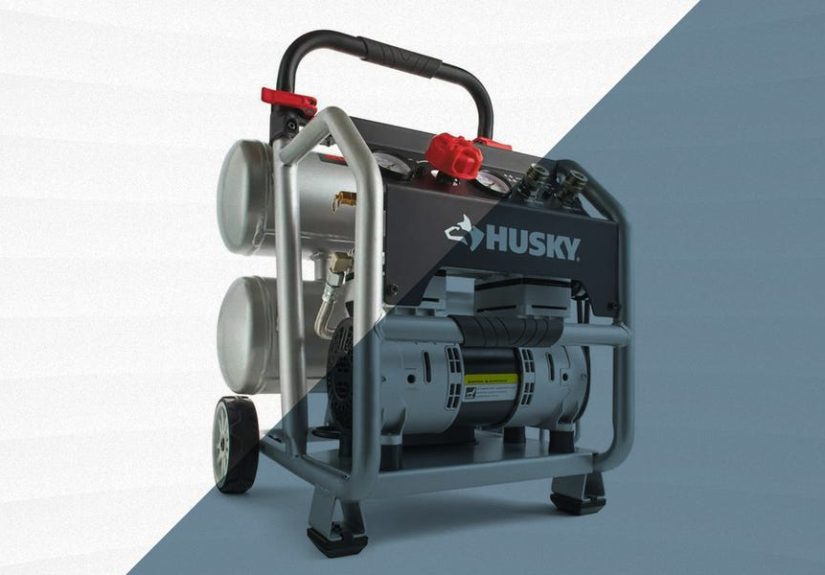
5. Husky 4.5-Gallon Portable Silent Air Compressor – Best Compact “Silent” Shop Unit
Husky’s 4.5-gallon portable “silent” compressor is another favorite among testers who want serious performance without serious noise. It typically offers a max pressure in the 125–135 PSI range and enough CFM at 90 PSI for trim work, small impact jobs, and general shop tasks, all while running at significantly lower noise levels than older oil-free designs.
The vertical tank and wheel kit make it easy to store and roll around tight garages. It’s a great compromise between the ultra-quiet hot dog models and the louder, small pancakes: plenty of capacity, a relatively compact footprint, and a noise level that won’t make your dog file a noise complaint.
Best for: Home shops and garages that need a “leave it plugged in and roll it around” compressor that keeps things civil on the noise front.
Pros: Quiet design, decent capacity, upright form factor saves floor space.
Cons: Heavier and larger than a simple pancake; best suited to semi-permanent shop duty rather than constant car-trunk travel.
6. Bostitch BTFP02012 Pancake – Best Value for Finish & Trim Work
Bostitch’s BTFP02012 is another 6-gallon pancake that frequently appears on best-of lists. With a max pressure around 150 PSI and about 2.6 CFM at 90 PSI, it’s ideal for running one or two finish nailers, brad guns, or staplers on trim and cabinetry jobs.
Like its peers, it uses an oil-free pump, making it low-maintenance and cold-weather friendly. The unit is compact and relatively light, and many combo kits include hoses and nailers, making it a strong value for new homeowners or first-time compressor buyers.
Best for: DIY trim and finish projects, installing baseboards, crown molding, and small carpentry jobs.
Pros: Great combo-kit options, easy to use, good performance for nailers and light tools.
Cons: Still loud; like most pancakes, it’s not meant for long-running, high-demand pneumatic tools.
7. Craftsman CMEC6150K 6-Gallon Pancake Kit – Best Starter Kit
The Craftsman CMEC6150K is a 6-gallon, oil-free pancake compressor often sold with a 13-piece accessory kit that includes a hose, blow gun, and inflator attachments. With a max pressure around 150 PSI and about 2.6 CFM at 90 PSI, it performs similarly to the PORTER-CABLE and Bostitch pancakes but adds nice starter accessories in the box.
It’s made in the USA with global materials, has a compact footprint, and weighs in the same 30-pound range as other pancakes. For many homeowners, this kit is a one-box solution: you can inflate tires, clean up sawdust, and run brad or finish nailers without buying extra fittings right away.
Best for: New homeowners and DIYers who want a single purchase that gets them a compressor plus basic accessories.
Pros: Includes useful accessories, solid performance, easy to store, oil-free pump.
Cons: Similar limitations to other pancakes on heavy-duty tools; the accessory hose is functional but not premium.
8. EPAuto 12V DC Portable Air Compressor Pump – Best Glovebox Tire Inflator
For many drivers, the most practical “air compressor” is something that lives quietly in the trunk until your tire pressure warning light pops on. The EPAuto 12V DC Portable Air Compressor is a compact unit that plugs into your vehicle’s 12V outlet, shows pressure on a digital gauge, and automatically shuts off once it hits a preset PSI.
It’s not built for nail guns or shop tools it has no tank and runs continuously while inflating. But for topping up car, bike, or trailer tires, sports balls, and small inflatables, it’s a game changer. Many tests praise its straightforward controls, built-in LED light, and ability to bring a low tire back to spec in just a few minutes.
Best for: Everyday drivers who want a small, inexpensive, “just in case” inflator that can live in the car.
Pros: Very portable, easy to use, automatic shutoff, works directly off the car’s 12V outlet.
Cons: Not suitable for tools or high-volume airflow; duty cycle limits how long it can run continuously.
9. AstroAI Portable Tire Inflator / Air Compressor – Best Programmable Tire Inflator
AstroAI’s portable tire inflators show up frequently in automotive-focused roundups because they combine solid inflation speed with handy features like programmable target pressure and compact design. Common models in this family use either a 12V car outlet or cordless power and inflate at roughly 30–35 L/min, making them fast enough for most passenger tires.
The digital interface lets you set your desired PSI, hit start, and let the inflator shut itself off once it hits the target. Built-in LED lighting and accessory tips make it useful for bikes, balls, and small inflatables too. For off-roaders and road-trip enthusiasts, it’s a smart backup to carry alongside a full-size compressor back home.
Best for: Drivers who want a compact, programmable inflator with a bit more polish and flexibility than bare-bones 12V pumps.
Pros: Simple programmable interface, portable size, good inflation speed for its class.
Cons: Like other inflators, it’s not designed for tools or long duty cycles; better as a complement to a shop compressor than a replacement.
10. Ryobi ONE+ 18V Cordless 1-Gallon Air Compressor Kit – Best Battery-Powered Option
The Ryobi ONE+ 18V cordless 1-gallon compressor leans into battery-powered convenience. Using the same 18V batteries as Ryobi’s popular power tools, this lightweight compressor is perfect when you’re far from outlets think punch-list trim work in a house with the power off, or inflating tires at a remote trailhead.
With a 1-gallon tank and a modest CFM rating, it’s best suited for brad and finish nailers, staplers, and inflating duties. The big advantage is freedom from cords: no searching for outlets, no dragging extension cords through a jobsite, and easy setup for quick tasks.
Best for: DIYers and pros already in the Ryobi ecosystem who value portability over raw power.
Pros: Cordless convenience, lightweight, excellent for small trim tasks and inflations.
Cons: Limited air volume and runtime per battery; not appropriate for heavy-duty tools or long sessions.
Tips for Using Portable Air Compressors Safely and Efficiently
- Match tool requirements to compressor specs. Check your tool’s required CFM and PSI, and make sure the compressor can comfortably exceed them. Running at the ragged edge leads to constant cycling and uneven performance.
- Drain the tank regularly. Condensation builds up inside the tank as you compress air. Use the drain valve after each work session to prevent rust and moisture problems in your tools.
- Use proper hoses and fittings. Longer thin hoses restrict airflow. For higher-demand tools, use a larger-diameter hose and avoid excessive length.
- Respect duty cycle. Many compressors are designed to run a certain percentage of the time (for example, 50% on, 50% off). Give the motor breaks so it doesn’t overheat and shorten its life.
- Wear hearing and eye protection. Even “quiet” models can be loud in enclosed spaces, and compressed air plus flying debris is not a good combination for unprotected eyes.
Real-World Experiences with Portable Air Compressors (500+ Words)
Specs and product charts are helpful, but most people fall in love with (or deeply resent) their air compressor because of what happens in real life. Here are a few common scenarios that highlight how different types of portable air compressors feel to use day-to-day.
The weekend warrior and the pancake compressor. Picture a Saturday morning when your “quick” project list includes installing baseboard in a spare room, fixing a sagging gate, and finally inflating the kids’ bike tires. A 6-gallon pancake compressor like the PORTER-CABLE C2002 or DEWALT DWFP55126 is tailor-made for this kind of day.
You roll it out of the garage, plug into a nearby outlet, and hook up a brad nailer. The tank fills in under a minute, the motor cuts off, and you start installing trim. With each rapid-fire burst of nails, you hear the compressor kick back on every so often to top up the tank, but you’re not waiting around for air it just happens in the background. When you’re done, you swap to a blow gun and blast sawdust off your miter saw and workbench, then use an inflator chuck to bring the kids’ bike tires up to pressure. One machine, three jobs, no drama.
The tradeoff? Noise. Run a pancake compressor in a small garage with the door closed and it will sound like a small airplane is landing. For a weekend warrior, that’s usually an acceptable compromise. If you’re working in a shared space or at odd hours, though, “acceptable” starts to feel a lot less charming.
The quiet-shop convert. Many woodworkers and hobbyists eventually reach the same conclusion: “I love air tools, but I hate how loud my compressor is.” That’s where quiet-series units like the California Air Tools 8010 or Husky’s silent-style compressors come in.
Imagine turning on your compressor and being able to have a normal conversation while it runs. You can sand or nail trim in the basement without waking a sleeping baby upstairs. You might still wear ear protection when other tools are going, but the constant drone is gone. Over a long day in the shop, that reduction in stress and fatigue is a big deal.
Of course, the quiet life has its price. These units often cost more and sometimes deliver slightly lower CFM than similarly sized loud models. But for people who spend many hours in the shop, most would say the upgrade is worth every penny.
The roadside save. Ask anyone who’s used a portable tire inflator in an emergency, and they’ll tell you: it’s not about CFM, it’s about peace of mind. You notice your tire looks low in a grocery store parking lot, or your TPMS light turns on halfway down the highway. With something like the EPAuto or AstroAI inflator in your trunk, the story is boring in a good way.
You pull into a safe spot, plug the inflator into the 12V outlet, set your target PSI, and press go. A few minutes later, you’re back on the road instead of begging for quarters at a sketchy gas station air pump. These little compressors won’t run a nail gun, but in that moment, they’re worth more than the biggest shop compressor on earth.
The cordless freedom moment. For people already invested in Ryobi’s ONE+ battery platform (or any similar system), that first experience with a cordless compressor feels a bit magical. You’re working on a punch list in a room with no finished outlets yet. Normally you’d string extension cords, trip over them all afternoon, and test your luck with breakers.
Instead, you drop a fully charged battery into the Ryobi 1-gallon compressor, hook up a brad nailer, and just go. No cords, no tripping, no hunting for power. Is it as strong as a big Makita? Not even close. But for small trim jobs and quick fixes, the freedom is hard to beat. Once you’ve had that experience, you start seeing more and more places where a small cordless compressor fits into your workflow.
Finding “your” compressor. What these scenarios have in common is that the “best” compressor isn’t universal it’s the one that makes your specific projects easier, safer, and less stressful. If you do a little of everything around the house, a 6-gallon pancake plus a small 12V inflator is an excellent one-two punch. If you’re primarily in the shop and value your hearing, a quiet hot dog or silent-style unit is a smart long-term investment. And if you’re in love with battery-powered tools, a cordless compressor might be the missing piece in your kit.
The goal isn’t to have the biggest or the fanciest compressor. It’s to have one that fits your work style so well that you don’t think about it you just get more done.
Conclusion
Portable air compressors in 2024 range from suitcase-sized inflators to professional-grade twin-tank beasts. The right one for you depends on what you do most: tire inflations and emergencies, all-day carpentry, weekend projects, or quiet shop work.
If you live with nail guns in your hand, a powerful unit like the Makita MAC2400 or a high-PSI pancake from DEWALT will keep up with your pace. If you just need a reliable helper for DIY, a budget-friendly pancake from PORTER-CABLE, Bostitch, or Craftsman will instantly upgrade your toolbox. And if you want something that lives in your trunk and saves road trips, a compact inflator from EPAuto or AstroAI might be the smartest $40–$60 you spend all year.
Whatever you choose, pay attention to PSI, CFM, tank size, and noise level and match those numbers to your real-world projects. Do that, and your new compressor will feel less like a noisy machine and more like a power multiplier for everything you build, fix, and inflate.