Table of Contents >> Show >> Hide
- What It Means to Use the Arts for Synthesis
- Why the Arts Help Students Deepen Understanding
- Practical Ways to Use the Arts to Synthesize Student Understanding
- What Strong Arts-Based Assessment Looks Like
- Classroom Examples Across Subjects
- Common Mistakes to Avoid
- A Simple Planning Framework for Teachers
- Experiences From Classrooms Where the Arts Clarify Learning
- Conclusion
Every teacher has seen it: a student passes the quiz, nods at the lecture, and still somehow treats the big idea like a sandwich bag full of loose socks. The facts are there, technically, but they are not connected. That is where the arts can do some heavy lifting. When students draw, perform, compose, design, dramatize, or choreograph what they know, they are not just repeating content. They are reorganizing it, interpreting it, and turning it into meaning.
In other words, the arts are not classroom glitter with a better publicist. Used well, they help students synthesize understanding. They push learners to combine knowledge, identify relationships, explain choices, and communicate ideas in a form that demands thought. A worksheet can show whether a student remembers a term. A carefully designed mural, monologue, rhythm piece, or movement study can show whether that student actually understands how the idea works.
That distinction matters. Schools are full of moments when students are asked to “show what they know,” but too often that means picking one correct answer from four suspiciously similar options. Arts-based learning opens wider doors. It allows students to make meaning with images, sound, movement, narrative, symbolism, and performance. For many learners, that is when the lights come on.
What It Means to Use the Arts for Synthesis
Using the arts to synthesize student understanding does not mean handing out markers and hoping for academic magic. It means asking students to pull together what they have learned and communicate it through an art form in a way that reveals depth, connections, and reasoning.
At its best, arts integration is rigorous because it includes goals in both the content area and the art form. A science class creating movement phrases about the water cycle is not just “doing something fun.” Students are making decisions about sequence, pattern, emphasis, and representation while also showing whether they understand evaporation, condensation, precipitation, and collection. The art becomes a language for thought.
This is the part many classrooms miss. If the assignment is “color a poster about the planets,” students may stay parked at the level of decoration. If the assignment is “design a visual campaign persuading families to move to a specific planet based on scientific evidence,” now students must synthesize facts, analyze features, make claims, and communicate with purpose. Same topic. Very different thinking.
Arts Integration Is Not Just Fancy Craft Time
Let’s say the quiet part out loud: not every lesson with paint counts as arts integration. Sometimes a class makes something artistic, but the task does not require artistic decision-making or deeper academic understanding. That is arts enhancement, not synthesis. And arts enhancement can still be lovely. It just should not be mistaken for rigorous demonstration of learning.
Strong arts-based synthesis asks students to do more than produce a pretty final product. It asks them to make choices. Why this image? Why this tempo? Why this angle, this line, this gesture, this color, this metaphor? When students can answer those questions, teachers get a clearer window into understanding than they often get from a multiple-choice test.
Why the Arts Help Students Deepen Understanding
The arts are powerful because they make students transform information rather than merely repeat it. Transformation is where synthesis lives. A student who turns a historical event into a scripted scene has to identify conflict, perspective, motive, and consequence. A student who creates a comic about photosynthesis must decide what matters most, what causes what, and how to explain a complex process clearly. A student composing a soundtrack for a novel’s turning point must interpret mood, tone, and character development instead of simply saying, “The theme is identity.”
That transformation process helps in several ways.
It Promotes Meaning-Making
Arts tasks force students to ask, “What is essential here?” They must sort the important from the merely interesting. That is synthesis in action.
It Makes Thinking Visible
When students sketch, perform, revise, annotate, or explain their creative choices, teachers can actually see how understanding is developing. Confusion no longer hides politely behind a completed worksheet.
It Supports More Than One Path to Understanding
Some students think best through words. Others think through sound, movement, image, or spatial design. The arts widen access without lowering expectations. They let students demonstrate learning in ways that are both demanding and humane.
It Encourages Retention
Students are more likely to remember learning experiences that involve emotion, embodiment, story, collaboration, and creative decision-making. When a concept gets attached to movement, imagery, rhythm, or performance, it tends to stick around longer than a lonely vocabulary list.
It Builds Transferable Skills
Arts-based synthesis also strengthens communication, collaboration, critique, and reflection. Those are not bonus features. They are part of what real understanding looks like in school and beyond.
Practical Ways to Use the Arts to Synthesize Student Understanding
The best arts-based tasks are usually anchored in a clear question: How can students show that they understand this idea deeply enough to represent it creatively and explain their choices? Once that question is on the table, classroom possibilities multiply.
1. Artist Statements
An artist statement is one of the simplest and smartest tools teachers can use. Students create an original work and then explain what they made, why they made it that way, what materials or techniques they used, and how the work expresses their understanding. Suddenly the assignment is not just “make something.” It becomes “make something, then defend your thinking.”
A fifth grader studying ecosystems might build a mixed-media habitat collage and write an artist statement explaining how color, texture, and placement represent interdependence, energy flow, and environmental stress. The art shows understanding. The statement clarifies it.
2. Tableau and Drama
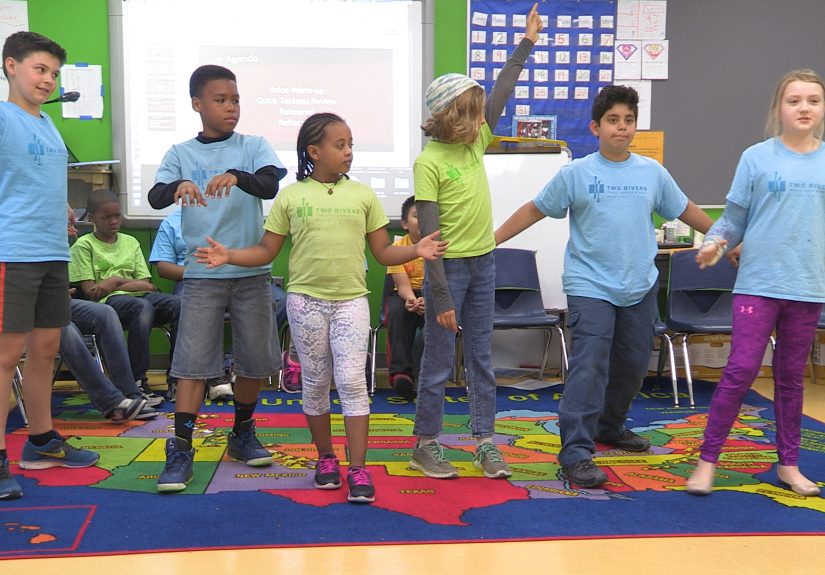
Drama is fantastic for synthesis because it requires point of view, sequence, and intention. In a social studies class, students can create tableaux showing causes and effects of the American Revolution. In English language arts, they can perform a silent scene that captures a character’s internal conflict. In health class, they can role-play decision-making around peer pressure. Drama makes students choose what matters and communicate it with precision.
3. Visual Representation
Visual art can move far beyond posters with giant titles and clip-art energy. Students can create symbolic self-portraits for memoir writing, infographics that use design principles to present data, editorial cartoons for civics, or collage timelines that show change over time. The key is to build the assignment around interpretation and evidence, not just neatness and color choices.
4. Music and Sound
Music can help students synthesize patterns, structure, and mood. Younger students might create rhythm patterns to show multiplication facts or syllable stress. Older students might compose a short musical piece that represents a scientific process, a literary theme, or a historical period. Even a simple soundscape can reveal how well students understand setting, tension, or system dynamics.
5. Movement and Dance
Movement is especially effective for abstract or process-heavy content. Students can choreograph the phases of mitosis, physically model geometric transformations, or use body shapes to represent the relationship between characters in a text. When students embody a concept, they often discover misunderstandings quickly. It turns out your body is an excellent honesty machine.
6. Multimedia and Performance-Based Projects
Today’s classrooms can also use video, podcasting, digital storytelling, and media arts to support synthesis. Students can produce a mini-documentary, stage a mock museum tour, create an audio diary from a historical perspective, or design a short animation explaining a scientific concept. These formats feel contemporary because they are contemporary, but they are still rooted in classic intellectual work: selecting, organizing, interpreting, and communicating.
What Strong Arts-Based Assessment Looks Like
If teachers want the arts to reveal real understanding, assessment has to match the ambition of the task. That means moving beyond “I liked it” or “good effort” and using criteria that are clear, teachable, and aligned to learning goals.
Start With Dual Objectives
Students should know what they are expected to learn in the content area and what they are expected to do in the art form. For example, a lesson might ask students to explain the causes of weather patterns and use line, contrast, and composition intentionally in a visual piece. When both objectives are visible, students take both kinds of thinking seriously.
Assess Process as Well as Product
A final performance or artwork matters, but so do the drafts, rehearsals, peer critiques, and revisions that led to it. Sometimes the most useful evidence of understanding appears in a student’s sketch notes, discussion comments, or revised explanation. If teachers assess only the polished ending, they may miss the best thinking in the room.
Use Rubrics That Reflect Quality, Not Vibes
A good rubric does not reward prettiness. It identifies what quality looks like. Did the student communicate the concept accurately? Did they use evidence? Did they make deliberate artistic choices? Did they revise based on feedback? That is much more useful than “4 points for colorfulness,” which belongs in the recycling bin with expired classroom coupons.
Build in Self-Assessment and Peer Critique
When students learn how to critique work respectfully and specifically, their understanding deepens. They begin to notice strengths, gaps, and opportunities for revision in their own work as well as others’. Sentence stems help: “I notice…,” “I wonder…,” “This choice helps communicate…,” and “You could make the idea clearer by…” Those routines turn feedback into part of learning, not just a postgame speech from the teacher.
Document Student Thinking
Photos, rehearsal notes, annotations, exit reflections, and artist statements can all capture learning that would otherwise disappear. Documentation is especially helpful in arts-rich work because understanding often unfolds over time. A teacher may not see the full story by looking at one final piece in isolation.
Classroom Examples Across Subjects
English Language Arts
Students reading The Giver create a gallery of symbolic objects representing key themes, then write curator notes explaining how each object reflects control, memory, and individuality. This task asks students to interpret symbols and explain their choices with textual evidence.
Science
After studying forces and motion, students create kinetic sculptures or movement demonstrations that model push, pull, gravity, and friction. They present the work and explain which design choices represent each force. If a student cannot explain the motion accurately, the sculpture politely tattles.
Social Studies
Students design a museum exhibit about migration, including visual artifacts, audio narration, and a performance piece from a first-person perspective. To do this well, they must combine historical facts, empathy, chronology, and perspective-taking.
Math
Students explore geometric transformations by designing repeating patterns, stage sets, or dance phrases that demonstrate translation, rotation, reflection, and symmetry. The work becomes a visible map of mathematical reasoning.
Elementary Integrated Project
A third-grade class studying weather creates a classroom “forecast studio.” One group writes scripts, one composes transition music, one designs the visual graphics, and one performs the forecast using accurate meteorological vocabulary. Students synthesize science content while communicating through media arts, music, design, and performance.
Common Mistakes to Avoid
Even strong teachers can drift into a few predictable traps.
- Confusing decoration with demonstration: A colorful project is not automatically evidence of understanding.
- Grading artistic talent instead of learning: Students should be assessed on criteria they were taught, not on whether they already draw like a tiny Renaissance master.
- Skipping explicit instruction: If students are using drama, visual art, music, or movement, they need some guidance in the language and techniques of that form.
- Leaving reflection out: Without explanation and revision, the teacher may only see the final surface, not the thinking underneath.
- Using vague prompts: “Be creative” is not a learning target. It is a motivational poster pretending to be pedagogy.
A Simple Planning Framework for Teachers
- Identify the core understanding. What should students know, understand, and be able to explain?
- Choose an art form that fits the thinking. Movement works well for process. Visual art works well for symbolism and relationships. Drama works well for perspective and conflict.
- Set dual objectives. Make the content goal and the arts goal clear.
- Create success criteria. Decide what evidence of understanding will look like.
- Model and scaffold. Show examples, teach vocabulary, and practice small pieces before the final task.
- Build in critique and revision. Learning gets sharper when students refine their work.
- Ask students to reflect. Have them explain how their creative choices communicate understanding.
That framework keeps the work purposeful. It also reassures teachers who worry that arts integration sounds wonderful but vaguely chaotic. It does not have to be chaos. It can be structured, standards-aligned, and deeply joyful at the same time.
Experiences From Classrooms Where the Arts Clarify Learning
In many schools, the turning point comes when teachers notice that a student who struggles with traditional written responses suddenly becomes articulate through an art form. A quiet student may say very little during a discussion on characterization, then create a monologue that reveals a layered understanding of motive, fear, and change. A student who freezes on science quizzes may build a visual model that accurately explains food webs and then speak confidently about why one missing organism affects the entire system. These moments are not miracles. They are reminders that understanding can be real before it becomes fluent in standard academic prose.
Teachers also often report that arts-based tasks change classroom energy. During a conventional review lesson, some students sit back and wait for the “right answer” to arrive from the front of the room like a pizza delivery. During an arts-rich synthesis task, more students lean in. They argue about symbolism, test ideas, revise plans, and negotiate meaning. That shift matters because it turns students from passive recipients into active makers of understanding.
One common experience appears during revision. In a traditional assignment, students may see revision as punishment with extra steps. In an arts-based assignment, revision feels more natural. They adjust a scene because the emotion is unclear. They change a color palette because it sends the wrong message. They rewrite narration because the audience will not understand the sequence. Without realizing it, they are practicing one of the most valuable habits in learning: improving communication in response to feedback.
Teachers also notice that the arts make misconceptions easier to catch. A child acting out the water cycle who skips condensation reveals confusion immediately. A group composing a rhythm pattern to represent fractions shows in seconds whether they understand part-whole relationships. A visual metaphor for a historical movement can uncover shallow thinking just as clearly as it can reveal deep insight. This is useful information, and it arrives before the unit test ambushes everyone.
Another repeated experience is that arts-based synthesis gives students a stronger sense of ownership. When learners make something original, they care differently. They are not just completing school; they are communicating an idea. That feeling can be especially powerful for students who have not always felt successful in academic spaces. The arts do not lower the bar for them. They simply provide more than one ladder.
Finally, classrooms that use the arts well often become more reflective places. Students begin to talk not only about what they know but about how they know it, why they made certain choices, and how their thinking changed. That language of reflection is one of the clearest signs that synthesis is happening. Students are no longer collecting isolated facts. They are building understanding that can be expressed, defended, revised, and remembered.
Conclusion
Using the arts to synthesize student understanding is not an extra flourish for classrooms that have time to spare. It is a serious instructional strategy for helping students connect ideas, show reasoning, and communicate learning with depth. When students draw, perform, compose, design, move, and reflect, they do more than complete a creative task. They reveal what they understand, where they are confused, and how they are making meaning.
That is why arts-based synthesis belongs in strong teaching. It invites rigor without killing curiosity. It supports assessment without flattening learning into a bubble sheet. And it gives students something every good classroom should offer: a chance to turn knowledge into understanding, and understanding into expression.