Table of Contents >> Show >> Hide
- The Middle Seat Meltdown: What Happened?
- Why Flight Attendants Take Seat Drama Seriously
- The Root Cause: Seat Selection Fees and the “Family Seating” Squeeze
- Seat Swap Etiquette: The Rules That Keep Society From Collapsing
- What Flight Attendants (Usually) Can and Can’t Do
- The Smart Way for Families to Avoid the Seat Swap Trap
- What to Do If Someone Asks You to Switch Seats
- Why “I Can’t Sit in the Middle” Isn’t a Magic Pass
- How This Ends (Most of the Time)
- Real-World Experiences: Seat-Swap Drama, Middle-Seat Survival, and What Actually Works (Extra 500+ Words)
- Experience #1: The “I’ll Trade You… Nothing” Offer
- Experience #2: The Seat Swap That Goes Perfectly Right
- Experience #3: The “Open Seat” That Isn’t Actually Open
- Experience #4: Middle Seat Survival Tips That Don’t Involve Crying
- Experience #5: When Flight Attendants Get Firm, It’s Usually a Good Sign
- Conclusion
There are two kinds of people on airplanes: the ones who quietly accept that the middle seat is a temporary tax on being alive,
and the ones who treat 19B like it’s a medieval punishment that violates the Geneva Conventions.
This story is about the second kindspecifically, an “I’m-a-mom-so-the-rules-are-optional” traveler who decided she simply
could not sit in the middle seat she booked… and then tried to make that everyone else’s problem.
If you’ve ever watched a pre-boarding seat dispute unfold, you know the vibe: hushed whispers, passive-aggressive sighing,
and one brave soul clutching their boarding pass like it’s a legal document. But when a flight attendant has to step in,
it’s not “customer service drama.” It’s a safety professional trying to keep a metal tube full of humans on schedule,
calm, and compliantbecause chaos in row 12 has a way of spreading like free champagne rumors.
The Middle Seat Meltdown: What Happened?
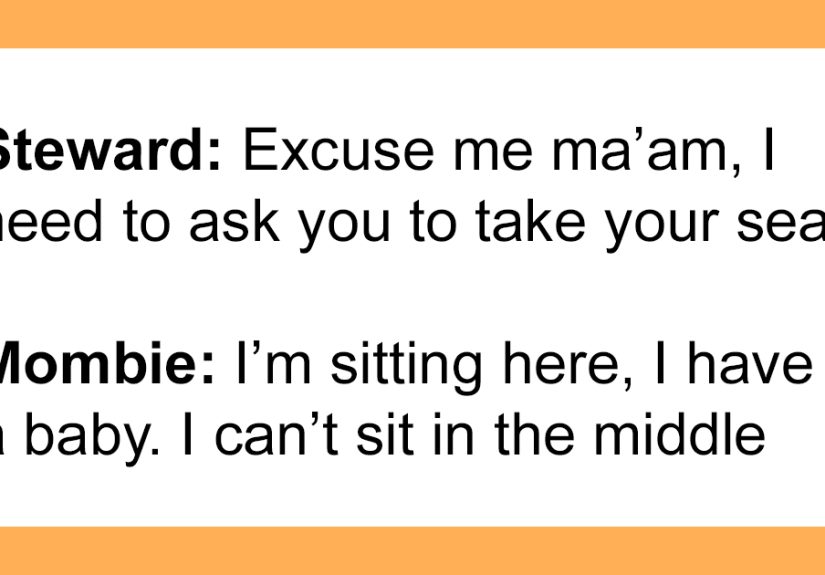
The situation (as shared online and widely discussed across travel communities) is painfully familiar:
a mom boards, realizes her assigned seat is a middle, and decides that “assigned” is more of a suggestion.
She tries to pressure other passengers into swappingoften targeting someone with a window or aisle,
because apparently the best way to solve your problem is to create a new one for a stranger.
At first, it’s the classic script: “I can’t sit in the middle,” “I get anxious,” “I have a child,” “It’s just for a little while,”
and the ever-popular “You don’t need that seat.” And when polite social pressure doesn’t work, it escalates:
louder objections, lingering in the aisle, refusing to sit down, and turning boarding into a live theater performance.
That’s when the flight attendant’s patience runs outnot because they hate parents, not because they enjoy confrontation,
but because boarding is not a choose-your-own-adventure. It’s a tightly timed process that affects departure, connections,
crew duty limits, and the general sanity of every person trapped behind a seat-swap standoff.
Why Flight Attendants Take Seat Drama Seriously
1) Flight attendants aren’t “air servers”they’re safety crew
Flight attendants manage safety compliance (seat belts, exits, carry-on stowage), respond to medical issues, coordinate evacuations,
and de-escalate conflict. When a passenger refuses instructions or blocks the aisle, it’s not just rudeit can interfere with duties.
In the U.S., interfering with crew members can trigger serious consequences, including civil penalties and, in severe cases, criminal charges.
2) “Just move wherever” can become a safety and logistics mess
On many flightsespecially smaller aircraftwhere people sit can affect weight and balance. Even on larger planes, airlines track
who is in which seat for operational reasons, including emergencies, headcounts, and (yes) the awkward moment when someone’s
in the wrong seat and two people insist the other one is “definitely wrong.”
3) One loud seat-swap can create a cabin-wide chain reaction
Seat disputes have a contagious quality. If one passenger “wins” a better seat by being disruptive,
other passengers notice. Suddenly, you’re not running a flightyou’re running a negotiation seminar at 35,000 feet.
The Root Cause: Seat Selection Fees and the “Family Seating” Squeeze
Let’s be fair for a second: airlines have turned seat selection into a mini-economy.
Basic fares can look cheap until you add bags, seat assignments, and “please don’t separate me from my own child” fees.
Some families gamble by skipping seat selection, hoping the airline will seat them together anyway.
Sometimes it works. Sometimes it turns into a scramble at the gate. And sometimes it becomes a pressure campaign aimed at passengers
who paid for a specific seat.
The U.S. Department of Transportation has pushed airlines to make family seating clearer and more consistent,
including public dashboards tracking which airlines commit to fee-free adjacent seating for young children and an accompanying adult.
There have also been federal rulemaking efforts aimed at reducing or eliminating “junk fees” for families trying to sit together.
Translation: parents are often stuck in a system that nudges them toward paying extra for certainty.
But here’s the crucial line: frustration with the system does not create a right to somebody else’s seat.
Seat Swap Etiquette: The Rules That Keep Society From Collapsing
Seat swapping isn’t inherently evil. It can be kind, practical, and genuinely helpfulwhen it’s done right.
The problem is the “entitled swap,” where someone asks you to downgrade while acting like you’re the unreasonable one for hesitating.
The Golden Rule: Offer equal or better
If you want someone’s aisle or window, you should offer something comparable or nicer. Period.
Asking a passenger to trade their aisle for your middle is like offering to “swap cars” because you don’t like yoursthen handing them a unicycle.
The Second Rule: Ask once, politely, then accept the answer
A seat swap is a request, not a summons. “No, thanks” is a complete sentence.
No explanations required. No moral trial. No courtroom monologue about how you’re a parent and the universe owes you upgrades.
The Third Rule: Don’t recruit the cabin as your jury
Turning around to announce your problem to rows 10 through 22 is a fast way to make everyone root against you.
If you need help, ask the flight attendant or gate agentnot the nearest captive audience.
What Flight Attendants (Usually) Can and Can’t Do
What they can do
- Enforce assigned seating during boarding to keep the process orderly.
- Re-seat passengers for operational or safety reasons (including special accommodations, equipment issues, or balance needs).
- Coordinate solutions by asking for volunteerssometimes with perks, sometimes just with gratitude.
- Remove disruptive passengers before departure if the situation escalates or safety compliance becomes an issue.
What they can’t do (without cause)
- Force you to give up a paid seat just because another passenger wants it, absent a safety/operational reason.
- Fix bad planning retroactively when a family didn’t reserve seats and the flight is full.
- Make everyone happy (even if their customer service smile is Olympic-level).
In the “can’t sit in the middle” scenario, the flight attendant’s job is to end the standoff.
That usually means a calm but firm boundary: this is your seat; you need to take it now; if you want to request a change,
we can talk after boardingor we can talk with a gate agent off the plane. The important part is that boarding keeps moving.
The Smart Way for Families to Avoid the Seat Swap Trap
1) Book early and pick seats strategically
The earlier you book, the more seat inventory is available. Waiting until the last minute and hoping for a miracle is like
arriving at a buffet at closing time and expecting fresh shrimp towers.
2) Know your airline’s family seating commitment
In the U.S., the DOT has made it easier to compare airline family seating practices. If sitting together is a must-have,
choose airlines with clearer commitmentsor be willing to pay for seat selection when needed.
3) If you didn’t reserve seats, talk to the gate agent before boarding
Gate agents have more flexibility than passengers in row 18. If there’s any chance to reseat your family without disrupting others,
the gate is the place to do itbefore the aisle becomes a traffic jam.
4) If you must ask a passenger, make it a good deal
Offer an equal-or-better seat. Consider trading within the same row or offering an aisle for an aisle.
If you’re asking someone to accept a minor inconvenience, a sincere apology and a small gesture (like buying a snack) can help
but it never replaces the “equal or better” rule.
What to Do If Someone Asks You to Switch Seats
You don’t need a speech. You don’t need to justify your boundaries.
Here are a few clean, polite responses that keep you out of a 12-minute debate:
- “No thank youI’m going to stay in my assigned seat.”
- “I’m not able to switch, but I hope you find someone who can.”
- “Sorry, I chose this seat for a reason.”
- “I’m happy where I am.” (Short. Peaceful. Powerful.)
If the person persists, stop engaging. Make eye contact with a flight attendant. Let the crew handle it.
You are not required to negotiate with someone who thinks your aisle seat is community property.
Why “I Can’t Sit in the Middle” Isn’t a Magic Pass
Some people do have legitimate reasons for avoiding middle seatsclaustrophobia, mobility issues, medical concerns.
But the solution is still the same: plan ahead, reserve a suitable seat, request accommodations through the airline,
or speak with an agent before the cabin becomes a hostage situation.
When the “I can’t” becomes “so you must,” that’s where entitlement enters the chat.
And entitlement doesn’t just annoy fellow passengersit can cross the line into disruptive behavior,
which airlines and regulators have taken more seriously in recent years.
How This Ends (Most of the Time)
In viral versions of this scenario, the flight attendant delivers a firm reality check:
sit in your assigned seat or deplane. And suddenly the “can’t” becomes a “fine.”
Because when the alternative is missing your flight, most people discover they have an unexpected talent for tolerating 19B.
The bigger lesson isn’t “never ask for help.” It’s: ask the right person, the right way, at the right time.
The sky is not the place to audition for the role of Main Character.
Real-World Experiences: Seat-Swap Drama, Middle-Seat Survival, and What Actually Works (Extra 500+ Words)
If you fly enough, you start collecting seat-swap stories the way some people collect magnets: you didn’t ask for them,
they just appear, and somehow they all involve mild emotional damage.
Experience #1: The “I’ll Trade You… Nothing” Offer
A traveler settles into a window seat they paid extra for. A parent arrives and says, “Can you switch with me so I can sit
next to my kid?” The offered seat: middle, several rows back, next to the lavatoryaka the aromatic crossroads.
The traveler politely declines. The parent replies, “Wow. Must be nice to not care about children.”
Here’s what’s happening psychologically: the requester is trying to convert their inconvenience into your obligation.
The best move is to stay calm, repeat your boundary once, and disengage. You’re not refusing to help children;
you’re refusing to be voluntold into a downgrade.
Experience #2: The Seat Swap That Goes Perfectly Right
Another flight: a couple is separated by one seat. They approach a passenger with a simple, respectful offer:
“Would you be willing to switch aisle-for-aisle so we can sit together? Same row, same section.”
That’s it. No guilt. No drama. The passenger agrees because it’s a fair trade.
This is the blueprint: equal seat + polite ask + easy logistics. If you want yeses, make it easy to say yes.
Experience #3: The “Open Seat” That Isn’t Actually Open
You see an empty aisle seat after boarding and think, “Blessings! Extra space!” Then someone from three rows back slides into it
like they’re stealing second base. A flight attendant comes by and asks them to return to their assigned seatbecause the empty seat
might be for a late-boarding passenger, a weight-and-balance plan, or simply an accurate manifest.
The key lesson: don’t move without asking. Even if it seems harmless, it can cause confusion, delays,
and occasionally a “sir/ma’am, you need to go back” moment that nobody enjoys.
Experience #4: Middle Seat Survival Tips That Don’t Involve Crying
If you’re stuck in the middle seat (voluntarily or by life’s cruel lottery), you can still make it tolerable:
- Claim the armrests early (middle-seat etiquette folklore exists for a reason). Don’t be aggressive; just be present.
- Pack small comfort tools: noise-canceling earbuds, a neck pillow that doesn’t look like an inflatable donut of shame, and a light hoodie.
- Use the “tiny boundaries” technique: elbows in, shoulders relaxed, feet flat. You can take up your space without starting a turf war.
- Control what you can: hydration, a downloaded show, and a snack that isn’t 90% regret.
Experience #5: When Flight Attendants Get Firm, It’s Usually a Good Sign
The moment a flight attendant steps in and draws a clear line“Take your seat now”the cabin almost always relaxes.
Not because people enjoy conflict, but because uncertainty is stressful. A single disruptive passenger can hold an entire cabin hostage.
When crew assert authority calmly, it restores order and keeps the flight moving.
So yes, “middle seat drama” is funny online. In real life, it’s a delay machine.
If you’re the one who needs a change, handle it early and respectfully. If you’re the one being pressured, stay polite and firm.
And if you ever feel tempted to announce, “I can’t sit in the middle,” remember: you absolutely can
you just don’t want to. And wanting is not a boarding policy.
Conclusion
Air travel is basically a group project where nobody picked their partners. The only way it works is when people follow the plan:
assigned seats, respectful requests, and letting the crew do their jobs. A flight attendant losing patience isn’t about being “mean”
it’s about preventing one person’s entitlement from turning into everyone’s delay.
If you’re traveling with kids, plan like seating mattersbecause it does. If you’re asked to swap, remember you’re allowed to say no.
And if you ever catch yourself thinking the middle seat is impossible… congratulations: you’re having a human moment.
Just don’t turn it into a cabin-wide event.