Table of Contents >> Show >> Hide
Modern sports can get rough. Football has collisions, boxing has knockouts, and hockey occasionally looks like a grudge match on ice. But ancient sports? Ancient sports often felt like civilization looked at a battlefield, dusted it off, added spectators, and called it a weekend event. In many early societies, the line between game, military training, religious ritual, and public spectacle was thinner than a sandal strap.
That is why so many ancient contests seem less like recreation and more like deleted scenes from a war movie. Some were designed to train men for combat. Some were tied to honor, empire, or religion. Some were wildly popular because crowds love speed, danger, and chaos now just as much as they did two thousand years ago. The only major difference is that modern stadiums usually try to avoid the words “armed sprint,” “beast hunt,” and “mock naval battle.” Ancient organizers, by contrast, heard those phrases and probably said, “Perfect. Add more seating.”
Why Ancient Sports Were So Brutal
Ancient cultures did not always define sports the way we do. A contest could be athletic, ceremonial, political, and violent all at once. Greek games celebrated physical excellence and civic pride, but they were also deeply tied to warrior ideals. Roman entertainment scaled everything up until it became state theater with sand, blood, and crowd control. In Mesoamerica, ballgames could carry cosmic meaning and political symbolism far beyond a final score. That means many of the “sports” on this list were not just games. They were tests of endurance, displays of power, and sometimes warnings dressed up as entertainment.
41 Savage Ancient Sports That Made Modern Games Look Tame
Ancient Greece: Where Athletics Met Combat Training
- Pankration — Part boxing, part wrestling, part human storm cloud. This Greek combat sport allowed a frightening range of techniques and had a reputation for turning fighters into legends or cautionary tales.
- Boxing (Pygmachia) — Ancient boxing had none of modern sport’s softening features. No padded gloves, no cozy rounds, and very little interest in making the experience comfortable.
- Wrestling (Pale) — Elegant in theory, punishing in practice. Wrestling was a prestige event, but under heat, dust, and ego, it became a grinding test of leverage and stubbornness.
- Hoplitodromos — The armed footrace was exactly what it sounds like: running while equipped like a soldier. It was cardio with a side of military anxiety.
- Pentathlon — This all-around contest mixed jumping, running, throwing, and wrestling into one package that looked suspiciously like a warrior résumé.
- Pyrrhic Dance Contests — Not a gentle recital. These martial dance displays mimicked combat movements and blended athleticism with battlefield style.
- Tethrippon — Four-horse chariot racing was the Formula 1 of the ancient world, except with more dust, fewer safety features, and a much stronger chance of disaster at the turn.
- Synoris — The two-horse chariot race was smaller in scale but not necessarily kinder. Speed plus cramped tracks still made for dangerous spectacle.
- Keles — Mounted horse racing rewarded control, nerve, and the ability to stay attached to a fast animal while everyone around you tried to win first.
- Apene — Mule-cart racing had less glamour than the great chariot events, but the risk of crashes and chaos remained very real.
- Kalpe — A race involving mares and a dismounting finish somehow managed to combine equestrian skill with the energy of a dare gone public.
- Boys’ Boxing — Yes, youth divisions existed, because the ancient world apparently believed childhood should include organized punching in front of a crowd.
- Boys’ Wrestling — A reminder that ancient athletic culture prized toughness early, often, and with very little helicopter parenting.
Ancient Rome: Empire, Spectacle, and “Let’s Make It Even Bigger”
- Gladiator Duels — The headline act of Roman brutality. These matches were choreographed, specialized, and wildly popular, turning trained fighters into both entertainers and symbols of imperial power.
- Female Gladiator Matches — Rare, flashy, and meant to shock the crowd. Women did enter the arena, though mostly as novelty acts rather than a standard part of the system.
- Murmillo vs. Retiarius Bouts — One heavily armored fighter against another armed with net and trident. It was less a sport than a live-action strategy puzzle with terrifying stakes.
- Thracian-Style Gladiator Contests — Different weapons, different armor, same basic concept: highly trained people trying not to become the crowd’s least favorite memory.
- Venationes — Beast hunts in the arena were staged spectacles that blended exotic animals, performance, danger, and Roman bragging rights into one loud public show.
- Bestiarii Contests — These fighters faced dangerous animals in displays that looked more like survival cinema than anything we would comfortably label sport today.
- Naumachiae — Mock naval battles were Rome doing what Rome did best: taking an already extreme idea and scaling it up until it became ridiculous and unforgettable.
- Circus Maximus Chariot Racing — Mass fandom, elite sponsorship, faction loyalty, and terrifying speed made Roman chariot racing one of the empire’s most addictive spectacles.
- Blue vs. Green Faction Racing — The racing teams had colors, fan bases, and emotional intensity that would make modern sports rivalries look almost polite.
- Desultor Racing — Stunt riders leaped between horses at speed. Apparently regular racing was not dangerous enough, so Rome added acrobatics.
- Harpastum — Often described as the ancient cousin of rugby, this hard-driving ball game rewarded aggression, grappling, and the ability to thrive in total confusion.
- Trigon — A fast-paced throwing game that sounds harmless until you remember Roman athletic culture admired pain tolerance and sharp reflexes in equal measure.
- Roman Boxing with the Cestus — If Greek boxing was severe, Roman boxing made the mistake of asking, “What if the hand gear felt even less friendly?”
- Lusus Troiae — The “Game of Troy” looked ceremonial, but it also functioned as elite youth cavalry display, political pageant, and martial theater rolled together.
- Festival Wrestling in Roman Egypt — Athletic contests under Roman rule could still be intensely competitive, public, and not always as honest as the posters promised.
Mesoamerica: Ballgames with Cosmic, Political, and Warrior Energy
- Classic Maya Ballcourt Matches — These games were not just recreation. They were tied to ritual, rulership, and the symbolic struggle between order and chaos.
- Aztec Ōllamaliztli — The famous rubber-ball game was demanding, physical, and often loaded with social meaning, betting culture, and ceremonial importance.
- Ulama — Surviving in parts of northwestern Mexico, this form preserves echoes of the ancient ballgame tradition and reminds us how physically punishing rubber-ball play could be.
- Tlachtli Traditions — Central Mexican versions of the ballgame carried mythic and political weight, making the court feel more like sacred theater than a local gym.
- Hip-Dominant Court Play — Many forms required striking the heavy rubber ball mainly with hips and thighs, which sounds impressive until you imagine doing it for real.
- Wager Matches — These games could include high-stakes betting on luxury goods, making every exchange feel like a sporting event crossed with a public gamble.
- Warrior-Linked Ritual Matches — In some contexts, the ballgame was connected to warfare, captives, and elite display, which gives the phrase “must-win game” a whole new attitude.
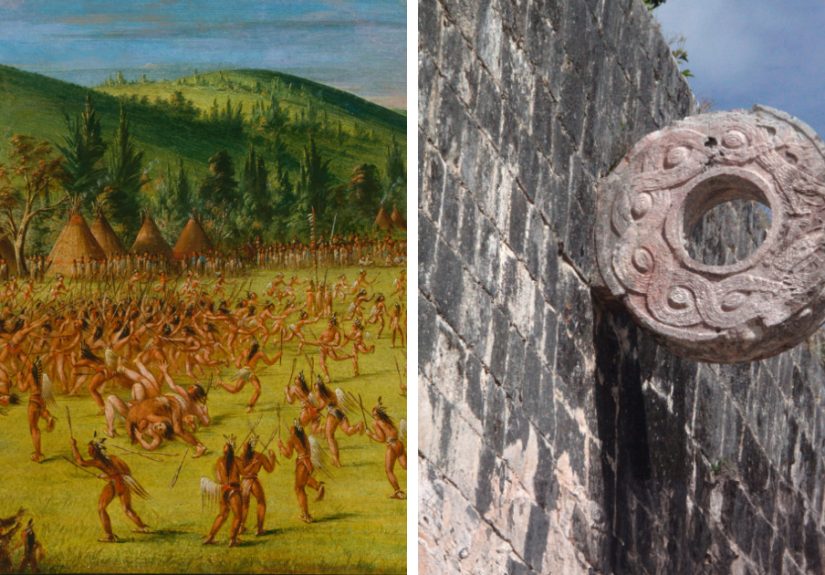
- Stone-Ring Scoring Contests — Sending a ball through a stone ring was spectacularly hard and dramatic enough to make a single successful shot feel like a miracle with an audience.
Other Ancient and Early Martial Traditions That Still Felt Battle-Tested
- Egyptian Wrestling — Depictions from ancient Egypt show highly developed grappling, proving that organized throwing and locking people to the ground has always had fans.
- Egyptian Stick Fighting — This martial game blended training, ceremony, and performance, turning what looked like sport into a polished rehearsal for conflict.
- Indian Malla-yuddha — Ancient Indian wrestling traditions treated combat skill as discipline, spectacle, and physical philosophy, but the matches could still be ferociously demanding.
- Early Japanese Sumo — Before it became more refined and ritualized, sumo carried a far rougher reputation as a forceful submission spectacle under elite patronage.
- Irish Clan Hurling — Ancient and medieval stick-and-ball play in Ireland could involve huge numbers, fierce rivalries, and enough chaos to make a peaceful afternoon highly unlikely.
- Norse Knattleikr — The old Icelandic ball game seems to have mixed speed, body contact, and regional toughness into something that sounds suspiciously like sport by way of saga.
What These Savage Ancient Sports Really Reveal
The most striking thing about these ancient sports is not just the violence. It is what the violence meant. These contests taught discipline, advertised political power, reinforced social hierarchies, displayed religious devotion, and gave crowds a shared emotional language. A chariot race was not just a race. A gladiator match was not just combat. A Mesoamerican ballgame was not just a game. Each event told a society what it admired, what it feared, and what it was willing to celebrate in public.
That is why these spectacles still fascinate people today. They reveal a truth modern audiences sometimes try to hide behind marketing and mascots: sports have always been about more than fun. They are also about identity, status, rivalry, endurance, and the human urge to witness extreme performance from a safe seat in the crowd.
What Watching These Events Might Have Felt Like
To imagine the experience of seeing these ancient sports in person, forget the modern idea of a clean stadium with polite announcements, halftime ads, and a person in a foam costume dancing near the tunnel. Ancient sporting events were louder, hotter, riskier, and emotionally heavier. A spectator might enter a packed space already buzzing with betting, prayers, gossip, tribal loyalty, political messages, and raw anticipation. The crowd was not there just to be entertained. It was there to witness courage, dominance, fortune, divine favor, and, sometimes, public humiliation. In that world, a contest could carry the weight of religion, local pride, and imperial propaganda all at once.
The physical setting alone would have been unforgettable. Dust rose from racetracks. Bronze flashed in the sun. Horses screamed through turns. Fighters hit the ground hard enough to make thousands of people gasp together. On a Greek field, the smell would have been sweat, oil, and dry earth. In a Roman arena, the architecture itself was part of the drama, swallowing up noise and throwing it back at the audience in waves. In a Mesoamerican ballcourt, the stone walls, the ritual seriousness, and the sharp bounce of a heavy rubber ball could make the whole event feel sacred and threatening at the same time. Even before anything dramatic happened, the atmosphere would have told you that this was not casual recreation.
There was also the emotional strange mix of admiration and dread. Ancient spectators probably respected skill the way modern fans do. They loved precision, stamina, daring, and comeback stories. But they also lived much closer to danger as a normal part of life. War, injury, class hierarchy, public punishment, and ritual sacrifice were not abstract ideas filed away in documentaries. They were woven into the culture. That meant spectators could watch a vicious contest and see not only spectacle, but proof of discipline, destiny, honor, or state power. What shocks a modern viewer may have felt, to them, like a natural public expression of how the world worked.
And yet some parts would feel very familiar. Fans still choose sides. Crowds still roar when momentum changes. People still adore athletes who seem part human, part myth. The chants, the arguments, the devotion to colors and factions, the retelling of famous wins, the suspicion that judges were crooked, the belief that this one contest mattered more than all the others—none of that is new. Ancient sports may look savage from a distance, but their emotional engine is recognizably human. They remind us that for thousands of years, people have gathered together to watch risk, skill, and rivalry collide in public. The costumes changed. The stakes changed. The safety standards improved, thankfully. But the thrill of seeing human beings push themselves to the edge? That part has never really left the stadium.
Final Takeaway
If these 41 ancient sports and spectacles prove anything, it is that the ancient world did not believe in separating entertainment from intensity. To many early civilizations, the best games were the ones that looked like combat, felt like ritual, and left the crowd talking for days. Modern sports still borrow some of that drama, just with more rules, better medicine, and far fewer tridents. Probably a good trade.