Table of Contents >> Show >> Hide
- Why Canada’s Offer Matters More Than It Sounds
- What Exactly Is Canadarm3?
- Why Gateway Needed a Smart Robot, Not Just Another Arm
- How the NASA-Canada Deal Worked
- The Industrial and Economic Case for Canadarm3
- What Gateway Was Supposed to Do
- What Has Changed Since the Original Offer?
- Why Canadarm3 Still Matters, Even in a Moving Target Program
- Experiences Related to "Canada Offers Robot Arm for NASA's 'Lunar Gateway' Program"
- Conclusion
- SEO Tags
If space exploration had a hall of fame for reliable sidekicks, Canada’s robotic arms would already have their own wing, gift shop, and probably a commemorative mug. First there was Canadarm on the space shuttle. Then Canadarm2 became a workhorse on the International Space Station. Now comes Canadarm3, Canada’s proposed next-generation robotic system for NASA’s Lunar Gateway program, a moon-orbiting outpost designed to support long-term lunar exploration.
On the surface, this sounds like a tidy international partnership story: one country brings the robot, another brings the rockets, and everyone meets near the Moon. But the reality is much more interesting. Canada’s offer is not just about lending a mechanical arm to a space station with excellent views and terrible room service. It is about robotics leadership, deep-space autonomy, industrial strategy, astronaut access, and the growing idea that future exploration missions will depend as much on smart machines as on brave humans.
In other words, this is not a story about a metal arm floating around in space doing chores. It is a story about who gets a seat at the lunar table, who builds the tools of the next space age, and why a nation with a smaller space budget can still shape one of the biggest exploration programs on the planet.
Why Canada’s Offer Matters More Than It Sounds
Canada did not arrive at Lunar Gateway by accident. It earned its reputation in space robotics the hard way: by building machines that actually worked when the stakes were sky-high and the repair shop was hundreds of miles below. The original Canadarm became a symbol of the shuttle era. Canadarm2 and Dextre helped assemble, maintain, and support operations on the International Space Station. That heritage matters because NASA and its partners do not hand out critical deep-space responsibilities like party favors.
So when Canada offered Canadarm3 for Gateway, it was really saying, “We know robotics, we know orbital operations, and yes, we would like to keep that streak alive all the way to lunar orbit.” That offer helped make Canada the first international partner to formally commit to Gateway. It also strengthened the country’s role in Artemis, NASA’s larger campaign aimed at returning humans to the Moon and eventually preparing for Mars.
There is also a diplomatic layer here. Big exploration programs are rarely just about science. They are about alliances, prestige, industrial policy, and long-term influence. By contributing a mission-critical robotic system rather than a symbolic add-on, Canada positioned itself as an engineering partner, not just a spectator holding binoculars.
What Exactly Is Canadarm3?
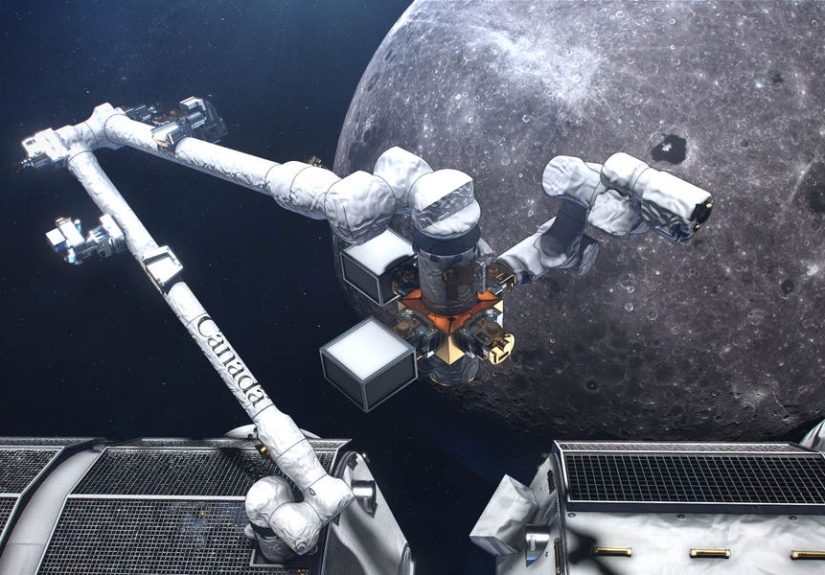
Canadarm3 is designed to be much more than a bigger, shinier version of earlier Canadian space robotics. It is a highly autonomous system intended for an environment where human crews will not be present all the time. That is a major difference from the International Space Station, where astronauts are around frequently enough to intervene, assist, or occasionally glare at a stubborn piece of hardware.
The system is expected to include a large robotic arm, a smaller dexterous arm, and a suite of specialized tools. Together, those components are meant to inspect Gateway, perform maintenance, relocate payloads, support astronauts during spacewalks, install science hardware, and interact with visiting spacecraft. In simple terms, Canadarm3 is the station’s mechanic, mover, inspector, and multitool all rolled into one very expensive overachiever.
One of its most important features is autonomy. Because Gateway will orbit the Moon at a great distance from Earth, communications delays make instant joystick control less practical than in low Earth orbit. Canadarm3 is therefore being designed with advanced software and AI-enabled capabilities so it can perform some tasks with limited human intervention. That is not science fiction language. It is a practical response to the reality of operating in deep space, where waiting for step-by-step instructions from Earth is not always ideal.
Another striking feature is mobility. Canadarm3 is expected to move “end-over-end” across the exterior of Gateway, allowing it to reach multiple work areas. Think of it as a robotic gymnast with a maintenance checklist and no fear of heights. On a lunar outpost that may be visited only periodically, that kind of flexibility is not a luxury. It is survival-level infrastructure.
Why Gateway Needed a Smart Robot, Not Just Another Arm
Gateway was conceived as a small but strategically important outpost in lunar orbit. Unlike the International Space Station, it was never meant to host a continuous human presence. Crews would visit, conduct science, prepare for surface missions, and leave. That operating model creates a very specific problem: who handles the station when the humans go home?
That is where Canadarm3 becomes central instead of optional. Gateway needs an external robotics system that can inspect components, support docking and cargo operations, move equipment, and keep the station functioning during quiet periods. A less capable robotic arm might help with isolated tasks. Canadarm3 is meant to serve as a backbone system.
This is one reason the Canadian offer made such a strong impression. Canada was not proposing a decorative gadget or a patriotic bolt-on. It was offering hardware that could help make Gateway workable in the first place. NASA’s own materials have consistently described Canadarm3 as a key operational element for the outpost, especially because the station’s architecture relies on advanced robotics when crews are absent.
That need also points toward the future. Autonomous robotics at Gateway could become a proving ground for more ambitious systems on the lunar surface and, later, on Mars. If engineers can build machines that maintain, inspect, and assist in deep space with partial autonomy, they are laying the groundwork for a broader off-Earth industrial toolkit.
How the NASA-Canada Deal Worked
Canada first publicly committed to Gateway in 2019, and the partnership was formalized in a 2020 agreement between NASA and the Canadian Space Agency. Under that agreement, Canada would provide Gateway’s external robotics system, including Canadarm3, along with robotic interfaces for Gateway modules. In return, Canada secured two astronaut opportunities tied to Artemis missions: one seat on Artemis II and one future mission opportunity involving Gateway.
That arrangement was a very clear reminder that contributions matter in space diplomacy. Astronaut seats do not appear out of thin vacuum. They are often linked to what a nation brings to the partnership, whether that is hardware, expertise, money, or sustained program support.
The Artemis II assignment made headlines for good reason. Canadian astronaut Jeremy Hansen became the first non-American selected for a lunar mission, a milestone that reflected both Canada’s long partnership with NASA and the political weight of the Canadarm3 contribution. It was a powerful symbol: Canada did not just buy visibility; it earned a place by bringing something essential.
This is one of the most fascinating parts of the story. In space exploration, hardware can become diplomacy in physical form. A robotic arm turns into national leverage. An engineering program turns into crew access. A machine designed to tighten bolts and relocate payloads can also open doors for astronauts and shape an entire country’s presence in deep space.
The Industrial and Economic Case for Canadarm3
Canada’s offer also had a strong domestic logic. Space robotics is one of the country’s most recognizable technological strengths, and Canadarm3 gives that expertise a long runway into the future. MDA, the company associated with the Canadarm legacy, has remained central to the program, and later phases of Canadarm3 development moved into more detailed design, construction, and testing.
That matters because flagship space projects do more than produce one piece of hardware. They sustain supply chains, create specialized jobs, develop software and control systems, and keep national expertise sharp. Robotics, sensors, machine vision, autonomous planning, and remote operations all stand to benefit. For a country that wants to stay relevant in a more competitive global space economy, Canadarm3 is not just a project. It is a platform for industrial continuity.
There is also a strategic branding effect. Nations tend to be remembered in space by the capabilities they become known for. The United States is associated with crewed exploration and major launch systems. Europe is associated with modules and service systems. Japan brings advanced cargo and logistics expertise. Canada’s brand is robotics, and Canadarm3 extends that brand from low Earth orbit to cislunar space.
That continuity matters in government planning too. Once a country becomes known as the reliable provider of a mission-critical capability, it is easier to justify future investments. Success builds its own argument.
What Gateway Was Supposed to Do
To understand the full significance of Canada’s offer, it helps to understand Gateway itself. NASA envisioned Gateway as a lunar-orbiting outpost that could support Artemis missions by providing a staging point for astronauts, science, logistics, and technology demonstrations. The station’s early elements, especially the Power and Propulsion Element and the Habitation and Logistics Outpost, were intended to be launched together and assembled into the first phase of a long-term deep-space platform.
Gateway was never supposed to be a giant orbital city. It was designed to be compact, modular, and highly functional. The idea was to create a place where astronauts could transit, prepare for lunar surface operations, conduct research, and test technologies for missions even farther away. In that framework, Canadarm3 was one of the systems that would make the whole concept practical.
Gateway also held symbolic power. It was meant to be one of the clearest examples of international cooperation in deep space, with contributions from multiple nations and agencies. Canada’s offer therefore fit into a broader pattern: modern lunar exploration is less likely to be a single-country performance and more likely to be a carefully choreographed international production, complete with engineering triumphs, funding headaches, and many meetings.
What Has Changed Since the Original Offer?
Here is where the story gets more complicated, because space plans have a habit of changing more often than launch dates. In March 2026, NASA announced that it intended to pause Gateway in its current form as part of a broader shift toward building infrastructure for sustained lunar surface operations. That does not erase the importance of Canada’s original offer, but it does change the program context.
In practical terms, the Gateway concept is no longer as straightforward as it seemed when Canadarm3 was first announced. Some hardware may be repurposed, international commitments may be reshaped, and the role of Gateway within Artemis is now less certain than before. At the same time, public statements from MDA indicated that work on Canadarm3 continued under its contract with the Canadian Space Agency. Canadian materials have also continued to list the system as being in development, with a target delivery no earlier than 2029.
So the cleanest way to understand the current moment is this: Canada’s robotic contribution still matters, but the environment around it is shifting. The offer remains historically important, technologically significant, and politically valuable, even if NASA’s architecture has evolved. If anything, that makes Canadarm3 more interesting. It may end up serving a future shaped by adaptation rather than the original blueprint.
Why Canadarm3 Still Matters, Even in a Moving Target Program
Space history is full of projects that changed form before they changed the future. Canadarm3 could become one of those stories. Even if Gateway is reworked, the technologies behind Canadarm3 remain deeply relevant: autonomous operations, robotic servicing, remote inspections, payload handling, and flexible external maintenance in deep space.
Those capabilities are not useful only for one lunar outpost. They are useful for surface habitats, logistics nodes, orbital depots, deep-space science missions, and eventually Mars architectures. In other words, the value of Canadarm3 is bigger than the original mission patch.
That is why Canada’s offer should be read as both a concrete contribution and a strategic bet. The country is betting that robotics will remain one of the most indispensable tools in human exploration beyond Earth orbit. That is a sensible bet. Humans may plant flags and take the famous photos, but robots do a shocking amount of the hard work before, between, and after those moments.
Experiences Related to “Canada Offers Robot Arm for NASA’s ‘Lunar Gateway’ Program”
One of the most compelling experiences connected to this topic is the way it changes how people think about space exploration. For many readers, the phrase “robot arm” sounds modest at first, almost like an accessory item on a giant machine. But once you understand what Canadarm3 is supposed to do, the story feels completely different. You begin to see that deep-space exploration is not only about rockets blasting off or astronauts bouncing across the Moon. It is also about the quieter systems that keep everything alive, stable, and useful after the launch cameras go home.
Following Canada’s role in Gateway also creates a more human experience of international cooperation. A student in Montreal, a space fan in Houston, an engineer in Arizona, and a mission planner in Ottawa can all look at the same robotic system and see different meanings in it. For one person, Canadarm3 is a symbol of national pride. For another, it is a case study in advanced autonomy. For someone else, it is proof that smaller space agencies can still make outsized contributions if they specialize well. That is one of the most powerful experiences space stories can offer: they connect technical detail to human ambition.
There is also an emotional layer to the story that should not be ignored. When Canada’s contribution helped secure astronaut opportunities in Artemis, it transformed the robot arm from a hardware program into something more personal. Suddenly, it was not just about metal joints, software, and contracts. It was about people. It was about who gets to fly, who gets represented in the next chapter of lunar exploration, and how decades of engineering effort can open a seat on a spacecraft. That makes the topic feel less abstract and much more real.
For young people interested in science, technology, engineering, or robotics, Canadarm3 offers a particularly valuable kind of inspiration because it does not rely on fantasy. The excitement comes from real design challenges: delayed communications, autonomous decision-making, repair tasks in deep space, and the need for a machine that can work when no crew is around. That is a different experience from simply admiring a dramatic rocket launch. It invites curiosity about software, controls, sensors, materials, and systems engineering. In other words, it shows that the future of space will need coders and roboticists just as much as it needs astronauts.
There is even a broader cultural experience wrapped into the story. Canadarm and Canadarm2 already occupy a special place in Canada’s national identity, and Canadarm3 extends that legacy into a new era. Watching that legacy evolve gives people a sense of continuity. The country is not starting from scratch. It is building on decades of trust, success, and technical competence. That can be deeply motivating, especially in a world where so many large projects seem temporary or politically fragile.
Finally, the topic offers a useful lesson in how exploration really works. Big missions are rarely neat, and Gateway’s more uncertain status in 2026 proves that. Plans shift. Timelines slide. Architectures get reworked. But the experience of following Canadarm3 reminds us that progress is not only measured by perfectly executed plans. It is also measured by resilient technologies, durable partnerships, and capabilities that remain useful even when the roadmap changes. That may be the most honest and inspiring experience of all. Space exploration is not magic. It is persistence with better tools.
Conclusion
Canada’s offer of Canadarm3 for NASA’s Lunar Gateway program is one of those stories that looks simple until you zoom in. Yes, it is about a robot arm. But it is also about how nations earn influence in space, how autonomy is becoming essential beyond Earth orbit, and how engineering specialties can shape the future of exploration.
Whether Gateway ends up following its original path or a revised one, Canadarm3 has already made its mark. It helped formalize Canada’s place in Artemis, reinforced the country’s reputation as a leader in space robotics, and highlighted a central truth of modern exploration: if humans want to work far from Earth, smart machines will be part of the crew.
And honestly, that may be the most Canadian space story possible. Not loud. Not flashy. Just deeply competent, technically impressive, and quietly essential while everyone else argues about the launch schedule.