Table of Contents >> Show >> Hide
- Who’s The Fisherman Behind The “Sea Monsters,” And Why Do People Keep Watching?
- Why Deep-Sea Creatures Look So “Terrifying” In Photos
- The “30 New Pics” Experience: What You’re Probably Seeing
- Why People Want Him To Stop (And Why Others Beg For More)
- The Science Angle: What These Photos Teach Us About The Deep Ocean
- Responsible Curiosity: How To Enjoy Deep-Sea Content Without Being A Jerk About It
- What “Terrifying Deep-Sea Pics” Reveal About Us
- Conclusion: The Deep Sea Doesn’t Need Our ApprovalBut It Deserves Our Attention
- Extra: Of “Deep-Sea Feed” Experiences People Describe (And Why They Stick With You)
If you’ve ever looked at the ocean and thought, “Aw, how relaxing,” congratulations: you are living in the sunlit part of reality.
Beneath that glittery surface is a world that runs on darkness, pressure, and the kind of evolutionary creativity that makes horror-movie makeup departments feel underemployed.
And every so often, that hidden world gets yanked into daylightusually attached to a fishing netthen posted online, where the comment section immediately screams
“NOPE,” “PUT IT BACK,” and “WHY DOES IT HAVE A FACE LIKE THAT?”
This post dives into the viral phenomenon of a Russian fisherman sharing unsettling deep-sea “creatures of the day,” the science behind why they look so unreal,
and what those photos can teach us about the least-understood habitat on Earth. No plagiarism, no copy-paste, just a fun, fact-based tour through the abyss.
Who’s The Fisherman Behind The “Sea Monsters,” And Why Do People Keep Watching?
The fisherman most commonly associated with these viral deep-sea “monster” photos is Roman Fedortsov, a trawler fisherman linked to Murmansk in northwest Russia,
who has built a major social media following by posting strange animals that end up in nets during commercial fishing trips. Articles profiling his work describe him
as a long-time trawler crew member who began documenting these unusual catches and sharing them widely online. The result is an ongoing internet series where deep-sea
biology meets meme cultureequal parts fascination, disbelief, and “please stop, my brain needs sleep.”
The reason it works is simple: deep-sea animals don’t look “wrong” down where they live. They look perfectly designed for their worldcold, dark, food-scarce,
and under crushing pressure. It’s only when they reach the surfacewhere the physics and lighting are completely differentthat they start looking like an alien
audition tape.
Why Deep-Sea Creatures Look So “Terrifying” In Photos
1) Darkness Changes Everything: Big Eyes, Bigger Mouths
In deep water, sunlight fades fast. Many species adapt with oversized eyes (to catch tiny traces of light) or, if vision isn’t useful, with enhanced senses that
don’t rely on sight. Some develop large, expandable mouths because meals are rare and unpredictablewhen food shows up, you don’t politely nibble; you take the whole
opportunity home. These traits are common themes in deep-sea fish descriptions and educational resources focused on survival in extreme ocean zones.
2) Bioluminescence: Nature Invented Neon Before Humans Invented Nightclubs
A huge portion of deep-sea life uses bioluminescencelight made by chemical reactionsfor hunting, camouflage, communication, and defense. Some fish use glowing lures
to attract prey. Others use light to confuse predators or to help find mates. When you realize that “flashlight face” is normal down there, the vibe shifts from
“monster” to “specialized survival machine.”
3) Pressure + Fast Trip Up = A Very Bad Day For A Fish
Here’s the part social media doesn’t always explain: animals brought up quickly from depth can suffer barotraumainjury caused by rapid pressure change.
Gas spaces (like swim bladders) may expand, tissues can be damaged, and bodies can distort. That “squishy blob” look in certain famous deep-sea fish is often a
surface artifact, not their normal shape in the deep. So yes, the creature looks like a sad stress-ball with eyesbut that’s partly because it just experienced a
physics problem at high speed.
The “30 New Pics” Experience: What You’re Probably Seeing
Since we’re not reposting images here, let’s break down the greatest hits you’ll typically see in a set of “new pics” from a deep-sea trawler haul.
Think of this as a field guide for your next doom-scroll. (You’re welcome. Or I’m sorry.)
Category A: The “Angry Face” Fish
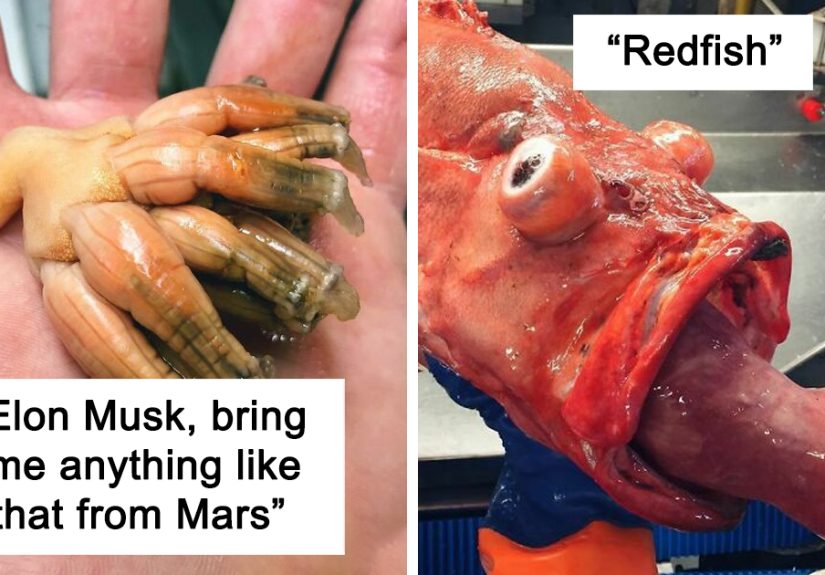
Some deep-sea fish look furious even when they’re doing absolutely nothingthanks to bony ridges, downward-angled mouths, or exaggerated jaws.
These features can help with feeding, sensing prey, or simply surviving in an environment where “cute” doesn’t pay rent.
Category B: The “Too Many Teeth For The Size Of The Room” Crew
Needle-like teeth and huge mouths show up in multiple deep-water predators. In a place where meals are rare, fish evolve to grab and hold whatever they can.
Photos often emphasize this because flash lighting and open jaws make the teeth poplike a jump scare, but in biology class.
Category C: The “Gelatinous Blob” Misunderstanding
Some deep-sea species have low-density bodies adapted to buoyancy and energy conservation. When brought up, pressure change can alter their appearance dramatically.
The internet sees “blob,” assumes “gross,” and misses the real story: these animals are built for a totally different set of rules.
Category D: The “Looks Fake” Shapes: Ribbons, Pancakes, and Floating Scarves
Elongated bodies, flattened forms, and unusual fins can be practical solutions to swimming efficiently or ambushing prey. In the deep, being sleek or strange can
be the difference between finding dinner and becoming dinner.
Category E: The “Why Is It Glowing?” Squad
Bioluminescent organisms may not glow brightly in every photo, but discussions around deep-sea catches often involve species that naturally produce light or have
reflective tissues. In scientific observations, light in the deep is a common strategylike a language, a weapon, and a disguise all rolled into one.
Why People Want Him To Stop (And Why Others Beg For More)
The comments under these posts tend to split into three camps:
- Camp 1: “Stop, I’m Scared.” They are not wrong to feel unsettled. Deep-sea life challenges our “normal animal” expectations.
- Camp 2: “More Pics, Please.” Curiosity is powerfulespecially when the ocean looks like a secret level in a video game.
- Camp 3: “Is This Ethical?” This group worries about deep-sea bycatch, animal welfare, and the bigger environmental cost of certain fishing practices.
All three reactions can be valid at the same time. You can be fascinated by deep-sea biodiversity and still feel uneasy about how those animals reached the surface.
The Science Angle: What These Photos Teach Us About The Deep Ocean
The Deep Sea Is Vast, And We Still Don’t Know Much
Scientists consistently emphasize how challenging it is to study deep ocean ecosystems: extreme pressure, darkness, cold temperatures, and high costs limit exploration.
That’s one reason deep-sea discoverieswhether from research submersibles or incidental catchescapture public attention. Even when a photo is “just a weird fish,”
it can spark real curiosity about a habitat that remains difficult to access.
Adaptations Are Not “Creepy”They’re Efficient
Many traits that look scary at the surface are simply optimized for survival: low metabolism, specialized senses, expandable stomachs, unusual body tissues,
and bioluminescent features. In other words, deep-sea animals aren’t designed to be nightmares. They’re designed to be alive in a place where survival is hard.
Barotrauma Explains Some Of The “Monster” Look
Rapid pressure change during capture can cause visible trauma and distortion in fish, especially those with gas-filled structures.
That’s why a surface photo can be misleading if we assume the animal looked like that at depth. Understanding barotrauma helps explain why some viral “aliens”
look swollen or misshapen.
Responsible Curiosity: How To Enjoy Deep-Sea Content Without Being A Jerk About It
- Don’t spread fake IDs. If you don’t know what it is, share it as “unidentified deep-sea fish,” not “proof of aliens.” (Unless you’re clearly joking.)
- Respect the context. Many of these animals appear due to commercial fishing operationsthere are real ecological conversations behind the viral moment.
- Use the curiosity. Let the shock lead to learning: ocean zones, bioluminescence, deep-sea food webs, and why pressure matters.
- Don’t harass creators. If you have ethical concerns, talk about the practice (bycatch, trawling impacts) rather than dogpiling one person.
What “Terrifying Deep-Sea Pics” Reveal About Us
These posts go viral because they hit a very human nerve: we’re uncomfortable with what we can’t easily categorize.
Deep-sea animals break the “cute wildlife” template. They look unfamiliar, and unfamiliar can feel threateningeven when it’s just a fish doing fish stuff.
But the flip side is hopeful: the internet’s obsession proves people still feel wonder. Even if that wonder is spelled “AAAAAA WHAT IS THAT.”
Conclusion: The Deep Sea Doesn’t Need Our ApprovalBut It Deserves Our Attention
Whether you’re Team “Stop Posting This” or Team “Post 30 More,” the real takeaway is bigger than the comment section.
Deep-sea life is stunning, weird, and wildly specialized. A viral photo can be a doorway into sciencebioluminescence, pressure physiology, and the reality that
the ocean contains ecosystems we’re only beginning to understand.
So the next time you see a “terrifying creature of the deep,” try this: take a breath, laugh at the memes, then remember that the creature isn’t a monster.
It’s a specialistbuilt for a world that was never meant to be photographed with a phone on a boat deck at noon.
Extra: Of “Deep-Sea Feed” Experiences People Describe (And Why They Stick With You)
People who follow accounts like this often describe a strangely predictable emotional roller coaster. It starts with curiositybecause the photo looks like a prop,
and your brain immediately goes, “That can’t be real.” Then comes the zoom-in. You notice details: tiny eyes placed in unexpected spots, translucent skin,
mouth structures that seem oversized, fins shaped like someone tried to draw a fish from memory after three hours of sleep. Your brain, which loves patterns, tries
to match it to something familiar: “It’s kind of like a tadpole… mixed with a mop… wearing a sad expression.” That’s usually when the comments get poetic.
A common “experience” fans mention is the whiplash between horror and empathy. One second, you’re laughing at a caption like “put it back,” and the next you’re
thinking, “Waitthis animal evolved perfectly for darkness and pressure, and now it’s here in bright air, confused, out of its element.” That empathy shows up as
people asking what the animal is, where it lives, and whether it can survive after being brought up. The viral content becomes a mini science lesson because people
genuinely want to understand what they’re seeing, not just react to it.
Another pattern: repeat viewers get better at “reading” deep-sea photos. They start recognizing broad featuresbig mouths for opportunistic feeding, odd textures that
signal low-density tissues, or body shapes suited to drifting in midwater zones. Over time, the fear response can soften into appreciation. The same creature that
once triggered “absolutely not” becomes “wow, look at the adaptation.” It’s like your eyes learn a new visual language.
People also talk about the community feelingbecause everyone is collectively processing the unknown. Someone cracks a joke, someone else identifies the species,
another person explains pressure changes, and suddenly you’ve got a crowd-sourced deep-sea biology seminar happening under a single photo. That combinationhumor plus
real informationis part of why these posts remain addictive. They’re entertaining, but they also scratch the itch of discovery.
Finally, there’s the “afterimage effect.” Deep-sea creatures linger in your mind because they challenge your assumptions about nature. Most of us grow up with wildlife
that lives in sunlight: birds, mammals, reef fish, backyard bugs. Deep-sea life reminds you that Earth isn’t just one set of conditionsit’s many. When you realize
that an animal can be built for near-total darkness, sparse food, and immense pressure, you come away with a bigger sense of scale. The ocean stops being “water with
fish in it” and becomes a layered world with rules that change dramatically as you go down. That shiftmore than the shock valueis the real reason people keep
coming back for “30 new pics.”