Table of Contents >> Show >> Hide
- Why Wildflower Farms Feels Like Americana, Rewritten
- The Setting: Meadows, Mountains, and a Strategic Exhale
- Design That Knows Better Than to Show Off
- Food, Farm, and the New Rural Luxury
- Wellness Without the Weird Lecture
- What to Do Beyond the Resort
- Who This Resort Is Really For
- The Bigger Takeaway: A Smarter Version of American Luxury
- Extended Experience: What a Stay at Wildflower Farms Feels Like
- Conclusion
- SEO Tags
There are luxury resorts that whisper, “Please relax.” Then there are places like Wildflower Farms that seem to murmur, “Take off your city armor, breathe a little deeper, and maybe touch some actual grass.” Set in Gardiner in New York’s Hudson Valley, Wildflower Farms has become one of those rare modern getaways that manages to feel polished without feeling plastic. It offers the fantasy of country life, but a highly edited, deeply comfortable, really-good-bedding version of country life. In other words, this is not rugged Americana. This is Americana with better lighting, better wine, and a spa waiting around the corner.
The title Americana Redux fits because Wildflower Farms is not trying to recreate some dusty postcard of old rural America. It is reworking the idea. Instead of nostalgia for nostalgia’s sake, the resort takes familiar ingredientsbarn silhouettes, wildflower meadows, local produce, wood beams, porches, campfires, mountain viewsand turns them into a sharper, more sophisticated experience. It is less “grandpa’s farm” and more “what if the American pastoral dream got a design degree, a wellness routine, and excellent taste in ceramics?”
Why Wildflower Farms Feels Like Americana, Rewritten
Wildflower Farms succeeds because it understands something many luxury properties miss: people do not just want escape. They want meaning with their escape. Today’s traveler is not always hunting for gilded excess. More often, they want beauty that feels rooted, food that tastes local, and experiences that don’t seem assembled by a corporate brainstorming retreat. Wildflower Farms taps directly into that craving.
Its version of luxury is tied to land, seasonality, and place. The appeal is not only that it looks beautiful on a phone screenthough, let’s be honest, it absolutely does. The deeper draw is that the resort presents the Hudson Valley as a living environment rather than a backdrop. The meadows matter. The farm matters. The ridge in the distance matters. Even the soil matters enough to inspire the name of the signature restaurant, Clay. That sense of environmental intimacy gives the whole property an identity stronger than the usual “nice hotel in a nice place” formula.
The Setting: Meadows, Mountains, and a Strategic Exhale
Location is a huge part of the magic. Wildflower Farms sits in Gardiner, one of those Hudson Valley towns that makes urban visitors start wondering whether they, too, should own a linen shirt and learn the difference between heirloom tomatoes. The property lies beneath the Shawangunk Ridge, with access to the landscapes that make this region beloved by hikers, climbers, cyclists, leaf-peepers, and anyone who likes their weekends seasoned with scenic drama.
That matters because the resort does not feel isolated in a generic way. It feels specifically embedded in the lower Hudson Valley’s outdoor and cultural rhythm. Nearby, Mohonk Preserve offers an enormous network of carriage roads and trails for hiking, biking, and climbing. Minnewaska State Park Preserve adds lakes, waterfalls, cliffs, and broad scenic routes that make even a simple daytime outing feel cinematic. If you want more than fresh air, you are also within reach of towns like Kingston, New Paltz, Beacon, and Woodstock, where the region’s art, antiques, food, and creative energy keep the countryside from ever feeling sleepy.
That is one reason Wildflower Farms works so well as a weekend trip. It is close enough to New York City to be practical, but far enough away to reset your mental browser tabs. You can arrive still thinking about emails and leave debating whether your apartment needs more wool throws and a bowl of wild apples.
Design That Knows Better Than to Show Off
Cabins and cottages with real restraint
One of the smartest choices at Wildflower Farms is that the design never lunges for attention. The accommodations are freestanding cabins, cottages, and suites, and that layout instantly gives the resort breathing room. Instead of a big-box hotel block plopped onto a rural property, the buildings are scattered across the land in a way that makes the place feel more like a design-forward hamlet than a conventional resort.
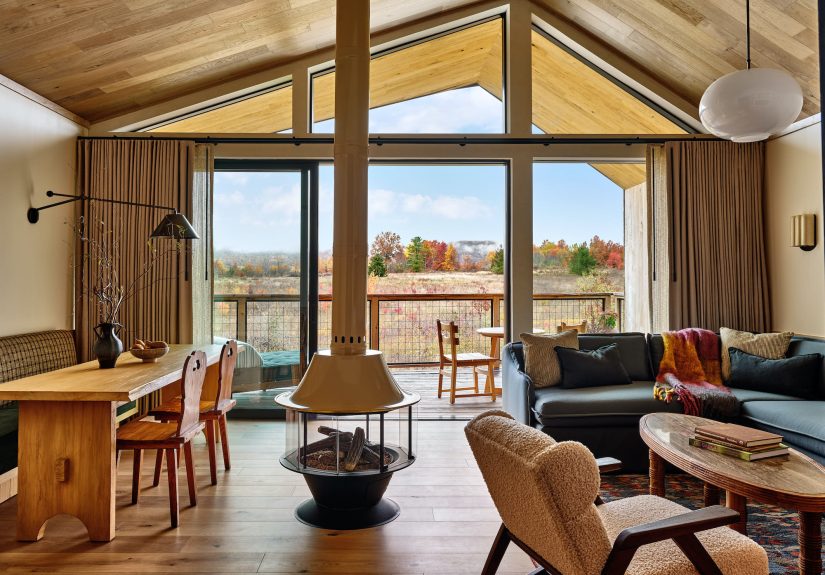
The architecture and interiors lean into natural materials, subdued color, and a soft-spoken barn-inspired vocabulary. Floor-to-ceiling windows bring in the meadows and mountain views. Patios and decks extend the rooms into the landscape. Inside, the mood is cozy without becoming kitschy. The style suggests American craft traditions, but updated with a cleaner hand: less country clutter, more tactile calm. It is rusticity after an editor came through and removed everything unnecessary.
That restraint is exactly why the place feels expensive in the right way. Wildflower Farms does not need gilded fixtures or dramatic chandeliers to sell luxury. Its confidence comes from proportion, texture, and atmosphere. The message is simple: when the landscape is this good, a room should support the view, not compete with it like a needy dinner guest.
The Great Porch as the social heart
If the cabins provide privacy, the Great Porch provides theater. This communal space, centered around a fire pit and framed by those wide-open views, acts as the emotional lobby of the resort. It is where guests transition from arrival mode into stay mode. You can practically feel the shoulders dropping in real time.
There is something deeply American about a porch as social center, and Wildflower Farms understands that instinct perfectly. But instead of a quaint historical replica, it delivers a more refined version: part gathering place, part lookout, part invitation to slow down. The porch embodies the whole resort’s philosophy. It is relaxed, social, scenic, and just polished enough to feel special.
Food, Farm, and the New Rural Luxury
Clay and the Hudson Valley pantry
At many countryside resorts, farm-to-table is a slogan printed on a menu and little else. At Wildflower Farms, it feels more structurally built into the property. Clay anchors the dining experience, and its identity is tied to local ingredients, on-site produce, and the agricultural richness of the Hudson Valley. This matters because the region has become one of the Northeast’s most compelling food destinations, thanks to farms, orchards, distilleries, wineries, and a restaurant culture that takes local sourcing seriously.
Clay’s style is best described as rustic New American, but smarter than that phrase sometimes sounds. The menu changes with the seasons, leaning vegetable-forward without being self-righteous about it. Proteins are thoughtfully sourced, and the whole program is designed to reflect what the land can actually support. The effect is generous rather than performative. You are not being lectured by your dinner. You are just eating very well.
Even the drinks reinforce the sense of place. Hudson Valley and New York State wines fit naturally here, and that regional emphasis helps the property avoid the common luxury-resort mistake of feeling as though it could be anywhere. Wildflower Farms wants you to taste where you are, not merely admire it from a window.
Maplehouse, foraging, and getting your hands a little dirty
Perhaps the most interesting part of the food story is that Wildflower Farms invites guests to participate. Experiences tied to the farm, Maplehouse education space, and seasonal programming turn the property into something more interactive than a standard high-end stay. Guests can encounter activities that connect the kitchen, the fields, and the broader rhythms of the site.
That participation is a major reason the resort feels fresh. Luxury used to mean avoiding labor at all costs. Now, at properties like this, the right kind of hands-on experience becomes part of the pleasure. Gathering produce, learning about botanicals, taking a cooking class, or feeding animals gives the stay a sense of texture. The point is not to cosplay as a farmer for an hour. The point is to feel, however briefly, reconnected to the chain that links land to table.
Wellness Without the Weird Lecture
Thistle, the resort’s spa, is where Wildflower Farms shifts from beautiful retreat to full-on wellness destination. What makes it appealing is that the wellness language here is gentler than the biohacking, optimization-heavy tone that dominates so much modern self-care. The spa leans into botanicals, slow rituals, bodywork, soaking, seasonal treatments, and a setting that lets the outdoors remain part of the experience.
That approach fits the property. Wildflower Farms does not seem interested in bullying you into becoming your best self by sunrise. It offers a calmer proposition: maybe your nervous system would appreciate a saltwater pool, a massage, a sauna, a steam, and fewer notifications. Revolutionary, frankly.
Even outside the treatment rooms, the resort folds wellness into the broader stay through yoga, forest-oriented experiences, quiet trails, and a general respect for slowness. This is not a place built around productivity disguised as restoration. It is built around restoration that actually feels restorative.
What to Do Beyond the Resort
Staying on property is tempting, and many guests probably do exactly that for good reason. Still, Wildflower Farms benefits enormously from what surrounds it. Mohonk Preserve and Minnewaska State Park Preserve are not filler attractions; they are world-class outdoor assets that give the resort a bigger sense of purpose. A morning hike, a bike ride on carriage roads, or an afternoon spent chasing valley views can make the indulgence back at the hotel feel earned in the most satisfying way.
Then there is the cultural side of the Hudson Valley. Drive a bit and you can shape your trip around antiques, contemporary art, local shopping, distilleries, orchards, or excellent small-town restaurants. Beacon offers Dia Beacon for serious art lovers. The broader region rewards people who like their countryside with an intellectual pulse. That mixturenature plus culture, quiet plus styleis exactly what has made the Hudson Valley so desirable in the first place.
Who This Resort Is Really For
Wildflower Farms is ideal for couples, design enthusiasts, city escapees, and travelers who think dinner is part of the destination, not just a necessity between activities. It also suits people who want outdoor access without full rugged commitment. You can go hiking in the Gunks and still return to a gorgeous bathroom, which is a very strong argument for civilization.
Families can absolutely enjoy the property, especially because there are activities tied to the farm and open-air exploration. But the emotional sweet spot of Wildflower Farms feels more adult. It is romantic without being cheesy, social without being loud, and luxurious without being stiff. That balance is hard to pull off. Wildflower makes it look easy, which is annoyingly impressive.
The Bigger Takeaway: A Smarter Version of American Luxury
What Wildflower Farms really captures is a shift in how American luxury now wants to present itself. The old formula leaned heavily on spectacle. The new formula, at least at its best, leans into atmosphere, ecology, craftsmanship, and local identity. Wildflower Farms is a perfect case study in that evolution.
It takes recognizable symbols of American country lifefields, porches, barns, fires, farm dinners, mountain silhouettesand reimagines them through modern hospitality. That is why Americana Redux feels like more than a catchy phrase. The resort is not trying to freeze the Hudson Valley in amber. It is showing how the region’s agricultural roots, scenic grandeur, and cultural sophistication can be translated into a contemporary travel experience that feels both comforting and current.
In the end, Wildflower Farms is not just selling a room. It is selling a mood, a setting, and a refreshed vision of what the American countryside can look like when luxury listens to place instead of overpowering it. And honestly, that is a much better souvenir than a monogrammed robe.
Extended Experience: What a Stay at Wildflower Farms Feels Like
Imagine arriving in late afternoon, when the light in the Hudson Valley starts doing what it does bestturning grasses into gold and making even your weekend bag look more poetic than it deserves. The drive in is quiet, understated, and almost modest. Then the property begins to reveal itself: low-slung cabins, long views, meadows that look brushed into place, and the Shawangunk Ridge rising in the distance like a patient stage set. You check in, but the emotional shift happens before the paperwork is done. The city pace falls off your shoulders. Your eyes stop darting. Your breathing starts to sound less like a to-do list.
You head to your cabin and the first thing that hits you is not extravagance but calm. The room feels edited, grounded, and deeply comfortable. The windows frame the outdoors instead of hiding it. The materials feel warm in the hand. The whole place seems designed to remind you that silence can be luxurious. You drop your bag, open the door to the patio, and suddenly you are doing the thing all good resorts hope you will do: absolutely nothing, and enjoying it tremendously. Maybe you sit outside with a drink. Maybe you notice birds instead of push notifications. Maybe you briefly entertain the fantasy that you could live like this all the time, before remembering that you also enjoy delivery noodles and indoor plumbing that is closer than a meadow away.
By evening, the Great Porch starts working its charm. Firelight flickers. Guests gather but never crowd. Someone has a cocktail with herbs or flowers in it. Someone else is wrapped in a blanket looking at the ridge as if they personally discovered scenic beauty. Dinner at Clay feels like the logical next chapter rather than a separate event. The room is warm, the menu is seasonal, and the food has that satisfying quality of tasting both thoughtful and unfussy. Vegetables actually taste like they were grown by people who care about vegetables, which should not be rare, but here we are. A glass of New York wine makes the whole thing feel even more regionally rooted.
The next morning is when the property really shows off. You wake to soft light and an almost suspicious level of tranquility. Maybe you go for a walk among the fields. Maybe you take yoga, book a treatment at Thistle, or join a farm experience that gets you closer to the land that shapes the property’s identity. The beauty of Wildflower Farms is that activity never feels mandatory. You can do a lot, or you can do nearly nothing, and both choices still feel correct. A hike nearby at Mohonk Preserve or Minnewaska gives you cliffs, woods, carriage roads, and that satisfying sense of being outdoors in earnest. Coming back afterward to a spa, a hot shower, and dinner is the kind of emotional plot twist most adults deserve more often.
By the time you leave, Wildflower Farms has done something sneaky. It has not just relaxed you; it has recalibrated your idea of a weekend away. You start thinking less about amenities and more about atmosphere. Less about status and more about place. What lingers is not one flashy detail but the total mood: the fire pit at dusk, the meadows in morning light, the smell of wood and herbs, the feeling that luxury can still be generous, grounded, and genuinely restorative. That is the real trick of Wildflower Farms. It makes a highly designed experience feel natural. And that is much harder than it looks.
Conclusion
Wildflower Farms Resort in the Hudson Valley is not memorable because it is rural, stylish, or expensiveplenty of places can claim that trio. It is memorable because it gives those qualities a point of view. This is Hudson Valley hospitality filtered through design intelligence, farm culture, regional flavor, and a generous understanding of modern wellness. It updates the American countryside fantasy without turning it into parody. If you want a resort that feels scenic, thoughtful, and unmistakably of its place, Wildflower Farms is one of the clearest examples of where American luxury is heading next.