Table of Contents >> Show >> Hide
- The Su-34 Was Built for a Different Kind of Fight
- The Slick Feature Everyone Notices First
- A Fighter Cockpit That Thinks Like a Long-Haul Office
- Armored, Pressurized, and Surprisingly Modern
- Why the Side-by-Side Layout Is More Than a Quirk
- Combat Use Has Kept the Su-34 in the Spotlight
- What the Cockpit Feature Really Says About Russian Aircraft Design
- The Crew Experience: What This Cockpit Probably Feels Like on a Long Mission
Some fighter jets impress you with stealth. Others do it with speed, swagger, or a ridiculous number of missiles hanging under the wings. The Sukhoi Su-34 Fullback, however, manages to grab attention with something much less expected: a cockpit feature that feels almost charmingly practical. Yes, this big Russian strike fighter has the usual military résumésupersonic dash, heavy weapons load, long-range attack capability, and a design descended from the famous Su-27 Flanker. But the detail that keeps aviation fans leaning closer is inside the nose: a retractable control panel that helps the crew climb in and settle down without doing the awkward pilot equivalent of folding yourself into a gym locker.
That may sound like a small thing, but in the Su-34, small ergonomic decisions are part of a much bigger story. This aircraft was built for long strike missions, hard target sets, and complex crew coordination. So instead of making the cockpit a cramped punishment box with a great view, Sukhoi gave it room, side-by-side seating, armor, and creature comforts that are almost comically domestic by fighter standards. The result is a front office that is one of the strangest, smartest, and most talked-about in modern military aviation.
The Su-34 Was Built for a Different Kind of Fight
To understand why the cockpit matters so much, it helps to understand what the Su-34 is supposed to do. The Fullback is not a pure dogfighter in the classic sense. It is a twin-engine, twin-seat strike fighter and fighter-bomber developed from the Su-27 family to replace older Soviet-era attack aircraft such as the Su-24 in deep strike and interdiction roles. In plain English, this is the kind of airplane meant to fly far, haul a serious payload, navigate tough air-defense environments, and still defend itself if things get spicy.
That mission profile shaped the airplane from the nose backward. The Su-34 uses a widened forward fuselage with a broad “platypus” style nose, canards near the cockpit, a large radar aperture, and an emphasis on range, endurance, and survivability. It is designed for all-weather attack work, terrain-following missions, and long-distance sorties that can push crew fatigue as much as engine performance. That is where the cockpit stops being a detail and becomes a strategy.
Most fighter cockpits are designed around one miserable truth: there is never enough room. Even two-seat jets often place one crew member behind the other to preserve aerodynamics and save space. The Su-34 goes the other way. It puts pilot and navigator-weapons officer side by side, which immediately changes the experience of flying it. That layout improves communication, reduces the need to duplicate every instrument, and creates a larger internal volume that would be impossible in a narrow tandem arrangement.
The Slick Feature Everyone Notices First
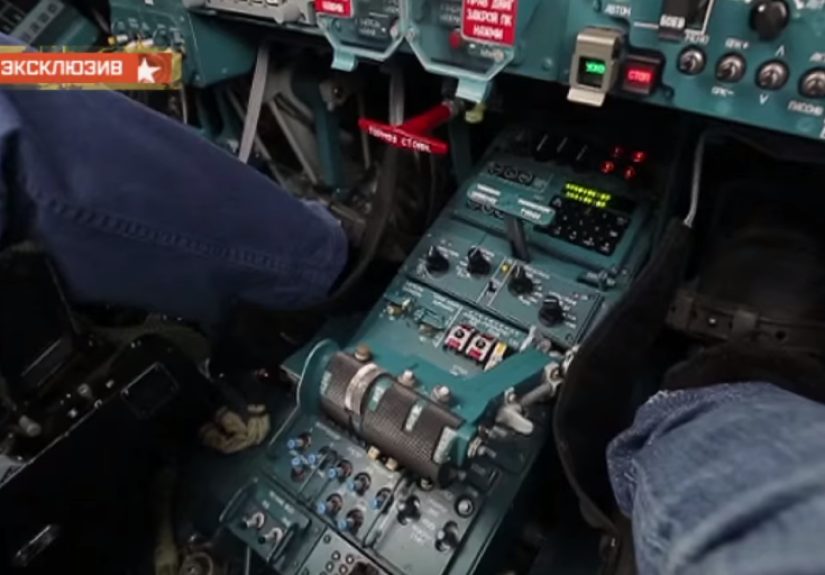
Let’s get to the celebrity of the article: the retractable control panel. In footage that gave outsiders a rare look at the Su-34’s cockpit, the most eye-catching detail was not a missile switch or dramatic red button. It was a center control panel that slides out of the way, making it easier for the crew to climb into their seats. In a normal fighter, getting strapped in can look like a ballet routine designed by an orthopedic surgeon with a sense of humor. In the Su-34, the retractable panel makes entry far more practical.
The trick works especially well because the crew does not board the aircraft like pilots in many Western fighters. Instead of climbing a ladder to the side and dropping in under a raised canopy, Su-34 crew members typically enter through a hatch in the floor using a built-in ladder that deploys through the nose gear area. Once inside, that movable panel helps clear the path. It is the kind of detail that makes you think someone on the design team had either flown long missions or at least watched enough pilots smack a knee on fixed hardware to say, “There has to be a better way.”
Is it flashy? In the Hollywood sense, not really. But in aviation design terms, it is downright elegant. It solves a real problem, matches the aircraft’s unusual entry route, and reinforces the idea that the Su-34 was built around crew endurance as much as raw performance.
A Fighter Cockpit That Thinks Like a Long-Haul Office
The retractable panel is just the appetizer. The main course is the entire philosophy behind the Su-34 cockpit. Because the jet was intended for long-range strike missions, its designers treated crew comfort not as luxury, but as mission insurance. The cockpit is roomy enough for the crew to sit side by side with more freedom of movement than in typical combat aircraft. Reports and cockpit imagery have long noted that there is enough internal space for a crew member to stand, stretch, and even lie down in a limited way during extended flights.
Then there are the details that turned the Fullback into aviation folklore: a primitive galley-like food warmer and a sanitary container often described as a kind of in-flight toilet solution. No, it is not a flying hotel suite. Nobody is serving hot towels and a dessert cart. But compared with the average fighter cockpit, it is practically an efficiency apartment with afterburners.
This matters because fatigue is a combat issue. On a long strike sortie, the crew is not just flying. They are navigating, monitoring threats, managing sensors, tracking fuel, communicating, watching timing windows, handling weapons logic, and reacting to things that would make most office workers spill their coffee instantly. A cockpit that allows the crew to move, coordinate, and stay physically functional is not indulgent. It is operational design doing its job.
Armored, Pressurized, and Surprisingly Modern
The Su-34’s cockpit is not just spacious; it is also built to survive. One of the aircraft’s defining features is its armored crew capsule, often described as a titanium-protected box around the cockpit area. That kind of protection fits the Fullback’s role as an aircraft expected to approach defended targets rather than orbit politely from a safe distance all day. It also helps explain why the cockpit feels more like a protected workstation than a minimal racing shell.
Inside, the Su-34 uses a modern glass cockpit layout with multiple multifunction displays and a head-up display for the pilot. That gives the crew a more flexible working environment than older Soviet strike aircraft, which were notorious for making avionics look like a punishment handed down by a committee. The digital displays support navigation, targeting, aircraft status monitoring, and tactical data, helping the crew divide tasks more efficiently during complex missions.
The aircraft also integrates terrain-following and strike-oriented avionics, electronic warfare equipment, and targeting systems intended to let it attack in bad weather and during day or night operations. One particularly interesting feature beyond the cockpit is the built-in Platan electro-optical targeting system, which retracts into the fuselage when not in use. That means the aircraft can retain precision-attack capability without always sacrificing an external hardpoint for a targeting pod. It is another example of the Su-34’s design leaning toward practicality, integration, and mission endurance.
Why the Side-by-Side Layout Is More Than a Quirk
At first glance, the Su-34’s side-by-side seating can seem like the aircraft is trying to cosplay as a bomber, a fighter, and a road trip vehicle all at once. But the layout is actually central to the jet’s identity. In a strike mission, crew coordination is everything. Pilot and weapons officer have to manage navigation, target updates, threat reactions, electronic warfare, and weapon release timing, often under pressure and at speed. Sitting shoulder to shoulder helps them communicate more naturally than in a tandem arrangement where one person is effectively speaking to the back of a helmet.
That side-by-side setup also reflects what the Su-34 is supposed to replace and how it is supposed to fight. This aircraft bridges the gap between tactical bomber and fighter. It carries a substantial weapons load, supports air-to-ground attack, can use anti-radiation and anti-ship weapons, and still carries air-to-air missiles for self-defense. In that sense, the cockpit is not weird for the sake of being weird. It is a direct answer to the aircraft’s workload.
There is also a psychological dimension. Long missions become easier when the crew can share information without shouting across a narrow fuselage or relying entirely on intercom discipline. Human factors rarely get top billing in military aircraft headlines, but in real operations, they can be the difference between smooth execution and a cockpit that feels like a stress blender.
Combat Use Has Kept the Su-34 in the Spotlight
The Fullback’s unusual cockpit might be the conversation starter, but its combat use is why the aircraft remains relevant. The Su-34 saw operational use in Syria and later became one of the more visible strike aircraft in Russia’s war against Ukraine. In recent years, it has been associated with standoff attacks, guided and unguided strike missions, and the use of glide-bomb tactics that let aircraft release weapons from safer distances than classic low-level bombing profiles.
At the same time, the war has also highlighted the risks facing non-stealthy strike aircraft in modern air defense environments. Losses, changing tactics, and debates over mission effectiveness have all kept the Su-34 under intense scrutiny. That makes its cockpit design even more interesting. The aircraft is not just a museum piece of clever ergonomics; it is an operational jet whose design reflects a serious attempt to combine survivability, endurance, and crew coordination in a demanding mission set.
In other words, the retractable control panel is not a gimmick floating inside an otherwise ordinary airplane. It is part of a broader design logic: help the crew get in, get settled, stay effective, and work together on missions that may be long, stressful, and dangerous.
What the Cockpit Feature Really Says About Russian Aircraft Design
There is a temptation to laugh a little at the Su-34’s “fighter jet with a kitchenette” reputation. Fair enough. The image is funny. But the joke can hide the point. The Fullback’s cockpit shows a branch of aircraft design that prioritized crew ergonomics in a very direct, almost old-school way. Rather than pretending pilots are indestructible action figures, the Su-34 quietly acknowledges that they are humans who get tired, stiff, hungry, and overloaded with tasks.
That is why the retractable control panel feels so memorable. It is not glamorous in the usual fighter-jet sense. It is simply thoughtful. And thoughtful engineering often ages better than flashy marketing. Plenty of aircraft look cool in profile shots. Fewer make you think the designers spent real time considering how to make a long combat sortie less physically punishing for the people inside.
So yes, Russia’s Sukhoi Su-34 fighter has a slick and awesome cockpit feature. But the real story is bigger than one sliding panel. The Fullback’s entire nose section was designed around the idea that a strike aircraft should support the crew, not just trap them in a high-speed aluminum stress dream. In a category full of machines built to intimidate, that is a surprisingly human touch.
The Crew Experience: What This Cockpit Probably Feels Like on a Long Mission
Based on the aircraft’s published layout, cockpit imagery, and the way defense analysts describe the Fullback’s role, the Su-34 likely feels very different from the average two-seat fighter once the mission clock starts running. Entry alone sets the tone. Instead of the usual ladder-to-cockpit shuffle followed by a careful drop into a narrow seat, the crew climbs up through the nose-gear area and into the aircraft from below. That is unusual enough to feel memorable before the engines even start. Add the retractable control panel moving out of the way, and the process probably feels less like squeezing into a machine and more like stepping into a purpose-built compartment.
Once strapped in, the side-by-side arrangement would change the mood of the flight immediately. In tandem cockpits, communication can feel procedural and slightly distant; in the Su-34, the two crew members are right next to each other, sharing the same forward view and much of the same workspace. That matters on long sorties. It makes pointing, confirming, cross-checking, and reacting more natural. In a high-workload environment, even small reductions in communication friction can save time and reduce mistakes.
The roomier cockpit would likely make the middle hours of a mission more manageable too. In many tactical jets, discomfort starts quietly and then becomes its own background threat. Knees lock up. Shoulders tighten. The helmet gets heavier. Every checklist feels a little slower because your body is slowly filing complaints with management. The Su-34’s larger internal volume was clearly meant to fight that decline. The ability to stand briefly, shift position, or stretch is not glamorous, but on a mission measured in many hours, it could make a serious difference in alertness and decision-making.
Then there is the famous matter of food and bathroom access. The Su-34’s so-called galley and toilet are basic to the point of comedy, but basic is still better than nonexistent when the alternative is enduring a long sortie with no relief at all. A warmed ration and a crude sanitary solution do not make the aircraft luxurious. What they do make it is practical. That practicality reinforces the Fullback’s identity as an aircraft intended for endurance and repeated operational use, not just air-show mystique.
Even the armored cockpit changes the psychological experience. Knowing the crew sits inside a titanium-protected capsule likely alters how the aircraft is perceived from the inside. It does not make the jet invulnerable, of course, and modern air defenses remain dangerous, but it contributes to the sense that the Su-34 was built as a serious strike platform expected to push into riskier environments. Combined with the glass cockpit, multifunction displays, and integrated mission systems, the overall experience would probably feel less like a stripped-down fighter and more like a compact strike workstation designed to keep two people effective for the long haul.
If that sounds almost too sensible for a combat aircraft famous for its duckbill nose and unusual silhouette, that is exactly the point. The Su-34’s cockpit experience appears to be driven by endurance, coordination, and mission reality. It may never win awards for subtlety, and nobody will mistake its interior for minimalist Scandinavian design, but it seems built around a truth many military machines ignore: if the crew can function better, the airplane can fight better. And sometimes the coolest feature in a warplane is not the one that looks dramatic in a brochure. Sometimes it is the one that makes eight hard hours in the air a little less punishing.
Note: This article is intended for informational and editorial use, focusing on aircraft design, ergonomics, and publicly reported operational context.