Table of Contents >> Show >> Hide
- From “Quick Fix” to Full Gut Renovation
- The Architects: Bangia Agostinho and the Power of Trust
- Opening the Living Floor for Modern Family Life
- The Navy Kitchen: Bold, Useful, and Not Too Precious
- Simple Materials With Character
- The Backyard: Artificial Turf and Real Life
- The Garret Addition and Basement Excavation
- Why the House Feels Personal, Not Perfect
- SEO-Friendly Renovation Lessons From the Project
- Experience Section: What This Remodel Teaches Anyone Facing a Gut Renovation
- Conclusion
There are Brooklyn renovation stories, and then there are Brooklyn renovation stories that begin with, “All we need to do is add a dishwasher.” That innocent sentence should probably be printed on a warning label and taped to every charming old townhouse in New York. For Rony Vardi, founder of the beloved Brooklyn jewelry brand Catbird, and her husband, artist Dwight Weeks, the dream started with a crooked but beautiful 1905 brownstone in Carroll Gardens. It had atmosphere. It had soul. It also had stairs leaning at a deeply suspicious angle.
What first looked like a modest remodel soon revealed itself to be something far more serious: a full gut renovation. The house needed structural attention, the exterior had to be shored up, the basement was excavated, the interior was reimagined, and a garret addition expanded the home upward. In other words, the townhouse did what old Brooklyn houses often do: smiled sweetly at the buyers, then handed them a clipboard full of surprises.
Yet the finished result is not a glossy, museum-like showpiece where guests are afraid to exhale near the marble. It is warm, lived-in, practical, slightly imperfect, and deeply personal. That is exactly why Rony Vardi’s Brooklyn townhouse remodel gut renovation remains such a useful case study for anyone planning a Brooklyn brownstone renovation, a townhouse remodel, or even a smaller home refresh with big personality.
From “Quick Fix” to Full Gut Renovation
The most important lesson from this remodel is simple: in an old townhouse, one problem often introduces you to six of its cousins. Vardi and Weeks initially thought the house needed manageable updates. The stairs were crooked, the layout was dated, and the rooms were chopped into smaller spaces. But the deeper issue was structural. A crooked stair was not just a quirky old-house detail; it was a clue that the building itself needed serious support.
That discovery changed the scope completely. Instead of a light renovation, the project became a two-year gut renovation. The exterior was strengthened, the interior was stripped and rebuilt, and the plan was redesigned for contemporary family life. This is where the phrase “gut renovation” earns its dramatic little cape. It does not mean changing paint colors and buying a new sofa. It means getting behind the walls, addressing structure, mechanical systems, layout, light, circulation, and long-term durability.
For a Brooklyn townhouse, this kind of work is both thrilling and terrifying. The reward is freedom: you can rethink how a house functions from top to bottom. The challenge is that every decision touches another decision. Moving a stair affects circulation. Opening a floor affects structure. Excavating a basement affects waterproofing, drainage, and budget. Adding a garret changes the roofline, light, and usable square footage. It is less like decorating and more like performing surgery on a very stylish patient.
The Architects: Bangia Agostinho and the Power of Trust
Vardi and Weeks worked with Anshu Bangia and William Agostinho of Bangia Agostinho Architecture DPC, who were not only architects but also friends and neighbors. That relationship mattered. A gut renovation is not a weekend errand; it is a long collaboration involving drawings, permits, budgets, field conditions, revisions, and many conversations that begin with, “So, we opened the wall and found…”
The couple had strong opinions and did not want the house to feel overly designed by someone else. Instead of hiring an interior designer to impose a finished “look,” they worked with architects who could guide the structure and layout while leaving room for the family’s own voice. This balance is one of the reasons the finished townhouse feels authentic. It has architectural clarity, but it does not feel like a showroom. It feels like people live there, lose socks there, make toast there, and occasionally say, “Who moved my keys?”
That is a useful model for homeowners. The right professional team should not erase your taste. A good architect helps translate your habits, preferences, and daily routines into a house that works. In this project, the architecture did not fight the family’s personality. It created the framework for it.
Opening the Living Floor for Modern Family Life
One of Vardi’s strongest ideas was to turn the kitchen, dining, and living areas into one open, connected space. The original layout was divided into smaller rooms, which is common in older townhouses. Historic homes were built for different domestic patterns: formal rooms, separated service spaces, and less emphasis on the kitchen as the social center of the house.
Modern families usually live differently. The kitchen is command central, snack station, homework zone, gathering place, and emotional support room. In Vardi’s remodel, opening the living floor made the house brighter, more flexible, and better suited to family life. French doors connect the interior to the backyard, allowing natural light to pull the eye through the space.
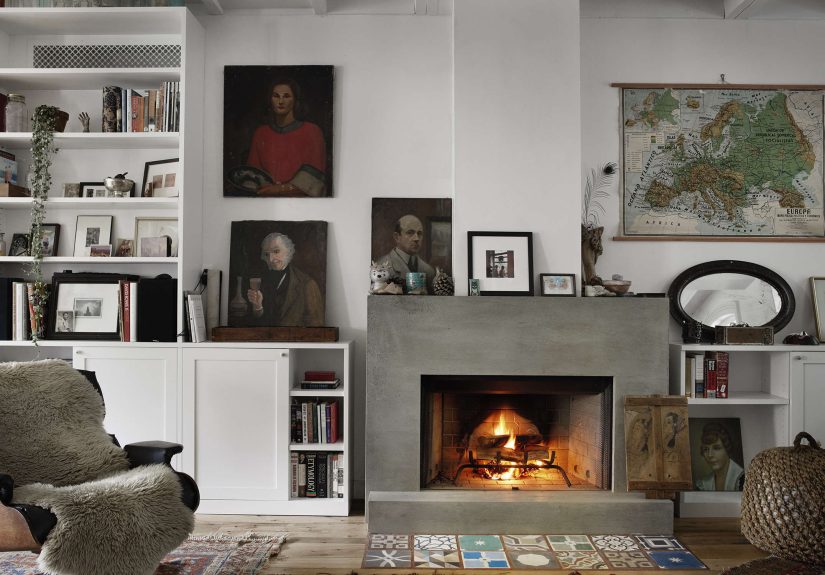
The success of the open plan comes from restraint. It is not an empty white box. The room is layered with texture: painted brick, wood, vintage rugs, plants, antique furniture, and personal objects. This is important because open layouts can sometimes feel echoey or generic. Here, the materials and furnishings bring intimacy back into the room.
The Navy Kitchen: Bold, Useful, and Not Too Precious
The kitchen is one of the most memorable parts of Rony Vardi’s Brooklyn townhouse remodel gut renovation. Vardi reportedly wanted a navy kitchen, and the choice works because it is bold without being loud. Navy cabinetry gives the room weight and confidence, while white brick walls, wood countertops, stainless steel, and copper accents keep it relaxed.
This kitchen also demonstrates a smart renovation principle: a strong color can behave like a neutral when the surrounding materials are honest and simple. Navy is dramatic, but paired with brick, wood, and metal, it feels timeless rather than trendy. It is not shouting, “Look at me, I read design blogs!” It is calmly saying, “I know who I am.”
Open storage and accessible details also fit the non-fussy spirit of the home. A family kitchen should not require choreography. It should let people cook, clean, grab a glass, and make a mess without turning daily life into a performance. In this house, beauty is not separated from use. That is the Catbird-like charm of it: delicate, personal, and still meant to be worn every day.
Simple Materials With Character
Vardi’s material palette is another reason the remodel feels enduring. Instead of leaning on overly polished finishes, the home uses straightforward materials such as wood, brick, marble, and brass. Some floors were reclaimed wood; others were painted white. Unlacquered brass was allowed to age naturally. Vintage rugs and flea market art soften the architecture.
This approach is especially effective in a Brooklyn brownstone renovation because old homes already have emotional texture. Trying to make them look brand-new from every angle can feel awkward, like putting a tuxedo on a sourdough starter. The better strategy is to respect age, even when much of the interior must be rebuilt.
Natural and time-worn materials help a renovated house avoid that “installed yesterday” feeling. They accept patina, fingerprints, small dents, and the evidence of life. For families, this matters. A home that looks better with use is a home that reduces stress. Nobody wants to spend Saturday morning apologizing to a countertop.
The Backyard: Artificial Turf and Real Life
The backyard is another practical choice wrapped in Brooklyn charm. Artificial turf may divide garden purists, but in Vardi’s case it created a durable play area for children. It drains, stays usable, avoids mowing, and can handle the intensity of city family life. In a dense neighborhood where outdoor space is precious, the smartest yard is the one that actually gets used.
That does not mean artificial grass is perfect for every home. It has environmental drawbacks, including its plastic composition and eventual disposal concerns. But this remodel shows the importance of matching choices to lifestyle. A tiny urban yard is not a suburban lawn. It may need to function as playground, dining area, mud-control zone, and sanity-saving outdoor room all at once.
The broader takeaway is this: good design is not about impressing imaginary guests. It is about solving real problems for the people who live there. If five kids can play outside and no one has to panic about mud, mosquitoes, or maintenance every afternoon, that is not a small victory. That is residential diplomacy.
The Garret Addition and Basement Excavation
The project did not stop at rearranging rooms. The renovation included a garret addition and basement excavation, two moves that show how Brooklyn homeowners often look for space in every direction: up, down, and out if zoning and structure allow. In narrow townhouses, every square foot matters. A garret can bring in light and create a special upper-level retreat, while a better basement can turn underused space into something valuable.
But these are not casual upgrades. Basement excavation can involve structural support, waterproofing, underpinning, drainage, and careful coordination. Adding usable space near the roof can affect framing, insulation, stairs, windows, and exterior approvals. These are the parts of renovation that rarely look glamorous on Instagram but determine whether the house will function well for decades.
Vardi’s project is useful because it does not romanticize the process. The scope grew because the house demanded it. Once structural work was necessary, the homeowners used the opportunity to make the house better, not just safer. That is often the silver lining of a gut renovation: if the walls are open and the budget is already sweating, it may be the right moment to solve deeper problems.
Why the House Feels Personal, Not Perfect
One of the most refreshing aspects of the remodel is Vardi’s acceptance that a home is a work in progress. The house includes antique furniture, family pieces, objects collected over time, and items with personal history. A sink came from her mother’s garage. A chair had a connection to the original Catbird store. Furniture from Weeks’s childhood found a place in the home.
These details matter because they prevent the space from feeling staged. A home becomes memorable when it contains stories. Perfectly matched furniture can look polished, but inherited pieces, odd finds, and well-loved objects create emotional depth. They make a room feel like a biography rather than a catalog.
This is where the remodel reflects Vardi’s business philosophy. Catbird became known for jewelry that is beautiful but not overly precious. The house follows the same logic. It is elegant, but it is not stiff. It values detail, but it does not worship perfection. It says: buy the beautiful thing, wear it, live with it, let it age, and please do not save your entire life for a special occasion that may or may not involve matching napkin rings.
SEO-Friendly Renovation Lessons From the Project
1. Fix the structure before chasing the mood board
The crooked stair in this Brooklyn townhouse was not just charming character. It pointed to a structural issue. Anyone planning a townhouse remodel should start with inspections, structural review, roof condition, basement moisture, and mechanical systems before finalizing finishes. Wallpaper can wait. A sinking house is less patient.
2. Design for how your family actually lives
Vardi wanted the kitchen, dining, and living areas connected because that suited her family. This is the heart of good renovation planning. Do not copy someone else’s floor plan just because it photographs well. Think about breakfast, school bags, dinner guests, pets, laundry, noise, light, and the route from the fridge to the sofa. Especially the fridge-to-sofa route. Civilization depends on it.
3. Use materials that can age gracefully
Brick, wood, marble, brass, vintage rugs, and reclaimed flooring all bring texture. They also handle imperfection better than hyper-polished surfaces. In a family home, materials should not require constant emotional reassurance. The best finishes can take daily use and still look intentional.
4. Let professionals guide the hard parts
A gut renovation involves structure, permits, trades, sequencing, and budget control. Vardi and Weeks had strong design opinions, but they still worked with architects. That combination is ideal: homeowners bring vision; professionals bring technical knowledge. Together, they can prevent the dream kitchen from accidentally becoming a very expensive hallway.
5. Leave room for evolution
The finished house was not treated as a frozen masterpiece. It was allowed to keep changing. That may be the healthiest renovation mindset of all. A home should improve with use. The first version does not have to be the final version. In fact, the best rooms often become better after a few years of books, plants, art, children, dinner parties, and one mysterious stain no one will admit to creating.
Experience Section: What This Remodel Teaches Anyone Facing a Gut Renovation
If you are standing inside an old townhouse and telling yourself, “This will be easy,” please take a deep breath and be kind to your future self. Rony Vardi’s Brooklyn townhouse remodel gut renovation shows that the emotional experience of renovating is just as real as the architectural one. You begin with optimism. You imagine paint colors, morning coffee, and friends saying, “Wow, you really have an eye.” Then the contractor opens a wall, and suddenly everyone is discussing beams, joists, water lines, and numbers that sound like international phone codes.
The first experience many homeowners share is scope shock. A renovation expands because old buildings hide information. Walls conceal old wiring. Floors hide slopes. Basements reveal moisture. Roofs reveal fatigue. None of this means the house is bad. It means the house has lived a long life and is now asking for a responsible adult. The best way to handle this is to build contingency into both budget and attitude. Money matters, but flexibility matters too. A rigid plan can snap under pressure; a flexible plan can adapt without losing the larger vision.
The second experience is decision fatigue. During a gut renovation, homeowners make hundreds of choices: stair placement, tile size, faucet finish, door swing, switch location, cabinet depth, grout color, and whether the powder room should be charming or aggressively charming. Vardi’s home offers a useful antidote: return to a few guiding principles. For her, the house needed to be non-fussy, warm, practical, and personal. When choices become overwhelming, a clear design philosophy acts like a compass.
The third experience is learning that “done” is a myth with better lighting. A renovated home may be complete enough to move into, but it will continue to evolve. Furniture shifts. Children grow. Plants either thrive or file a formal complaint. The house teaches you what it wants. This is why personal objects are so powerful. They allow a new renovation to feel lived-in before time has done all the work.
The fourth experience is discovering that beauty and function are not enemies. The navy kitchen works because it is attractive and usable. The backyard works because it serves real family life. The open plan works because it brings people together. The best renovation decisions do not merely ask, “Is this pretty?” They ask, “Will this make Tuesday easier?” Tuesday is the true test of design. Anyone can design for a dinner party. A great home also works when someone is late, the dishwasher is full, and a child needs poster board by tomorrow morning.
Finally, this remodel teaches patience. A two-year gut renovation is not a cute little weekend transformation montage. It is a long process with dust, delays, revisions, and moments when even calm people begin speaking to plumbing fixtures as if they are personal enemies. But when the work is grounded in structure, lifestyle, and honest materials, the result can be more than a renovated house. It can become a family archive, a daily tool, and a living expression of taste. That is the real achievement of Vardi’s Brooklyn townhouse: it is beautiful, but it also looks ready for breakfast.
Conclusion
Rony Vardi’s Brooklyn townhouse remodel gut renovation is memorable because it combines the romance of an old Carroll Gardens brownstone with the realism of a serious structural overhaul. The project began with modest hopes and grew into a full transformation, guided by Bangia Agostinho Architecture and shaped by Vardi’s unmistakable preference for warmth, simplicity, and non-fussy beauty.
The finished home proves that a gut renovation does not have to erase character. It can reveal it. By opening the living floor, choosing honest materials, adding practical family spaces, and allowing personal objects to lead the decoration, Vardi and Weeks created a house that feels modern without becoming cold. For anyone planning a Brooklyn townhouse renovation, the lesson is clear: respect the bones, plan for surprises, design for real life, and never underestimate a crooked stair.