Table of Contents >> Show >> Hide
- What the podcast means by “getting messy”
- The new rules of the game: why health care feels messier than ever
- Who’s in the stadium? A quick guide to the roles we play
- “Best school”: combining technology with human values
- How to get messy (productively) without getting crushed by the system
- Three “new rules” reshaping the game (and why they matter)
- Podcast takeaways: the message beneath the metaphor
- Field Notes: of “messy” experiences people recognize
- Conclusion: a smarter way to play
If U.S. health care were a sport, it would be a full-contact game played on a field made of paperwork… while the scoreboard keeps changing… and someone keeps moving the goalposts “for your convenience.”
That’s why the phrase “getting messy in the game of health care” lands so well as a podcast title. It admits what most of us already know: this system isn’t clean, linear, or polite. It’s complicated, emotional, expensive, andon some daysdeeply absurd. But it’s also where people heal, families get answers, and clinicians do heroic work with too little time and too many tabs open.
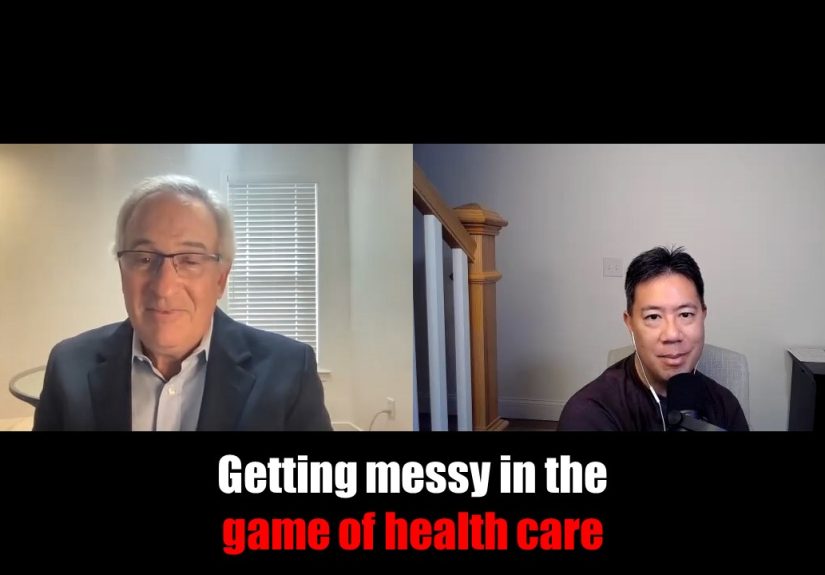
In the “Getting messy in the game of health care” episode of The Podcast by KevinMD, physician-writer Paul Pender, MD uses a sports metaphor to make a blunt point: we can’t just sit in the stands and complain. Patients, clinicians, leaders, and communities have to understand the rules, see the full field, and get involvedeven when it’s uncomfortable, inconvenient, or (yes) messy.
This article breaks down the podcast’s central idea, connects it to the real-world “new rules” shaping care in America, and offers practical ways to play smarterwhether you’re a patient, a caregiver, a clinician, or the person who somehow became the “family insurance whisperer.”
What the podcast means by “getting messy”
Pender’s metaphor is simple: people relate to a sport differently depending on where they sit. A casual observer might not know what’s happening. A season ticket holder has experience, history, and emotional investment. Players have skill and pressure. Coaches juggle strategy, personalities, and politics.
Now swap the stadium for the clinic:
- Casual observer → someone who uses health care occasionally and expects it to behave like online shopping (fast, transparent, predictable).
- Season ticket holder → someone living with chronic illness, caring for a parent, or navigating ongoing treatmentdeeply invested, often exhausted.
- Player → clinicians and staff delivering care under intense time, documentation, and staffing pressures.
- Coach/GM → administrators, insurers, and policymakers trying to run a system where the “win” is quality, access, cost control, and safetyall at once.
The kicker is the “blimp view”stepping back to see the whole field: incentives, regulations, technology, staffing, public health, pricing, and trust. Without that view, people default to frustration and blame. With it, we can at least aim our energy at the right problems.
The new rules of the game: why health care feels messier than ever
1) The cost scoreboard is… alarming
We’re not imagining it: the money is huge. National health spending in the U.S. reached $4.9 trillion in 2023about $14,570 per personand represented 17.6% of GDP. That’s not a typo. That’s the economy-sized version of your “this lab bill can’t be real” moment.
Employer coverage tells the same story in human-scale numbers: average annual premiums in 2024 were about $8,951 for single coverage and $25,572 for family coverage, with workers contributing thousands out of pocket. It’s hard to be a “casual observer” when the ticket price for entry is basically a used car.
2) Administrative friction is a tax you didn’t vote for
In a perfect world, “health care administration” would mean scheduling, safety processes, and coordination that actually helps patients. In reality, a big chunk of admin work exists because the U.S. system is fragmentedmany payers, many billing rules, many networks, many authorizations, many forms.
Multiple studies estimate administrative expenses at roughly 15% to 25% of total national health care expenditureshundreds of billions of dollars each year. Translation: we’re spending a stadium’s worth of money just managing the stadium.
3) Prior authorization has become the surprise defensive line
Prior authorization (PA) is supposed to prevent inappropriate care. In practice, it often delays appropriate care. Physician surveys report that PA can lead to serious adverse events, hospitalizations, and even life-threatening situations. It also eats timetime that could have gone to patient care, or to a clinician remembering what daylight looks like.
4) Trust is part of the clinical workflow now
Health care isn’t only about science; it’s about relationships. Pender argues that the high-value patient-doctor relationship should be the fundamental principle behind whatever “new model” comes next. That’s not nostalgiait’s strategy. When people trust their clinicians and understand the plan, adherence improves, follow-up happens, and outcomes tend to get better.
The problem: trust gets harder when visits are short, portals are confusing, bills are shocking, and the system feels like it’s designed to say “no” before it says “how can we help?”
Who’s in the stadium? A quick guide to the roles we play
The casual observer: “I just need this rash checked.”
Casual observers expect care to be straightforward. They may not know the difference between urgent care and the ER, why the “same” MRI costs different amounts, or why a referral can take weeks. When something goes wrong, it feels personaleven if it’s systemic.
Messy moment example: A patient gets a simple imaging order. The earliest appointment is three weeks out. The in-network site has a higher out-of-pocket estimate than the independent imaging center. The insurance phone rep reads a script. The clinic says, “That’s billing.” Billing says, “That’s insurance.” The patient googles “is screaming into a pillow deductible-eligible.”
The season ticket holder: “I know the system. I’m tired anyway.”
Season ticket holders are patients and caregivers with repeated exposurediabetes, cancer care, autoimmune disease, a child with special needs, aging parents. They learn the rules because they have to. They build spreadsheets. They track symptoms. They also carry a mental load that doesn’t show up on labs.
They’re often the first to spot what’s broken: poor coordination between specialists, duplicative tests, conflicting advice, medication access hurdles, and financial toxicity.
The players: clinicians and staff who keep the game moving
Players have expertise, but they’re also operating inside constraints: staffing shortages, documentation requirements, inbox volume, and an environment where doing the right thing can require five clicks, two phone calls, and a peer-to-peer review.
National organizations have warned that clinician burnout threatens quality and safety, emphasizing that burnout is a systems problem, not a personal weakness. When the system demands more than it suppliestime, tools, staffing, clarityburnout rises, turnover increases, and continuity suffers.
The coaches and owners: policy, payment, and incentives
Coaches decide the playbook: what gets measured, paid, rewarded, or penalized. In Medicare, “value-based” programs are designed to move payment from volume to qualityrewarding outcomes rather than sheer throughput.
But here’s the messy truth: changing incentives changes behavior, and behavior changes culture, and culture changes the patient experience… eventually. Meanwhile, the transition can feel like playing two games at once: the old fee-for-service world and the new value-based world, running in parallel like mismatched socks.
“Best school”: combining technology with human values
Pender describes his most appealing version of the health care game as “best school”a model that combines technology with the values that drew many clinicians into medicine: service, dignity, curiosity, and patient engagement.
That framing matters because tech can either:
- Clarify care (easy scheduling, transparent estimates, better communication, shared decision-making tools), or
- Complicate care (endless portals, clunky EHR workflows, information silos, “please fax this” in the year 2026).
“Best school” isn’t anti-tech. It’s anti-tech-that-forgets-humans. It asks: does this tool make it easier for a patient to understand their options? Does it make it easier for clinicians to spend time listening instead of hunting for checkboxes?
Sometimes “best school” shows up in unexpected places. For example, some primary care practices move to direct primary care (DPC), where patients pay a periodic fee for a defined set of services and the practice avoids billing third parties for each visit. The promise is more time, less billing complexity, and a stronger relationshipthough it’s not a fit for every community or financial situation.
How to get messy (productively) without getting crushed by the system
Getting messy doesn’t mean starting a screaming match with a call center. It means participating with intentionlearning the rules, asking better questions, and pushing in the right places.
If you’re a patient or caregiver: 10 practical “plays”
- Bring a one-page summary to appointments: meds, allergies, diagnoses, recent tests, top 3 questions.
- Ask for the goal: “What outcome are we aiming for in the next 4–6 weeks?”
- Ask for options: “What are the reasonable alternatives, and what happens if we wait?”
- Confirm next steps before leaving: referrals placed, labs ordered, follow-up scheduled.
- Use the portal strategically: concise messages, one issue per thread when possible.
- Request the reason behind denials: “Is this a coding issue, a policy issue, or a clinical guideline issue?”
- Know your plan basics: deductible, out-of-pocket max, in-network rules, pharmacy formulary.
- Ask for cost info early: especially for imaging, procedures, and specialty meds.
- Keep a “billing file”: EOBs, itemized bills, names/dates of phone calls.
- Choose a primary care home when possible: continuity reduces duplication and improves coordination.
If you’re a clinician or team member: “best school” moves that protect trust
- Name the mess: “This part is frustrating; here’s what we can do next.” Patients relax when reality is acknowledged.
- Translate the plan into plain language: what to do today, what to watch for, when to call.
- Close loops: tests ordered → results reviewed → patient notified → next action documented.
- Make “who does what” explicit: clinic vs specialist vs pharmacy vs insurer.
- Use warm handoffs when possible: a quick intro to care managers, social workers, or pharmacists.
- Reduce cognitive load with templates that serve the patient (not just billing), checklists, and clear follow-up pathways.
- Protect the relationship: small behaviorseye contact, listening, “what matters to you?”still change outcomes.
If you’re a leader or policymaker: fix the field, not just the players
- Attack administrative waste with standardization (billing, prior auth, data exchange) and fewer “special rules.”
- Measure what patients feel: access, communication, safety, and coordinationnot just throughput.
- Make prices usable, not merely posted: real estimates, plain language, consumer-friendly tools.
- Invest in primary care and team-based models that reduce fragmentation.
- Support clinician well-being as a quality strategy (staffing, scheduling, workflow, usable tech).
- Align incentives toward outcomes and equity, while minimizing “measure fatigue.”
- Design for the season ticket holders: chronic care navigation, medication access, and financial counseling.
Three “new rules” reshaping the game (and why they matter)
Rule #1: Value-based care is the direction of travel
In Medicare, value-based programs aim to reward quality rather than quantity. Whether any individual program is perfect (spoiler: none are), the direction is clear: more accountability for outcomes, safety, and readmissions, and more pressure to coordinate care across settings.
Rule #2: Price transparency is becoming harder to ignore
Hospitals are required to make standard charges public, including machine-readable files and consumer-friendly displays for shoppable services. Enforcement has evolved over time, with processes that include warnings, corrective action plans, and civil monetary penalties for continued noncompliance. Transparency doesn’t automatically make care affordablebut it can reduce the “mystery box checkout” vibe that destroys trust.
Rule #3: Telemedicine is now part of the baseline toolkit
Telemedicine surged during the pandemic and then settled into a new normal. National surveys show that about 30% of adults used telemedicine in the prior 12 months in 2022 (down from 2021), with differences by geography, insurance, and income. In other words: the tool is real, but access and adoption are still unevenwhich means the “best school” version of tech must include equity and usability.
Podcast takeaways: the message beneath the metaphor
Here are the “sticky” ideas the episode leaves behind:
- Health care is changing whether we like it or not. Pretending it’s still 2005 doesn’t help patients in 2026.
- The relationship is the strategy. Models and metrics matter, but trust is what makes plans work in real life.
- The blimp view reduces misplaced blame. When you see the system, you stop yelling at the nearest human and start pushing on the right levers.
- Everyone has a role. Patients aren’t passive passengers; clinicians aren’t invincible; leaders aren’t optional.
- “Getting messy” is participation, not chaos. Learn the rules, show up prepared, and advocate with purpose.
Bottom line: the mess isn’t proof the game is unwinnable. It’s proof we need better teamwork, clearer rules, and a lot more honesty about how the field actually works.
Field Notes: of “messy” experiences people recognize
Note: The following are composite, anonymized scenarios based on commonly reported experiences in U.S. health care. They’re not about any one personthey’re about patterns.
1) The “simple test” that turns into a five-act play. A middle-aged patient with persistent abdominal pain gets an order for imaging. The clinic is supportive. The radiology center is booked out. The insurer requires prior authorization. The patient calls the insurer and is told the request is “under review.” The clinic resubmits paperwork. Days pass. Symptoms continue. When the imaging is finally approved, the patient learns the out-of-pocket cost depends on where the scan happensand the estimator tool doesn’t match the eventual bill. Nothing about the clinician’s medical judgment was the problem. The friction lived entirely in the system around the decision.
2) The season ticket holder who becomes the care coordinator by default. A caregiver is managing an older parent’s diabetes, heart disease, and memory changes. One specialist changes a medication. Another specialist doesn’t see the update. The pharmacy flags a potential interaction. The caregiver spends lunch breaks on hold, collecting instructions like they’re trading cards. Eventually, they build a binder: med list, visit notes, phone call logs, lab results, and “things I need to say in under 90 seconds when the doctor walks in.” It’s messy, but it worksbecause someone took ownership. The tragedy is that “someone” is often the person with the least training and the most stress.
3) The clinician who can feel trust slipping through the keyboard. A primary care physician wants to practice “best school” medicine: listen, engage, teach, partner. But their day is packedback-to-back visits, refill requests, portal messages, disability forms, prior authorizations, and a charting backlog that follows them home like a needy pet. They start using every efficiency trick they can: pre-visit planning, team-based workflows, templated education, and setting expectations with patients early. On the good days, it works: patients feel seen, decisions are shared, and outcomes improve. On the bad days, the clinician’s best effort runs into a wall of delays, denials, and disconnected data.
4) The small win that changes everything. A clinic adds a care coordinator who calls high-risk patients after hospital discharge. The coordinator confirms medications, checks symptoms, schedules follow-ups, and helps with transportation. Readmissions drop. Patients stop feeling abandoned between settings. Staff morale improves because the system finally supports the team. The care is still messybut it’s managed mess, the kind that creates stability instead of burnout.
These “messy moments” aren’t random. They’re the predictable result of complexity, fragmentation, and misaligned incentives. The podcast’s challenge is to stop treating them like personal failures and start treating them like design problems we can solvetogether.
Conclusion: a smarter way to play
“Getting messy” is not a call to panic. It’s a call to participate. The U.S. health care system is changingon cost, technology, transparency, and payment modelswhether we’re ready or not. The people who do best in changing games are the ones who learn the rules, look up from the sidelines, and coordinate like a team.
For patients, that means asking clearer questions, preparing for visits, and demanding transparency with persistence (and snacks for long hold times). For clinicians, it means protecting trust through communication and workflow designand pushing back on systems that burn out the workforce. For leaders, it means redesigning the field so the players can play: reduce administrative waste, make prices meaningful, invest in primary care, and treat well-being as a quality strategy.
Because the mess isn’t the point. The point is what happens when we stop pretending the mess is “just how it is,” and start building a game that people can actually survivemaybe even enjoy watchingwhile it helps them live longer, healthier lives.
Educational content only; not medical advice. If you have a medical concern, seek care from a qualified professional.