Table of Contents >> Show >> Hide
- What “Mini Split Installation” Actually Includes
- Before You Install: The Three Decisions That Make or Break the Job
- Permits, Codes, and “Will This Void My Warranty?”
- Choosing the Right Ductless Mini Split System
- Mini Split Installation Overview: The Process, Start to Finish
- Step 1: Plan the indoor unit location
- Step 2: Confirm the line set route (the “measure five times” moment)
- Step 3: Install the mounting plate and indoor unit
- Step 4: Choose and prep the outdoor unit location
- Step 5: Electrical and disconnect (hire this out if you’re not qualified)
- Step 6: Condensate drain routing (where “small mistakes” become ceiling stains)
- Step 7: Refrigerant-side connections and commissioning
- Step 8: Startup, testing, and “does it actually feel good in here?”
- Common Mini Split Installation Mistakes (and How to Avoid Them)
- Mini Split Maintenance After Installation
- FAQ: Mini Split Installation Questions Homeowners Ask
- Real-World Experiences: What Mini Split Installation Is Like (The Part Manuals Don’t Tell You)
- Conclusion
If your home had a “most misunderstood appliance” award, ductwork would take it every year. It’s hidden, it leaks,
it collects dust like a hobby, and when it’s in an attic it basically turns your cooled air into a donation to the summer sky.
That’s why ductless mini splits have become the go-to upgrade for bedrooms, additions, garages, older homes, and anyone who
hears the words “new ducts” and suddenly remembers they left the stove on.
This guide walks through mini split installation in a realistic way: what the process looks like, what choices matter,
what typically goes wrong, and which steps are smart to leave to licensed HVAC and electrical pros. You’ll get enough detail
to plan confidently, speak the language, and avoid expensive oops-momentswithout turning your weekend into a surprise
career change.
What “Mini Split Installation” Actually Includes
A ductless air conditioner (often a ductless mini split heat pump) has two main parts: an indoor air handler and an outdoor
condenser/compressor. They’re connected by a line set (refrigerant lines), communication/power wiring, and a condensate drain.
That connection is the whole story. If the connection is clean, sealed, supported, and correctly sized, the system is usually
a quiet comfort machine. If it’s sloppy, the system becomes a dramatic water feature and a high-effort way to get “meh” cooling.
Single-zone vs. multi-zone
A single-zone mini split connects one outdoor unit to one indoor unit. A multi-zone system connects one outdoor unit to multiple
indoor units. Multi-zone can be elegantbut planning and sizing become less forgiving, and partial-load performance (like running
only one room at a time) can be tricky depending on the system’s minimum capacity.
Before You Install: The Three Decisions That Make or Break the Job
1) DIY vs. pro install (be honest with yourself)
Many homeowners can handle parts of a ductless mini split installlike mounting the indoor unit, installing line-hide covers,
or prepping a clean route through a wall. But traditional systems often require specialized tools and legal requirements for
refrigerant-related work. If your installation involves opening refrigerant lines, evacuating the system, or charging refrigerant,
that’s typically technician territory (and in many cases, certification territory).
A practical compromise is “hybrid install”: you do the carpentry and placement prep, and a licensed HVAC technician handles the
refrigerant-side commissioning and verification, while a licensed electrician handles the circuit and disconnect.
Your future selfwho enjoys air conditioningwill thank you.
2) Sizing: bigger isn’t better, even for mini splits
It’s tempting to oversize because mini splits modulate. But oversizing can still cause comfort issues (like short cycling or
weaker humidity control) and waste money. The gold standard is a load calculation (often referred to as Manual J),
not a square-foot “rule of thumb.” Right-sizing is how you get steady temperatures, better moisture removal, and quieter operation.
3) Placement: location is performance
Mini splits are sensitive to airflow and drainage. The indoor unit needs a spot that can “see” the room (not tucked behind a door),
and the outdoor unit needs breathing room, service access, and a stable mounting surface. Good placement also helps with noise,
snow clearance (where relevant), and keeping the unit from blasting your neighbor’s patio like a leaf blower with a college degree.
Permits, Codes, and “Will This Void My Warranty?”
Permitting is local, but many U.S. jurisdictions require permits when you add or modify HVAC equipmentespecially when new electrical
work is involved. It’s common to see a mechanical permit for the HVAC equipment and an electrical permit for the circuit and disconnect.
Some areas may also care about structural penetrations or exterior mounting.
Also: manufacturers may require installation to follow their instructions to keep warranty coverage intact. Even if you do portions
of the work, keep documentation, take photos of concealed routing, and follow the manual’s requirements for clearances, drainage,
and line set support.
Choosing the Right Ductless Mini Split System
Heat pump vs. cooling-only
In many U.S. climates, a ductless mini split heat pump is the popular choice because it can cool in summer and heat in winter.
If you’re replacing window units or electric resistance heat, a heat pump can be a major comfort and efficiency upgrade.
Efficiency ratings that actually matter
You’ll see SEER2 (cooling efficiency) and HSPF2 (heating seasonal performance). Higher numbers generally mean better efficiency,
but don’t shop on ratings aloneproper sizing and quality installation often determine real-world performance.
ENERGY STAR-qualified equipment can be a helpful baseline when you’re comparing models.
“DIY” quick-connect kits
Some systems are marketed with pre-charged line sets and quick-connect fittings to reduce specialized steps. These can simplify parts
of the process for homeowners, but they still require careful routing, protection from kinks, reliable drainage, and safe electrical work.
“Easier” doesn’t mean “effortless,” and it definitely doesn’t mean “skip the manual.”
Mini Split Installation Overview: The Process, Start to Finish
Below is the typical workflow for installing a ductless air conditioner. Think of it as a map, not a “hold my energy drink
and watch this” checklist.
Step 1: Plan the indoor unit location
- Airflow: Pick a wall that lets air spread across the room, not straight into a corner.
- Support: Ensure the wall can support the indoor unit and mounting plate securely.
- Service access: Filters need cleaning. Choose a location you can reach without assembling scaffolding.
- Condensate route: Plan how the drain will run (gravity drainage is simpler than relying on a pump).
Step 2: Confirm the line set route (the “measure five times” moment)
Line set routing is where good installs become great installs. Your goals are: keep the run reasonable, minimize sharp bends,
protect the lines from sun and physical damage, and seal the wall penetration properly. Many installers use line-hide (a protective
cover) for aesthetics and UV protection. If you’re drilling through an exterior wall, the opening typically needs weatherproofing
and a slight outward slope so water doesn’t migrate indoors.
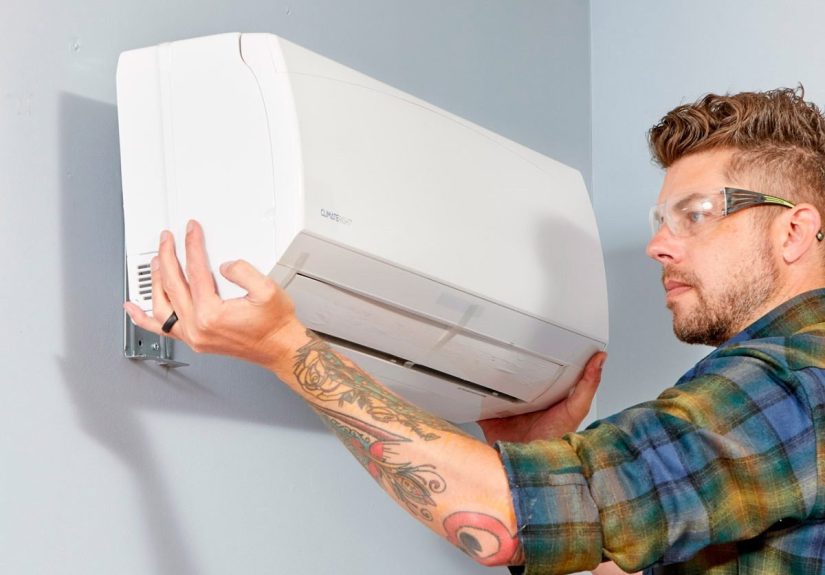
Step 3: Install the mounting plate and indoor unit
Indoor units mount to a metal plate secured to the wall. The plate must be level and anchored properly. A unit that’s out of level
can drain poorly and cause water issues. Once the plate is installed, the indoor unit is set onto it after the connections and routing
are staged according to the manufacturer’s instructions.
Step 4: Choose and prep the outdoor unit location
The outdoor condenser needs a stable base (a ground pad or wall bracket) and adequate clearance for airflow and service.
Good locations avoid roof runoff dumping water on the unit, avoid snow drifts (in cold climates), and avoid trapping the unit in a tight
alcove that recycles its own exhaust air.
- Noise planning: Keep it away from bedroom windows if possible.
- Serviceability: A tech should be able to access panels without performing yoga on shrubs.
- Airflow: Follow the manufacturer’s clearance requirementsthese are not “suggestions.”
Step 5: Electrical and disconnect (hire this out if you’re not qualified)
Mini splits usually require a dedicated circuit sized to the equipment, plus an outdoor disconnect. Electrical requirements depend on
the unit’s specifications and local code. This is one of the most common permit triggers, and it’s also one of the highest-risk steps.
If you’re not a qualified electrician, treat this as a professional-only task.
Step 6: Condensate drain routing (where “small mistakes” become ceiling stains)
Cooling removes moisture from air, and that water needs a reliable path out. Many systems use gravity drainage, which means your drain
line needs continuous slope and insulation where needed to prevent sweating. If gravity isn’t possible, a condensate pump may be used,
but pumps add complexity and maintenance.
Step 7: Refrigerant-side connections and commissioning
This is the step most often handled by licensed HVAC technicians. Traditional installs may involve connecting refrigerant lines,
verifying tightness, evacuating moisture/air from the system, and confirming proper operation at startup. Doing this incorrectly can cause
poor performance, shortened equipment life, or refrigerant leaks. If your installation method keeps the system sealed (as some DIY-oriented
kits aim to do), you still need to follow the manufacturer’s process exactly and verify system performance.
Step 8: Startup, testing, and “does it actually feel good in here?”
Once the system runs, confirm that airflow feels balanced, the unit responds to controls, and condensate drains properly.
A good commissioning includes verifying temperatures, checking for unusual vibration/noise, and ensuring the outdoor unit remains unobstructed.
Common Mini Split Installation Mistakes (and How to Avoid Them)
Oversizing and expecting magic
Oversizing can reduce comfort and humidity control. A right-sized system tends to run longer at lower output, which can improve comfort,
reduce temperature swings, and help manage moisture.
Poor indoor unit placement
If the unit blasts air directly onto a couch, you’ll be comfortable for 11 minutesthen annoyed for the next 11 hours.
Place it where air can mix through the space.
Drain line drama
No slope, kinks, or poor insulation can lead to leaks or water damage. If you remember nothing else: water always finds a way,
and it usually finds the most expensive way.
Outdoor unit boxed in
Restricted airflow reduces efficiency and can cause operational issues. Give it room to breathe, and keep vegetation trimmed.
Skipping permits and documentation
Even if enforcement varies, permits protect you during resale, insurance claims, and warranty conversations. Keep manuals, photos,
and model/serial numbers recorded.
Mini Split Maintenance After Installation
- Clean filters: Most indoor units have washable filters that need regular cleaning.
- Keep outdoor coils clear: Remove leaves and debris; maintain clear airflow.
- Watch the drain: If you see dripping where it shouldn’t drip, address it early.
- Seasonal checkup: Periodic professional service can catch issues before they become expensive.
FAQ: Mini Split Installation Questions Homeowners Ask
Do I need a permit to install a ductless mini split?
Often, yesespecially if new electrical work is required. Mechanical permits are also common for HVAC equipment. Your local building
department is the final authority, but plan as if permits will be needed so you don’t get stuck mid-project.
Can I install a mini split myself?
You can often do parts of the installation (mounting, line routing prep, sealing, line-hide), but many homeowners hire licensed pros for
electrical and refrigerant-side commissioning. This approach lowers risk and helps protect performance and warranty coverage.
How long does installation take?
A straightforward single-zone install can sometimes be completed quickly by a professional crew, while multi-zone systems or complex routing
can take longer. If you’re doing prep work yourself, factor in time for careful layout, weatherproofing, and cleanup.
Where should the outdoor unit go?
Prioritize stable mounting, proper clearance, service access, and a location that avoids noise problems and airflow restrictions.
Follow the manufacturer’s clearance requirements.
Is a higher SEER2 always worth it?
Higher efficiency can lower operating cost, but the best value depends on climate, usage, electricity prices, and how well the system is
sized and installed. A correctly installed ENERGY STAR-level system often offers a strong balance of cost and performance.
Real-World Experiences: What Mini Split Installation Is Like (The Part Manuals Don’t Tell You)
Homeowners often expect mini split installation to be either “plug-and-play” or “rocket science,” and the truth lives comfortably in the middle.
The most common experience is that the planning takes longer than the mounting. People are usually surprised by how much time goes into
deciding where everything should go: not just the indoor unit, but the line set route, the drain path, and where the outdoor unit can sit without
becoming an eyesore or a noise complaint.
One very typical scenario: someone installs a mini split in a bedroom addition. The indoor unit mounting feels satisfyinglike hanging a sleek TV.
Then the routing question shows up: “Where do I hide these lines so my house doesn’t look like it’s wearing a plastic backpack?” That’s where
line-hide covers become the unsung hero. Homeowners who take an extra hour to plan clean linesstraight runs, tidy bends, and a route that doesn’t
fight windows and trimtend to be happiest every time they pull into the driveway. The ones who rush often end up staring at the line set like it’s
judging them.
Drainage is another repeat character in real-world stories. In humid climates, mini splits pull a lot of water from the air, and homeowners quickly
learn that “gravity is free” is not just a physics factit’s a lifestyle. When the drain can run downhill continuously, life is good. When it can’t,
a condensate pump may be required, and people report mixed feelings: pumps can work well, but they add sound, maintenance, and a new way for a system
to stop making you happy at 2:00 a.m. The happiest installs tend to be the ones where someone thought through drainage early, insulated where needed,
and made sure the exit point won’t soak a walkway or stain siding.
Another common experience is the “I almost oversized it” moment. Homeowners frequently assume more capacity means more comfort. After talking to a pro
or reading up on sizing, they learn that right-sizing matters for steady comfort and humidity control. People who choose a properly sized unit often
describe the comfort as “even” and “quiet,” which is exactly what you want from an appliance that lives on your wall. The folks who oversize sometimes
describe a blast-cold-on/off patterngreat for pretending you’re on a movie set in Antarctica, less great for sleeping.
Electrical work is where experienced homeowners tend to draw a firm line. Even confident DIYers often hire a licensed electrician for the dedicated
circuit and disconnect. The shared sentiment is: “I’m handy, not reckless.” This is also where permits and inspections stop feeling like paperwork and
start feeling like protectionbecause the system is powerful, and mistakes can be expensive or dangerous.
Finally, there’s the emotional victory lap: the first hot day when the mini split turns a sticky room into a calm, cool space in minutes. Many people
report that the best part isn’t just the temperatureit’s the control. Being able to condition one room (instead of the whole house), set schedules,
and avoid duct losses makes the system feel smarter and more personal. The common takeaway from satisfied owners is consistent: a mini split install is
worth it when you respect the detailsplacement, drainage, sizing, and safetybecause comfort is built, not wished into existence.
Conclusion
Mini split installation is part design project, part mechanical work, and part common sense. When you plan placement carefully, right-size the system,
respect drainage, and treat electrical and refrigerant-side work with the seriousness it deserves, a ductless air conditioner can deliver quiet,
efficient comfort for years. If you want to DIY, do it strategically: handle the prep and mounting, then bring in licensed pros for the high-risk steps.
That’s not “cheating”that’s how you get great comfort without turning your house into a learning experience.