Table of Contents >> Show >> Hide
- The Plague Arrives in a Booming Port City
- Chinatown at the Centerand in the Crosshairs
- A Governor in Denial: Henry Gage’s Cover-Up
- Racism, Quarantines, and a Landmark Court Case
- Federal Pressure and the End of the First Wave
- The 1907–1908 Plague: When the Rest of the City Couldn’t Ignore It
- Why the Cover-Up Matters Today
- On the Ground: Imagined Experiences from Plague-Era San Francisco
When you picture bubonic plague, you probably imagine medieval Europe, beaked masks, and ominous church bellsnot cable cars and fog rolling over San Francisco Bay. Yet in the early 1900s, the “Black Death” quietly hit San Francisco, especially Chinatown, and local leaders tried very hard to pretend it wasn’t happening. The story has everything: politics, racism, public-health heroics, and a cover-up so intense that for decades many Californians barely knew their state had battled the plague at all.
Today, this forgotten epidemic feels uncomfortably familiar. Officials argued about science, worried about trade, scapegoated immigrants, and fought in court over quarantine rules. The difference is that in 1900, the disease in question was the same bacteria that had killed millions in earlier centuriesYersinia pestis, carried by fleas on rats. And it landed right in one of the busiest, most unequal cities in America.
The Plague Arrives in a Booming Port City
To understand why plague showed up in San Francisco at all, you have to zoom out. The city was tied directly into the “third pandemic” of bubonic plague, which started in China around 1855 and spread through major port cities, especially Hong Kong. From there, steamships crossing the Pacific carried goods, people, and, unfortunately, infected rats and fleas.
By 1899, U.S. health officials already knew plague was hitting places like Honolulu. Ships arriving on the West Coast were inspectedat least, the passengers were. The rats in the hold, not so much. In January 1900, the steamship S.S. Australia docked in San Francisco after sailing regularly between Honolulu and the city. Soon afterward, people began noticing an unusual number of dead rats near the docks and in the alleys of Chinatown. That’s never a good sign in a plague story.
The first confirmed case: a death in Chinatown
On March 6, 1900, a Chinese immigrant named Wong Chut King (records use several spellings of his name) died in the basement of the Globe Hotel on the edge of Chinatown. He had classic bubonic plague symptoms: high fever and painfully swollen lymph nodes, or “buboes.” A city bacteriologist examined tissue samples and, suspecting plague, sent them to a federal laboratory run by Dr. Joseph Kinyoun of the U.S. Marine Hospital Service.
Lab animals injected with the sample died. Under the microscope, the bacteria looked like plague. Within days, federal experts were convinced: San Francisco had the first confirmed case of bubonic plague on the U.S. mainland.
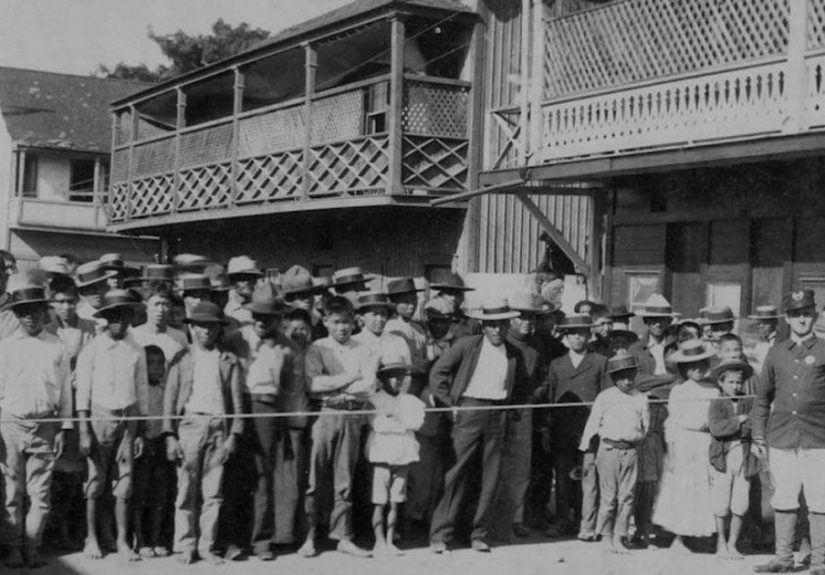
The city’s Board of Health responded quickly at first. Overnight, they surrounded Chinatownroughly a 12-block areawith ropes and police lines. Chinese and other Asian residents were trapped inside; white visitors walking through the neighborhood were allowed to leave. The quarantine, in other words, followed race lines far more than it followed the path of the bacteria.
Chinatown at the Centerand in the Crosshairs
Turn-of-the-century San Francisco was deeply segregated. Chinatown had been crammed into a small, dense district by law and violence, and the Chinese Exclusion Act limited immigration and made Chinese residents a permanent target for blame. Overcrowded housing and poor sanitationlargely the result of discriminatory policiesmade the neighborhood an easy scapegoat.
When plague appeared there first, many white San Franciscans jumped to a dangerous conclusion: the disease wasn’t a citywide problem; it was a “Chinese disease.” That idea shaped nearly every decision that followed.
From emergency response to finger-pointing
After the first quarantine sparked outragefrom Chinese residents, businesses, and even some white employers who suddenly lost their workforcethe city lifted the cordon after just a couple of days. Instead, officials launched house-to-house inspections, burned “suspicious” belongings, and disinfected buildings using harsh chemicals. Doctors tried to identify cases, but residents, fearful of being locked away or having their homes destroyed, often hid sick family members or their dead.
Over the next months, more sudden deaths in Chinatown showed signs of plague. Federal health officials kept confirming what they were seeing in the lab. Yet the political reaction in Sacramento was heading in the opposite direction.
A Governor in Denial: Henry Gage’s Cover-Up
Enter California’s governor, Henry Gage. Aligned with powerful railroad and business interests, Gage didn’t want the word “plague” anywhere near California’s brand. He feared that admitting to an outbreak would lead other states to quarantine California’s goods and passengers, choking off trade and tourism.
So he went with a different strategy: deny, deny, deny.
Gage publicly insisted that there was no bubonic plague in San Franciscojust “ordinary” diseases, exaggerated by federal doctors and fearmongers. Friendly newspapers in the city echoed his message, attacking Dr. Kinyoun as an alarmist and hinting that federal agents were inventing cases to grab power and funding. Editorial cartoons mocked plague reports; business leaders warned that “hysteria” was the real threat.
Science vs. spin
The federal government wasn’t convinced. The U.S. Marine Hospital Service sent a commission of plague experts who had worked in places like India and China. After inspecting several San Francisco cases, they once again confirmed: this was bubonic plague.
Gage responded by doubling down. He blocked the commission from using state-funded laboratories, pressured officials who took the outbreak seriously, and tried to suppress official reports that might alarm other states. Behind the scenes, the state negotiated with federal authorities to quietly clean up conditions in Chinatown without using the “plague” label publicly.
In theory, this was meant to protect the economy. In practice, the cover-up delayed aggressive, transparent action and deepened mistrust between Chinese residents, local health officials, and the state government.
Racism, Quarantines, and a Landmark Court Case
While politicians fought in the press, real people were living under confusing, often discriminatory rules. Public health measures were not applied evenly across the city. Asian residents, especially Chinese and Japanese communities, bore the brunt of coercive policies.
The Haffkine vaccine and targeted inoculations
One controversial plan ordered all residents of Chinatownand later, all people of Asian descent traveling in or out of the stateto be inoculated with an experimental plague vaccine developed by Waldemar Haffkine. The vaccine, still new and sometimes associated with serious side effects, was not required for white residents.
This unequal policy led to widespread resistance. Community leaders argued that health officials were treating Chinese residents as disposable test subjects. Many people refused the injections, worried about side effects and skeptical of a government that had rarely protected their interests before.
Wong Wai takes the government to court
The most famous pushback came in the form of a lawsuit: Wong Wai v. Williamson. A Chinese merchant named Wong Wai, backed by the Chinese Six Companies (a major community association), challenged the forced vaccination and travel restrictions.
In 1900, federal judge William Morrow ruled that San Francisco’s quarantine and vaccination rules violated the Fourteenth Amendment because they targeted Chinese residents without solid evidence that Chinese people were uniquely responsible for spreading plague. If the disease was truly an emergency, he reasoned, then restrictions should apply to everyone equally, not just one ethnic group.
City officials tried to redraw the quarantine boundary so it technically didn’t mention racebut, conveniently, still enclosed almost all of Chinatown while carving out white-owned properties at the edges. The court struck that plan down as well, pointing out that the line clearly tracked race more than genuine infection risk.
The lawsuit didn’t end health measures entirely, but it forced San Francisco and California to confront how much their “public health” policies were driven by racism rather than science.
Federal Pressure and the End of the First Wave
As Gage continued to deny the epidemic, other states started to lose patience. Some threatened trade boycotts or their own quarantines against California. The federal government pushed harder, and national newspapers began covering the story of a state governor apparently pretending plague didn’t exist.
Eventually, California’s own business leaders realized that Gage’s strategy was backfiring. Instead of keeping commerce flowing, the cover-up invited more suspicion from the rest of the country. In the 1902 election, Gage’s Republican allies refused to renominate him. Instead, they backed George Pardee, a physician-turned-politician who actually believed in public health.
Under Pardee, the state coordinated more closely with federal health officials. Anti-rat campaigns ramped up, sanitation efforts expanded, and the city movedslowly but seriouslytoward recognizing that plague was a shared problem, not just a “Chinatown issue.” By early 1904, the first epidemic wave was declared under control, with 121 recorded human cases and 119 deaths, almost all in or near Chinatown.
The 1907–1908 Plague: When the Rest of the City Couldn’t Ignore It
If this were a movie, you’d expect the credits to roll here. But plague stories love a sequel.
After the devastating 1906 earthquake and fire, much of San Franciscoincluding Chinatownlay in ruins. As the city rebuilt, plague reappeared in 1907. This time, the pattern looked different. Cases popped up across neighborhoods and even across the bay in Oakland. Infected ground squirrels and rats showed that the bacteria had escaped into the broader environment, creating what’s known as a “sylvatic,” or wildlife, reservoir.
Now the problem clearly wasn’t confined to Chinese residents or a single neighborhood. Suddenly, the entire city cared a lot more.
Public health officials launched a massive anti-rat effort, offering bounties for dead rodents and spending millions (in early-20th-century dollars) on rat control, improved garbage collection, and better building standards. Between 1907 and 1911, more than 160 cases of plague were documented in this second wave, with a significantly lower death rate than in 1900–1904partly thanks to better medical understanding and quicker action.
Why the Cover-Up Matters Today
For decades, the San Francisco plague years were treated as a strange, embarrassing footnote in California history. The silence was intentional: local elites didn’t want the city’s reputation tied to bubonic plague. Ironically, their attempt to bury the story nearly made things worse in real time: slow, politicized responses let the disease spread from the city into wildlife populations in the American West, where it still circulates among rodents today.
The story of San Francisco’s plague epidemic hits several themes that feel very modern:
- Economy vs. transparency: Officials feared that admitting a health crisis would hurt business. In reality, secrecy invited mistrust and heavier restrictions from the outside world.
- Racism disguised as “sanitation”: Chinatown was blamed and targeted with coercive policies, even when evidence showed the bacteria could spread anywhere rats and fleas lived.
- Science vs. politics: Federal doctors and local health workers tried to follow the evidence. Some politicians tried to protect their careers and donors instead.
- Courts as a check on public health overreach: Lawsuits like Wong Wai’s forced cities to confront the difference between necessary health measures and discriminatory ones.
It’s a reminder that the microbes are the same old villains, but the script we write around themwho gets blamed, who gets protected, who gets listened todepends entirely on human choices.
On the Ground: Imagined Experiences from Plague-Era San Francisco
Historical records give us dates, numbers, and policy debates. To grasp what this episode felt like, you have to imagine life in the city during those years. The following scenes are based on documented conditions and events, stitched together into composite experiences that reflect what many people likely went through.
A grocer in Chinatown
Imagine you run a tiny grocery shop on a crowded Chinatown alley in March 1900. You share a bed in a basement room with other workers. The streets are packed; sunlight barely reaches the ground between tall, aging buildings. Rumors swirlsomeone died at the Globe Hotel, the “rat sickness” from overseas is here, and white doctors are poking around with glass tubes and strange instruments.
One morning, you step outside and see policemen stretching rope across the street. White visitors who’d been buying curiosities and cheap labor yesterday are allowed to duck under and leave. Your neighbors are stopped and pushed back. Suddenly, you’re not just a shopkeeper; you’re a potential biohazard in the eyes of the city.
A health inspector bangs on your door later that week. They sprinkle disinfectant, check your bedding, and threaten to burn anything that looks “dirty.” You’ve heard about an experimental vaccine that makes people feverish and sick, and you’re not convinced these same authorities care whether you live or die. So when a cousin develops a high fever, you quietly move him to a friend’s attic outside Chinatown instead of calling a doctor. Survival and fear are now your main public-health strategy.
A dockworker watching the rats
Down at the piers, a longshoreman notices more and more dead rats turning up near cargo sheds. At first, they’re just a nuisanceone more thing to sweep up, another reason to complain to the foreman. But as word of “plague” slips through the city despite the governor’s denials, dead rats become something else: a warning sign.
He hears that Hawaii burned part of Honolulu’s Chinatown trying to stop plague there. He also hears that California’s governor says everything is fine, so his paycheck will keep coming. When rumors about possible travel bans start up, he realizes that if other states shut their doors to California goods, his job could disappear overnight. Now the dead rats symbolize something more than diseasea direct threat to his ability to put food on the table.
A public health nurse in the second wave
Fast-forward to 1907. You’re a public health nurse assigned to help with rat control and case tracking after the earthquake. You’ve been taught about fleas and bacteria; you’ve seen the maps showing infections popping up in wealthier neighborhoods and across the bay, not just in Chinatown.
You go door to door explaining to families why they should bring in dead rats for testing, why they should fix cracks in their floors, why burning garbage in open lots isn’t helping. Sometimes people slam doors in your face, convinced that any government official means bad news. Sometimes they listen, especially when you mention that the disease no longer cares about race or ZIP codeif it ever really did.
At the end of the day, your notebook is full of addresses, rat counts, and suspected cases. You’ve seen firsthand that the best tools you have are honesty, simple explanations, and a willingness to stand in the same rooms as the people you’re trying to protect. You’re very aware that a few years earlier, some of your colleagues were part of harsh, racially targeted enforcement. You’re trying to build a different relationship, one wary conversation at a time.
A modern visitor looking back
Today, a visitor walking through Chinatown might pass historical plaques, bustling dim sum shops, and tourists snapping photos of Dragon Gate, with no clue that the neighborhood was once surrounded by ropes and guards to contain a disease the city insisted didn’t exist. A short ride away, in the hills and rural areas of the West, plague still occasionally shows up in squirrels, prairie dogs, and even the rare human.
Looking back, it’s easy to see what went wrong: officials tried to hide a dangerous problem, blamed a marginalized community, and turned a local outbreak into a long-term ecological issue. It’s also easy to see what worked: when leaders finally took the science seriously, invested in sanitation, targeted the real vectors (rats and fleas, not ethnic groups), and communicated more openly, the human toll went down.
The bubonic plague in San Francisco is more than a strange historical episode. It’s a cautionary taleand a reminder that the next time a new disease comes knocking, the most dangerous thing we can do isn’t to acknowledge it. It’s to pretend it isn’t there.