Table of Contents >> Show >> Hide
- Before You Dig: The “Koi-First” Checklist
- 8 Backyard Koi Pond Ideas That Look Amazing (and Work in Real Life)
- 1) Storybook Pond (Curves, Boulders, and “Accidental” Perfection)
- 2) Waterfall Circulation Pond (Pretty, Practical, and Oxygen-Rich)
- 3) Renter-Friendly Koi Pond (Above-Ground, Modular, and Surprisingly Legit)
- 4) Brick Koi Pond (Raised, Clean-Lined, and Easy to View)
- 5) Japanese-Inspired Koi Pond (Zen Garden Energy, Not “Theme Park”)
- 6) Hot Tub Koi Pond (Repurpose a Tub Into a Backyard Showpiece)
- 7) Small-Space Corner Pond (Compact Footprint, Big Impact)
- 8) Bog-Filter Koi Pond (A Wetland Zone That Does Heavy Lifting)
- Design Details That Make Any Koi Pond Better
- Budget Reality Check (So Your Wallet Doesn’t Feel Ambushed)
- of Real-World Koi Pond “Experience” (What People Learn After the Instagram Photos)
- Conclusion
A backyard koi pond is one of the rare home upgrades that’s equal parts landscaping, relaxing hobby, and “tiny outdoor aquarium that somehow becomes a full-time job.”
Done right, it looks like a living postcard: shimmering water, a gentle waterfall, and koi that glide around like they pay rent. Done wrong, it becomes a murky soup
bowl with a pump that wheezes louder than your lawn mower.
This guide gives you eight koi pond ideas you can actually build aroundplus the planning basics that keep koi healthy: proper depth, circulation, filtration, predator
protection, and low-drama maintenance. You’ll get specific examples, design tips, and practical “learn-from-my-mistakes” wisdom (so your pond doesn’t become a
wildlife buffet or an algae convention).
Before You Dig: The “Koi-First” Checklist
Koi ponds aren’t just garden décor with fish sprinkles. Koi grow large, live a long time, and produce enough waste to qualify as tiny, beautiful compost machines.
The best-looking koi pond is the one designed around koi needs firstthen dressed up like a magazine feature.
1) Size and depth: plan for “future koi,” not baby koi
Most koi pond guidance points to a minimum depth around 3 feet, with deeper water providing better temperature stability and predator protection (and often deeper
still in colder climates).
If you’re anywhere with hard freezes, deeper water helps prevent the pond from icing solid and gives koi a stable zone at the bottom.
Stocking isn’t a flex. A common rule-of-thumb is budgeting roughly 250 gallons per koi (more is better), especially as they grow.
Translation: if you build a small pond because it “looks cute,” you’ll either keep a very small number of koi or you’ll be upgrading filtration forever.
2) Sun and location: bright is nice; baking is not
Koi enjoy stable conditions. Too much direct midday sun can warm shallow water fast, which stresses fish and can fuel algae. Many pond guides recommend siting ponds
to avoid full midday sun or adding shade features.
Choose a spot you can reach easily with a hose and power, because maintenance is harder when you have to hike to your own pond like it’s a national park.
3) Filtration isn’t optionalit’s the heart of the pond
Think of filtration in three roles: mechanical (catches debris), biological (hosts beneficial bacteria that process waste), and clarifying/UV (helps control green water).
A pretty pond with weak filtration becomes a green pond with confidence.
4) Water safety: chlorine/chloramine and electricity
If you fill from municipal water, you must treat chlorine/chloramine before it goes in with fish. Chloramines don’t simply “sit out and disappear” like chlorine can,
and they’re toxic to fish at drinking-water levels.
For pumps and lights, use GFCI-protected outlets and follow manufacturer guidance. Water and electricity can be a great pair only if the electricity is correctly
protected and installed.
5) Human safety: kids, pets, and local rules
Ponds are water featuresand water features come with responsibility. Consider fencing, covers, or layout choices that reduce fall risk, especially with kids or pets.
Also check local rules for setbacks, electrical requirements, or fencing requirements where applicable.
8 Backyard Koi Pond Ideas That Look Amazing (and Work in Real Life)
Below are eight koi pond design directions that range from storybook-natural to clean-lined and modern. Mix and match elementsbecause the best “idea” is the one
that fits your yard, your climate, and your willingness to do maintenance on a Saturday.
1) Storybook Pond (Curves, Boulders, and “Accidental” Perfection)
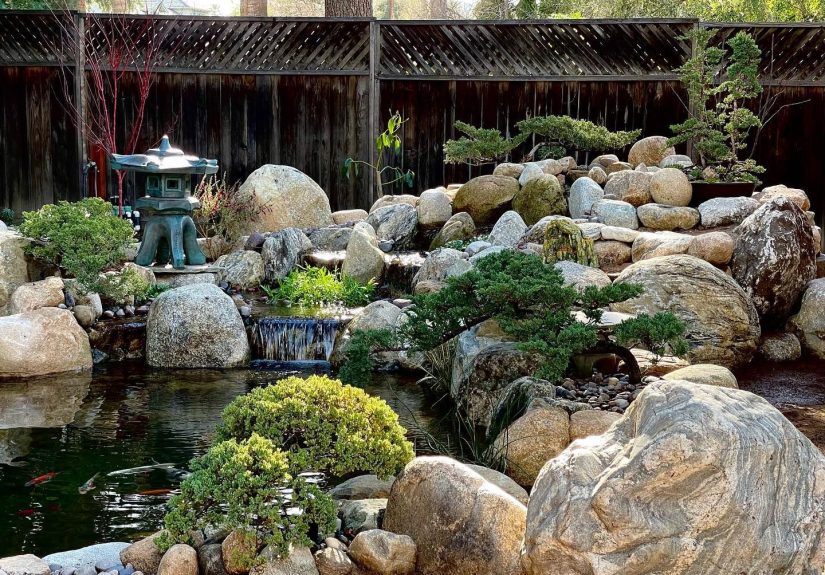
This is the classic naturalistic pond: organic curves, stacked stone edges, boulders that look like they’ve lived there forever, and plantings that soften every line.
It photographs beautifully because it has depthliterally and visually.
How to make it koi-friendly: Keep shallow shelves limited and reserve the center for deeper water (3+ feet). Add a couple of hiding spots:
overhanging rock ledges or a cave-like section where koi can retreat if a heron shows up for brunch.
Specific example: A 10′ x 14′ pond with an average depth around 3.5′ can hold a surprising volume. Design it with a deeper “bowl” in the center,
and contour edges so planting pockets don’t eat the whole swim zone.
2) Waterfall Circulation Pond (Pretty, Practical, and Oxygen-Rich)
A waterfall isn’t just for vibes. Moving water improves circulation, helps oxygenation, and gives you a natural focal point. It also masks neighborhood noiseso your
yard feels like a retreat instead of a group chat with leaf blowers.
Design tip: Build the waterfall so it returns water across the pond (not straight down into one corner). The goal is a gentle “loop” that moves
surface debris toward a skimmer and keeps water mixing.
Maintenance tip: Add a skimmer and a mechanical pre-filter before water hits biological media. Your bio filter will last longer (and smell less
like regret) if you keep leaves and fish waste from packing into it.
3) Renter-Friendly Koi Pond (Above-Ground, Modular, and Surprisingly Legit)
Yes, you can do a koi setup without permanent excavationespecially if you’re renting or simply not ready to commit your yard to a backhoe relationship.
Above-ground systems often use stock tanks, framed boxes lined with EPDM liner, or modular containers.
The trick: Volume and filtration. A small container pond is usually better for goldfish, but if you go large enough (and keep stocking light),
it can support koi with serious filtration and consistent maintenance.
Make it look intentional: Wrap the exterior with wood slats, add a cap ledge for seating, and plant tall grasses around it. Suddenly it’s a
“designer water feature,” not a “farm supply store find.”
4) Brick Koi Pond (Raised, Clean-Lined, and Easy to View)
A raised brick pond gives you structure, seating-height edges, and a crisp look that pairs well with patios. It’s also easier to see fish (and easier on your knees
when you’re doing routine checks).
Build smart: Use a proper liner and underlayment, and design overflow handling so heavy rain doesn’t turn your pond into a koi-powered flood event.
Consider a bottom drain or a well-placed cleanout pointbecause someday you will want to remove settled debris without draining the whole pond.
Style upgrade: Add a wide coping stone ledge on top. It looks finished and becomes your “pond-side coffee bench,” which is basically the whole point.
5) Japanese-Inspired Koi Pond (Zen Garden Energy, Not “Theme Park”)
If you love calm, minimal design, go Japanese-inspired: clean stonework, a simple bridge or stepping stones, sculptural plants, and intentional negative space.
This style shines when you keep materials consistenttwo or three main textures max.
Koi-friendly features: Deeper center water and overhanging edges help protect koi from predators.
Add gentle aeration and avoid too many tiny nooks that trap debris.
Specific example: A rectangular pond, 8′ x 12′ and 4′ deep, with a stone coping edge, a single spillway waterfall, and a gravel path leading to a
small bench. The fish become the “art,” not the décor.
6) Hot Tub Koi Pond (Repurpose a Tub Into a Backyard Showpiece)
Repurposing an old hot tub into a koi pond can be a brilliant shortcut: it’s already a big water container with defined walls. But it’s not a “fill it and toss fish
in” situationold plumbing and chemical residue can be issues.
Do it safely: Thoroughly clean and rinse, remove or bypass unnecessary jets, and ensure all materials contacting water are fish-safe. Add a dedicated
pump and proper filtration. If you insulate the exterior and add a partial cover, it can also help with temperature stability.
Make it pretty: Build a surrounding deck or stone skirt and add a small waterfall return. Suddenly your “retired hot tub” becomes a conversation piece.
7) Small-Space Corner Pond (Compact Footprint, Big Impact)
Not every yard has room for a sprawling pond. A corner pond can be tucked into an unused space near a fence, patio, or garden bed. The key is designing it so it
still has adequate depth and volume for koior keeping koi numbers modest and your filtration strong.
Smart layout: Go deeper rather than wider. Add a skimmer on the “downwind” side where leaves naturally collect, and return water across the surface
to keep debris moving.
Visual trick: Use a dark liner and a clean edge. Dark bottoms make water look deeper and fish colors pop like they’re on HD mode.
8) Bog-Filter Koi Pond (A Wetland Zone That Does Heavy Lifting)
A bog filter (also called a constructed wetland filter) is a planted gravel bed that water flows through, allowing beneficial bacteria and plant roots to help remove
nutrients and improve water clarity.
It’s one of the most satisfying “ecosystem” upgrades because it looks like landscaping while quietly fighting algae.
How it works: Water moves through gravel and plant roots where waste breaks down and plants uptake nutrients.
It’s not a replacement for all filtration in a heavily stocked koi pond, but it can dramatically reduce maintenance and green-water drama when properly sized.
Design idea: Build the bog as a shallow adjacent “plant shelf” separated by stones, with water entering at the bottom and exiting back to the pond as a
gentle spill. It looks like a natural marsh edgeon purpose.
Design Details That Make Any Koi Pond Better
Build a flow path (so debris goes somewhere useful)
A great pond has a “plan” for debris: surface leaves go to the skimmer, heavier solids settle where you can remove them, and filtered water returns in a way that keeps
circulation consistent. This is why pros obsess over placement of skimmers, returns, and (in larger builds) bottom drains.
Plan for predators (because koi are basically living jewel candy)
Koi colors are gorgeous…and unfortunately visible from orbit (or at least from the nearest heron). A deeper center, hiding ledges, and smart edge design help prevent
birds from wading in.
Netting can protect fish during peak predator seasons, but many homeowners prefer hiding structure plus depth so the pond doesn’t look like it’s wearing a hairnet.
Think seasonally: winterizing and summer heat
In cold climates, winter care often includes keeping a small opening in ice for gas exchange (de-icers/aeration) and adjusting water features to avoid supercooling.
Feeding typically stops when water temps drop into the mid-40s °F because koi metabolism slows.
For ponds that ice over, guidance from university extension sources notes aeration decisions can depend on ice cover duration and conditions; many owners run aeration to
maintain oxygen and reduce winterkill risk.
Don’t skip water testing (your pond can’t text you when it feels off)
Regularly test key parameters like ammonia, nitrite, nitrate, pH, and temperature. If your fish seem sluggish, stop eating, or flash (rub against surfaces), check water
quality firstproblems are often environmental before they’re “fish illness.”
Budget Reality Check (So Your Wallet Doesn’t Feel Ambushed)
Costs vary wildly depending on size, excavation, stonework, and filtration. Koi ponds typically require a pump, filtration, aeration, and fish-safe liner materials,
plus landscaping.
Practical takeaway: If you’re forced to choose where to spend, choose filtration and circulation. You can always upgrade the rock edge and fancy lights
later. Upgrading a struggling biological system is way less fun than buying a nicer waterfall stone.
of Real-World Koi Pond “Experience” (What People Learn After the Instagram Photos)
Here’s the part nobody tells you when you’re daydreaming about koi drifting peacefully under lily pads: a koi pond teaches you patience. Not the cute, inspirational
quote kind of patiencethe kind where you stare at a water test kit like it’s a courtroom verdict. The most common experience new pond owners report is that the
pond’s biology takes time. Your filter media doesn’t magically become a waste-processing superhero overnight; it needs beneficial bacteria to establish, and that
takes consistent flow, oxygen, and a steady routine. Early on, many owners deal with cloudy water, then green water, then a short period of panic, and finally a calmer
system once everything balances out.
Another experience: koi grow faster than your mental picture of them. People often start with small fish and think, “Aw, a few more won’t hurt.” Then months pass,
fish get bigger, feeding increases, waste increases, and suddenly the pond that once looked spacious feels crowded. That’s when you learn the “grown-up” version of pond
ownership: either expand the pond, reduce stocking, or upgrade filtration. Most folks do the third option first because it feels easiestuntil they realize every filter
upgrade also asks for more pump capacity, better pre-filtration, and more frequent rinsing. It’s like adopting a puppy and discovering it can operate the refrigerator.
Predator lessons hit hard too. Many pond owners have a moment where they spot a heron standing perfectly still at the pond edge like a professional waiter waiting for
the “special of the day.” That’s when hiding spots become non-negotiable. Overhang ledges, deeper centers, and areas koi can retreat into reduce losses and also reduce
stressbecause stressed fish are more likely to get sick. Owners also learn that pond edges matter: shallow “beaches” look charming, but they’re basically a runway for
predators unless you counterbalance with depth and cover.
Maintenance surprises are real, but they’re manageable once you accept a routine. A quick daily glance (Are fish active? Is water moving? Any unusual foam?) prevents
bigger headaches. Weekly tasks often include skimmer basket emptying and filter rinsing. Seasonal tasks include leaf management in fall and smarter winter prep in colder
regions. People also learn that the prettiest ponds are designed to be cleaned: a hidden cleanout spot, an accessible pump vault, and plumbing you can reach without
excavating your flower beds.
Finally, the best part: koi ponds create a “sit down” habit. Many owners describe how they started using their yard morecoffee by the water, a five-minute break that
turns into thirty, family members drifting outside just to watch fish. It’s not just a landscape feature; it becomes a tiny daily ritual. And if that means you’re now
the person who owns pond netting, a dechlorinator bottle, and opinions about biological media…welcome. The fish will pretend they don’t recognize you until snack time.