Table of Contents >> Show >> Hide
- Meet the USS Johnston: A “Tin Can” With a Big Attitude
- The Battle off Samar: A Last Stand in the Pacific
- Lost to the Deep: Decades of Mystery
- First Clues: RV Petrel Spots Debris
- Deepest Wreck Dive in History: Caladan Oceanic Confirms the Johnston
- Why the USS Johnston Wreck Matters
- What the Wreck Tells Us About the Final Moments
- Looking Ahead: Other Wrecks, Ongoing Stories
- Experiences and Reflections: What It’s Like to “Visit” the USS Johnston Wreck
- Conclusion: A Heroic Destroyer, Finally Seen Again
Imagine diving four miles straight down into the Pacific, into water so dark and
pressurized it could turn a car into scrap metal in a heartbeat. Somewhere in that
cold black lies one of World War II’s boldest “tin can” destroyers: the USS
Johnston. For decades, the ship’s exact resting place was a mystery,
its story carried mostly in survivor memories and history books about the
Battle off Samar. Now, thanks to modern explorers, high-tech
submersibles, and a lot of stubborn curiosity, we’ve finally come face to face with
this historic wreck.
In this article, we’ll look at how explorers located the USS Johnston wreck, why the
ship’s last battle has become legendary, and what the discovery means for naval
history, deep-sea technology, and the families of the crew. Grab your virtual
dive helmetwe’re going down deep.
Meet the USS Johnston: A “Tin Can” With a Big Attitude
The USS Johnston (DD-557) was a Fletcher-class destroyer, one of the
workhorse ship types of the U.S. Navy in World War II. Laid down in 1942 and
commissioned in October 1943, she measured about 376 feet long and carried five
5-inch guns, torpedo tubes, depth charges, and anti-aircraft weaponsplenty of bite
for a relatively small ship.
Destroyers like Johnston were nicknamed “tin cans” because of their thin hulls. They
were fast and aggressive but not exactly built to trade punches with battleships.
Think of them as the boxing lightweight who somehow keeps getting matched with
heavyweightsand still steps into the ring anyway.
Johnston’s commanding officer, Commander Ernest E. Evans, was known
for being fearless and blunt. At the ship’s commissioning, he reportedly told his
crew that he intended to take them into harm’s wayand that anyone who didn’t like
that idea could leave now. Not many COs open with “this is going to be dangerous,”
but Evans meant it.
The Battle off Samar: A Last Stand in the Pacific
Taffy 3 vs. the Japanese Center Force
On October 25, 1944, Johnston was part of Task Unit 77.4.3,
nicknamed Taffy 3, a group of six small escort carriers guarded by
three destroyers and four destroyer escorts. Their job? Provide air support and
anti-submarine coverage for the invasion of Leyte Gulf in the Philippinesnot duke
it out with the main Japanese fleet.
Unfortunately, that’s exactly what happened. A powerful Japanese forcefour
battleships (including the giant Yamato), cruisers, and destroyersslipped
through the San Bernardino Strait and surprised Taffy 3 off the island of Samar.
The Americans suddenly found themselves facing ships that massively out-gunned and
out-armored them.
Johnston Charges Into History
While the escort carriers turned away and started laying smoke, Commander Evans
didn’t wait for detailed orders. He turned Johnston toward the Japanese
fleet and launched a solo torpedo run, firing her guns at the heavy cruiser
Kumano and setting her ablaze. At least one torpedo blew off
Kumano’s bow, forcing her out of the battle.
That attack drew the attention of multiple Japanese ships. Johnston took hits from
shells as large as 6-inch and 8-inch, losing power in some systems and suffering
heavy damage. Still, once she disengaged briefly under a smoke screen and rain
squall, Evans turned her back into the fight again to support other American
destroyers and protect the escort carriers.
Over the next hours, Johnston punched far above her weight, firing at battleships
and cruisers, laying smoke for the carriers, and drawing fire away from the more
vulnerable vessels. Eventually, the destroyer was hit repeatedly, lost power, and
was left dead in the water. Around 09:45, Evans gave the order to abandon ship. The
USS Johnston sank with about 186 of her crewand with her
reputation as one of the most tenacious destroyers in the Pacific.
Evans was posthumously awarded the Medal of Honor, and Johnston
received the Presidential Unit Citation and six battle stars for her World War II
service.
Lost to the Deep: Decades of Mystery
After the battle, survivors knew roughly where Johnston had gone down, but that
didn’t mean she was easy to find. The sinking took place near the
Philippine Trench, in some of the deepest waters on Earth. Depths
in this area exceed 20,000 feet (over 6,000 meters), far beyond what traditional
research submarines could safely visit for many years.
For decades, the ship existed mostly in memoirs, naval archives, and books like
The Last Stand of the Tin Can Sailors. The exact location of the wreck was
unknown. Unlike shallower wrecks that divers and remotely operated vehicles (ROVs)
can visit regularly, Johnston remained in the category of “someday, when we have
the tech.”
First Clues: RV Petrel Spots Debris
The first real break came in 2019, when researchers aboard the
late Paul Allen’s research vessel RV Petrel used a deep-diving ROV
to explore the seafloor off Samar. They found a debris field containing a 5-inch
gun, propeller shaft, and other wreckage consistent with a Fletcher-class
destroyer. At depths around 20,400 feet, it was the deepest wreck located up to
that time.
The catch: the ROV couldn’t safely reach the deepest parts of the site, and the
debris alone wasn’t enough to positively identify the ship as Johnston rather than
another lost destroyer such as USS Hoel. Researchers had a strong hunchbut not yet
a confirmed ID.
Deepest Wreck Dive in History: Caladan Oceanic Confirms the Johnston
Enter the DSV Limiting Factor
In 2021, undersea explorer and former U.S. Navy officer Victor Vescovo
and his company Caladan Oceanic mounted a new expedition to the
Samar battlefield. Using the titanium-hulled submersible
DSV Limiting Factor, designed to withstand full ocean-depth
pressure, Vescovo and his team were able to dive repeatedly to more than 21,000
feet (about 6,456 meters).
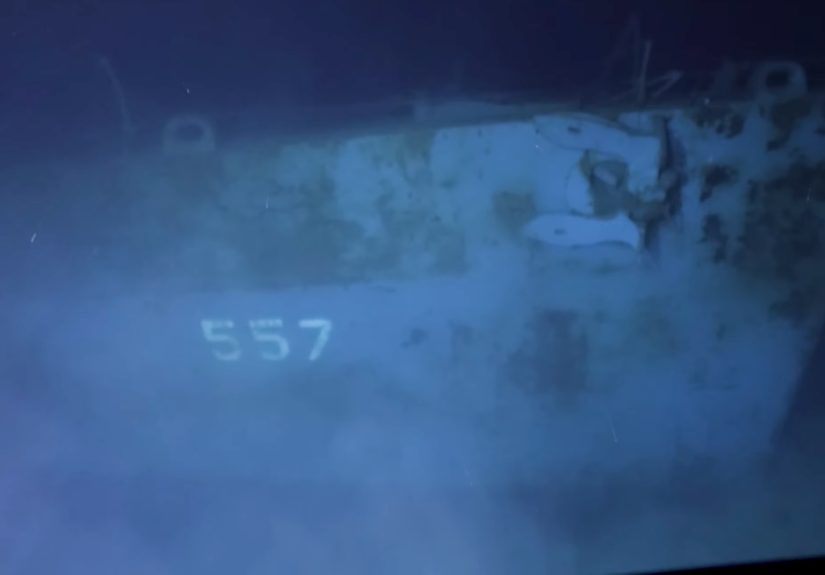
On two eight-hour dives, the team surveyed the wreck lying upright on the seafloor.
They documented key featuressuch as the bow shape, gun mounts, superstructure,
and, most importantly, the clearly visible hull number “557” painted on the side.
That left no doubt: this was USS Johnston.
The World’s Deepest Known Shipwreck (For a While)
At the time of the survey, Johnston was recognized as
the deepest shipwreck ever visited and identified, sitting more
than 20,000 feet below the surfaceabout 62 percent deeper than where the Titanic
rests in the North Atlantic. Later, Vescovo’s team found USS
Samuel B. Roberts (“Sammy B”) even deeper, but Johnston still holds a special place
as the first “tin can” from Samar to be found and fully surveyed.
High-definition video shows the forward two-thirds of the destroyer resting
upright. Her main guns are still trained off to starboard, just as they were during
her final minutes as she fired on the Japanese fleet. Many of the shell holes
visible in the hull line up closely with survivor accounts and wartime action
reports.
Why the USS Johnston Wreck Matters
A Powerful Memorial to “Tin Can Sailors”
For historians and families of the crew, the wreck is more than rusty steel. It’s a
war grave and a physical memorial. U.S. policy treats such wrecks
as protected sites, not salvage opportunities, so the team took care not to disturb
the ship.
The visual confirmation of Johnston’s condition helps validate survivor stories
about where and how the ship was hit. It also personalizes the Battle off Samar.
Reading that a destroyer fought battleships is one thing; seeing the torn metal,
the still-aimed guns, and the hull number glowing faintly in deep-sea light is
another. It drives home the cost of that courage.
Pushing the Limits of Deep-Sea Exploration
The expedition also marks a major step forward in
deep-ocean exploration technology. Diving a crewed submersible to
more than 6,400 meters, maneuvering it around a wreck, and capturing sharp imagery
is no small feat. Techniques developed for exploring sites like the Johnston wreck
can be applied to studying deep-sea ecosystems, mapping the seafloor, and even
monitoring critical underwater infrastructure.
In other words, chasing a World War II shipwreck isn’t just nostalgiait’s a test
bed for the next generation of undersea science and engineering.
Connecting Past and Present
Finally, the rediscovery of USS Johnston helps connect modern audiences to a
rapidly receding generation. Fewer and fewer World War II veterans are alive to
tell their stories. High-quality video of the wreck, carefully contextualized by
historians, gives us a powerful way to keep those stories alive for students,
museum visitors, and casual history nerds alike.
What the Wreck Tells Us About the Final Moments
Detailed analysis of the wreck has allowed naval historians to reconstruct parts of
Johnston’s last battle with surprising precision. A 3-D model created from
expedition data shows that the forward two-thirds of the ship is relatively intact,
while the aft section appears to have broken off and remains undiscovered or
scattered.
Shell damage on the superstructure and hull matches accounts of hits from Japanese
cruisers, destroyers, and secondary batteries from battleships like Yamato. Some
large holes may correspond to massive shells that over-penetrated before
detonatingor didn’t explode at allhelping to explain how the ship stayed
afloat as long as it did despite overwhelming fire.
The guns frozen in place at high elevation, still pointed toward where the Japanese
fleet once was, are a visual echo of Johnston’s reputation: fighting to the end,
even when the odds made survival nearly impossible.
Looking Ahead: Other Wrecks, Ongoing Stories
USS Johnston is only one of several ships from the Battle off Samar and the wider
Battle of Leyte Gulf that lie in deep water. Other wrecks, such as
USS Samuel B. Roberts and USS Hoel, have also been located or are the subjects of
ongoing search efforts. Each new discovery adds another puzzle piece to the picture
of what happened on that chaotic October morning in 1944.
As technology improves, we can expect more detailed mapping, more 3-D modeling, and
more respectful documentation of these underwater battlefields. The key is balance:
use modern tools to learn as much as possible while remembering that these are also
graves and deserve the same respect as any military cemetery on land.
Experiences and Reflections: What It’s Like to “Visit” the USS Johnston Wreck
Most of us will never sit inside a deep-sea submersible looking out at a shipwreck
four miles down. Still, thanks to expedition footage, interviews, and reports, we
can piece together what that experience is likeand why it leaves such a deep
impression on the people who make the journey.
Descending Into the Dark
Explorers describe the descent to the USS Johnston wreck as a surreal, almost
meditative process. The submersible leaves the surface in bright daylight, then
slowly passes through bands of fading blue until the outside world is completely
black. The only light is whatever the crew brings with them. It takes hours to
fall through that water column, with the passengers feeling more like they’re in
space than under the sea.
During these hours, the team monitors depth, systems, and navigation, but there’s
also time to think. For many, this means reflecting on the sailors who went down in
this same stretch of ocean under very different circumstancesclinging to rafts,
struggling with injuries, and hoping rescue ships would find them in time.
A Sudden Encounter With the Past
When the submersible finally nears the seabed, the pilot begins sweeping with
sonar and lights, searching for any hint of structure on the bottom. In the case of
the Johnston, the first glimpses are often hauntingly ordinary: a patch of sand,
then a line that turns into part of the hull, or the faint glow of “557” emerging
in the headlamps.
Explorers often talk about a jolt of emotion at that moment. Even for seasoned
deep-sea crews who have visited other wrecks, seeing a famous “tin can” destroyer
appear out of the darknessand knowing what happened to the people aboardcan be
overwhelming. There’s excitement at finally confirming the wreck, but also a sense
of solemn responsibility to get everything right.
Working Carefully in a Place That Isn’t Yours
Operating a submersible around a wreck at these depths is a delicate balancing act.
The team wants detailed imagery and mapping, but they also know the wreck is
legally and morally a protected site. That means no touching, no
collecting souvenirs, and no disturbing the structure more than necessary
for navigation.
Pilots report that maneuvering around twisted metal and collapsed structures feels
a bit like flying a helicopter inside a cathedral made of steel. One wrong move
could damage the wreckor the submersible. So movements are slow and deliberate.
Lights trace along gun barrels still aimed skyward, across torn plating, and over
torpedo racks now half-buried in sediment.
Emotional Impact on Explorers and Families
Many expedition members have military backgrounds themselves, which adds another
layer of connection. They aren’t just visiting a famous ship; they’re visiting the
final resting place of sailors who wore the same uniform. Some have described
quietly reading out the ship’s name and hull number over the submersible’s
intercom, or pausing operations briefly to “stand in silence” in their own way,
four miles underwater.
For families of the crew, seeing images of the wreck can be bittersweet. On one
hand, the footage confirms what history has always said: Johnston fought hard and
died hard. On the other, it offers a sense of closure. The ship isn’t lost in some
abstract senseit’s there, in a real place, still bearing scars that match
the stories passed down through generations.
Why These Deep-Sea Visits Matter
Ultimately, deep-sea expeditions to wrecks like USS Johnston are about more than
technology or record-setting depth numbers. They’re about knitting together the
human experience across time. From the sailors who fought on deck in 1944, to the
explorers piloting submersibles in the 2020s, to the people watching documentary
clips at home, everyone shares a piece of the same story.
When we “visit” the Johnstonphysically with a sub or virtually through video and
articleswe’re reminded that history isn’t just dates and diagrams. It’s real
people, real risks, and real courage, all still resting quietly on the bottom of
the sea.
Conclusion: A Heroic Destroyer, Finally Seen Again
The discovery and survey of the USS Johnston wreck bring together
everything that makes this story compelling: daring naval combat, cutting-edge
technology, deep-sea exploration, and a powerful human legacy. From Commander
Ernest Evans’s fateful decision to charge a vastly superior enemy, to modern
explorers diving to record-breaking depths, the Johnston’s story spans generations.
Today, the ship rests quietly on the seafloor, guns still aimed toward where the
enemy once was. Thanks to the work of explorers, historians, and engineers, we can
now see and study that final poseand, more importantly, remember the people who
put the ship there. For the “tin can sailors” of Taffy 3, the rediscovery of the
USS Johnston is a long-overdue salute from the deep.