Table of Contents >> Show >> Hide
- Meet the Oregon Chainsaw Sharpener Family
- Oregon 410-120: The Sweet Spot for Most Users
- How the 410-120 Performs in Real Use
- How the 520-120 and 620-120 Compare
- What About the 12V Oregon Sure Sharp?
- Who Is the Oregon Chainsaw Sharpener Best For?
- Tips to Get the Best Results from an Oregon Chainsaw Sharpener
- Bottom Line: Is the Oregon Chainsaw Sharpener Worth It?
- Real-World Experiences with the Oregon Chainsaw Sharpener
If you run a chainsaw more than twice a year, you eventually face the same problem: that glorious, wood-chewing beast turns into a spark-throwing butter knife. At that point, you have three optionskeep pushing (and abuse your saw), pay someone else to sharpen your chain, or finally invest in a proper chainsaw sharpener.
Enter the Oregon chainsaw sharpener lineup, especially the Oregon 410-120 bench grinder and its bigger siblings, the 520-120 and 620-120. These aren’t cute little gadgets; they’re legit shop tools designed to give you consistent, factory-quality teeth in a fraction of the time it would take with a file.
In this in-depth Oregon chainsaw sharpener review, we’ll look at how precise, fast, and adjustable these sharpeners really are, who they’re best for, and what it’s like to actually live with one on your workbench.
Meet the Oregon Chainsaw Sharpener Family
When people say “Oregon chainsaw sharpener,” they’re usually talking about one of three electric bench models:
- Oregon 410-120 – mid-sized, bench/wall mount, value-oriented sharpener ideal for homeowners, landowners, and light pros.
- Oregon 520-120 – heavy-duty, higher-power bench grinder for frequent use and multiple saws.
- Oregon 620-120 – pro-grade beast with hydraulic assist clamping for high-volume sharpening shops.
All three share Oregon’s core strengths: solid build quality, consistent angles, and the ability to sharpen most common chain pitches up to .404″. But their personalities are different enough that it’s worth picking the right one for the way you actually cut.
Oregon 410-120: The Sweet Spot for Most Users
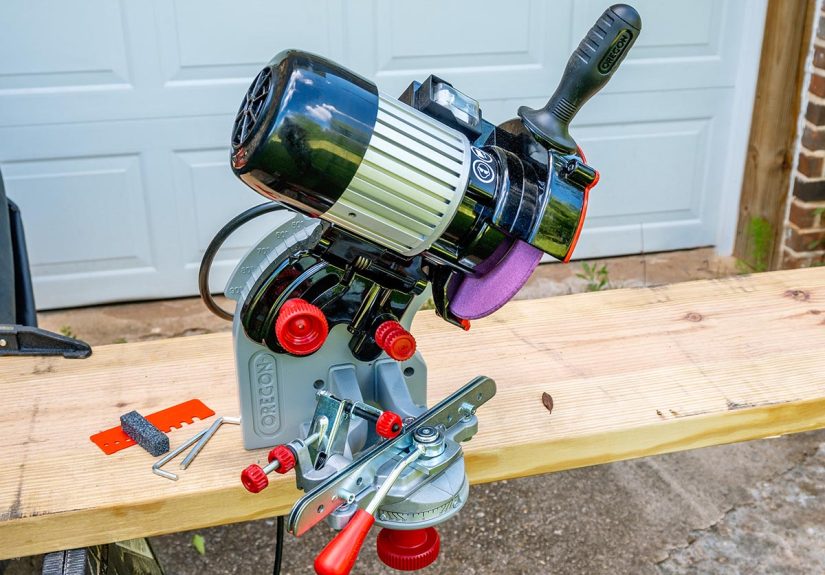
The star of this review is the Oregon 410-120, because it hits the sweet spot between price, precision, and features. It’s built as a mid-sized bench grinder that can mount to either a bench or a wall and sharpen chains up to .404″ pitchso it will handle the chains on most homeowner and farm/ranch saws.
Key Features at a Glance
- Power and speed: Around 220W, single-phase motor spinning in the 3,000+ RPM rangeenough for fast material removal without burning the cutters when used correctly.
- Universal chain capacity: Works with 1/4″, 3/8″ low profile, .325″, 3/8″, and .404″ pitch chainsgreat if you own multiple saws.
- Bench or wall mount: Mounts to a board, bench, or wall, which is handy in small shops or sheds.
- Built-in work light: An integrated light makes it easier to see the cutter edges and witness marks.
- Included wheels: Typically ships with multiple grinding wheels for different chain pitches plus a dressing brick and profile guide for depth gauges.
On paper, that sounds pretty standard. Where the Oregon 410-120 really earns fans is in its combination of adjustability and repeatabilitytwo things that matter a lot more than raw motor size when you’re chasing sharp, even teeth.
Adjustability: Where the Precision Comes From
“Adjustable” isn’t just a marketing word here. The 410-120 lets you dial in several key settings:
- Top-plate angle: The swing of the head can be set for different chain designslike 25° or 30° for many standard chains.
- Down angle (tilt): Helpful for certain professional chains that call for a specific down angle to maintain cutting efficiency.
- Depth stop: Controls how far the wheel bites into each cutter so you don’t grind away half the tooth on your first try.
- Vise adjustment: The chain vise clamps the chain and keeps each cutter in the same position relative to the wheel, making your results more consistent.
Once you set these angles based on your chain spec, you’re not just “sharpening”you’re resetting the geometry back to what the manufacturer intended. That’s why chains sharpened on a well-set Oregon grinder often cut smoother and straighter than chains that have been hand-filed inconsistently over time.
Speed: How Fast Is It Really?
How fast the Oregon sharpener works depends on how dull and damaged your chain is, but for a typical workshop scenario, it’s significantly faster than filing by hand.
On a lightly dulled chain that just needs a touch-up, you can work through an entire loop in roughly 5–10 minutes once you get the hang of it. On a beat-up, rock-kissed chain that needs more material removed and the cutters evened out, you might spend 15–20 minutesbut you’re still saving time compared to filing multiple passes on every tooth.
One underrated time saver: once your settings are dialed in, every subsequent chain goes faster. The sharpener doesn’t get tired, doesn’t rush, and doesn’t decide that “close enough” is good enough on the last few cutters.
How the 410-120 Performs in Real Use
So how does this thing behave in the shop when you’re actually trying to get back to cutting?
Setup and Learning Curve
Assembly is straightforward for anyone comfortable with basic tools. You’ll need to mount the unit, install the grinding wheel, and adjust the safety guards. The manual includes starting points for common chain pitches, but expect a little trial and error the first time.
The biggest learning curve is getting your adjustments locked in:
- Set the top-plate angle according to the chain manufacturer.
- Dial in the head tilt if your chain spec calls for it.
- Use the depth stop so the wheel just kisses the cutting edge instead of hogging off metal.
- Adjust the cutter stop so every tooth lands in exactly the same spot under the wheel.
Once you nail those, your job becomes simple: flip the head down, sharpen a tooth, advance the chain, repeat. After that, you rotate the head to sharpen the teeth on the opposite side.
Cut Quality and Consistency
This is where the Oregon 410-120 earns its reputation. A lot of users report that chains sharpened on this unit cut:
- Straighter – because left and right cutters end up the same length and angle.
- Faster – sharp, evenly ground teeth bite cleanly into the wood instead of tearing fibers.
- Smoother – less chatter and fewer aggressive grabs compared with badly filed chains.
If you’ve ever noticed your saw “pulling” to one side, that’s usually because one side’s cutters are longer or sharper than the other. A bench grinder like the Oregon sharpener eliminates that sloppiness by giving all cutters the same treatment.
Downsides and Limitations
No tool is perfect, and the Oregon 410-120 has a few trade-offs worth knowing:
- You must remove the chain from the saw. That’s normal for bench grinders, but if you’re used to quick field touch-ups, it’s a shift in workflow.
- Not a “grab-and-go” field tool. This is a corded, 120-volt unit for the shop, not for the back of the truck.
- Requires some attention to detail. If you rush your setup, you can grind too much metal or round over the edge. Precision comes from patience and a light touch.
That said, once you get comfortable with the adjustments, those downsides mostly disappearand you’re left with repeatable, professional-looking results.
How the 520-120 and 620-120 Compare
If you sharpen a lot of chainsor you’re running a small shopOregon’s 520-120 and 620-120 sharpeners might make more sense than the 410-120.
Oregon 520-120: Heavy-Duty All-Rounder
The 520-120 steps things up with more power and a more robust chassis built for high-volume use. It includes many of the same angle adjustments as the 410-120 but adds a few pro-leaning touches:
- Higher power motor suited for daily or frequent sharpening.
- Full range of pitch support, including 1/4″, 3/8″ low profile, .325″, full chisel 3/8″, .404″, and even some specialty chains.
- Top-plate and down-angle adjustments similar to the 410-120, with refined controls.
- Cast aluminum construction built for durability and shop abuse.
Think of the 520-120 as the “I sharpen chains regularly” version. It’s precise, fast, and more than enough for tree services, firewood businesses, or serious property owners who run several saws.
Oregon 620-120: Pro-Level with Hydraulic Assist
The 620-120 is the top of the Oregon bench grinder line and it shows. Its biggest party trick is the hydraulic assist clamping vise, which automatically clamps the chain when you bring the head down to grind and releases when you raise it.
That sounds like a small feature until you sharpen dozens of chains in a row. Not having to manually tighten and loosen the vise for every tooth saves real time and reduces fatigue. For shops that sharpen large .404″ chains or do contract sharpening, the 620-120 turns the Oregon sharpener from “nice tool” into “production machine.”
For most homeowners, this is overkill; for pros, it can be a justified investment.
What About the 12V Oregon Sure Sharp?
While this review focuses on bench-mount sharpeners, it’s worth mentioning the Oregon 12V Sure Sharp handheld sharpener. This portable, cigarette-lighter-powered grinder lets you sharpen chain right at the truck or in the field.
It’s:
- Compact and lightweight.
- Powered by a vehicle 12V outlet or battery clamps.
- Sold with multiple stone sizes for different pitches.
It’s not as precise or adjustable as the bench grinders, and some users report durability concerns if pushed too hard, but as a companion tool to a 410-120 or 520-120 in the shop, it’s a convenient way to keep chains cutting well between full regrinds.
Who Is the Oregon Chainsaw Sharpener Best For?
Choose the 410-120 If:
- You’re a homeowner, landowner, or firewood cutter with one or several saws.
- You’re tired of paying for chain sharpening or waiting for the shop to call you back.
- You want pro-looking results but don’t need full-time, high-volume equipment.
- You’re willing to spend a bit of time up front learning the angles and settings.
Step Up to the 520-120 or 620-120 If:
- You sharpen chains weekly or even daily.
- You run multiple saws in a business or crew.
- You want the most robust build, maximum pitch range, and fastest workflow.
- In the case of the 620-120, you want that hydraulic assist for serious volume.
All of these Oregon sharpeners are precise, fast, and adjustableyour choice depends more on how many chains you sharpen than whether the tool can do the job.
Tips to Get the Best Results from an Oregon Chainsaw Sharpener
1. Always Start with a Clean Chain
Brush off pitch, sap, and debris before sharpening. A dirty chain loads up the grinding wheel and makes it harder to see what you’re doing. If the chain is really gunky, a quick soak in a degreaser followed by a thorough dry can make a huge difference.
2. Use the Right Wheel for the Pitch
Oregon includes different wheel sizes for different chain pitches. Using the wrong size can change the cutter profile or dig grooves where you don’t want them. Match the wheel to the chain, and dress it regularly so the face stays flat and clean.
3. Take Light Passes
Let the wheel do the cutting. Slam the head down too hard and you’ll blue the metal, shorten the teeth, and shorten the life of the chain. Gentle, controlled passes keep the cutters cool and the edge crisp.
4. Equalize All the Cutters
Pick the shortest, most damaged tooth first, set your depth stop there, and grind all the others to match. This keeps the chain balanced and helps prevent the saw from pulling to one side.
5. Don’t Forget the Depth Gauges
Cutters get all the glory, but if your depth gauges (rakers) sit too high, the chain won’t bite properly. If they’re too low, the saw gets grabby and dangerous. Oregon includes a flat wheel and guides to safely bring those rakers back into spec.
Bottom Line: Is the Oregon Chainsaw Sharpener Worth It?
If you only use a chainsaw once every few years, probably not. A basic filing kit will get you by. But if you cut regularlyfirewood, storm cleanup, tree work, millingan Oregon chainsaw sharpener quickly pays for itself in saved sharpening fees, longer chain life, and smoother, faster cutting.
The Oregon 410-120 is the best starting point for most users. It’s precise enough to restore beat-up chains, fast enough to be worth setting up, and adjustable enough to handle multiple chain types. If your life involves a wall of dull chains hanging in the shop, the 520-120 or 620-120 just makes sense.
Either way, once you’ve run a freshly ground chain through a log and watched chipsnot dustfly out of the kerf, you won’t want to go back.
Real-World Experiences with the Oregon Chainsaw Sharpener
Specs and features are nice, but what really sells a tool is how it behaves when there’s a truck bed full of rounds waiting and daylight is running out. Here are some experience-based insights that rarely make it onto product cards, but matter a lot in real life.
From “Might as Well Buy New Chains” to “Sharpen and Go”
Many users make the jump to an Oregon sharpener after getting tired of tossing dull or damaged chains. Hand-filing a chain that kissed a rock can feel like punishment; a bench grinder turns that job into a salvage operation. It’s common to take an old, uneven chainone that has been filed randomly over the yearsand completely reset it with the Oregon sharpener.
One of the big “aha” moments is when you run that resurrected chain again and realize it cuts almost like it did out of the box. Instead of carrying “backup dull chains” you start carrying “chains I’ll fix tonight.” That shift alone can save you serious money over a season.
The Confidence Factor in the Woods
There’s a psychological benefit here, too. Knowing that you can go back to the shop, throw a chain on the Oregon, and have it ready for work again makes you less hesitant to push your saw. You’re more willing to tackle dirty logs, storm-damaged material, or uprooted stumps because dulling the chain isn’t a disasterit’s a small maintenance task.
That confidence is especially important if you’re cutting for income. Time spent babying a dull chain is money lost. Time spent making clean, efficient cuts with a properly ground chain is money made.
Workflow in a Small Shop
In a small shop or garage, the chainsaw sharpener often ends up with its own mini-station: a short section of bench or a wall mount with a shelf for spare wheels, dressing brick, safety glasses, and a magnet or hook for files and gauges. The Oregon grinder becomes part of a routine:
- End of the day, hang up the saws.
- Pop off the chains that felt sluggish.
- Run them through the Oregon sharpener.
- Hang them back up sharp and ready.
This rhythm means you start the next cutting session with sharp chains instead of remembering mid-cut that “I really should have sharpened these last night.” Over time, that habit does more for your productivity than any single horsepower upgrade.
High-Volume Lessons from the 520-120 and 620-120
In professional settings, the 520-120 and 620-120 show their strengths in different ways. With the 520-120, the extra power and robust chassis matter when you’re grinding through big, full-chisel chains day after day. The machine simply feels plantedless vibration, smoother adjustment, and consistent performance even during long sharpening sessions.
The 620-120’s hydraulic assist becomes a quiet hero in this environment. When you’re sharpening multiple loops for a crew, manually clamping and unclamping each cutter gets old fast. The hydraulic system that clamps automatically when the head drops and releases as it rises saves a small movement per toothwhich adds up to a big time savings over hundreds or thousands of cutters.
Pro shops often talk about these sharpeners in terms of “throughput.” Instead of chains stacking up in a backlog, they move: a customer drops off three chains; an hour later, they’re sharpened, bagged, and ready. That kind of flow is hard to achieve with hand-filing alone.
Living with the Tool Long-Term
Over time, the Oregon sharpener becomes less of a “new toy” and more of a quiet workhorse. You’ll replace wheels occasionally, dress them often, and maybe swap out a light bulb or two. The core of the machinethe motor, arm, and visetends to hold up well as long as you don’t treat it like a demolition tool.
The main wear item is your own discipline: if you stay consistent with light passes, proper settings, and occasional maintenance, the sharpener will keep paying you back season after season. If you rush, slam the head, or ignore wheel dressing, you’ll still get a sharper chain than you started withbut you’ll miss out on the full precision the tool is capable of.
In short, the Oregon chainsaw sharpener doesn’t just sharpen chains. It quietly upgrades the way you workturning “I hope this chain holds up” into “I know exactly how to make this chain cut like new again.” That’s the real value behind the words precise, fast, and adjustable.