Table of Contents >> Show >> Hide
Picture a math classroom where the loudest voice in the room is not the teacher’s, but a fifth grader confidently explaining fractions to her classmates. Another student walks over to a “help desk” staffed by peers, while the teacher quietly circulates, listening in, nudging thinking, and asking questions. In this kind of student-centered math classroom, learners don’t just answer questionsthey become the experts.
That’s the big idea behind positioning students as experts in math: shifting some of the traditional “math authority” from the teacher to the students so everyone sees themselves as capable mathematicians. Research on student-centered math instruction, mathematical mindsets, and productive struggle shows that when students have real agency over their learning, they develop deeper understanding, stronger problem-solving skills, and more positive attitudes toward math.
This approach may sound a little nerve-racking if you grew up in a classroom where the teacher did all the explaining and the rest of you silently copied. But the move to students-as-experts doesn’t mean chaos, or that the teacher steps back and hopes for the best. Instead, it’s a carefully designed culture where students support each other’s learning, grapple with challenging problems, and use tools and strategies to check and refine their thinking.
What Does It Mean to Treat Students as Math Experts?
In a traditional setting, students often see the teacher, the textbook, and the answer key as the only “real” sources of math knowledge. In a classroom where students are positioned as experts, the teacher deliberately breaks that hierarchy. Students are encouraged to:
- Explain how they solved a problem and why their strategy works.
- Ask clarifying questions when a peer’s explanation doesn’t quite land.
- Refer to their own work, each other’s work, and shared resources (like answer keys or anchor charts) to verify solutions.
- Make conjectures, test ideas, and revise their thinking out loud.
One simple but powerful move highlighted in Edutopia’s work on this topic is guiding students to check their answers with classmates before coming to the teacher. Instead of “Can you tell me if this is right?” students hear, “Ask a peer firstsee if you can figure it out together.” Over time, students begin to see their classmates as legitimate sources of mathematical insight, not just the person they share a pencil sharpener with.
Another strategy is to give students access to the answer key. Yes, really. Rather than guarding it like a state secret, teachers can use it to shift authority: “Here are the answers. Your job is to figure out how to get there and convince us your method makes sense.” When the focus moves from “getting it right” to “explaining how and why,” learners step into the role of mathematician instead of passive worksheet-filler.
Why Positioning Students as Experts Matters
1. It Builds Deeper Understanding
Student-centered math instruction has been shown to improve academic performance, especially when students have opportunities to discuss, defend, and revise their strategies. In studies comparing student-centered approaches to teacher-centered ones, the students who engaged in collaborative problem solving and explanation showed larger gains on post-tests in mathematics.
When students explain their thinking, they are forced to clarify how they moved from step to step. This metacognitive workthinking about their own thinkinghelps them connect procedures to concepts, making math less about memorized steps and more about meaningful relationships between numbers and ideas.
2. It Fosters Mathematical Mindsets
Jo Boaler and other math education researchers have written extensively about “mathematical mindsets”the belief that everyone can grow in math with effort, good strategies, and support. In classrooms that emphasize student agency and open-ended tasks, students are more likely to see mistakes as part of learning rather than proof that they’re “not a math person.”
When students are treated as experts, even in small ways, their identity starts to shift. They don’t just “do math”; they see themselves as people who can reason, argue, design strategies, and help others make sense of difficult ideas.
3. It Encourages Productive Struggle
The National Council of Teachers of Mathematics (NCTM) highlights “supporting productive struggle” as a key teaching practice: students should work on tasks that are challenging enough to require effort, but not so impossible that they give up. In a student-as-expert classroom, peers are part of that support structure. They offer hints, ask questions, and co-construct solutions, turning individual frustration into a shared puzzle.
Instead of swooping in with the “right way,” teachers learn to ask questions like, “What have you tried so far?” or “Can you show your idea with a drawing or manipulatives?” This helps students stay in the struggle long enough to experience the satisfaction of figuring things out.
4. It Centers Student Voice and Agency
Learner-centered math classes are designed so that every student can contribute, not just the quick finishers who always raise their hand first. That may mean using structures like turn-and-talk, small-group tasks, or “math congress” discussions where multiple strategies are shared. Research on learner-centered math shows that when students’ voices and perspectives are valued, they are more engaged and more willing to take intellectual risks.
Practical Ways to Make Students the Experts
1. Use Rich, Open-Ended Tasks
You don’t need a brand-new curriculum to invite deeper reasoning. Many existing problems can be tweaked into richer tasks by:
- Asking “How do you know?” and “Can you find another way?”
- Removing step-by-step instructions and asking students to choose their own strategy.
- Exploring multiple correct answers (for example, “Find three different rectangles with the same area.”)
These kinds of prompts naturally generate a range of approaches and partial ideas, which is exactly what you want if students are going to act as experts and compare strategies.
2. Build in Structures for Student-to-Student Help
Create predictable ways for students to seek and offer support:
- Math Help Desk: A rotating group of students sits at a designated table during work time. Classmates can visit to ask for explanations or feedback.
- Peer Conferencing: Before turning in a problem set, students must show their work to at least one partner and receive a specific piece of feedback.
- Student “Office Hours”: During a review day, certain students volunteer or are chosen to lead mini-workshops on topics they feel confident in.
These routines reinforce the idea that the classroom is full of knowledgeable people, not just one at the front.
3. Make Reasoning Visible with Math Talks and Representations
Short daily or weekly math talkswhere students solve a mental problem and share strategiesare a powerful way to surface different ways of thinking. Students might explain how they solved 18 × 5, talk through how they decomposed a fraction, or compare two different approaches to a word problem.
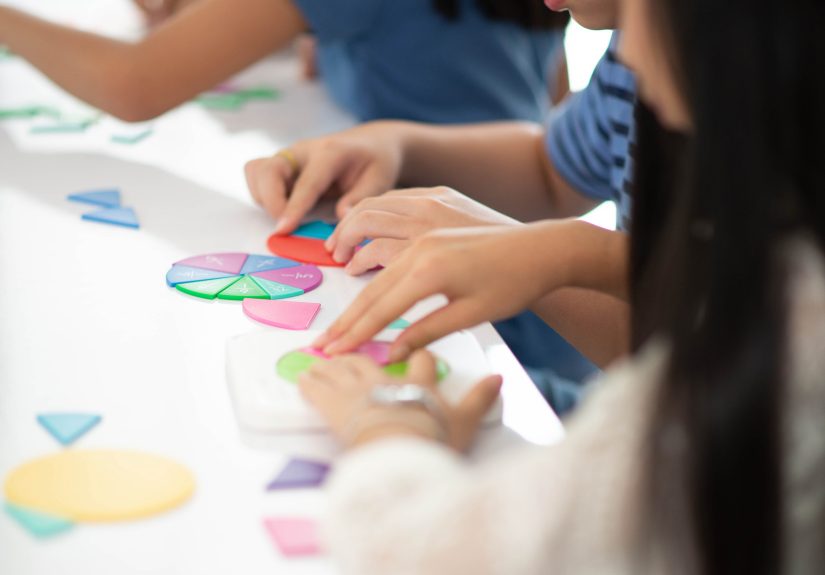
Encourage students to use multiple representations: drawings, number lines, arrays, manipulatives, and equations. Concrete materials like counters, base-ten blocks, and fraction tiles support access for a wider range of learners and make it easier for students to “see” and demonstrate their thinking to peers. Research suggests that manipulatives, when used consistently and purposefully, increase engagement and conceptual understanding.
4. Leverage Students’ Prior Knowledge
Students bring a surprising amount of informal math knowledge from everyday life: splitting snacks, comparing prices, tracking game scores, estimating time. By asking questions like, “Where have you seen this kind of situation before?” or “How would you solve this if it were about your favorite game?” teachers invite students to connect new ideas with familiar contexts.
When students see that their life experiences are valid starting points for mathematical reasoning, they are more likely to speak up, share, and assume an expert role with confidence.
Common Challengesand How to Handle Them
“But My Students Aren’t Ready to Be Experts”
It’s completely normal to feel that your students are too quiet, too off-task, or too dependent on you to suddenly take center stage. The key is to start small:
- Choose one routine (like peer checking) and introduce it gradually.
- Model what productive help looks like: asking questions rather than giving answers.
- Celebrate small wins“I noticed you tried a new strategy” is just as important as “You got the right answer.”
Over time, as students experience success supporting each other, they’ll lean into the expert role more naturally.
Time Pressure and Curriculum Pacing
Many teachers worry that discussions and group work will slow them down. Ironically, taking time for students to explain and wrestle with ideas often saves time later. When learners understand concepts deeply, they need less re-teaching and are better able to apply skills in new situations. That’s particularly important in math, where misunderstandings can snowball if they don’t get addressed early.
Assessment and Grading
If you want students to value explanation and collaboration, your grading practices need to reflect that. Consider:
- Giving points for explanations, representations, and revision.
- Including reflection questions like “What strategy did you use?” or “What mistake helped you learn?”
- Using occasional group tasks where the group’s ability to communicate their solutions is part of the score.
When assessments reward expert-like behaviors, students quickly understand that their role in class goes beyond filling in blanks.
Getting Started: A Simple Roadmap
- Pick one unit where you’ll commit to a more student-centered approach.
- Choose a few high-leverage routinesmath talks, peer checking, or a help deskto support students as experts.
- Model and practice discussion norms like listening, paraphrasing, and respectfully disagreeing.
- Use a couple of rich tasks per week that invite multiple strategies and require explanation.
- Reflect with students on how these changes feel and what helps them learn best.
You don’t have to transform your entire math program overnight. Every time you shift a bit of authority to studentsletting them verify answers, lead explanations, or pose questionsyou’re building a culture where everyone can be an expert in math.
Real-World Experiences: What It Feels Like When Students Become the Experts
Theory is great, but what does this actually look and feel like on a Tuesday morning when the coffee has barely kicked in and someone has already lost their pencil? Let’s walk through a few snapshots drawn from real classroom experiences that reflect the “students as experts” mindset.
In one fifth-grade classroom, the teacher starts the day with a short math talk. The prompt is simple: “Find 3/4 of 24.” Students think silently, then share their answers and strategies. One student explains how they divided 24 into four groups, then took three of them. Another used multiplication: “I did 24 × 0.75.” A third drew a bar model. Instead of the teacher deciding whose method is “best,” the class compares each strategy, debating which is most efficient and why. As they talk, the teacher records their reasoning on the board, but the voices doing the heavy lifting belong to the students.
Later in the lesson, students work in small groups on word problems involving fractions. At the “Math Help Desk” in the corner, two students are on rotation as peer coaches. They aren’t there to hand out answers; their job is to ask questions like, “What have you already tried?” and “Can you show me with a picture?” One student arrives looking frustrated: “I don’t get this one at all.” After a few minutes of discussion and sketching out the problem together, she walks away saying, “Ohhh, OK, so I just need to find half of the half.” She returns to her group ready to explain it, effectively becoming the expert for that problem.
In a middle school algebra class, the teacher tries a “gallery walk” with systems of equations. Each group solves a different problem and posts their work around the room. Students circulate, leaving sticky notes with comments and questions: “Why did you choose substitution instead of elimination?” or “Could you have graphed this instead?” The teacher doesn’t correct every error right away; instead, they ask groups to revise their posters based on peer feedback. By the end of class, the walls are filled with improved solutions and evidence of deep mathematical conversation.
Teachers who have adopted this approach often report that the shift is as emotional as it is instructional. At first, it can feel risky to let students lean so heavily on one another, especially if you were trained to maintain tight control over every step. But many describe a turning point: a quiet student leading a brilliant explanation at the board, a group rallying around a peer who used to give up quickly, or a class collectively catching and fixing a mistake without the teacher saying a word.
Students notice the difference too. When asked what they like about math in a more student-centered classroom, they often say things like, “We actually talk about how we think,” “If I don’t get it, someone in my group can help,” and “I don’t feel dumb for asking questions because everyone explains stuff.” For students who previously labeled themselves “bad at math,” these experiences can be transformative. It’s hard to cling to that identity when your classmates keep turning to you and saying, “Can you show us how you did that?”
None of these classrooms are perfect. There are still off-task moments, incomplete assignments, and days when a lesson falls flat. But in rooms where students are consistently treated as budding experts, the long-term trajectory shifts. Instead of learning to wait for the teacher’s next step, students learn to lean on one another, trust their own reasoning, and see math as something they actively donot something that happens to them.
That’s ultimately the promise of positioning students as experts in math class: not just higher test scores or nicer-looking notebooks, but young people who walk out of your classroom believing, deep down, “I am a mathematician, and my ideas matter.”