Table of Contents >> Show >> Hide
- Table of Contents
- What the video actually confirms (and what it can’t)
- What is the Switchblade-600, in plain English?
- How it likely got to Ukraine: a quick timeline
- Why “tank-busting” is headline fuel
- Reality check: the limits nobody puts in the thumbnail
- What confirmation means for the U.S., allies, and defense industry
- The ethics and policy questions that don’t fit in a 30-second clip
- FAQ: common questions about Switchblade-600 and loitering munitions
- Experience section: living in the “confirmation video” era
- Wrap-up
If you’ve spent any time online during the war in Ukraine, you’ve seen the same pattern play out a thousand times: a short clip appears,
commentators declare it “game-changing,” and the internet promptly turns into a courtroom where everyone is simultaneously the judge, jury,
and self-appointed wing-sweep inspector.
That’s why a simple “wreckage video” can matter. Not because scraps of hardware show the full story (they don’t), but because confirmation
changes the conversation from “maybe someday” to “this is actually in the theater.” In this case, the video in question has been widely
treated as the first solid, visual confirmation that the U.S.-made Switchblade-600 loitering munitionoften described as “tank-busting” in
headlinesmade it onto the battlefield in Ukraine.
Let’s unpack what the video does (and doesn’t) prove, why the Switchblade-600 is different from smaller “kamikaze drone” systems, and what
its confirmed appearance says about modern drone warfarewhere the invisible fight against jamming can matter as much as the visible flight
path in a clip.
What the video actually confirms (and what it can’t)
The biggest reason this “confirmation” moment landed is pretty simple: it moved the Switchblade-600 from rumor and procurement updates
into the category of “identified in-the-wild.” Reporting on the clip described it as footage of aftermathhardware visible on the ground
and noted that some observers initially misidentified the system as a different loitering munition before analysts pointed to external
design differences (yes, drone nerds really do argue about tail shapes the way car people argue about headlights).
So what does that confirm?
- Presence: It strongly supports that Switchblade-600 systems were in Ukraine and used in combat conditions.
-
Timing: It aligns with the broader story that the larger Switchblade-600 took longer to arrive than the smaller
Switchblade-300, which had been discussed earlier in the war. -
Relevance: It signals that U.S.-supplied loitering munitions are not just a press-release bullet point; they’re part of
the evolving drone ecosystem on the battlefield.
And what can’t a single video prove?
- Scale: One confirmed sighting doesn’t tell you how many systems are in country or how widely they’re being used.
- Effectiveness: A clip rarely tells you success rates, mission outcomes, or how often drones are lost to countermeasures.
-
Who “wins”: Tech isn’t magic. A capability can be real and still be constrained by training, logistics, or electronic
warfare.
Think of it like spotting a rare sports car in a parking lot. It proves the model exists in your city. It does not prove everyone is now
commuting in a Lamborghini.
What is the Switchblade-600, in plain English?
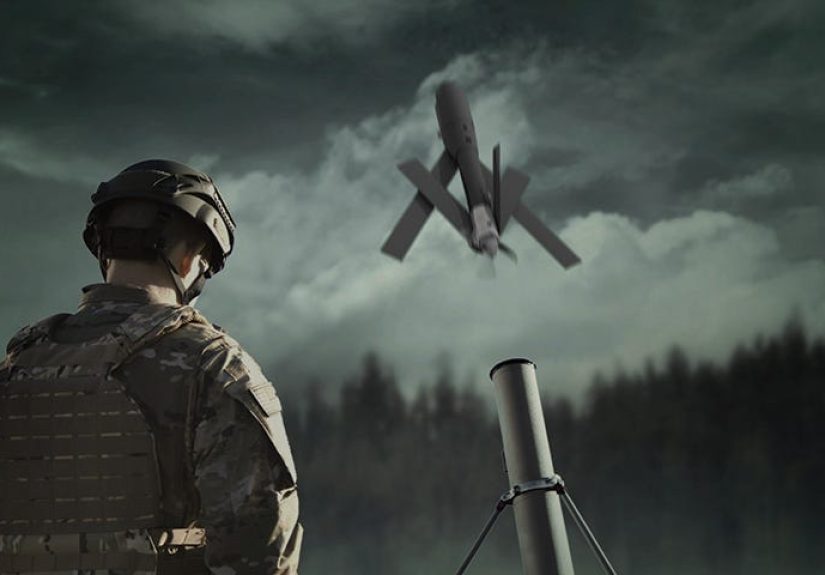
The Switchblade-600 is a loitering munition, sometimes called a “kamikaze drone” in popular coverage. The key idea is in
the word loiter: it can fly and wait while an operator searches for a target using onboard sensors. Unlike a typical drone that
drops a munition and returns home, a loitering munition is designed for a one-way mission once committed.
What makes the 600 different from the smaller 300?
In broad terms, the smaller Switchblade-300 is optimized for shorter-range use and lighter targets, while the Switchblade-600 is built for
longer range and heavier, hardened targets (the type of targets that get described with words like “armored” and “protected”).
-
Endurance and range: Public materials describe the Switchblade-600 as having roughly 40+ minutes of
endurance and tens of kilometers of range (exact performance depends on conditions and is often discussed differently
across public sources). -
Sensors and operator control: The system is commonly described as operator-controlled with electro-optical/infrared
sensing, allowing identification before a strike decision. -
Purpose: The “tank-busting” label refers to its anti-armor roledesigned to threaten armored vehicles more credibly than
smaller systems.
The best mental model is: portable precision + time to look. The “time to look” part is strategically important in a war
where targets can appear, disappear, and get covered by smoke, terrain, or decoyssometimes in minutes.
And yes, the name “Switchblade” is a branding home run. It’s punchy, it’s memorable, and it sounds like it should come with a warning label
on the box. (To be fair, it doesjust not the fun kind.)
How it likely got to Ukraine: a quick timeline
The Switchblade story in Ukraine is a classic “fast war meets slower procurement” tale. Public reporting and official releases suggest a
phased progression: early announcements about Switchblade systems broadly, early focus on smaller variants, and later attention to the
larger Switchblade-600 as contracts and deliveries matured.
2022: Announcements, urgency, and the long shadow of contracts
In spring 2022, U.S. military aid packages publicly referenced Switchblade systems as part of broader security assistance. At that point,
multiple defense outlets reported that the larger Switchblade-600 was not yet in Ukraine and that contracting and delivery timelines were
still being worked out.
Mid-2022: Switchblades are in the assistance totals
U.S. Department of Defense fact sheets later listed 700+ Switchblade Tactical Unmanned Aerial Systems among committed
assistance totals. These tallies did not always separate variants, which matters because the 300 and 600 serve different roles and have
different availability.
2023: A bigger package, and then a “first confirmed” moment
By early 2023, major U.S. outlets reported on packages that specifically mentioned more advanced small drones, including the Switchblade-600.
In April 2023, reporting tied to the now-famous clip treated it as the first clear confirmation that the “tank-busting” Switchblade-600 had
been used in Ukraine.
2024–2025: From “sent to Ukraine” to “built into U.S. force planning”
After Ukraine helped demonstrate what loitering munitions can do in modern combat, U.S. planning accelerated. Reporting in 2024 described
the Pentagon selecting Switchblade-600 under the Replicator initiative and the Army expanding procurement and testingsignaling a shift from
emergency assistance to scaled acquisition and institutional learning.
The big takeaway: the “video confirmation” isn’t just gossip. It’s a milestone in a supply-and-adaptation chainaid, field experience,
countermeasures, upgrades, and then broader adoption.
Why “tank-busting” is headline fuel
“Tank-busting” is one of those phrases that can make any defense technology sound like a movie trailer. But the underlying point is real:
modern armored vehicles are difficult to defeat, and anti-armor capabilities have outsized psychological and tactical value.
Why armor matters in Ukraine’s war
Armor still plays major rolessupporting assaults, moving troops, and anchoring defensive positions. Even when tanks aren’t charging across
open fields like it’s 1943, armored vehicles can be durable, mobile firepower. The ability to threaten them at distance changes planning:
it complicates movement, slows tempo, and can push forces into more cautious routes or formations.
Why loitering munitions are different from a traditional missile
A traditional anti-armor missile is fast and direct. A loitering munition is slowerbut has something missiles don’t: time.
Time to search. Time to confirm. Time to abort if the situation changes. In the abstract, that means fewer rushed decisions and potentially
more precise engagementsthough in practice, the battlefield is never as neat as product brochures.
In other words: the “wow” factor is not only the punch. It’s the combination of reach + observation + precision, packed into a
system that’s far more portable than many traditional long-range strike options.
Reality check: the limits nobody puts in the thumbnail
If you only learn about drones from viral clips, you’d think the battlefield is a smooth runway where every device flies perfectly and
every target politely holds still. Real war is messierand drone warfare is basically a competitive sport between
adaptation and counter-adaptation.
Electronic warfare is the quiet villain of the drone era
One of the most consistent themes from reporting on Ukraine is that jamming and electronic warfare can degrade drone
effectiveness. The drone doesn’t need to be “shot down” to be neutralized; interference can break links, distort navigation, or force
operators to change tactics. Public reporting has indicated that early experiences with some systems ran into heavy jamming, and that
software updates plus improved training helped mitigate (not eliminate) the problem.
Training and integration matter more than the spec sheet
A loitering munition is not just “a drone in a tube.” It’s a mini kill chain: spotting, identifying, coordinating, and deciding under time
pressure. Even a highly capable tool can underperform if units lack training time, spare parts, or a reliable way to integrate it into
broader reconnaissance and artillery workflows.
Numbers matter
A single confirmed use doesn’t mean ubiquity. Availability is shaped by production rates, contracts, shipping, maintenance cycles, and the
simple fact that wars consume equipment quickly. The U.S. and allies have wrestled with scaling production for multiple munition types, and
loitering munitions are part of that broader industrial story.
So yes: the Switchblade-600 can be a meaningful capability. But it is not a cheat code.
What confirmation means for the U.S., allies, and defense industry
Once a system is confirmed in combat, the discussion tends to shift from “Should we send it?” to “How do we scale it, harden it, and train
around it?” Ukraine has effectively become a harsh classroom for drone warfare lessonsespecially around electronic warfare resilience,
rapid iteration, and the value of relatively low-cost precision at scale.
Replicator and the push to scale unmanned systems
Reporting in 2024 described the Pentagon selecting Switchblade-600 as an early publicly confirmed buy under the Replicator initiativean
effort aimed at fielding large numbers of uncrewed systems quickly. That matters because it signals institutional momentum: not just aid to
Ukraine, but a rethinking of what the U.S. military wants in its own inventory.
The Army’s testing and procurement pipeline
By 2023–2025, coverage in U.S. defense press described the U.S. Army ordering Switchblade-600 for testing and moving toward larger buys.
That’s how battlefield lessons become doctrine: trials, feedback, updates, procurement, and training cycles that turn “interesting tech” into
“standard capability.”
Industrial scaling and updates
Defense industry reporting has also emphasized a familiar pattern: systems meet stronger countermeasures in high-intensity combat, then get
software updates, upgraded training, and iterative improvements. In drone warfare, that upgrade loop can be as important as the original
hardware.
In short, the video confirmation is not just a “Ukraine story.” It’s part of a larger shift toward loitering munitions becoming normal
tools in modern arsenals.
The ethics and policy questions that don’t fit in a 30-second clip
The rise of loitering munitions sits right on the border between “remotely piloted weapon” and a future where autonomy plays a larger role.
Even when a system is operator-controlled, the trajectory of warfare technology raises uncomfortable questions:
- How much decision-making should ever be delegated to software?
- How do militaries ensure accountability and compliance with the laws of war?
- How do we prevent proliferation and misuse?
The war in Ukraine has intensified global debates over “killer robots,” AI-assisted targeting, and how regulations might evolve. These
questions are not abstract: they shape procurement, training standards, and how governments communicate about the systems they deploy or
provide to partners.
And if it feels weird that a viral drone clip can lead to policy conversations at think tanks and ministries? Congratulationsyou have
correctly identified 2026 as a strange time to be alive.
FAQ: common questions about Switchblade-600 and loitering munitions
Is the Switchblade-600 fully autonomous?
Public descriptions generally frame it as operator-controlled, with the operator making the final engagement decision. Discussions of
autonomy in warfare are broader than any single platform, but the Switchblade-600 is commonly presented as a system where human control is
central.
Why does video confirmation matter if aid was already announced?
Announcements tell you intent. Confirmation tells you arrival and use under battlefield conditions. Those are different milestonesespecially
when timelines, contracts, and production constraints are involved.
How is this different from the cheap FPV drones we hear about?
FPV drones are often improvised or rapidly adapted and can be produced at scale, but they typically have shorter ranges and different sensor
packages. Systems like Switchblade-600 are purpose-built loitering munitions with specific performance targets, integration requirements,
and procurement pathways.
Does “tank-busting” mean it guarantees a kill?
No. It means the system is designed for an anti-armor role. Real-world effectiveness depends on conditions, countermeasures, target
protection, operator training, and many other variables.
What’s the biggest lesson from Ukraine’s drone war so far?
Probably this: drones are now a mass ecosystem, not a niche tool. And electronic warfare, training, and rapid iteration can matter as much
as any single platform’s headline-grabbing capabilities.
Experience section: living in the “confirmation video” era
There’s a peculiar modern experience that didn’t really exist at scale in earlier wars: watching major battlefield technology “arrive”
through the internet’s strange little ritual of verification. A government announces a capability. Commentators argue about whether it’s in
theater. Months pass. Then one day, a clip appearsgrainy, brief, often lacking contextand suddenly the debate isn’t “Is it coming?” but
“It’s here; now what?”
For analysts and defense reporters, this is both useful and exhausting. Useful because open-source intelligence (OSINT) can help confirm
presence, identify equipment, and track trends without relying solely on official statements. Exhausting because the same dynamics that make
OSINT powerfulfast sharing, many eyes, collaborative scrutinyalso make it vulnerable to misidentification and hype. One person posts a
confident claim, ten accounts repeat it, and a hundred people form opinions before anyone asks the most basic question: “Are we sure this is
the right system?”
The Switchblade-600 “confirmation” discourse highlights that tension perfectly. The core idea is simple: people saw evidence consistent with
a specific loitering munition, and specialists pointed out design cues that separated it from similar-looking platforms. But around that
simple core, the internet did what it always doesbuilt a whole cinematic universe. Suddenly, you’re not just talking about a single
confirmed system. You’re talking about “turning points,” “silver bullets,” and “the end of tanks,” as if one platform can rewrite the
physics of combined-arms warfare.
Meanwhile, the battlefield experience behind the clipwhat it’s like to rely on drones in a high-electronic-warfare environmentrarely gets
the same attention. In Ukraine, drones are not just gadgets; they’re part of a daily rhythm of surveillance, adaptation, and caution.
Operators and units have to assume that signals can be disrupted, that skies can be watched, and that yesterday’s reliable technique may be
tomorrow’s failure. That produces a mindset that’s half engineering, half street smarts: keep learning, keep updating, keep changing your
routines before the other side learns them.
There’s also a quieter emotional side to “confirmation videos.” For distant audiences, these clips can feel like sports highlightsa clean
“before/after” story that invites commentary. But wars are not sports, and hardware is never the whole picture. That’s why responsible
reporting tends to focus on capability and policy rather than sensationalizing impact. It’s possible to discuss what a system doeshow it
extends reach, how it changes risk calculationswithout treating conflict like entertainment.
For policymakers and defense planners, the experience is different again. A confirmed combat appearance can function like a real-world test
result. It pushes questions up the chain: Is the system resilient? Can it be produced quickly? Does training need to change? Are software
updates required? What countermeasures are proving effective? Those questions eventually lead to bigger programslike Replicatoror to
expanded Army testing and procurement. This is how “a clip on the internet” can ripple into budgets, doctrine, and industrial planning.
The weirdest part is that all of these experiencesOSINT debates, operator realities, policy shiftscan be triggered by the same tiny spark:
a few seconds of video and a pile of wreckage. In the “confirmation video” era, modern warfare isn’t just fought in fields and cities; it’s
also interpreted, misinterpreted, corrected, and reinterpreted online in near real time. If that sounds chaotic, that’s because it is.
Welcome to the new normalwhere even a tail-fin silhouette can start an argument, end an argument, and restart the argument all in the same
afternoon.
Wrap-up
The confirmed appearance of the Switchblade-600 in Ukrainevia widely discussed video evidencematters less as a viral moment and more as a
strategic signal. It suggests that a longer-range, anti-armor loitering munition moved from procurement plans into operational use, and it
reinforces what the war has made painfully clear: drones and counter-drones are now central to modern combat, and electronic warfare is the
constant shadow over every “amazing” clip.
If you take one lesson from the Switchblade-600 story, make it this: the future of warfare is not a single miracle weapon. It’s an
ecosystemplatforms, sensors, training, jamming, software updates, and industrial capacitymoving at internet speed, but built on supply
chains that definitely do not.