Table of Contents >> Show >> Hide
- The Story: A 1960s Gem Above Tomales Bay
- Commune’s Vision: Organic Architecture, Turned Up
- A Material Palette Drawn from West Marin
- Reimagined Layout for Modern Living
- Craft, Vintage, and the “Collected Over Time” Effect
- A Retreat Aligned with Slow Living & Sustainability
- Design Lessons You Can Steal for Your Own Home
- Living the West Marin Dream: Experiential Perspective (Extended)
- Conclusion
Perched above Tomales Bay in Northern California, the West Marin Retreat is the kind of house that makes even the fog feel like a design feature.
Originally built in the early 1960s by local architect Alex Riley as his own compact hideaway, the property evolved over the decades with a primary suite
and guest house added later. When the current owners took over, they didn’t want a museum piece. They wanted a soulful, lived-in retreat that honored Riley’s
organic architecture while feeling unmistakably theirs. Enter Commune Design, the Los Angeles–based studio known for turning good bones into quietly iconic spaces.
The result is a renovation that doesn’t shout. It hums. Commune leans into West Marin’s rugged landscape, the house’s low-slung geometry, and a palette of
honest materials to create a retreat that is equal parts midcentury, bohemian, and deeply Californian. This is a design story about respecting history,
layering character, and proving that restrainthandled by the right peopleis its own luxury.
The Story: A 1960s Gem Above Tomales Bay
The original 1,000-square-foot structure sat lightly on the hillside, oriented to frame the bay and hills rather than dominate them. Riley’s approach was rooted
in the principles of organic modernism: low profiles, warm woods, deep overhangs, and carefully edited openings that choreograph light and views. Over time,
an owner-commissioned primary suite and guest house extended the compound while keeping the architecture modest and context-driven.
By the time Commune arrived, the charm was intact, but the program needed a reset. The ownersimmersed in design, food, and filmneeded better flow for hosting,
more storage that didn’t kill the architecture, and interiors that matched how they actually lived: casual, tactile, layered, and quietly cinematic.
Commune’s Vision: Organic Architecture, Turned Up
Commune Design approached the West Marin Retreat with a simple but uncompromising brief: keep the spirit, deepen the experience. Rather than erase Riley’s work,
they clarified it. Sightlines were cleaned up, awkward transitions tightened, and every decision treated the original structure as collaborator, not obstacle.
The design language is what Commune does best: warm modernism grounded in craftsmanship. The rooms feel curated but not precious; they’re the kind of spaces
where you can pour a great natural wine, cook for a crowd, leave a book on the table, and nothing looks “ruined”it just looks real.
A Material Palette Drawn from West Marin
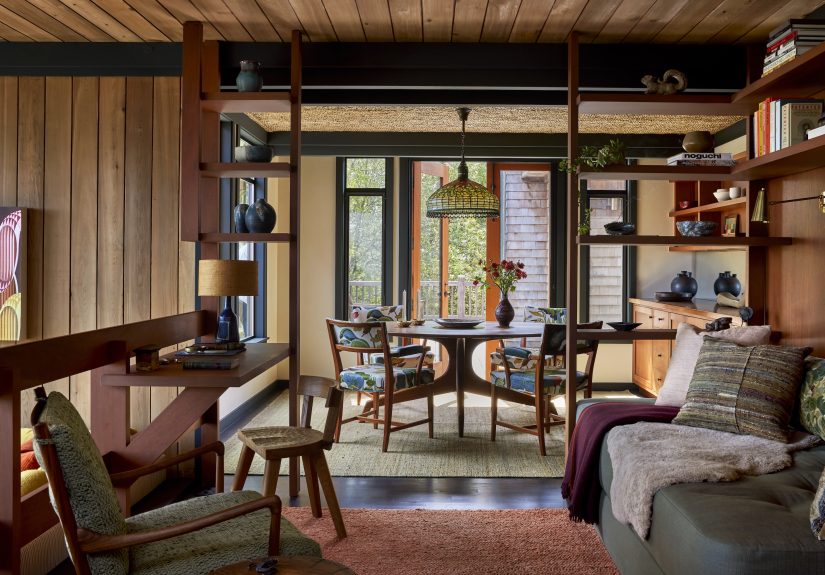
Step inside and the landscape follows. Commune leans into a palette that tracks directly with West Marin’s surroundings: weathered woods, foggy neutrals,
bay-water blues, mossy greens, and the warm notes of coastal soil.
Wood, Limewash, and Quiet Texture
Original wood paneling is refinished instead of replaced, gaining depth and subtle sheen. Walls in key rooms are treated with limewash, softening light and
giving surfaces a matte, almost hand-hewn quality that plays beautifully against clean-lined cabinetry and metal details. Floors are refreshed rather than
over-styled, allowing patina to read as a feature, not a flaw.
Stone, Metal, and Natural Fibers
Natural stone, unlacquered brass, sisal, wool, and linen show up throughout the retreat. The mix is tactile and durable: a kitchen that can handle
serious cooking, a mudroom that tolerates sandy boots, living spaces that welcome dogs, friends, and the occasional storm watch. Materials age in sync with
the climate, creating an authenticity that glossy surfaces can’t fake.
Reimagined Layout for Modern Living
Commune doesn’t blow up the floor plan for drama’s sake; they fine-tune it for how the owners actually move through the day.
- Connected Social Core: The kitchen, dining, and living areas read as one cohesive volume, oriented toward bay views and anchored by low,
comfortable seating and built-in elements that visually calm the space. - Primary Suite as Sanctuary: The added wing becomes a true retreatsubdued colors, textural bedding, tailored millwork, and views
framed like landscape photography. - Guest House with Purpose: Rather than an afterthought, the guest quarters function as a self-contained hideout: relaxed, layered,
and consistent with the main house in material and tone.
Circulation is intuitive. You move from indoors to deck to hillside without theatrical gesturesjust a series of well-edited thresholds that make the
property feel larger, more considered, and effortless to live in.
Craft, Vintage, and the “Collected Over Time” Effect
One of the defining signatures of the West Marin Retreat is its use of handcrafted and vintage pieces. Commune layers in California pottery, carved wood,
woven textiles, and midcentury and 1970s furnishings that feel like they’ve been gathered over decades, not rushed in for a photoshoot.
Built-insbenches, bookcases, headboards, and storage nichesare detailed with the same care as standalone furniture. Their presence is practical (hidden
storage, display for art and books) but also architectural, giving each room a strong, integrated identity. Lighting is warm and human-scaled: shaded sconces,
simple pendants, discreet task lamps that let the evening fall softly rather than blast from the ceiling.
A Retreat Aligned with Slow Living & Sustainability
Without screaming “eco,” the renovation folds in slow-design principles that resonate with West Marin’s environmental ethos:
- Preserving the existing structure instead of starting over, a major win in embodied carbon terms.
- Using durable, repairable materialssolid woods, mineral paints, natural textilesrather than short-lived synthetics.
- Designing for cross-breezes, daylight, and orientation so the home relies more on its site than on systems.
The effect is subtle but powerful: a house that feels both luxurious and low-key, perfectly in tune with its rural coastal setting.
Design Lessons You Can Steal for Your Own Home
You may not own a hillside retreat above Tomales Bay (tragic, frankly), but the principles behind this project scale beautifully to regular houses and
city apartments.
1. Honor What’s Already Working
Instead of erasing your home’s quirks, identify the strong boneswindow placements, original floors, a weirdly great built-inand design around them.
Commune’s respect for Riley’s architecture is a reminder that thoughtful edits often beat dramatic overhauls.
2. Choose a Landscape-Inspired Palette
Pull colors from your surroundings: the sky after rain, local stone, tree bark, earth tones. A tight palette across rooms, as seen in West Marin, builds
calm continuity and instantly feels intentional.
3. Layer Craft and Vintage for Soul
Mix in handmade objects, vintage lighting, or a single well-chosen midcentury chair instead of buying everything new. The West Marin Retreat shows how this
strategy creates emotional depth without visual noise.
4. Design Built-Ins That Do the Quiet Work
Thoughtful millwork hides clutter, frames views, and makes small rooms feel tailored, not cramped. Even a simple wall-length bench with storage can turn an
ordinary room into a “stay a while” space.
5. Keep the Tech Invisible
Part of the retreat’s magic is how analog it feels, even if it’s fully wired. Tuck speakers, routers, and screens away so materials, light, and landscape
remain the stars.
Living the West Marin Dream: Experiential Perspective (Extended)
Imagine waking up in the primary suite: the limewashed walls catch the first gray-blue light off Tomales Bay, and the wood ceiling gives the room a grounded,
almost cabin-like calm. There’s no screaming alarm clock, just the muted sound of wind and distant water. This is where the renovation really proves itself
it’s not just photogenic; it’s emotionally tuned.
You pad across warm wood floors into a bathroom where the finishes feel tactile but unfussy: a stone ledge, a simple plaster wall, a handmade sconce.
Nothing is over-designed, and yet every line has been considered. Commune’s skill is making everyday rituals feel elevated without turning them into theater.
In the kitchen, the layout is built for people who actually cook. Counter space is generous, storage is concealed but accessible, and open shelves display
pieces worth looking atceramic bowls, heavy glasses, a few copper pots that earn their keep. You can host friends for a long lunch without tripping over
anyone, and the transition to the deck feels seamless: doors open wide, and the bay becomes part of the backdrop for everything from oysters to pasta to
late-afternoon cocktails.
Guests staying in the separate quarters get their own West Marin experience: cozy bedding, layered textiles, a reading lamp that invites them to linger.
The spaces match the main house in tone but never feel like copy-paste. That consistency across the compound is what keeps the property reading as a single
narrative instead of a collection of random upgrades.
As fog rolls back in, the house shifts gear. Warm pools of light from sconces and lamps pick up the honeyed tones of wood and textiles. You notice how
the renovation anticipates evening life: places to curl up with a film, tables for board games, corners that are lit just enough for a book and a blanket.
It’s cinematic, but quietly soappropriate for owners whose work and interests live in the worlds of story, food, and image.
That lived experience offers useful guidance for anyone renovating:
- Design for sequences, not snapshots. Think about how your home feels at 7 a.m., noon, 5 p.m., and midnight. Commune’s renovation works
because each moment has been considered. - Invest in touchpoints. Door hardware, handrails, faucet levers, dining chairsthese small-contact elements subtly define how “rich” a
space feels over time. - Plan for hosting as you actually do it. If you love long-table dinners, shape your dining area and kitchen around that reality. If your
life is more tea-for-two than parties-for-20, design intimately instead of aspirationally. - Allow patina. The West Marin Retreat feels inviting because nothing is too fragile. Choose finishes that welcome use, not just admiration.
In the end, the West Marin Retreat by Commune Design is less about spectacle and more about calibration: between old and new, rugged and refined, private and
shareable. It’s a blueprint for how to renovate with integrityand how to create a retreat that genuinely earns the right to be called home.
Conclusion
This renovation succeeds because it doesn’t chase trends or overcompensate. It respects a 1960s architectural original, aligns with the wild beauty of West Marin,
and channels Commune Design’s finely tuned eye for material, craft, and mood. For homeowners and designers alike, it stands as a compelling case study in how to
transform an existing property into a deeply personal, enduring retreat without losing its soul.
SEO Summary
sapo: Discover the story of a 1960s hillside house above Tomales Bay, originally designed by Alex Riley and thoughtfully reimagined by Commune Design
into a warm, handcrafted California retreat. From limewashed walls and refinished wood to custom millwork, vintage pieces, and landscape-driven palettes, this renovation
shows how to honor original architecture while tailoring every space to modern life, slow living, and effortless hostingoffering rich design lessons you can apply at home.