Table of Contents >> Show >> Hide
Laundry is already doing the mostsorting, soaking, spinning, and somehow eating one sock per week.
The least we can do is make the room it lives in feel a little less “utility closet energy” and a little more
“I might actually fold this pile today.” The good news: laundry room decor isn’t about fancy stuffit’s about
smart choices that make the space easier to use, nicer to look at, and harder to mess up (even on chaotic Tuesdays).
This list mixes style and function on purpose, because the prettiest laundry room in the world is still annoying
if you don’t have a place to set a basket. Use these ideas as a menu: pick 5 that solve real problems, then add
2–3 purely for joy. That’s not “extra.” That’s survival.
Before You Decorate: A Quick Cheat Code
- Fix the workflow first: sort → wash → dry → fold → put away (or at least “contain neatly”).
- Give every item a home: detergents, stain tools, baskets, hangers, lint rollers, lost socks.
- Choose moisture-friendly finishes: washable paint, wipeable surfaces, and rugs that can take a spill.
- Pick one style direction: bright + clean, cozy farmhouse, modern minimal, bold pattern, or vintage charm.
37 Laundry Room Decor Ideas (Pretty, Practical, and Copy-Pasteable)
Walls, Color, and Personality
-
Paint it a “happy color.”
A laundry room is a perfect place to go bolder than the rest of your house. Try deep blue, sage green, or even a cheerful blushthen keep trim crisp for balance. -
Add peel-and-stick wallpaper.
Instant personality, minimal commitment. Use it on one accent wall, behind shelves, or inside cabinet backs for a “surprise” moment. -
Try beadboard or wainscoting.
It adds texture and makes the room feel finished. Bonus: it hides scuffs from baskets and vacuum bumps better than flat drywall. -
Create a mini gallery wall.
Frame laundry-themed art, vintage botanical prints, or black-and-white photos. Keep frames consistent so it looks curated, not chaotic. -
Hang one oversized statement piece.
If your room is tiny, one big piece beats ten small ones. Think: a large framed print or a playful typography poster. -
Add a pinboard or magnetic board.
Use it for stain-removal cheat sheets, care-label reminders, and the “mystery sock adoption program” announcements. -
Install wall hooks that look intentional.
Matching hooks = instant order. Great for delicates, bags, aprons, and “I wore it once” clothes that aren’t dirty but are definitely not clean.
Floors and Lighting That Don’t Feel Like a Basement
-
Use a washable runner.
A soft runner makes the room feel cozy and saves your feet during long folding sessions. Choose low-pile and easy-clean materials. -
Go bold with patterned floor tile (or a tile-look option).
Small rooms can handle pattern beautifully. If you’re renovating, tile is great; if not, consider durable, water-friendly floor coverings. -
Upgrade to a statement light fixture.
Swap the builder-grade dome for something with personalityschoolhouse, pendant, or a sleek flush mount. -
Layer lighting for real visibility.
Overhead light is good; task lighting is better. Add an under-shelf LED strip so you can actually see stains (and stop re-washing “clean” shirts). -
Use a mirror to bounce light.
A framed mirror makes small laundry rooms feel bigger, brighter, and oddly more “room-like,” especially in hall or closet setups.
Storage That Looks Like Decor
-
Install floating shelves above machines.
Use them for pretty baskets, labeled jars, and folded linens. Keep frequently used items at arm height, not “step-stool Olympics” height. -
Decant supplies into matching containers.
Clear jars for pods and clothespins, pump bottles for detergentsuddenly your shelves look boutique, not chaotic. -
Use labeled baskets for categories.
Try: “Stain Tools,” “Delicates,” “Cleaning Cloths,” “Spare Sheets,” “Lost & Found.” Labels turn clutter into a system. -
Add a slim rolling cart.
Perfect for tight spaces beside machines. Use it for sprays, dryer sheets, and a small bin for “things that belong upstairs.” -
Hang a pegboard for vertical organization.
Add hooks, small shelves, and hanging cups for scissors, lint rollers, and sewing kits. Functional, flexible, and oddly satisfying. -
Use wall-mounted drying racks.
Fold-down racks save floor space and look tidy when closed. Great for sweaters, delicates, and anything that would rather not meet the dryer. -
Install behind-the-door storage.
Over-the-door shelves or hooks can hold small supplies, extra towels, or an ironing spray station without taking up wall space. -
Try cabinet “inserts” that do the work for you.
Pull-out hampers, tilt-out bins, and drawer dividers keep the room looking calm even when life is not. -
Add open cubbies for towels and linens.
Cubbies feel “mudroom-chic,” and they make sorting and grabbing easy. Mix baskets and folded stacks to keep it visually balanced.
Countertops, Folding Zones, and Work Surfaces
-
Build a simple countertop over front-loaders.
Butcher block or a sealed wood top turns “two machines” into “one long folding station.” Add a small tray for essentials. -
Create a drop zone tray.
A shallow tray keeps keys, stain pens, and pocket findings from migrating across the room (or into the washer, never to be seen again). -
Add a small stool that looks cute.
Handy for reaching shelves, pre-treating stains, or perching while waiting for the spin cycle to finish telling you its life story. -
Install a hanging rod for drip-dry and “hang immediately.”
Mount it under shelves or between cabinets. This is the secret to fewer wrinkles and fewer “I forgot it in the dryer” tragedies. -
Upgrade your sink area like it’s a mini kitchen.
A nicer faucet, attractive soap dispenser, and a tidy towel hook make the sink feel intentionaluseful for soaking, rinsing, and quick cleanup. -
Use a backsplash that’s easy to wipe.
Subway tile, beadboard, or a durable panel protects the wall from splashes and makes the space feel designed, not temporary.
Small-Space Tricks That Make a Big Difference
-
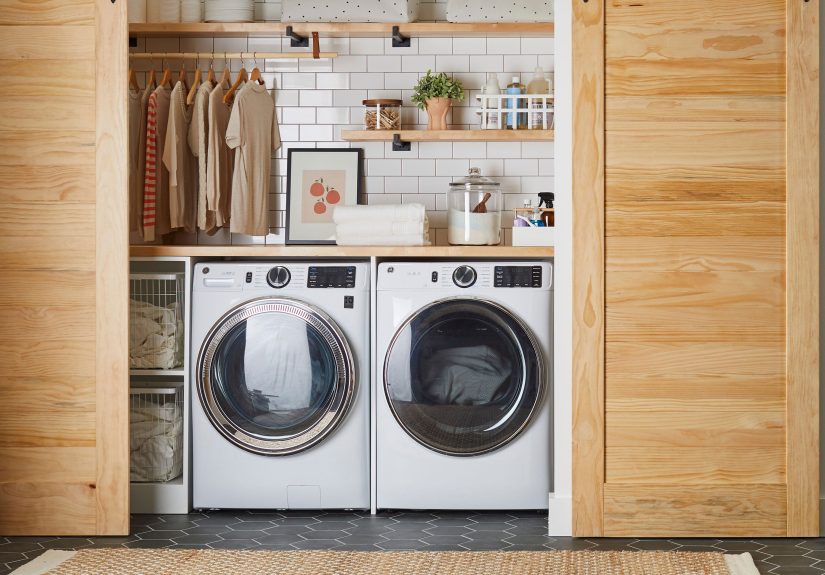
Hide a laundry closet with pretty doors.
Barn doors, bifolds, or curtains can conceal machines when the laundry area shares space with a hallway or kitchen. -
Use matching hampers for “sort as you go.”
Two or three bins (lights/darks/towels) reduce decision fatigue later. The decor win: pick hampers that match your style. -
Put the most-used items at “one-hand reach.”
A small wall caddy near the washer for pods, stain spray, and mesh bags prevents constant cabinet rummaging. -
Make the corners useful.
Corner shelves or a corner rod can turn dead space into storage. Small room math: corners are free real estate. -
Try stacking appliances (if your layout needs it).
When floor space is limited, going vertical can free up room for shelves, a folding surface, or even a small hanging zone. -
Use a fold-down ironing board or wall station.
It disappears when not in use, which is great because ironing should not be haunting you visually at all times.
Finishing Touches That Make It Feel “Done”
-
Add greenery (real or convincing faux).
A small plant on a shelf instantly softens the room. If you’re low-light, choose a hardy plant or a quality faux option. -
Style your shelves like a grown-up.
Mix practical items (baskets, jars) with one decorative object (vase, framed print, candle) so it feels designed, not stocked. -
Use matching hardware.
Swapping knobs and pulls is a small upgrade with big impact. Choose one finish (black, brass, nickel) and repeat it throughout. -
Add a scent momentlightly.
A subtle reed diffuser or a drawer sachet can make the room feel fresh without overwhelming sensitive noses. -
Create a “sock amnesty” jar.
Put a glass jar or basket on a shelf labeled “Lonely Socks.” It’s functional, funny, and shockingly effective. -
Frame a laundry schedule (or pretend you’ll follow it).
A simple printable schedule or checklist helps busy households. Even if you only follow it 60% of the time, it still reduces chaos.
Common Decor Mistakes to Avoid (So You Don’t Redo It in Three Weeks)
- Too little lighting: if you can’t see stains, you’ll keep washing “clean” clothes.
- No folding surface: baskets will take over every flat area you own.
- Open storage with no plan: shelves are greatuntil they look like a supply closet exploded.
- Ignoring moisture: choose easy-clean finishes and leave breathing room so the space doesn’t feel damp.
Real-World “Experience” Notes: What Tends to Work in Actual Homes (About )
In real households, laundry rooms succeed when they support habits people already havethen gently nudge those habits
in a better direction. The biggest difference-makers are rarely the fanciest materials; they’re the layout choices
that remove friction. For example, a folding surface is less about aesthetics and more about preventing the classic
“clean laundry mountain” from relocating to the couch. When a countertop is right there, the pile gets folded sooner
because it’s easy, not because anyone suddenly became a folding enthusiast.
Another pattern that shows up again and again: open shelving looks amazing in photos, but only if you give it a
container strategy. Without bins, jars, or a few closed baskets, open shelves become visual noise. A good rule is
“display the pretty, hide the messy.” Put matching jars and a couple of labeled baskets at eye level, then reserve
the less-attractive stuff (bulk refills, backup cleaners) for a closed cabinet or a lidded bin. This way the room
feels styled even on busy weeks.
Small-space laundry areasespecially closetsbenefit from thinking vertically and thinking in zones. A rod for hanging
is a zone. A tiny shelf for stain tools is a zone. A basket for clean cloths is a zone. When each step has a spot,
the room stays calmer because you’re not improvising every time. People also tend to underestimate how helpful
“one-hand storage” is: a small caddy or wall-mounted bin near the washer means detergent and stain spray don’t migrate
around the house like they’re on a world tour.
Comfort matters more than it sounds. A washable runner makes a laundry room feel less clinical, which makes it a place
people don’t avoid. Better lighting (even a simple bulb upgrade and a small LED strip) makes tasks faster and reduces
re-washing mistakes. And little “joy” detailsart, a fun print, a plantactually help the room feel like part of the
home instead of a penalty box. That emotional shift is real: when the space looks cared for, people treat it better.
Finally, the most successful laundry rooms are the ones that plan for mess instead of pretending it won’t happen.
That means wipeable surfaces, baskets that can get tossed around, hooks that catch things quickly, and a “temporary
holding spot” (like a tray or a bin) for pocket clutter and lonely socks. If you design for real life, your decor
won’t just look good on day oneit’ll still look good when you’re doing your third load in a row and someone yells,
“Do we have any clean hoodies?!”
Conclusion
A stylish laundry room doesn’t require a full renovation or designer budget. Start with one “function fix” (shelves,
a rod, a counter, better lighting) and one “mood lift” (paint, wallpaper, art, or a rug). Layer in storage that
looks intentional, keep moisture and mess in mind, and give every item a home. Your laundry room will feel more
like a real roomand laundry day might not become your favorite hobby, but it can stop feeling like a weekly ambush.