Table of Contents >> Show >> Hide
- Why Turkish Special Effects Are Their Own Genre
- 1. Stolen Space Battles and Cardboard Cockpits in “Turkish Star Wars”
- 2. Karate vs. Foam Rocks and Sesame Street Aliens
- 3. Murderous Spider-Man and His Paper-Mâché Death Traps in “3 Dev Adam”
- 4. Superman on a Clothesline in “Süpermen Dönüyor”
- 5. The Cardboard Enterprise in “Turist Ömer Uzay Yolunda”
- 6. E.T.’s Cousin Made of Indoor Carpeting in “Badi”
- What These Ridiculous Effects Tell Us About Filmmaking
- Experiences: What It’s Like to Watch These Effects Today
If you think modern CGI disasters are bad, wait until you meet the glorious,
gravity-defying, copyright-ignoring special effects of classic Turkish cinema.
Long before “so bad it’s good” became a streaming category, Turkish filmmakers
were out there reverse-engineering Hollywood blockbusters with pocket change,
cardboard, and what appears to be the entire clearance rack of a fabric store.
The original Cracked.com piece “6 Hilarious Special Effects From Turkish Cinema”
helped introduce this wild world to English-speaking audiences years ago.
Think of this article as a fresh, in-depth tour of the same universe: we’ll look at
six legendary Turkish “special” effects, explain what’s actually happening on screen,
and explore why these moments still delight movie nerds today.
Why Turkish Special Effects Are Their Own Genre
To understand why Turkish special effects look the way they do, you have to zoom out
to the Yeşilçam era, roughly the 1950s through the early 1980s. This was the golden
age of Turkish popular cinema, when local studios were cranking out hundreds of
films a year on budgets that wouldn’t cover a Marvel craft-services table.
Tight schedules, low budgets, and extremely relaxed attitudes toward copyright meant
directors would “remake” Western hits by stitching together whatever they had lying
around: borrowed soundtracks, repurposed props, and, often, literal footage from the
original movie projected on a screen and re-filmed.
The result is a uniquely Turkish form of remix cinema. These films aren’t polished,
but they are energetic, shamelessly creative, and accidentally hilarious. Let’s dive
into six of the most unforgettable effects that turned Turkish genre movies into
cult classics around the world.
1. Stolen Space Battles and Cardboard Cockpits in “Turkish Star Wars”
What You See on Screen
Officially, the film is called Dünyayı Kurtaran Adam (“The Man Who Saves the
World”), but fans know it simply as Turkish Star Wars. The movie opens
with frantic space dogfights that look suspiciously familiar: X-wings, TIE fighters,
and explosions straight out of Star Wars race across the screen, while two
Turkish pilots bark technobabble in front of shaky cockpit sets that resemble a
spray-painted washing machine.
The difference is all in the seams. The grain, color, and lighting change from shot
to shot. One moment you’re in a Hollywood blockbuster; the next, you’re watching two
guys in motorcycle helmets sitting in a plywood box on a soundstage that looks like
it shares a wall with a grocery store.
How They Pulled It Off
The filmmakers simply projected Star Wars onto a screen, pointed a camera at
it, and edited those shots into their movie alongside their own footage. No subtlety,
no wink, just pure “we needed a space battle and Lucas already made a perfectly good
one” energy.
Technically, it’s a copyright nightmare. Culturally, it’s become a legendary example
of how far filmmakers will go when they want spectacle but only have a shoestring
budget and a dream.
2. Karate vs. Foam Rocks and Sesame Street Aliens
What You See on Screen
Later in Turkish Star Wars, our hero crash-lands on a rocky desert planet
that looks a lot like Cappadocia because it is Cappadocia. The film turns this
real-world landscape into an alien arena by populating it with monsters that look
like rejected mascots from a kids’ show and stuntmen in fursuits that barely fit.
Our hero spends long stretches of the film doing intense martial arts training with
boulders clearly made of foam. He lifts rocks that wobble, punches enemies who react
half a second too late, and slices creatures that look like off-brand Muppets. At one
point, a monster is karate-chopped in half like a piñata filled with old couch
stuffing.
Why It Weirdly Works
The choreography is surprisingly committed. Turkish action star Cüneyt Arkın throws
himself into every leap, flip, and punch as if he’s in a serious martial arts epic,
even while wrestling something that looks like it escaped from a children’s
birthday party.
The contrast between the earnest physical performance and the bargain-basement
creature design is what makes it so funny. It’s not trying to be campy; it’s trying
to be epic and overshoots straight into comedy.
3. Murderous Spider-Man and His Paper-Mâché Death Traps in “3 Dev Adam”
What You See on Screen
3 Dev Adam (“Three Giant Men”) is an unauthorized crossover where Captain
America and Mexican wrestler El Santo team up to fight a villainous Spider-Man in
Istanbul. Yes, you read that correctly. Spider-Man is the bad guy. He kills people,
runs a crime ring, and seems deeply committed to eyebrow acting.
One of the film’s most notorious sequences involves Spider-Man burying a woman in
sand up to her neck and then shredding her with a boat propeller. The “gore” is
conveyed through rapid cuts, swirling water, and what looks like a mannequin head
and red dye. The physics of it all make no sense, but the movie sells it with
breathless editing and dramatic zooms.
Elsewhere, Spider-Man scurries through cheap tunnel sets and pops out of the ground
like a horror-movie gopher. The climbing scenes which should be his heroic
signature are clearly just a stuntman scrambling up whatever wall the crew could
find that day.
How This Became Cult Gold
The special effects in 3 Dev Adam are less about optical tricks and more
about pure audacity: cartoonish violence, nonsensical props, and superhero costumes
that look like they were ordered from a catalog called “Almost Legal.” Modern
critics and fans now celebrate the film as a quintessential example of
“Turksploitation” Turkish cinema’s gleefully chaotic relationship with Western
pop culture.
4. Superman on a Clothesline in “Süpermen Dönüyor”
What You See on Screen
In Süpermen Dönüyor (“The Return of Superman”), Turkey puts its own spin on
the Man of Steel. The film borrows iconic elements the costume, the Clark Kent
alter ego, the general concept of “guy can fly” and then tries to recreate those
powers with blue screens, rear projection, and what appears to be a very long wire
attached to an actor who is doing his best not to spin.
The flying sequences have a very specific charm: Superman glides across obviously
static backgrounds, wobbling slightly as if he’s hanging from a laundry line in a
strong breeze. Landings are usually accomplished with a quick edit from a “flying”
pose to the actor stepping awkwardly into frame.
Low-Budget Kryptonian Physics
Modern superhero movies rely on digital doubles and complex rigging. Süpermen
Dönüyor relies on courage, cardboard, and stolen music cues. Contemporary
write-ups point out that the film simply lifts parts of John Williams’ famous score
along with its basic imagery of Superman soaring through the sky.
The effect never looks real, but that’s what makes it delightful. It’s a practical
solution to an impossible ask: “Make a man fly, but your budget is whatever change
we found in the producer’s coat.”
5. The Cardboard Enterprise in “Turist Ömer Uzay Yolunda”
What You See on Screen
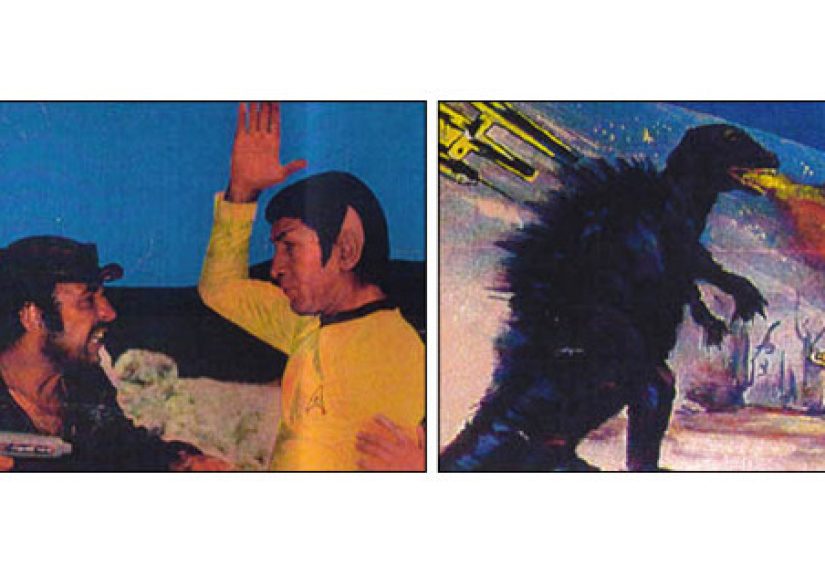
Turist Ömer Uzay Yolunda (“Tourist Ömer in Star Trek”) takes a beloved
Turkish comedy character and literally drops him onto the Starship Enterprise.
The movie recreates the Star Trek bridge with hand-built sets, painted
backdrops, and blinking lights that look one power surge away from disaster.
The uniforms are “inspired by” the originals but never quite match. The transporter
effect that iconic beam-me-up shimmer is approximated with simple dissolves,
jump cuts, and occasional overlay effects that look like someone was experimenting
with the “sparkle” setting in an old editing machine.
Why Fans Still Love It
Despite the bargain-basement visuals, reviewers have noted that the film actually
captures more of the original series’ character dynamics than you might expect
including McCoy and “Spak” bickering over logic and emotion.
That’s the strange magic of these effects: you can clearly see the tape, glue, and
cardboard, but there’s an obvious affection for the source material. It feels less
like a ripoff and more like a fan film made by people who sincerely love
space-exploring weirdos.
6. E.T.’s Cousin Made of Indoor Carpeting in “Badi”
What You See on Screen
Badi is essentially “Turkish E.T.” a story about a young boy who befriends
a stranded alien but the creature design takes things in a wildly different
direction. Instead of the carefully sculpted, expressive puppet from Spielberg’s
film, Badi looks like a mix of plush toy, floor rug, and Halloween mask.
Badi has a rubbery face, big round eyes, and a body that moves like the actor
inside is trying very hard not to trip. The alien’s powers telekinesis and a
healing touch are portrayed using very simple practical tricks: apples sliding
across tables on hidden strings, bright light sources offscreen, and cuts that hide
the “before” and “after” of a healed wound.
From Knockoff to Cult Curiosity
Critics who’ve revisited Badi note that it came out near the end of the
Yeşilçam boom, when Turkish cinema was still remixing Western hits but with even
fewer resources. The movie’s special effects are crude, but there’s a sincere,
almost childlike tone to the whole thing that makes it oddly endearing.
Watching Badi’s glowing finger heal bruises with visible cuts in the footage
doesn’t feel like a failure; it feels like seeing the strings at a magic show and
clapping anyway.
What These Ridiculous Effects Tell Us About Filmmaking
When you strip away the memes and the mockery, Turkish genre films from this era
are fascinating examples of what happens when creativity runs into hard limits.
These directors wanted spaceships, aliens, superheroes, and ray guns, but they
didn’t have access to industrial-grade visual effects.
So they hacked the system: reuse popular soundtracks, re-film Hollywood footage off
a screen, build costumes out of whatever’s cheap, and lean heavily on editing to
sell the illusion. Modern articles on Turkish “mockbusters” point out that this
wasn’t just laziness; it was a survival strategy for an industry competing with
imported Western films and trying to give local audiences something equally
spectacular.
Today, these effects feel hilariously dated, but they also highlight a truth about
cinema: clever staging and sheer commitment can go a long way, even when your
alien costume looks like it was sewn in the dark.
Experiences: What It’s Like to Watch These Effects Today
So what is it actually like to sit down in 2025 and watch these infamous Turkish
special effects? The short answer: it’s half comedy show, half film-school
crash-course, and fully unforgettable.
Most people outside Turkey discover these movies through cult-film communities,
online clips, or commentary tracks that treat Turkish Star Wars as the
holy grail of “so bad it’s good” cinema. Fan restorations and uploads have made it
easier than ever to track down scenes of foam-rock training montages and wobbly
flying superheroes.
Watching them with friends is almost a rite of passage in certain movie-nerd
circles. Someone will pause the film to yell, “Wait, that’s literally a shot from
Star Wars!” Another person will rewind a scene just to re-watch a monster
get karate-chopped in half. The room fills with that particular kind of laughter
you only get when everyone is surprised and delighted at the same time.
But once the initial shock wears off, a different reaction kicks in: curiosity.
Why is Spider-Man the villain? Why does this Superman fly like he’s on a clothes
line over a painted backdrop? Why does the Enterprise bridge look like a theater
class project that got wildly out of hand?
That’s when these films stop being just “bad movies” and start feeling like
historical artifacts. You begin to notice how resourceful the crews had to be,
shooting in real locations like Cappadocia’s rock formations instead of building
expensive sets, or recycling familiar music cues to instantly communicate mood to
audiences who already knew the original tunes.
The more you watch, the more you start rooting for the filmmakers. Every wobbly
spaceship, every obvious mannequin, every jump cut that stands in for a laser beam
feels like a tiny victory over a long list of constraints: no money, limited
technology, and the pressure to compete with Hollywood imports.
If you’re used to spotless Marvel-style effects, these movies can be weirdly
refreshing. There’s no pretense of photorealism; you’re always aware that you’re
watching humans in suits, standing on hand-built sets, trying really hard to sell
an illusion. That awareness invites you into the process instead of hiding it from
you.
For modern viewers, especially aspiring filmmakers, that can be oddly inspiring.
You realize you don’t need a giant budget to make something memorable. You need
ideas, nerve, and a willingness to let the seams show sometimes literally.
So if you’ve never experienced Turkish special effects before, consider hosting a
themed movie night: start with Turkish Star Wars, follow it up with
3 Dev Adam and Badi, and sprinkle in scenes from
Süpermen Dönüyor and Turist Ömer Uzay Yolunda. Embrace the
cardboard, the stolen soundtracks, and the rubber masks. By the end of the night,
you’ll have laughed a lot but you’ll also have a deeper appreciation for just how
far filmmakers will go to bring wild ideas to life, even when the special effects
budget barely covers the tape.