Table of Contents >> Show >> Hide
- The Viral Beverage Cart Video Everyone Was Talking About
- How Did the Airport Cart Spin Out of Control?
- Why the “Beverage Cart Goes Wild” Clip Was a Serious Safety Wake-Up Call
- Meet the Ramp Worker Who Saved the Day
- What Airlines Learned from the Out-of-Control Cart
- Runaway Beverage Carts Aren’t Just an Internet Joke
- Watching the Wild Beverage Cart Video: Experiences and Takeaways
- Conclusion: More Than Just a “Crazy Airport Video”
Every so often, the internet gifts us a clip that’s equal parts hilarious and horrifying.
The “Beverage Cart Goes Wild” video is one of those moments: a tiny airport catering cart
spinning like a mechanical tornado on the tarmac, flinging drinks and danger in all directions,
while a parked airplane sits uncomfortably close in the background. It looks like slapstick comedy…
until you remember there’s a jet full of people just a few feet away.
In this article, we’ll break down what actually happened in that viral airport cart video,
why the “airport cart spins out of control” incident grabbed so much attention, and what
aviation experts say it teaches us about ground safety. Then, we’ll close with some “from-the-gate”
style experiences and reflections to help you see the tarmac with new eyes the next time you fly.
The Viral Beverage Cart Video Everyone Was Talking About
Where and when did the runaway airport cart incident happen?
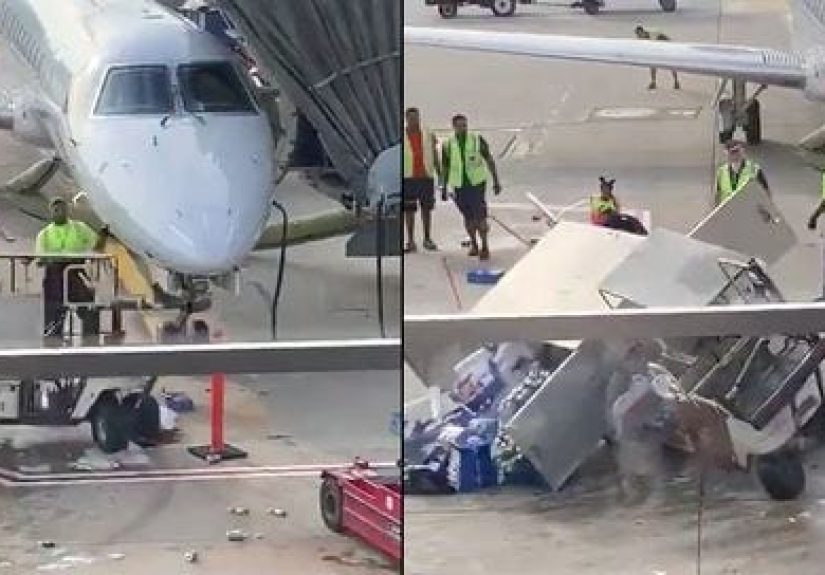
The now-famous “beverage cart goes wild” video was filmed at Chicago O’Hare International Airport
in late 2019. A small American Airlines–affiliated catering cart was parked near a regional jet
when something went very wrong: the vehicle started spinning in tight circles on its own, wheels
skidding on the tarmac, while coolers and cans whipped around like they were on a carnival ride.
Passengers watching from inside the terminal recorded the scene through large glass windows.
In the clip, you can hear people laughing and gasping as the cart spins closer and closer to the
nose of a parked aircraft. At first, it looks like one of those harmless “look at this weird thing
happening at the airport” moments. But as the cart edges nearer to the plane’s fuselage, the mood
shifts from amused to anxious.
The hero move that stopped the spinning cart
Just when it seems like the runaway airport cart is about to slam into the aircraft, a ramp worker
in a pushback tug (the squat vehicle used to move planes away from the gate) rushes into the frame.
Instead of trying to run up and grab the cart by handa terrible idea given its speedhe aims the
tug like a bumper car and rams the cart from the side.
The impact knocks the catering cart onto its side and finally brings the chaos to a halt.
Passengers in the terminal reportedly erupted in applause. For viewers online, the clip quickly
became one of those oddly satisfying videos: a tense build-up, a clever solution, and a clear hero.
How Did the Airport Cart Spin Out of Control?
What went wrong with the equipment?
According to statements from American Airlines, preliminary reports indicated that the accelerator
on the cart became stuck, causing it to speed up and spin out of control with no one at the wheel.
In other words, this wasn’t someone joyriding the Sprite cart for funit was a mechanical failure
that turned a simple ground vehicle into a dangerous projectile.
Ground support equipment at airports includes tugs, belt loaders, fuel trucks, and catering carts.
These vehicles are usually governed by strict maintenance schedules and safety checks. But like any
machinery, parts can wear out, pedals can jam, and control systems can fail. When that happens around
expensive aircraft and human beings, even a small cart can become a big problem.
Why the cart kept spinning instead of just driving off
If you look closely at the “beverage cart goes wild video,” you can see the cart tracing almost
perfect circles. That’s likely because a combination of steering position and throttle created an
unintentional “donut” pattern. With no operator to straighten the wheels or hit the brakes, the
vehicle simply kept looping around, gaining just enough momentum each time to stay upright and
dangerous.
On a highway, a stuck accelerator is terrifying. On a crowded apron full of jet fuel, people, and
aircraft wingtips? It’s a nightmare scenario that airport safety teams train obsessively to prevent.
Why the “Beverage Cart Goes Wild” Clip Was a Serious Safety Wake-Up Call
Ground incidents are more common than most travelers realize
Commercial flying is statistically very safe, and most of us think of turbulence or takeoff as the
riskiest parts of a trip. But many aviation safety reports point out that a surprising number of
incidents happen on the groundespecially when aircraft are parked and being serviced.
Ground handling studies have found thousands of cases where support vehicles, equipment, or human
error caused damage to planes or created hazardous situations.
In that context, the spinning cart wasn’t just a funny viral video. It was a near-miss: a small
vehicle that came within a few feet of hitting a parked aircraft loaded with people and aviation fuel.
Even a low-speed impact from a heavy cart can dent a fuselage, damage sensitive equipment, or
injure workers.
What could have happened if nobody intervened?
Safety experts who analyzed the incident pointed out several possible worst-case outcomes:
-
Structural damage to the aircraft. A direct hit to the nose, engine, or control
surfaces could have grounded the plane and required expensive inspections and repairs. -
Injury to ramp workers. Any attempt to physically grab or jump onto a spinning cart
might have ended with someone knocked down, run over, or pinned. -
Collateral damage. If the cart had collided with other equipmentlike a fuel truck
or another vehiclethe chain reaction could have been far more serious.
Instead, the incident ended with no injuries and only a short delay for one flight. That’s the kind of
outcome aviation safety teams want every time something unexpected happens on the ramp.
Meet the Ramp Worker Who Saved the Day
The “ramp hero” behind the wheel
The worker who drove the pushback tug into the runaway airport cart was later identified and praised
by both his employer and news outlets as a prime example of quick thinking under pressure. Airline
internal communications and local news reports highlighted how his decision to use the tug as a shield
was the safest practical option: he put a heavy, controlled vehicle between the cart and the aircraft,
instead of risking a direct human confrontation with the spinning cart.
His response wasn’t just about braveryit reflected training. Ramp employees are taught to prioritize
safety over everything else: protect people first, protect aircraft, and never take unnecessary personal
risks. Using the tug allowed him to stop the cart while staying inside a protective vehicle.
Why his decision impressed safety professionals
Many aviation safety professionals praised the move for three big reasons:
-
Situational awareness. He recognized the immediate risk to the aircraft and
nearby workers. -
Use of available tools. Instead of charging in on foot, he used the equipment he
already had in a controlled, deliberate way. -
Decisiveness. On a busy ramp, seconds matter. Hesitation can be as dangerous as
a bad decision. He chose quicklyand correctly.
It’s the kind of “ordinary hero” moment that happens more often in aviation than most passengers ever see.
What Airlines Learned from the Out-of-Control Cart
Equipment checks and mechanical safeguards
After the video went viral, American Airlines stated that it was investigating exactly how the cart’s
accelerator malfunctioned and what could be done to prevent a repeat. For airlines and ground-handling
companies, an incident like this usually triggers a review of:
-
Maintenance logs: Were the cart’s inspections up to date? Any prior reports of
sticky pedals or throttle issues? -
Design features: Does the equipment include fail-safes, such as automatic
shutoffs or dead-man switches that stop motion when no one is seated or holding a control? -
Positioning rules: Are carts parked far enough away from aircraft and critical
equipment when not in active use?
When you multiply these questions across every airport and every piece of equipment, you start to see
how a single viral video can push an entire industry to tighten up its already strict safety culture.
Training for “this is not in the manual” moments
The runaway beverage cart also underscored the importance of training ground workers to handle
unusual events. You can’t script every possible scenario, but you can teach principles:
- Never run directly toward uncontrolled moving equipment.
- Use heavier, more stable vehicles as barriers when necessary.
- Communicate quickly with coworkers and control centers.
- Always protect people and aircraft above everything else.
For many ramp workers, the clip became a real-world case study: “What would you do if this happened
during your shift?” That kind of mental rehearsal is exactly what safety trainers hope for.
Runaway Beverage Carts Aren’t Just an Internet Joke
Incidents inside the cabin
While the Chicago O’Hare incident took place outside on the tarmac, runaway beverage carts have also
caused injuries inside airplane cabins. Legal and safety case reports describe situations where an
unsecured cart rolled down the aisle during turbulence or landing, hitting passengers’ knees, ankles,
or shins. In some cases, these incidents led to lawsuits and medical treatment for bruises, sprains,
or fractures.
That’s one reason flight attendants are so careful to lock cart wheels and stow equipment before
takeoff and landing. If you’ve ever wondered why they insist the aisle be clear and carts be fully
secured, imagine a 200-pound metal box full of soda cans and coffee pots suddenly getting airborne
in rough air. It’s not just inconvenientit’s dangerous.
Why ground safety matters to everyday travelers
For most passengers, airport ground operations are just background noise: flashing vests, small
vehicles zipping around, and the occasional whiff of jet fuel. But incidents like the “beverage cart
goes wild” video are a reminder that what happens on the ramp has a direct impact on your flight:
- A minor collision can delay a flight while crews inspect the aircraft for damage.
- A serious incident can cancel a flight entirely or trigger broader safety checks.
- Even near-misses inform future training and procedures, making flying safer over time.
When you see ground crews pausing operations during lightning, double-checking a cargo door,
or carefully repositioning equipment, that’s not inefficiencyit’s insurance against the next
runaway cart–style incident.
Watching the Wild Beverage Cart Video: Experiences and Takeaways
Seeing the tarmac differently as a passenger
If you’ve ever sat in a window seat during a delay, you know the “airport stare”: you gaze out at
the ramp, halfway bored, halfway hypnotized by the choreography of ground vehicles and workers.
The runaway beverage cart video changed the way a lot of travelers look at that choreography.
What once seemed like simple busywork now reads more like a tightly rehearsed safety dance.
Many frequent flyers say that after seeing the clip, they started paying closer attention to what’s
happening outside the plane. You notice how carefully tugs approach the nose gear, how slowly belt
loaders creep toward the cargo hold, and how often workers stop to signal each other. It becomes
clear that the “chaos” is actually a carefully controlled system designed to keep people and planes safe.
From amusement to appreciation
On first viewing, the “airport cart spins out of control” clip feels like something you’d see in a
slapstick movie. There’s a rogue vehicle, a ring of cautious onlookers, and finally a heroic crash
that saves the day. It’s no surprise that social media reactions ranged from jokes about “possessed
beverage carts” to memes comparing the cart to a toddler in a sugar rush.
But after you dig into the backstory, the tone shifts. You realize that the ramp worker’s quick
reaction wasn’t just entertaining; it was the difference between a viral video and a major accident.
The more you learn about ground operations, the more that moment looks less like random luck and more
like a trained professional making the best possible choice in a split second.
How ground workers describe similar “uh-oh” moments
Talk to people who work on the ramp, and you’ll hear plenty of “close call” storiesmost of which
never end up on video. Maybe a belt loader’s brake slipped, but a coworker grabbed a chock in time.
Maybe a headset cable snagged, but someone noticed before an engine spooled up. These stories often
follow the same pattern as the wild beverage cart incident: a small piece of equipment misbehaves,
a few seconds of adrenaline, and then a quiet return to normal once the situation is under control.
What ties all these experiences together is a shared mindset: assume nothing, stay alert, and always
be ready to act. The viral video simply gave the public a rare window into that world.
What travelers can learn from the runaway cart
Even if you never go near the tarmac, there are a few practical takeaways from the “beverage cart
goes wild” episode:
-
Respect the seat belt sign. Just as a runaway cart can cause trouble outside,
unexpected jolts and stops can send carts rolling inside the cabin. Staying buckled reduces your
risk of being in the path of a loose object. -
Be patient with delays. When an airline pauses boarding, repositions an aircraft,
or calls for extra inspections after an odd event, they’re doing exactly what they should do: putting
safety ahead of speed. -
Give ground crews some silent applause. Most of their best work is invisible.
The only reason the runaway airport cart stands out is because it was caught on video. Countless
other risks are quietly prevented every day.
Next time you’re sitting at the gate, watching the orange vests and tiny vehicles crisscross the
apron, you might remember that spinning drink cart and the tug that took it down. Behind the memes
and viral headlines is a simple truth: aviation safety depends just as much on the people working on
the ground as on the pilots in the cockpit.
Conclusion: More Than Just a “Crazy Airport Video”
The “Beverage Cart Goes Wild Video – Airport Cart Spins Out of Control” is easy to file under
“internet curiosities,” but it’s really a case study in how quickly routine operations can changeand
how critical it is to have trained people on the ground ready to respond. A stuck accelerator turned a
simple catering cart into a spinning hazard. A ramp worker’s fast, thoughtful decision turned it back
into a footnote instead of a headline-grabbing disaster.
For travelers, the clip is a reminder that the safest flights are often the ones where “nothing happens”
because countless small problems are prevented or quietly solved behind the scenes. For ground crews and
airlines, it’s another example of why checklists, maintenance, and quick-thinking employees matter.
That wild little cart may have gone viral, but the real story is the safety culture that stopped it.