Table of Contents >> Show >> Hide
- What Is Phototherapy for Psoriasis?
- Main Types of Phototherapy for Psoriasis
- Who Is Phototherapy For?
- What to Expect During Psoriasis Light Therapy
- Risks and Side Effects of Phototherapy for Psoriasis
- Phototherapy vs. Other Psoriasis Treatments
- Practical Tips to Make Phototherapy Work for You
- Real-Life Experiences with Phototherapy for Psoriasis
- Bottom Line: Is Phototherapy Right for You?
If you live with psoriasis, you’ve probably tried an entire shelf of creams,
a small pharmacy’s worth of pills, and at least one “miracle” remedy you saw on social media.
Somewhere in that treatment maze, your dermatologist may bring up a less flashy but very
evidence-based option: phototherapy for psoriasis, also called
psoriasis light therapy.
Phototherapy uses carefully controlled doses of ultraviolet (UV) light to calm your overactive
immune system in the skin and slow down the runaway skin cell growth that causes plaques.
It’s not a spa tan, it’s not a DIY tanning bed hack, and it definitely shouldn’t be done by
guessing exposure times with your backyard sun lounger. Done in a medical setting (or with
prescribed home units), phototherapy is a well-studied, guideline-backed treatment for
moderate to severe psoriasis.
What Is Phototherapy for Psoriasis?
In psoriasis, your immune system sends out inflammatory signals that tell skin cells to grow
way too fast. Normally, a skin cell takes about a month to rise to the surface and shed.
In psoriasis, that process can shrink to just a few days, leaving thick, scaly plaques.
Phototherapy exposes affected skin to specific wavelengths of UV light to:
- Slow down rapid skin cell turnover
- Reduce inflammation in the skin
- Improve redness, thickness, and scaling of plaques
- Extend periods of remission between flare-ups
Modern psoriasis guidelines from the American Academy of Dermatology (AAD) and the
National Psoriasis Foundation (NPF) list phototherapy as an effective option for
moderate to severe plaque psoriasis, guttate psoriasis, and for people who haven’t
responded to topical treatments alone.
Main Types of Phototherapy for Psoriasis
Not all light therapy is the same. When we talk about phototherapy for psoriasis
treatment, dermatologists usually mean a few well-defined options with different
wavelengths, delivery methods, and risk profiles.
1. Narrowband UVB (NB-UVB): The Workhorse Treatment
Narrowband UVB phototherapy uses a tight range of UVB light around 311–313 nm.
This wavelength range hits a sweet spot: it’s effective at calming psoriasis while reducing
some of the burns and long-term risks associated with broader UV exposure.
According to expert reviews and psoriasis treatment guidelines, NB-UVB is generally considered
the “gold standard” phototherapy option for psoriasis because of its balance
of effectiveness and safety.
Key points about NB-UVB:
- Typically given in a light box that looks a bit like a stand-up phone booth made of lamps.
- Treatments are usually scheduled 3–5 times per week for about 6–10 weeks, or until significant clearing.
- Effective for plaque and guttate psoriasis, and can be used in adults, children, and even during pregnancy with appropriate precautions.
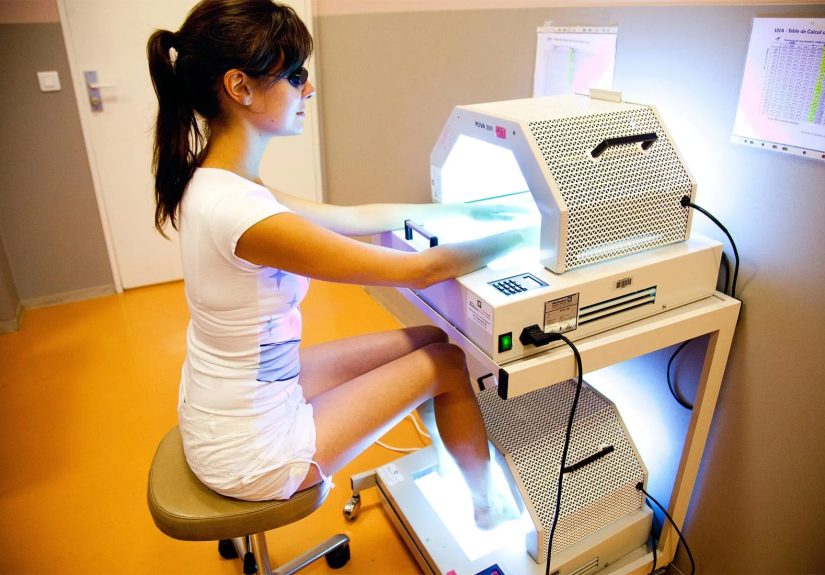
- Available as full-body booths, partial units, or smaller hand/foot devices.
The National Psoriasis Foundation notes that NB-UVB slows skin cell growth and is a common
choice both in-office and in certain prescribed home phototherapy systems.
2. Broadband UVB (BB-UVB)
Broadband UVB phototherapy uses a wider range of UVB wavelengths. It’s an older
form of light therapy that can still be effective, but it has largely been replaced by
narrowband UVB in many centers because NB-UVB offers similar or better results with a somewhat
safer side-effect profile.
Today, BB-UVB may still be used where NB-UVB equipment isn’t available, or in certain
individualized treatment plans. It follows a similar schedule of several sessions per week
over multiple weeks.
3. PUVA (Psoralen + UVA)
PUVA therapy combines UVA light (a longer wavelength than UVB) with a
photosensitizing medication called a psoralen. The psoralen can be taken orally,
applied to the skin, or used in a bath before UVA exposure.
PUVA can be very effective, especially for thicker or stubborn plaques and for palmoplantar
psoriasis (hands and feet). However, it’s no longer the first-line phototherapy for many people,
primarily because of long-term risks.
Long-term studies have shown that high cumulative doses of PUVA significantly increase the
risk of squamous cell carcinoma and may also increase the risk of
melanoma, particularly in people who receive large numbers of treatments
(for example, more than 200–250 sessions).
For that reason, PUVA is often reserved for:
- Severe, treatment-resistant psoriasis
- Patients who haven’t responded adequately to NB-UVB
- Shorter, carefully monitored treatment courses
4. Targeted Phototherapy: Excimer Laser and Excimer Lamp
Sometimes psoriasis likes to be annoying in very specific spotslike your elbows, knees,
scalp edges, or just one stubborn patch on your lower back. That’s where
targeted phototherapy can shine (literally).
Excimer devices use a single, precise wavelength (often 308 nm, a subtype of NB-UVB)
and focus it directly on psoriasis plaques, leaving surrounding healthy skin largely untouched.
This can allow for higher doses to problem areas without exposing the whole body.
Targeted phototherapy is especially useful when:
- You have limited, localized psoriasis patches.
- You can’t easily stand in a full-body booth (for example, because of mobility issues).
- You want to minimize total body UV exposure while aggressively treating specific plaques.
5. Home Phototherapy Units
Driving to a dermatology office three times a week sounds great… until traffic, work, kids,
and life show up. For people who respond well to NB-UVB and can handle self-treatment
safely, dermatologists may prescribe a home phototherapy unit.
In-home NB-UVB units:
- Are prescribed and dose-adjusted by a dermatologist.
- Require strict adherence to eye protection, timing, and safety precautions.
- Are often used for maintenance after an initial in-office course.
Home units are not the same as tanning beds. Commercial tanning beds usually emit more UVA
and aren’t calibrated or monitored for medical use, which increases the risk of burns and
skin cancer without controlled therapeutic benefit.
Who Is Phototherapy For?
Phototherapy may be considered if:
- You have moderate to severe plaque psoriasis or widespread guttate psoriasis.
- Topical therapies alone are not enough, or are hard to apply over large areas.
- You prefer to avoid or delay systemic medications or biologic injections.
- You’re pregnant or breastfeeding and need systemic-sparing choices (NB-UVB is often used in this scenario).
Phototherapy can also be combined with topicals (like vitamin D analogs or topical steroids)
and, in some cases, with systemic therapies, in line with guideline-based treatment plans.
What to Expect During Psoriasis Light Therapy
The first session of psoriasis light treatment usually involves:
- A skin exam and review of your medical history and medications.
- Establishing your starting dose based on your skin type and psoriasis severity.
- Instructions about eye protection, clothing, and how long you’ll be in the booth.
During treatment:
- You’ll typically stand (or sometimes sit) in a phototherapy booth wearing goggles.
- Genital areas and uninvolved skin may be covered or protected with sunscreen.
- The actual light exposure usually lasts seconds to a few minutes, depending on the protocol.
- Treatments are short, but you’ll repeat them several times a week for many weeks.
Most people begin to see improvement after a few weeks, with maximum benefit often reached
around 20–30 sessions. Remission times varysome people enjoy months of improved skin, while
others may need maintenance sessions.
Risks and Side Effects of Phototherapy for Psoriasis
Any treatment that involves UV light comes with potential downsides. The goal with medically
supervised phototherapy is to carefully balance benefit vs. risk.
Short-Term Side Effects
- Sunburn-like redness (erythema), especially if doses are increased too quickly.
- Dryness and itching of the treated areas.
- Temporary darkening (tanning) or lightening of the skin.
- Eye irritation without proper protective goggles.
Your care team will usually adjust doses, slow down increments, or space out sessions if
you develop significant redness or discomfort.
Long-Term Risks
Long-term risks depend strongly on the type of phototherapy and cumulative exposure.
Skin Cancer Risk
-
NB-UVB: Current evidence suggests that NB-UVB, when used in standard
medical protocols, has a relatively favorable long-term safety profile, with a much lower
documented skin cancer risk than PUVA. Long-term data are still monitored, but it is widely
regarded as a low-risk, high-benefit option in guidelines. -
PUVA: Numerous long-term studies have shown that high cumulative PUVA
exposure significantly increases the risk of squamous cell carcinoma and,
at high exposure levels, may increase the risk of melanoma. This risk
rises with the total number of treatments.
Because of this, dermatologists track how many PUVA sessions you’ve had over your lifetime
and may cap the total number or move you to a different therapy.
Photoaging and Cataracts
Repeated UV exposure can contribute to:
- Photoaging (wrinkles, texture changes, sunspots).
- Cataracts, if proper eye protection isn’t used consistently.
That’s why every phototherapy visit involves goggles and specific instructions to protect
sensitive areas with clothing or sunscreen.
Who Should Avoid or Use Caution with Phototherapy?
Phototherapy may not be appropriateor may require extra cautionif you have:
- A history of melanoma or multiple non-melanoma skin cancers.
- Certain genetic or autoimmune photosensitivity disorders.
- Use of medications that make you very sensitive to light (some antibiotics, diuretics,
antifungals, and others). - Uncontrolled cataracts or eye conditions without appropriate protection.
- Significant liver disease (especially if considering psoralen tablets for PUVA).
Your dermatologist will weigh these factors, review your medical history, and design a plan
tailored to your risk profile and psoriasis severity.
Phototherapy vs. Other Psoriasis Treatments
Modern psoriasis treatment is often described as a ladder or toolbox. On one step you have
topicals, on another you have systemic medications (like methotrexate, cyclosporine, or
newer oral agents), and then higher up you have biologic injections targeting specific
immune pathways.
Where does phototherapy fit?
- For mild psoriasis, topicals alone may be enough.
-
For moderate to severe psoriasis, guidelines often consider phototherapy
or systemic agents (including biologics), depending on your overall health, access, and preferences. -
Phototherapy can be a good option if you’re hesitant about long-term systemic
immunosuppression but need more than creams.
That said, phototherapy requires time and access: several sessions a week, often at a clinic.
Biologics, despite being more expensive, may be more convenient for some people who prefer
injections every few weeks over frequent visits to a light box.
Practical Tips to Make Phototherapy Work for You
- Commit to the schedule. Consistency matters. Missing sessions can slow or
blunt your response. - Report burns early. If you feel more than a mild “pinkness,” let your
clinic know so they can adjust doses. - Moisturize regularly. Well-hydrated skin responds better and tolerates
treatment more comfortably. - Track your progress. Take photos (in good lighting) and notes so you can
see changes over weeks, not just day to day. - Think long-term. Phototherapy is a marathon, not a sprint. The goal is
sustained improvement with a manageable risk profile.
Above all, treat phototherapy as a medical treatment, not a tanning session. Your dermatologist
will adjust doses, monitor your skin, and keep an eye on cumulative exposure over time.
Real-Life Experiences with Phototherapy for Psoriasis
Clinical guidelines and wavelength diagrams are helpful, but what does phototherapy actually
feel like in day-to-day life? While everyone’s journey is different, certain themes come up
again and again in patient experiences with psoriasis light therapy.
“The Commute Treatment” – Time and Routine
Many people describe phototherapy as a part-time jobespecially in the beginning. You might
drive to a dermatology clinic three times a week, spend a few minutes getting ready, hop into
the light box for less than a minute, then head back to your real job or home. At first, the
time commitment can feel frustrating: “I’m doing all this for a 45-second treatment?”
But phototherapy is cumulative. Think of it like going to the gym: one workout won’t transform
you, but consistent sessions build results. People who stick with the schedule often report that
the first visible changesless scaling, smoother edges, reduced itchingare subtle but deeply
encouraging. Over a few weeks, plaques can flatten and fade, clothes feel more comfortable, and
daily life becomes less dominated by itching and flaking.
Small Rituals, Big Impact
Patients often develop their own little rituals around treatment:
- Applying moisturizer at the same time every day to keep the skin ready for the next session.
- Wearing loose, easy-to-remove clothing for fast changing in the clinic.
- Using a note or phone reminder for appointment days, especially when juggling work and family.
- Bringing a podcast or audiobook for the waiting room, since the treatment itself is quick but clinics can get busy.
These habits may sound trivial, but they make the process feel more manageable and less like a
disruption to life. Over time, some people describe phototherapy as just another part of their
health routine, like going for blood pressure checks or dental cleanings.
Body Image and Confidence
For many people with psoriasis, the most meaningful “before and after” isn’t just skin deep.
When plaques shrink and redness fades, there’s often a ripple effect in self-esteem:
- Short-sleeve shirts feel less intimidating.
- Work meetings, dates, or social events spark less anxiety about flaking or visible patches.
- Activities like swimming or going to the gym feel more accessible.
While phototherapy is not a cure and flares can return, periods of clearer skin can provide
mental breathing room and a sense of control. Some people say that just having another
effective optionespecially one that doesn’t involve ongoing pills or injectionsmakes them
feel less trapped by their condition.
Home Phototherapy: Freedom with Responsibility
Patients who transition to home NB-UVB units describe the experience as a mix
of freedom and responsibility. On the positive side, there’s no commute, no waiting room,
and no rushing across town for a four-minute appointment. You can treat before work, after
dinner, or whenever it fits your schedule.
But home treatment also demands discipline:
- Carefully following the dermatologist’s dosing schedule.
- Using goggles every time, even when you’re tempted to “just do a quick session”.
- Recording sessions and doses so your care team can track your cumulative exposure.
People who succeed with home phototherapy often keep a simple treatment log and schedule
routine follow-up visits with their dermatologist to review progress and safety.
Managing Expectations and Emotions
Like any psoriasis treatment, phototherapy has its emotional ups and downs:
- Some people respond dramatically; others see only partial improvement.
- Results can plateau, requiring a switch to a different therapy or combination regimen.
- Flares can still happen, especially under stress, illness, or medication changes.
One helpful mindset is to view phototherapy not as a “magic fix” but as a powerful tool in a
long-term management plan. For many, it becomes one chapter in a larger story that includes
lifestyle choices, stress management, other medications, and regular follow-up with a
dermatologist who understands their goals and priorities.
Bottom Line: Is Phototherapy Right for You?
Phototherapy for psoriasis treatment is a well-established, guideline-supported
therapy that can significantly improve plaques, reduce itching, and extend periods of remission
for many people. Narrowband UVB is the most commonly used and generally safest form, while PUVA,
targeted phototherapy, and home units broaden the options for more complex situations.
It does require time, commitment, and ongoing monitoring, and it’s not right for everyoneespecially
those with a history of certain skin cancers or strong light sensitivity. But for many, the trade-off
of consistent visits for a non-pill, non-injection therapy with durable benefits is well worth it.
The best next step is to speak with a board-certified dermatologist about where
psoriasis light therapy fits into your overall treatment plan, your personal risk profile,
and your day-to-day life. Together, you can decide whether stepping into the light box is the
right move for your skin and your future health.