Table of Contents >> Show >> Hide
- South Park vs. Family Guy: The Cartoon Cold War
- Jay Leno vs. Conan O’Brien: The Late-Night Civil War
- Norm Macdonald vs. Chris Kattan: When One Quote Follows You Forever
- Arsenio Hall vs. Roseanne Barr: Prime-Time Punches
- Larry the Cable Guy vs. David Cross: Lowbrow vs. “Comedy Snob”
- Mike Myers vs. Dana Carvey: Who Owns Dr. Evil?
- Will Ferrell vs. Adam McKay: A Creative Divorce
- Andy Dick vs. John Lovitz: The Phil Hartman Fallout
- Chelsea Handler vs. Joan Rivers: Who Owns the Throne?
- Kathy Griffin vs. Ellen DeGeneres: Fighting Over Joan’s Legacy
- Bobcat Goldthwait vs. Jerry Seinfeld: Cool vs. Clean
- Bill Cosby vs. Eddie Murphy: Clean vs. Raw (and History’s Verdict)
- Dane Cook vs. Steve Byrne: The Case of the Stolen “Essence”
- What All These Comedy Feuds Have in Common
- Extra: Watching Comedy Feuds as a Fan – of Hard-Earned Experience
Comedy is supposed to punch up, roast the powerful, and unite us in shared laughter.
But every now and then, comedians turn their sharpest jokes on the people who know
their tricks best: other comedians. The result? Feuds that are petty, principled,
heartbreaking, and absolutely fascinating to watch from the cheap seats.
The original Cracked.com piece “South Park Vs Family Guy And 12 Other Comedy Feuds”
rounded up some of the juiciest beefs in modern comedy history.
Here, we’ll revisit those clashes with fresh analysis, extra context from across the
U.S. entertainment press, and a look at what these fights say about ego, art, and
who gets to decide what’s “real” comedy.
From animated insult wars and late-night turf battles to stand-up showdowns and
creative breakups, these 13 comedy feuds prove one thing: nobody can drag comedians
quite like other comedians.
South Park vs. Family Guy: The Cartoon Cold War
If you’ve ever wondered what would happen if one cartoon show subtweeted another for
an entire episode, the “Cartoon Wars” two-parter on South Park is your answer.
Trey Parker and Matt Stone essentially turned their series into a 44-minute thesis on
why they think Family Guy is lazy. The episode portrays the
Family Guy writers as literal manatees pushing random idea-balls into a tank
to generate cutaway gags a savage metaphor for joke-first, story-later writing.
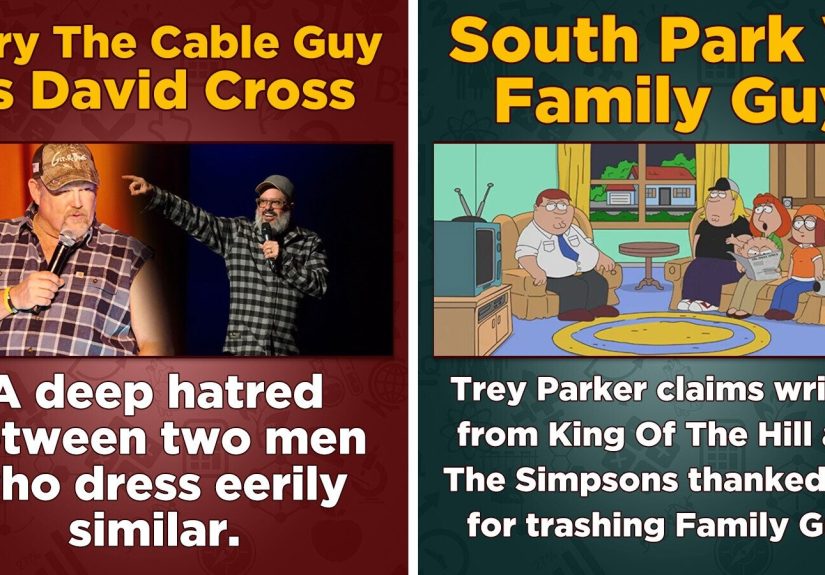
According to Parker, writers from shows like The Simpsons and
King of the Hill quietly reached out afterward to say,
“Thank you for saying what we couldn’t,” confirming that there was a broader
industry gripe about Family Guy’s plug-and-play humor.
Seth MacFarlane, for his part, shrugged it off, joking that his staff didn’t have the
free time to devote an entire episode to dunking on South Park.
Underneath the jokes is a genuine artistic divide. South Park prides itself
on tightly woven satire with emotional stakes; Family Guy leans into absurd,
cutaway-driven chaos. It’s less “good vs bad” and more “who gets to define what
clever looks like in animation.”
Jay Leno vs. Conan O’Brien: The Late-Night Civil War
The Leno–Conan saga is less a simple feud and more a six-car pileup of bad
communication, panicked executives, and wounded pride. After NBC promised Conan
The Tonight Show years in advance, Jay Leno stepped aside in 2009… only to
return when his primetime experiment flopped. NBC’s solution was to push Conan’s
Tonight Show past midnight, which he publicly refused, walking away after
only seven months in the chair.
The comedy world took sides. Conan scorched NBC and Leno in his monologues, joking
that kids can achieve their dreams “unless Jay Leno wants to do it too.” Leno, in
turn, joked about Conan’s short run while insisting it was just business.
Late-night hosts like David Letterman and Jimmy Kimmel openly sided with Conan, with
Kimmel famously going on Leno’s own show and roasting him in real time over the
debacle.
Over a decade later, the conflict is remembered as a turning point: fans realized how
fragile those “nice guy” host personas can be once ratings and contracts get involved.
It also cemented Conan’s underdog status and showed that audiences will absolutely
pick a side when their favorite comic gets bumped.
Norm Macdonald vs. Chris Kattan: When One Quote Follows You Forever
On paper, the Norm Macdonald–Chris Kattan feud sounds brutal: in a 1997
Rolling Stone interview, Norm insulted Kattan’s comedy and made a snide
comment about his perceived persona. The press ran with it, spinning a full-blown
blood feud between the two SNL castmates.
In reality, Kattan later clarified that things weren’t nearly as dramatic.
After Norm’s death in 2021, Kattan spoke warmly of him, stressing that they shared a
real respect for each other and for stand-up as a craft. The “feud” was mostly a case
of one sharp quote escaping its context and becoming the entire story.
It’s a reminder that in comedy, a line that kills in print can haunt you for decades,
even if the comics involved moved on long ago.
Arsenio Hall vs. Roseanne Barr: Prime-Time Punches
In the early ’90s, Arsenio Hall and Roseanne Barr were both huge TV personalities,
which meant any jab landed in front of millions of viewers. Hall poked fun at
Roseanne and then-husband Tom Arnold with fat jokes and swimsuit photos on his show.
Barr fired back in her stand-up act by mocking Arsenio’s look and calling him a nerdy
knockoff of other Black comics.
For a minute, it looked like another rivalry carved in late-night stone. But both
comedians eventually buried the hatchet on Arsenio’s show within the same year,
proving that sometimes the only thing comics love more than a good insult is a good
booking.
Larry the Cable Guy vs. David Cross: Lowbrow vs. “Comedy Snob”
This feud is basically a TED Talk about class, politics, and what counts as
“acceptable” humor, disguised as a fight between two very different stand-ups.
David Cross publicly ripped into Larry the Cable Guy in interviews and an infamous
open letter, arguing that Larry’s redneck persona leaned on racist and homophobic
stereotypes and rewarded anti-intellectualism.
Larry responded in his book and on stage, painting Cross as an over-serious comedy
snob who forgot the basic mission: make people laugh. From there, the two traded
shots in print and online, with fans arguing in comment sections like it was a
playoff game.
Underneath the mudslinging is a genuine philosophical divide: Is comedy allowed to be
“cheap” if the audience is howling, or does it carry a responsibility not to punch
down? Cross and Larry never resolved that question but their fight made a lot of
people think about it harder.
Mike Myers vs. Dana Carvey: Who Owns Dr. Evil?
Wayne and Garth looked like best friends on camera, but behind the scenes, the
creative relationship between Mike Myers and Dana Carvey was complicated.
After Wayne’s World exploded, Myers assumed more control over the sequel and
their shared material, which reportedly left Carvey feeling sidelined. Things got
worse when Carvey became convinced that Dr. Evil, the villain from
Austin Powers, was basically his long-running Lorne Michaels impression with
a new name tag.
Years later, both comics say they’ve patched things up, even making occasional
reunion appearances in full Wayne and Garth gear. Still, the feud underscores a
recurring theme in comedy: impressions and characters are often born in messy
writer’s rooms, and it’s not always clear who “owns” them once they go global.
Will Ferrell vs. Adam McKay: A Creative Divorce
Some feuds start with a punchline; this one started with casting. Will Ferrell and
Adam McKay built an empire together Anchorman, Step Brothers,
Talladega Nights, and the production company Gary Sanchez. Then McKay
decided to cast John C. Reilly, not Ferrell, as Jerry Buss in the HBO Lakers series
that became Winning Time, and didn’t tell Ferrell until the deal was done.
McKay has publicly admitted he mishandled the situation and took full blame for the
friendship’s collapse. Ferrell, reportedly deeply hurt, essentially cut off contact.
For fans, it felt like watching your favorite comedy duo break up in real time
less dramatic than a Twitter brawl, but emotionally rougher.
The feud highlights one of the harshest truths in show business: eventually, career
choices and creative control can strain even the most successful partnerships more
than a bad joke ever could.
Andy Dick vs. John Lovitz: The Phil Hartman Fallout
Few comedy feuds carry the emotional weight of Andy Dick vs. John Lovitz. After the
murder of beloved comic Phil Hartman by his wife, who had struggled with substance
use, Lovitz came to believe that Andy Dick had reintroduced her to drugs. Years
later, tensions boiled over: Dick reportedly told Lovitz he’d “put a curse” on him,
and Lovitz responded by physically slamming his head into a bar multiple times at
The Laugh Factory.
This wasn’t just a clash of egos; it was grief, anger, and guilt, misdirected and
then turned into tabloid fodder. Unlike some of the other feuds on this list, it
never really became funny it’s more a cautionary tale about what happens when real
tragedy enters a world built on jokes.
Chelsea Handler vs. Joan Rivers: Who Owns the Throne?
When Chelsea Handler dismissed Joan Rivers on Howard Stern’s show with a blunt
“What do I care about Joan Rivers?”, she lit a fuse under one of comedy’s most
famously sharp tongues. Joan fired back on Stern as well, accusing Handler of
sleeping her way to the top and calling her a drunk, among other colorful phrases.
Their war of words played out across radio, tabloids, and late-night gossip, fueled
by the fact that both women worked in the same cable ecosystem and targeted
overlapping audiences. After Rivers’ death, Handler acknowledged that Joan had
opened doors for women in comedy but the two never had a warm public reconciliation.
It’s a textbook generational clash: the trailblazer who thinks the newcomer doesn’t
show enough respect, and the newcomer who doesn’t want to be defined by anyone else’s
legacy.
Kathy Griffin vs. Ellen DeGeneres: Fighting Over Joan’s Legacy
Joan Rivers inspired another feud this time between Kathy Griffin and Ellen
DeGeneres. Griffin has said that in her final conversations with Joan, Rivers felt
shunned by Ellen, who allegedly saw her comedy as too mean and vulgar. After Rivers’
death, Griffin says she called Ellen urging her to do a proper on-air tribute.
Ellen reportedly refused, sticking to her belief that Rivers’ style didn’t fit her
own brand.
Griffin later told audiences that the two comics had a heated phone call, during
which she called Ellen an “untalented hack.” Ellen eventually posted a short tribute
tweet about Rivers, but the personal relationship stayed frosty.
This feud isn’t really about who’s funnier; it’s about who gets to decide where the
line between “mean” and “fearless” is and whether that line should move for the
sake of daytime TV comfort.
Bobcat Goldthwait vs. Jerry Seinfeld: Cool vs. Clean
Bobcat Goldthwait and Jerry Seinfeld have been sniping at each other, directly and
indirectly, for decades. In the ’90s, Goldthwait mocked Seinfeld as a creepy,
Scientology-adjacent sitcom star dating much younger women, questioning how “real”
his TV persona was.
Seinfeld finally answered back years later on his Netflix series
Comedians in Cars Getting Coffee, tearing into an unnamed comic (widely
understood to be Goldthwait) as unfunny, bitter, and reliant on a gimmicky voice
instead of solid material.
Their beef lays bare a classic comedy fault line: the alt-comedy crowd, who pride
themselves on being edgy and subversive, versus mainstream megastars who insist that
the only real metric that matters is whether people laugh and keep buying tickets.
Bill Cosby vs. Eddie Murphy: Clean vs. Raw (and History’s Verdict)
In the ’80s, Bill Cosby confronted a young Eddie Murphy about his profanity-heavy
stand-up, reportedly lecturing him about being a role model and using cleaner
material. Murphy turned the story into a legendary bit in his 1987 special
Raw, reenacting Cosby’s scolding and sharing Richard Pryor’s advice to him
on the matter.
Decades later, when Murphy accepted the Mark Twain Prize for American Humor, he
revisited Cosby on stage with a pointed joke that landed very differently in light of
Cosby’s criminal convictions. The power dynamic had flipped: the once-reprimanded
“vulgar kid” now stood as the acclaimed elder statesman, and the self-appointed
moral authority had lost nearly all of his.
This feud shows how time can completely rewrite who we see as the hero or the villain
in a comedy argument.
Dane Cook vs. Steve Byrne: The Case of the Stolen “Essence”
Not all feuds are about jokes; sometimes they’re about vibes. According to stories
retold on Marc Maron’s WTF podcast, Dane Cook confronted comic Steve Byrne
years ago in Los Angeles and accused him not of stealing material but of stealing his
“essence” dressing like him, performing like him, and generally giving off
Dane-adjacent energy.
Cook has claimed the two had a friendly talk and that Byrne acknowledged the
similarity. Byrne has described the conversation as awkward and strange, insisting
they barely knew each other and that the accusation felt overblown. For fans, it’s
one of those feuds that’s equal parts serious and ridiculous: what exactly is the
legal definition of “essence theft”?
Still, it taps into a real anxiety among comics that in an oversaturated scene,
one strong persona can shape a generation of imitators, and drawing the line between
“inspired by” and “carbon copy” gets very messy.
What All These Comedy Feuds Have in Common
Look across all these battles and patterns start to pop out. A lot of these feuds
are really about:
- Control: over shows, time slots, characters, and creative direction.
- Respect: older comics wanting credit, younger comics wanting independence.
- Values: what counts as “smart,” “cheap,” “mean,” or “honest” comedy.
There’s also the simple fact that comedians are professional overthinkers. Their job
is to analyze everything including each other and turn it into material. Add
network pressure, social media, and a 24/7 comment section, and small slights can
snowball into full-blown public feuds.
But there’s a silver lining: feuds like these often push comedians to sharpen their
work, define their voice, and pick a lane. Even when the fights get ugly, the art
that comes out of them can be sharper, funnier, and more honest than before.
Extra: Watching Comedy Feuds as a Fan – of Hard-Earned Experience
Even if you’ve never held a microphone in your life, living through these comedy
feuds as a fan is its own weird experience. One day you’re just happily watching
cartoons or late-night monologues; the next, your Twitter feed is full of carefully
worded “I’ve always respected them, but…” statements, and suddenly you’re
emotionally invested in a scheduling decision from 2010.
If you followed the Leno–Conan saga in real time, you probably remember exactly where
you were when Conan posted his “People of Earth” statement or when he used his
monologue to say hosting The Tonight Show was his childhood dream and that
“kids can do anything unless Jay Leno wants to do it, too.”
For many fans, that was the first time late-night TV felt less like background noise
and more like a cause. People wore “I’m With Coco” T-shirts; Facebook groups turned
into miniature protest rallies. You weren’t just picking a show; you were picking a
worldview: messy corporate compromise vs. “do the right thing, even if it hurts.”
The South Park vs. Family Guy feud hit differently. Instead of a
network meltdown, fans got a meta-episode that put their own tastes on trial. If you
loved Family Guy, suddenly you had to defend cutaway gags and absurdism
against the charge of being lazy and random. If you were a South Park
loyalist, you felt vindicated by that manatee tank gag finally, someone said what
you’d been yelling at the TV for years.
What’s funny is how quickly fans start talking like tiny executives. After a few
weeks of following a feud, you’ll catch yourself saying things like, “Creatively,
Adam McKay had to move on,” or “Dana Carvey deserved a producer credit.” You go in
for the jokes and come out with a working knowledge of development deals and
first-look contracts. The parasocial brain is powerful.
There’s also the awkward moment when your favorite comics wind up on opposite sides
of the same fight. Maybe you admire Jerry Seinfeld’s precision and Bobcat
Goldthwait’s chaos; suddenly they’re trading barbs about who’s bitter and who’s
creepy, and you’re stuck thinking, “Okay, but can I still laugh at both of you?”
The answer, most of the time, is yes as long as you accept that comedians are
people first and brands second, and people are messy.
From a distance, comedy feuds are incredibly educational. You see how jokes age, how
reputations flip, and how the “moral” of a feud can look very different 20 years
later. The Cosby–Murphy clash, for instance, was once framed as a clean legend
lecturing a vulgar upstart. Today, Murphy’s career and legacy look far healthier
than Cosby’s, and that old lecture bit plays like a time capsule of who we used to
take seriously as a moral authority.
The trick, as a fan, is not to let the drama ruin the fun. Feuds are real and often
painful for the people involved, but they can also reveal what comics truly care
about: credit, craft, fairness, and sometimes just being able to say, “I was here
first.” You don’t have to pick a permanent side in every fight. You can appreciate
South Park’s satirical precision and still enjoy a dumb Family Guy
cutaway about a chicken fight. You can recognize that Conan got a raw deal and still
admit Jay Leno was a late-night workhorse for decades.
In the end, comedy feuds are like bonus commentary tracks for the stuff you already
watch. They pull back the curtain on how fragile careers can be, how emotional
creative work really is, and how quickly a single joke can turn into a ten-year
grudge. If you’re paying attention, you don’t just get gossip you get a sharper
eye for the power dynamics and insecurities hiding inside the punchlines.