Table of Contents >> Show >> Hide
- From Sci-Fi Dream to Engineering Project
- Picking the Neighborhood: Where Would We Build?
- What Martian Homes Would Be Made Of
- Breathing, Drinking, and Staying Alive: Life Support on Mars
- Growing Food on the Red Planet
- Powering a City in the Dust
- Getting Around: Rovers, Tunnels, and Space Suits
- Work, Play, and Mental Health in a Mars Colony
- Rules, Money, and Who’s in Charge
- What Could Go Wrong – and How Colonies Stay Resilient
- The Long View: From Outpost to Real City
- Experiences: What Life in a Mars Colony Might Feel Like
Picture this: you wake up, pull back the shade, and instead of traffic and trees you see a dusty red landscape, a salmon-colored sky, and a pair of robots arguing silently over whose turn it is to recharge. That’s everyday life in a Mars colony – at least, the realistic version, not the Hollywood one with instant terraforming and T-shirt weather.
Space agencies, private companies, scientists, and sci-fi writers have spent decades sketching out what living on Mars would actually take. When you mix those plans with what we know about Martian geology, radiation, life support, and human psychology, you get a surprisingly consistent picture of the first real Martian settlement. It’s less “glass city of the future” and more “hyper-efficient Antarctic base with better views and no easy rescue.”
From Sci-Fi Dream to Engineering Project
The basic outline is clear: heavy-lift rockets like SpaceX’s Starship move people and cargo to Mars, where pre-deployed habitats and infrastructure are waiting. NASA’s long-running Mars Design Reference Architecture concepts imagine missions where uncrewed cargo ships land first to deliver habitats, power systems, and ascent vehicles before any humans leave Earth. The crews follow on a later launch window, spend well over a year on the surface, then head home, leaving behind a growing outpost that later missions expand.
Instead of a single giant “Mars city” popping up overnight, think of a staged evolution:
- Phase 1: Small outpost, 6–20 people, tightly packed habitats.
- Phase 2: A village-scale base with more modules, greenhouses, and dedicated labs.
- Phase 3: Only after many successful missions does it begin to feel like a town, with redundancy in power, food, and transport.
In other words, if you’re imagining a million-person metropolis with skyscrapers and Martian brunch spots, that’s a late-game dream. The first few generations of Martians will live in something closer to a space-rated research campus than a sci-fi mega-city.
Picking the Neighborhood: Where Would We Build?
Key Ingredients for a Martian “Good Location”
Mars is big, but only a few places are realistic for a first colony. A practical site needs:
- Water ice nearby for drinking, making oxygen, and rocket fuel.
- Relatively mild temperatures by Martian standards – still freezing, but less bone-crackingly cold.
- Good solar exposure plus room for nuclear backup systems.
- Flat terrain for landing and driving rovers, with stable ground for building.
That points to mid-latitude regions where radar and orbiter data already suggest rich ice deposits and decent sunlight. Sites on the edges of ancient glaciers and buried ice sheets are especially tempting. Colonists won’t be setting up camp in the postcard-perfect canyons of Valles Marineris right away; they’ll prioritize ice over Instagram.
Going Underground: Lava Tubes and Buried Bases
The number one enemy of a Mars colonist isn’t cold – it’s radiation. Without a thick atmosphere or global magnetic field, cosmic rays and solar storms can deliver a serious lifetime dose. That’s why so many Mars habitat concepts lean heavily on shielding.
One attractive idea is to build inside lava tubes – giant tunnels carved by ancient volcanic flows. These natural cavities could offer meters of rock overhead, dramatically reducing radiation and micrometeorite exposure. Where lava tubes aren’t accessible, another strategy is to bury surface modules under a few meters of Martian soil (regolith) using robotic bulldozers and 3D-printing systems.
From the outside, an early Mars colony might look surprisingly understated: mostly mounds, berms, and low domes rather than gleaming glass skyscrapers. The real action would be underground or within shielded structures, connected by pressurized tunnels like an ant farm designed by aerospace engineers.
What Martian Homes Would Be Made Of
You can’t ship a suburb from Earth, so a Mars colony will use a mix of imported hardware and local materials.
Inflatables, Hard Shells, and 3D-Printed “Stone”
Early missions will almost certainly rely on pre-fabricated pressure vessels – think rigid modules similar to those on the International Space Station, plus inflatable habitats that ride to Mars in compact form and expand on the surface. These require sophisticated internal structures to hold pressure and keep people from living in what is essentially a very nice balloon.
To reduce dependence on Earth, concepts funded by NASA explore using Martian regolith as a 3D-printing feedstock. Robotic printers could build shells, walls, and vaults out of sintered or bound dust. Inside these shells, you’d place pressurized living spaces like pods in a protective concrete-like exoskeleton. Other proposals experiment with mycelium (fungus-based) materials or ice-rich structures in colder regions.
Interiors would be compact but carefully designed: bunk rooms, shared hygiene modules, galley and dining areas, laboratories, small gyms, and a few precious “earthlike” spaces with plants and warmer lighting. Every cubic foot is expensive, so there’s no walk-in closet, but there might be a walk-in algae bioreactor.
Breathing, Drinking, and Staying Alive: Life Support on Mars
A Mars colony is essentially a giant, very fussy machine whose whole job is to keep humans within a narrow comfort zone. That means robust, closed-loop life support systems.
Air
Mars does have an atmosphere, but it’s 95% carbon dioxide and less than 1% of Earth’s surface pressure. Colonists will rely on:
- Electrolysis and chemical processors that split CO₂ into oxygen and carbon monoxide.
- Water electrolysis to generate oxygen from locally obtained ice.
- Plants and algae that help recycle CO₂ into oxygen as part of bioregenerative systems.
Redundancy is key – expect multiple oxygen generation systems, spare parts, and emergency tanks. “Running out of air” is not something you want on the maintenance checklist.
Water
Melting subsurface ice is the main source of water. Once inside the colony, water will be treated like liquid gold:
- Condensing and purifying humidity from the air.
- Recycling graywater and urine through advanced filters and biological treatment.
- Routing water through greenhouses, then recovering it again.
If you’ve seen how aggressively the International Space Station recycles water, expect Mars to push that to an even higher art form. Showers will be short. Very short.
Waste
In a Mars colony, “trash” is just future resource. Organic waste feeds bacteria that help produce fertilizer. Plastics may be melted and reprinted. Metals get smelted and reused. The less you throw away, the fewer rockets you need from Earth.
Growing Food on the Red Planet
Shipping everything from Earth is wildly expensive, so food production becomes central to colony design. That’s where greenhouses and plant-growth chambers come in.
Early Mars farms will likely use:
- Hydroponics and aeroponics – plants grown in nutrient solution or mist, not raw regolith.
- LED lighting tuned for photosynthesis to supplement fragile sunlight.
- Carefully chosen crops like wheat, soybeans, potatoes, lettuce, and dwarf fruiting plants that offer a lot of calories and nutrients per square foot.
Over time, bioregenerative systems aim to do double duty: plants create food, help recycle water, and scrub CO₂ from the air. Colonists will still import specialty items, but a large share of calories will come from these tightly controlled indoor farms. Think salad bars and potato-everything menus rather than gourmet tasting menus – at least at first.
Powering a City in the Dust
Life on Mars runs on electricity – lots of it. Power keeps air flowing, water circulating, greenhouses glowing, and equipment warm. Mars also has epic dust storms that can dim sunlight for weeks, so a colony can’t rely on solar panels alone.
A realistic power mix would include:
- Solar farms spread across the landscape, cleaned regularly by robots.
- Compact nuclear reactors providing stable baseline power through long nights and storms.
- Energy storage in batteries or flywheels to smooth out peaks and gaps.
From orbit, the colony might look like a cluster of low mounds with glittering solar fields around it – humanity’s off-world rooftop.
Getting Around: Rovers, Tunnels, and Space Suits
Inside the colony, people will mostly walk through pressurized tunnels and modules. Outside, everything happens in suits and vehicles.
- Pressurized rovers act like mobile mini-habitats for longer trips.
- Unpressurized utility vehicles handle cargo and construction, driven remotely or autonomously.
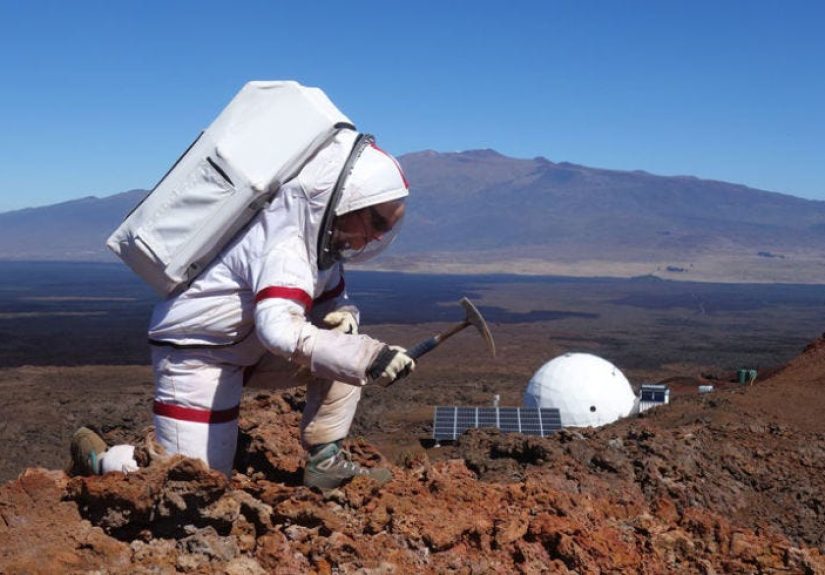
- Smart spacesuits offer more flexibility and dust-resistance than current EVA suits, with modular components that can be swapped and repaired.
Routine activities like inspecting solar arrays or checking ice mines could feel like a strange blend of road trip and construction shift – except stepping outside without the right gear remains instantly lethal.
Work, Play, and Mental Health in a Mars Colony
A Mars colony isn’t just hardware; it’s a small, extremely isolated community. Colonists will work long hours maintaining systems, running experiments, and expanding infrastructure. But for long-term success, they also need a life that doesn’t feel like a never-ending emergency drill.
Expect a daily rhythm something like:
- Mornings: System checks, habitat inspections, lab work, and planning.
- Midday: EVAs (spacewalks) and outside tasks timed to best lighting and conditions.
- Evenings: Exercise (to fight muscle and bone loss), meals, communication with Earth, and downtime.
Designers are very aware of psychological stress: confinement, monotony, delayed communication with home, and the constant background knowledge that the outside world is instantly hostile. That’s why habitat concepts almost always include recreation spaces with plants, natural-spectrum lighting, flexible social areas, musical instruments, and digital entertainment. A quiet hour in a greenhouse might be just as important as another scientific experiment.
Rules, Money, and Who’s in Charge
The first Mars outposts will likely be run by space agencies or tightly controlled private ventures. Over time, though, questions about governance and economics get complicated:
- Do colonists follow the laws of the sponsoring nation, a multinational treaty, or something new?
- Are Martian resources a shared human heritage or assets that companies can claim?
- How do you handle crime, disagreements, or simply someone refusing to do their assigned job when everyone’s survival is linked?
Many scenarios imagine something like a charter town at first – strict rules, clear chains of command, and detailed emergency protocols. As the population grows and economic activity diversifies (research, manufacturing, data services, tourism), governance would evolve with it. But for the first few decades, Mars is much more likely to feel like a high-responsibility posting than a frontier free-for-all.
What Could Go Wrong – and How Colonies Stay Resilient
Any realistic Mars colony design spends most of its pages on failure modes. Life support disruptions, power outages, habitat leaks, contamination in greenhouses, psychological breakdowns – all of these are analyzed, simulated, and redundantly mitigated.
That’s why a colony will be built around:
- Redundant systems for air, water, power, and communications.
- Modular design so damaged sections can be isolated and repaired.
- Training and drills where every crew member has multiple specialties.
- Local manufacturing capacity to make essential parts from Martian materials.
Mars won’t be safe in the way a city on Earth is safe, but it can be made robust enough that everyday life becomes normal most of the time – with occasional reminders that you live in one of the harshest environments humans have ever attempted to settle.
The Long View: From Outpost to Real City
Fast-forward a century from the first human landing, and a mature Mars colony – or several – might look genuinely city-like: multiple hubs connected by maglev rail or pressurized tunnels, large agricultural complexes, multiple power plants, and a mix of research, industry, and tourism.
Over generations, colonists may adapt culturally and even physically. Different gravity, a unique day-night cycle, and an outdoor environment nobody can walk through unprotected will shape everything from architecture to sports. Kids might grow up thinking of the sky as pink, “outside” as a place you visit in a suit, and Earth as a distant bright star where their grandparents were born.
But all of that future depends on getting the first few steps right: building sustainable habitats, closing life-support loops, generating reliable power, and keeping small crews healthy and sane far from home.
Experiences: What Life in a Mars Colony Might Feel Like
So what is it actually like to live in such a place, day to day? We don’t have real colonists yet, but we do have analog missions on Earth and a lot of detailed planning. Put those together and you can sketch a pretty vivid experience.
A Morning in New Ares Station
You wake up in a compact sleeping pod – just room for a bunk, a privacy curtain, a small screen, and a handful of personal items velcroed to the wall so they don’t drift if the artificial gravity system hiccups. The colony’s internal lights slowly shift from deep amber to bright white to mimic sunrise. Outside, the actual sunrise is a faint increase in dusty daylight filtered through a sky that’s more butterscotch than blue.
On your way to the galley, you pass a wall-mounted screen showing environmental stats: oxygen partial pressure, CO₂ scrubber status, water reserves, power levels, outside temperature, and radiation index. You don’t glance at social media first thing in the morning – you glance at that. If those numbers look good, everyone’s day gets a little easier.
Breakfast is surprisingly fresh: hydroponic lettuce, a tomato or two, some scrambled egg substitute grown from cultured cells, and coffee that is absolutely not negotiable. People from half a dozen countries share the same long tables, trading jokes and updates. The lag to Earth is long enough that live conversations feel awkward, so most communication from home arrives as recorded messages you watch like personal mini-documentaries.
Stepping Outside
Mid-morning, you suit up for an external inspection run. The suit is lighter and more flexible than old-school space suits, but getting into it is still a careful ritual: medical sensors on, joints checked, seals verified, redundant comms tested. You cycle through the airlock with a partner, pressure hisses down, and for a few seconds there’s silence so complete you can hear your own heartbeat.
The outer hatch opens and Mars is there – red dust under your boots, low gravity that makes each step a slow exaggerated bounce, the colony behind you partly buried under protective berms. To the east, rows of solar panels stretch toward the horizon. Farther out, small mounds mark the sites of ice extraction wells. Every footprint your team leaves will probably still be there hundreds of years from now.
You walk the solar array, brushing off dust with a robotic cleaning arm, scanning for micro-fractures, and logging any anomalies into your wrist display. Overhead, a faint dot crawls across the sky – a relay satellite linking the colony to orbit and home. You wave at it out of habit, even though nobody can see you.
Work, Community, and Tiny Luxuries
Afternoons are a mix of science and maintenance. Maybe you run experiments in a geology lab, studying core samples drilled from beneath the regolith in search of ancient water flows or biosignatures. Maybe you analyze how crops respond to slightly different light spectra, hunting for an extra few percent efficiency that could mean more fresh food per square foot.
Between tasks, you share quick messages with friends on Earth – birthday video clips, news highlights, a niece’s first steps. The time delay makes conversations feel like exchanging letters rather than chatting, but it also adds a certain weight. Words are chosen more carefully because each one takes minutes to cross space.
After work comes the non-negotiable gym session. In one corner of the habitat, treadmills, resistance machines, and VR-assisted training systems keep bones and muscles from giving up in the low gravity. People compete on leaderboards not for sculpted abs but for long-term health metrics. “Skipping leg day” is not an option when the alternative might be a lifetime of frailty.
Evenings are where the colony feels most human. Someone plays guitar in the greenhouse, the sound softened by leaves and mist. A group gathers for movie night, drawing lots to decide whether tonight’s selection will be something set on Mars (for the meta-joke) or absolutely anything else. Others escape into video games, virtual hikes through forests and oceans, or reading – often about places with thick air and rain purely for the novelty.
The colony’s small size means everyone knows everyone. Conflicts happen, but so do elaborate in-jokes, shared rituals, and a sense of being part of something absurdly ambitious. When you step back and think, you’re aware that a few thin layers of metal, plastic, and rock stand between you and instant vacuum – but most days, it just feels like home, with weird house rules.
Living with the Red Horizon
The best moments are quiet ones. Standing in a pressurized observation dome, looking out at the pale disk of Earth hanging low in the sky. Watching dust devils twist across the plains, knowing that inside your habitat the air is warm, the plants are growing, and the numbers on the environmental panel are comfortably green.
A Mars colony, ultimately, is less about pristine sci-fi design and more about this delicate balance: an engineered bubble of Earthlike conditions, full of tired, smart, occasionally grumpy people doing their best to keep it all running. It’s fragile, but it’s also the first real foothold our species has ever taken on another planet. That mix of vulnerability and possibility is exactly what will make living there so intense, so demanding, and – for the right kind of person – so irresistible.