Table of Contents >> Show >> Hide
- Quick refresher: what is an undercroft, really?
- The brief: more space, but don’t break what makes the house lovable
- The two bold moves that make everything else possible
- How the undercroft becomes the “main floor” without feeling like a basement
- Material choices that make the undercroft feel calm (and a little bit fancy)
- Light + breeze: the undercroft’s “free air-conditioning” (with realistic expectations)
- Indoor/outdoor living that’s actually livable
- Landscape isn’t “after”it’s part of the architecture
- Design lessons you can steal for your own “build under” remodel
- Cost, value, and the “why not just add an extension?” question
- The takeaway: “Above & Beyond” isn’t about biggerit’s about better
- Experiences: What it’s like to live with a reclaimed undercroft ()
If you’ve ever stood under a classic Brisbane Queenslander on a steamy afternoon, you already know the secret:
the best “room” might be the one the house never officially claimed. The undercrofttraditionally a shaded,
semi-open zone beneath a raised timber homeoften starts life as a place for storage, a laundry, maybe a bike
graveyard, and at least one mysterious plastic tub labeled “XMAS.” But in the hands of a careful designer,
it can become the heart of a house: bright, breezy, and deeply connected to the garden.
That’s the big idea behind Above & Beyond, a Brisbane remodel that treats the undercroft not as leftover
space, but as the main event. Instead of the usual “build under” movewalls slapped under an existing house
to create dark, awkward roomsthis project leans into what the undercroft is naturally good at: shelter,
airflow, shade, and a close relationship to outdoor living.
Quick refresher: what is an undercroft, really?
In architecture-speak, an undercroft is the space beneath a buildingoften partially open, sometimes enclosed,
and typically not designed as prime living space. In Queenslanders, this area sits under the raised floor
and is shaped by posts, beams, and the practical logic of building up off the ground.
The undercroft’s superpower is comfort. It’s shaded. It catches breezes. It’s naturally protected from harsh sun
and sudden rain. In Brisbane’s subtropical climate, that can make the undercroft the coolest-feeling zone
on a hot dayif you don’t ruin it by turning it into a sealed box with tiny windows and a permanent “dungeon vibe.”
The brief: more space, but don’t break what makes the house lovable
The homeowners needed practical upgrades: more bedrooms, better entertaining space, and another bathroomwithout
losing the charm of their modest, raised timber house. The smartest remodels don’t start by asking,
“How do we make it bigger?” They start with: “Where does the house already want to be generous?”
Here, the answer lived below the floorboards. By treating the undercroft as a future living level, the design could
expand the home while keeping the existing structure’s character largely intact.
The two bold moves that make everything else possible
1) Lift the existing house to unlock a new level
The project raises the original Queenslander high enough to create a genuinely livable, light-filled layer beneath.
This is the crucial difference between “extra storage” and “a new home level.” When you gain real height under the
existing floor, you gain dignity: full-height doors, better proportions, and rooms that don’t feel like they were
negotiated into existence.
2) Shift the house on the site for light, outlook, and a better relationship to the street
The remodel also repositions the structure on its property to improve daylight and the overall feel of the new
undercroft level. That site decision does something quietly radical: it changes what the “front” and “back” mean.
Instead of hiding family life behind the house, the design treats the garden and undercroft living areas as an
inviting face to the neighborhood.
How the undercroft becomes the “main floor” without feeling like a basement
The undercroft level is planned as a sequence of connected spacessocial, flexible, and oriented to the outdoors.
Rather than forcing everything into one echo-y rectangle, the layout creates distinct zones that still flow:
places to cook, eat, lounge, and drift outside.
A standout idea is the “garden room” approach: a living area that behaves like a sheltered outdoor space. It’s not
pretending to be an upstairs parlor. It’s closer to a pavilionprotected overhead, open to breezes, and visually
tied to planting and sky.
Material choices that make the undercroft feel calm (and a little bit fancy)
Great undercroft remodels often borrow their materials from the outside world. That’s the visual trick that keeps
a lower level from feeling subterranean: you make it feel like an extension of the yard.
-
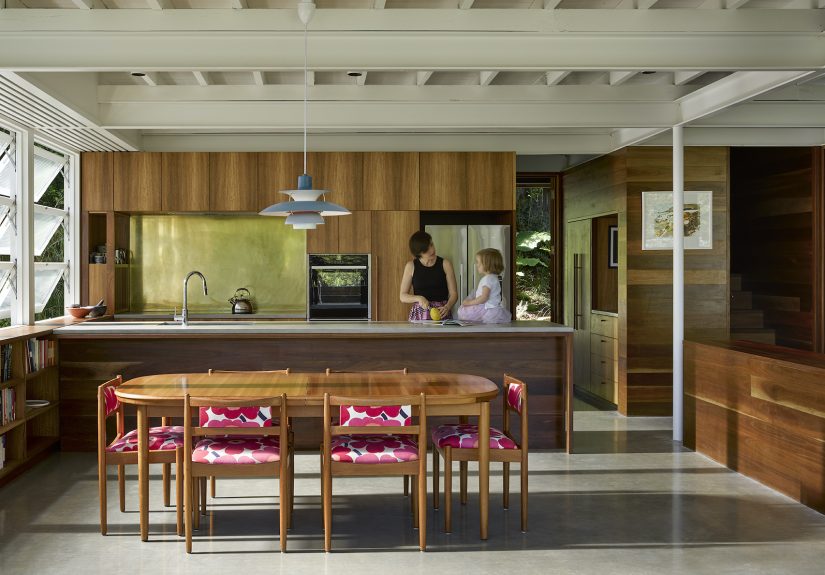
Concrete underfoot: A concrete floor provides a durable base for a high-traffic family zone and can
help moderate temperature swings as a form of thermal mass (when paired with climate-appropriate shading and ventilation). -
Timber that belongs to the original house story: Warm wood elements echo the Queenslander’s DNA,
keeping the new lower level from feeling like a different building entirely. -
Structure as rhythm, not clutter: Instead of hiding everything behind drywall, the design treats
posts and beams as part of the architecturelike a repeating beat that organizes the rooms.
Light + breeze: the undercroft’s “free air-conditioning” (with realistic expectations)
The undercroft’s comfort depends on airflow. Natural ventilation works when air can enter and exit in a clear path:
openings that catch prevailing breezes, relief points on the leeward side, and a layout that doesn’t block the flow
with unnecessary partitions.
A key nuance: in humid climates, breezes can boost comfort by increasing air movement across the skin, even if they
don’t lower humidity. That’s why ceiling fans, shaded openings, and operable windows can matter as much as
high-tech systems. The design aims for spaces that feel garden-connected and breezy, not sealed and dependent.
Indoor/outdoor living that’s actually livable
“Seamless indoor/outdoor living” is usually where marketing copy goes to do push-ups. But in subtropical regions,
it’s also just common senseif it’s done with care. The remodel supports that by:
- Extending floor materials outward to blur the boundary between inside and terrace.
- Creating shaded thresholdsso you’re not stepping from cool interior to blazing sun like a vampire at noon.
- Using semi-permeable edges (screens, battens, filtered openings) for privacy without shutting down airflow.
Landscape isn’t “after”it’s part of the architecture
The most convincing undercroft projects treat the garden as a room. Planting becomes a privacy tool, a shading
strategy, and a backdrop that changes by season (or, in Brisbane, changes by “wet” and “not as wet”).
In this remodel, the outdoor spaces aren’t ornamental extras. They’re functional extensions of daily lifeplaces
where kids spill out, adults reset, and the house feels bigger because it’s allowed to borrow space from the yard.
Design lessons you can steal for your own “build under” remodel
Start with water management (seriouslybefore paint colors)
Any ground-adjacent space has to earn the right to be finished. That means controlling bulk water first:
site drainage, guttering and downpipes, ground slope away from the house, and a plan for the “what if” moments
(storms, plumbing leaks, humidity spikes). If you skip this, you’re basically building a future science project
called “Why Does This Smell Like a Gym Sock?”
Respect ceiling height, egress, and local code
Livable space needs real headroom and safe escape routes, especially if you’re adding bedrooms or a guest suite.
In the U.S., many jurisdictions follow standards that require minimum ceiling heights for habitable rooms and
code-compliant emergency egress for sleeping areas. In Australia, requirements differso the big rule is:
design to local code, not vibes.
Don’t fight the undercroft’s personalityuse it
Undercrofts like being:
shaded, breezy, tactile, and garden-adjacent.
They do not like being:
sealed, dim, and over-partitioned.
If you want it to feel like the best room in the house, design it like a sheltered outdoor room with comforts,
not a disguised basement.
Make structure a feature (and save some budget doing it)
Exposed structure can be beautiful and practical: fewer boxed-in soffits, clearer maintenance access, and a strong
architectural rhythm. Done well, it feels intentionallike the house is proudly showing how it stands.
Choose finishes that can handle real life
The undercroft is often the “high-traffic, high-chaos” zone: kids, pets, sandy feet, wet towels, and the occasional
runaway scooter. Durable floors, wipeable surfaces, and smart storage can keep the space looking calm even when life
is… not.
Cost, value, and the “why not just add an extension?” question
Creating new livable space under an existing home can be cost-effective compared to building outespecially when
the site is tight or you want to preserve yard area. Costs still vary wildly based on structure, utilities, access,
and how “finished” the new level needs to be. But the value proposition is often strong: you gain square footage,
improve daily flow, and keep the original character upstairs.
If you’re planning a similar move, budget for the unglamorous essentials: drainage, moisture control, insulation
strategy, electrical upgrades, and any structural work required to safely lift and support the existing building.
The gorgeous kitchen can only be gorgeous if the building envelope is doing its job.
The takeaway: “Above & Beyond” isn’t about biggerit’s about better
This Brisbane remodel is a reminder that the most transformative renovations aren’t always loud. They can be
sensitive, strategic, and deeply respectful of what already works. By lifting and re-siting the home, the design
turns a neglected undercroft into a bright, breezy living levelone that feels like it belongs to the garden and
to everyday family life.
The real win is emotional: the house doesn’t just gain rooms. It gains a new way to livecooler, calmer, and more
connected to the outdoors. That’s going above and beyond… without turning the place into a showpiece you’re afraid
to touch.
Experiences: What it’s like to live with a reclaimed undercroft ()
Living with an undercroft that’s been thoughtfully remodeled is a little like discovering your house has a second
personalityone that’s more relaxed, more outdoorsy, and way less interested in being “perfect.” The upstairs
might still feel like the classic Queenslander: cozy bedrooms, familiar timber, and that sense of being tucked
into the treetops. But downstairs? Downstairs becomes the life zone.
Mornings are where you notice the shift first. A well-designed undercroft tends to be naturally inviting early in
the dayshaded, softly bright, and connected to the garden. It’s the kind of space where coffee tastes better
because you can hear birds and neighborhood sounds without feeling exposed. If the remodel is done right, you get
that “outside, but protected” comfort: you can sit near an opening with a breeze passing through, and it doesn’t
feel like you’re choosing between airflow and privacy.
Then comes the real test: afternoons. In hot, humid weather, you quickly learn that comfort is a team sport.
The undercroft helps by staying shaded and encouraging cross-breezes, but you’ll still rely on practical habits:
opening up at the right times, using fans to keep air moving, and closing things down when the heat spikes.
What’s surprising is how much the space feels usable even when it’s warmbecause it was designed for real life,
not just for photos. It’s less “formal living room” and more “family headquarters.”
If you have kids (or friends who behave like kids), the undercroft becomes the spill zone in the best way. Wet
shoes? Fine. Sandy feet? Whatever. Someone runs in to grab a snack and leaves the door open? You won’t panic,
because the whole point is that this level is allowed to breathe. The materials matter here: concrete, durable
timber, and outdoor-friendly finishes make the daily mess feel manageable instead of catastrophic.
The undercroft also changes how you host people. Instead of the upstairs being the only “nice” area, gatherings
spread naturally: someone cooking, someone lounging, kids drifting in and out of the yard, a little breeze moving
through the space. It feels less like you’re entertaining inside and more like you’ve created a sheltered
garden pavilion that happens to have a kitchen.
And here’s the unexpected bonus: you start caring more about the landscape. When your main living areas face the
garden, planting isn’t decorationit’s daily scenery. Privacy screens become greenery, shade becomes a design
feature, and the yard stops being “the thing you’ll get to later.” The undercroft makes the outdoors part of the
home’s routine. Over time, that’s the biggest experience of all: you don’t just gain square footageyou gain a
lifestyle that feels lighter, breezier, and genuinely more human.