Table of Contents >> Show >> Hide
- America’s pothole problem: why your car hates springtime
- Meet the company with a roller and a grudge: Domino’s “Paving for Pizza”
- From “a few towns” to “all 50 states”: how the idea snowballed
- Why the reason behind it is so satisfying
- Is it philanthropy, marketing, or a little bit of “welcome to 2018”?
- The bigger picture: America’s roads still need serious investment
- What we can learn from “pizza-powered road maintenance”
- Conclusion: the pothole fix you didn’t expect, but kind of needed
- of Experiences That Make This Whole Thing Hit Home
- SEO Tags
There are two universal truths in America: (1) you will eventually hit a pothole, and (2) the moment you do,
your entire car will make a noise that sounds like a filing cabinet falling down the stairs.
Now imagine that same pothole… but you’re also carrying pizza. Suddenly, it’s not just your suspension that’s in danger.
It’s dinner. And that is exactly how one company ended up doing something wildly unexpected: helping fix roads across the U.S.
for a reason so petty, so practical, and so oddly wholesome that it feels like a tiny miracle with extra cheese.
The company? Domino’s. The motive? Protecting pizza from “irreversible damage.” The result? Smoother streets, happier drivers,
and a marketing idea that’s strangely satisfying in the way popping bubble wrap is satisfyingexcept the bubble wrap is asphalt.
America’s pothole problem: why your car hates springtime
The U.S. has an enormous road networkmillions of miles of public roads ranging from busy interstates to the neighborhood street
that looks like it was designed by a toddler with a jackhammer. Interstates get the spotlight, but local and collector roads make up
the bulk of what we actually drive on day-to-day.
Potholes form when water slips into cracks, freezes, expands, then thawsrepeat that cycle a few times and your road starts flaking
apart like a croissant. Add heavy traffic, aging pavement, and delayed maintenance, and you get the annual tradition known as
“Pothole Season,” where drivers suddenly become amateur slalom racers.
And potholes aren’t just annoyingthey’re expensive. AAA has documented that potholes can cause significant vehicle damage
(think tires, wheels, suspension, alignment), and the repair bills add up fast. The pain is real, the invoices are realer, and the rage
is basically a public resource at this point.
Why “the highways look fine” isn’t the whole story
Some national performance data paints a decent picture for portions of the Interstate system. But potholes tend to thrive where
most people actually live and drive: on local streets, arterials, and older routes that get hammered by weather and daily traffic,
often with tighter budgets for quick fixes.
In other words: even if the big roads are holding up reasonably well on paper, the last mile to your house (and the last two miles to
your favorite pizza place) might still feel like a low-budget off-road documentary.
Meet the company with a roller and a grudge: Domino’s “Paving for Pizza”
In 2018, Domino’s launched a campaign called Paving for Pizza. The pitch was as blunt as it was relatable:
bad roads can ruin a pizza on the ride home. If you’ve ever opened a box to find the toppings relocated like they paid rent somewhere else,
you understand the emotional stakes.
The campaign started with grants to municipalities to repair potholes and cracks on roads that matter to customersparticularly routes near
Domino’s stores and common delivery paths. Domino’s wasn’t rolling out a national Department of Transportation. It was offering targeted funding
and letting local crews do the actual work.
How it worked (the surprisingly simple version)
- People nominated their towns to receive help for pothole repairs.
- Selected municipalities received funding (often framed as $5,000 grants) to patch problem areas.
- Local public works crews (or contractors) handled the repairs using normal road-maintenance methods.
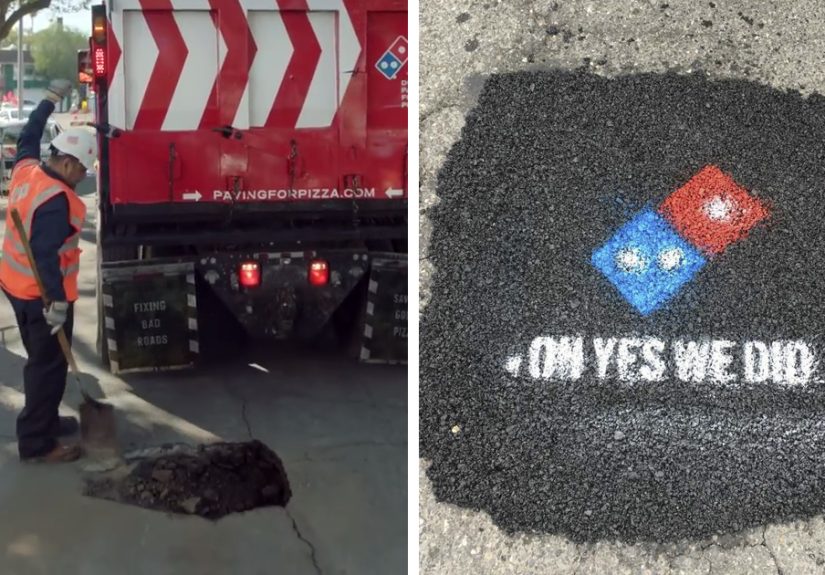
- Some repairs were branded with the Domino’s logo and the cheeky tagline “OH YES WE DID.”
It’s marketing, sure. But it’s marketing that leaves behind something you can drive onliterally. Instead of another billboard you ignore,
you get a smoother lane and a reduced chance of launching your soda into the passenger seat.
The pilot cities: small checks, immediate impact
Early examples included places like Milford, Delaware; Bartonville, Texas; Athens, Georgia; and Burbank, California. In Milford, local leaders
later described patching dozens of potholes in a short windowreal work done by real crews using the city’s process, accelerated by a small
burst of outside funding.
Domino’s didn’t claim it could solve infrastructure at scale with pocket change. Instead, it leaned into a specific problempotholesand picked a
tactic that creates visible, fast results. That speed is part of the satisfaction: you can literally see the “before” and “after” on the street.
From “a few towns” to “all 50 states”: how the idea snowballed
Domino’s quickly learned something that will shock absolutely no one: Americans have strong feelings about potholes.
Once nominations opened, the requests piled up from across the country.
With that response, Domino’s expanded the effort beyond an initial limited rolloutpushing toward at least one participating community in every state.
The program’s public story became less “quirky PR stunt” and more “okay, we accidentally tapped into a national frustration.”
Examples that made the campaign feel real
The most convincing part wasn’t the slogans. It was the very municipal nature of it all: mayors thanking the company, public works crews filling holes,
and residents watching their streets get patched. It felt local, practical, and refreshingly unglamorous.
Notably, coverage also described how franchisees and local Domino’s teams could help keep the idea aliveturning a corporate campaign into something that
could continue at the community level, even if the national spotlight moved on.
Why the reason behind it is so satisfying
Let’s be honest: “We’re fixing roads to protect pizza” is funny. But it’s also effective because it’s visceral.
Infrastructure problems can feel abstractbudgets, backlogs, lanes, funding cycles. Pizza damage is not abstract. Pizza damage is personal.
Here’s why people find this whole thing strangely delightful:
- It solves a problem you feel immediately. You don’t need a policy brief to understand potholes.
- It’s visible. A repaired patch is a physical improvement, not a promise.
- It’s a rare “brand action” that matches the tagline. The benefit is tangible even if you never buy a slice.
- It’s mildly chaotic in a wholesome way. A pizza company paying for asphalt is absurd, but also… helpful?
It scratches the same itch as watching a pressure washer clean a filthy driveway. The satisfaction isn’t just that it’s cleverit’s that it works.
Is it philanthropy, marketing, or a little bit of “welcome to 2018”?
The campaign was not without criticism. Some commentators argued that basic road upkeep shouldn’t require corporate sponsorship.
Others raised questions about branding public infrastructure, even if the markings were temporary.
Milford’s city manager, for instance, described the practical and ethical balancing act: taking a small grant for needed repairs while ensuring the city
wasn’t “endorsing” a brand in an inappropriate way. The branding itself was described as spray chalkmeaning it didn’t permanently stamp the street
like an ancient corporate rune.
Another criticism is scale. A $5,000 grant can do a lot in a targeted area, but it doesn’t rebuild entire corridors or replace failing base layers.
Pothole patching is often a short-term fix, especially after harsh winters. Still, short-term fixes matter when your tire is one impact away from becoming
an expensive donut.
But here’s the nuance most takes miss
The campaign didn’t claim it could replace public investment. What it did show is something cities already know:
small dollars applied at the right moment can prevent bigger problems. A patched crack today can delay a larger failure tomorrow.
Even a modest grant can help crews get ahead of the worst spots before they multiply.
The bigger picture: America’s roads still need serious investment
Domino’s didn’t create potholes, and it can’t un-create the backlog. National assessments and report cards have repeatedly pointed out that U.S. roads
remain under strain, with many major routes rated poor or mediocre and long-term funding needs still substantial.
Federal agencies and analysts have described large maintenance backlogs and the complexity of tracking pavement conditions across different systems.
Translation: it’s hard, it’s expensive, and it takes timeeven when money is availablebecause projects require planning, permitting, materials, labor,
and construction windows that don’t magically appear when your city council gets in a good mood.
Why potholes keep coming back (even after patching)
- Water + freeze/thaw cycles repeatedly weaken pavement and expand cracks.
- Deferred maintenance turns small defects into structural failures.
- Heavy loads accelerate wear, especially on older roadbeds.
- Local funding gaps can delay repairs on the roads people use the most.
This is why the Domino’s story lands: it’s a tiny patch on a giant issue, but it’s also a reminder that infrastructure is ultimately about daily life
commuting, deliveries, school drop-offs, ambulances, buses, and yes, pizza.
What we can learn from “pizza-powered road maintenance”
If you strip away the logo and the memes, the campaign offers a few practical lessons that apply far beyond Domino’s:
1) Make the problem human (and specific)
“Infrastructure” is broad. “My pizza got wrecked by a pothole” is specific. The second one gets attentionand attention helps unlock action.
2) Fund what cities can execute quickly
Municipal crews already know how to patch potholes. They often just need funding, prioritization, and a reason to move faster on certain segments.
3) Partnerships don’t have to be perfect to be useful
A corporation shouldn’t replace government responsibility, but strategic partnerships can still provide benefitsespecially when they support
public works rather than bypass it.
4) The “satisfying” part isn’t the brandit’s the result
The campaign works as a story because it produces a visible improvement. If the road gets smoother, the public wins. If dinner arrives intact,
the public also wins. If a brand gets attention, finejust don’t pretend the asphalt is imaginary.
Conclusion: the pothole fix you didn’t expect, but kind of needed
Domino’s didn’t set out to become America’s cutest infrastructure side character. It set out to keep pizza from getting demolished in transit.
And in the process, it highlighted something bigger: when roads fall apart, everyone paysdrivers, cities, businesses, and anyone who has ever
watched their dinner slide into a sad corner of the box.
Is it a substitute for long-term investment? No. Is it a surprisingly smart and satisfying way to turn a national annoyance into a tangible improvement?
Absolutely. Sometimes progress looks like trillion-dollar bills. Sometimes it looks like a fresh patch of asphalt with a goofy slogan that disappears
after the first rain.
Either way, if you’ve ever hit a pothole and instantly whispered, “my alignment,” you understand why this story feels so good.
of Experiences That Make This Whole Thing Hit Home
The first time I realized potholes have a personality, it was on a Monday morningbecause of course it was. I hit a crater big enough to qualify as a
minor geological feature and my coffee did that slow-motion splash that makes you question every life decision that brought you to this moment.
The car didn’t just bump; it complained. Loudly. In the language of “you’ll be hearing from my mechanic.”
After that, I started driving like I was auditioning for a cautious version of “Fast & Furious.” Eyes scanning the road, hands at ten and two,
emotions at eleven. You learn the pothole routes: the one by the gas station that always refills itself like it’s a subscription service, the one on the
right lane that gets worse every week, the sneaky one hidden in a puddle that turns your tire into an unwilling participant in a trust fall.
And then there’s the pizza factor. Carryout pizza makes you drive with a special kind of tendernesslike you’re transporting a sleeping baby made of cheese.
You slow down, you avoid sharp turns, you take the gentler route even if it’s longer. Because deep down, you know the heartbreak of opening the box and
finding the toppings rearranged like a modern art piece titled “Impact Trauma.”
That’s why the idea of a company fixing potholes for pizza feels so satisfying. It’s not that we’re obsessed with corporate goodwill (we’re not that easily
bribed, and also we have the internet). It’s that pothole repairs are one of the few things that instantly improve your day. You can feel it the
next time you drive through. Your steering wheel stops vibrating like it’s trying to send Morse code. Your passengers stop bracing for impact. Your car’s
suspension gets to live another week without sending passive-aggressive signals.
There’s also something deeply calming about seeing a fresh patch of asphalt. It’s the road version of making your bed: small, practical, and weirdly
reassuring. Like, “Okay. Someone noticed. Someone did something.” Even if that “someone” is a pizza chain with a marketing budget and a very real fear of
pepperoni migration, the result is still a smoother ride.
And looknobody wants to live in a world where potholes are fixed only when a brand has a clever slogan. But until we achieve the utopia where every street
is maintained on schedule and your tires never meet a surprise crater, I’ll take the win where I can get it. If a repaired road means my pizza arrives
intact and my car stops making suspicious noises, then yes: that is, in fact, extremely satisfying.