Table of Contents >> Show >> Hide
- Who Are the Frecce Tricolori, and Why Is Everyone Looking Up?
- Before the Jets: How I Planned the Shoot (So I Didn’t Panic-Adjust Everything)
- Gear That Helped (and the Stuff That Mostly Helped My Confidence)
- Settings That Made the Difference
- Composition: Turning “Plane in Sky” Into a Photo People Stop Scrolling For
- Safety, Etiquette, and Not Becoming the Main Character (In a Bad Way)
- Post-Processing: Making the Tricolor Smoke Look Like It Felt
- What I Learned Photographing the Frecce Tricolori Flyover
- My 500-Word Flyover Photo Diary: The Part Where My Neck Files a Complaint
- Conclusion
There are flyovers… and then there are Frecce Tricolori flyovers. The Italian Air Force’s legendary aerobatic team doesn’t just
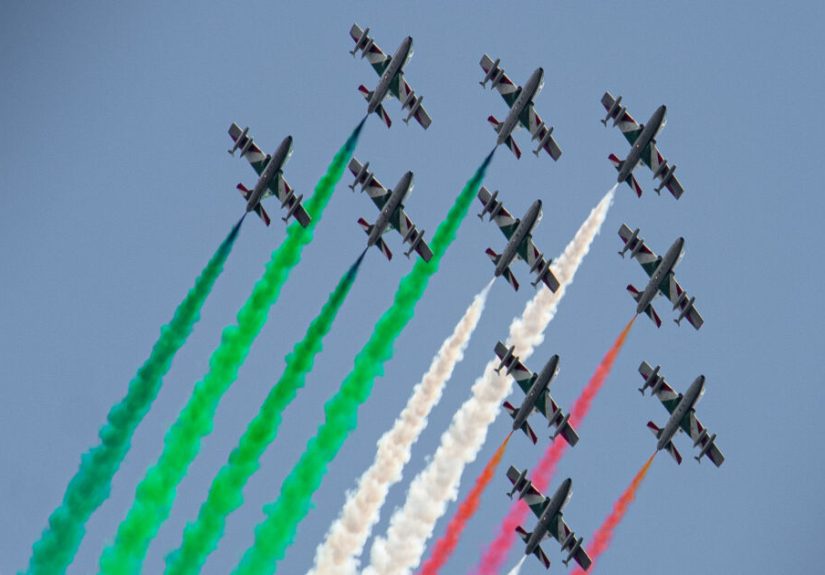
pass overhead like a polite commuter flight. They arrive with precision, geometry, and a dramatic ribbon of green, white, and red smoke that
looks like someone underlined the sky with a highlighter the size of a small country.
Photographing them is equal parts camera skills, planning, and accepting that your neck will file a formal complaint the next morning.
But if you’ve ever wanted to capture that “how is this even real?” feeling in a still image, this is the kind of aviation moment that makes you
check your memory card twice… and your pulse about eight times.
Who Are the Frecce Tricolori, and Why Is Everyone Looking Up?
Frecce Tricolori (often translated as “Tricolor Arrows”) are the Italian Air Force’s National Aerobatic Team, famous for tight formations and
signature tricolor smoke trails. The team was established in 1961 at Rivolto Air Base and is widely recognized as one of the world’s most
iconic military demonstration teams. They fly the Aermacchi MB-339 in a specialized aerobatic configuration designed for display flying.
Their flyovers and full aerobatic sequences have a distinct personality: crisp lines, synchronized turns, and that unmistakable “the sky is now a canvas”
vibe. In the U.S., appearances are rare enough that aviation fans treat them like a touring rock band that refuses to play small venues.
(And yes, there are people who can tell you the formation names faster than they can tell you their own Wi-Fi password.)
Before the Jets: How I Planned the Shoot (So I Didn’t Panic-Adjust Everything)
1) I treated the flyover like a timed performance, not a surprise
The easiest way to miss a flyover is to assume you’ll “figure it out when it happens.” That’s a great strategy for choosing a snack.
For photographing fast aircraft, it’s basically self-sabotage. I looked up the scheduled window, noted the direction of the pass, and picked
a spot with a clean sightline and a background that wouldn’t turn every photo into a messy game of “spot the jet behind the light pole.”
2) I chose a location with options, not perfection
“The best spot” is a myth because the best spot is also where every other photographer stands. I aimed for a place where I could shoot:
(a) wide to show the smoke pattern and context, and (b) tighter to isolate the aircraft and formation spacing. If I needed to pivot 20 feet for a better
angle, I couldwithout accidentally stepping into someone’s cooler civilization.
3) I planned for the light, not just the aircraft
Bright midday sun can be harsh, and haze/heat shimmer can soften details. If the flyover timing gives you a choice, earlier or later light can add shape
and reduce the “everything looks flat and slightly angry” contrast. But even in tough light, you can still win by prioritizing sharpness, exposure control,
and composition.
Gear That Helped (and the Stuff That Mostly Helped My Confidence)
Camera body: fast autofocus and burst rate matter
You don’t need the most expensive camera on Earth, but you do want reliable continuous autofocus and a decent burst rate.
The key is consistency: you want a camera that keeps tracking as the formation moves across the sky, not one that hesitates like it’s deciding whether
to focus on the jets or the idea of jets.
Lens choice: telephoto for drama, zoom flexibility for survival
A telephoto zoom is the sweet spot for flyovers and airshows. Something in the 100–400mm range (or longer, if the flight line is far) gives you reach
without locking you into a single framing. Wide angles are still usefulespecially for capturing the tricolor smoke as an environment shot that shows
scale, crowd, landmarks, or skyline.
Accessories: I packed like a person who has been sunburned before
Ear protection, water, sunscreen, and a hat are not “nice extras.” They’re the difference between staying focused and turning into a dehydrated gremlin
who can’t remember where the ISO button is. A lens hood helped with contrast, and a strap kept my camera from doing a surprise acrobatic routine of its own.
Settings That Made the Difference
There’s no single perfect recipe, but there are reliable starting points. The trick is matching settings to what you’re trying to show:
frozen sharp jets vs. motion-implying panning vs. smoky sky art with context.
My baseline for jets: prioritize sharpness and tracking
- Focus mode: Continuous AF (AF-C / AI Servo)
- Drive mode: High-speed continuous
- Shutter speed: Fast enough to freeze motion (often 1/1000s or faster as a starting point)
- Aperture: Mid-range like f/5.6–f/8 when light allows (helps keep multiple aircraft in a formation sharp)
- ISO: As low as practical, raised when needed to maintain shutter speed
When I wanted motion and “feel”: panning on purpose
Panning shots look dynamic because the background streaks while the aircraft stays relatively sharp. It’s harder than it looks, and it turns your first
dozen attempts into abstract art. But when it works, it looks like speed.
- Shutter speed: Slower than freeze-action speeds (you experiment until it fits your skill and aircraft speed)
- Technique: Start tracking early, rotate smoothly through the shot, keep moving after the shutter fires (follow-through)
- Stabilization: If your lens has a panning mode, it can help; otherwise, practice makes up the difference
Exposure tip: the sky is trying to trick your meter
Bright sky can cause underexposure on the aircraft. I watched my histogram and highlights and wasn’t afraid to use exposure compensation when needed.
If the jets looked like silhouettes when I didn’t want them to, I adjusted. If I wanted silhouettes for drama, I leaned into it and made the sky look gorgeous.
Composition: Turning “Plane in Sky” Into a Photo People Stop Scrolling For
1) Include context when it adds meaning
A perfectly sharp formation against an empty blue background is nice. But a wide frame with the tricolor smoke over a recognizable landmark,
crowd line, or airfield instantly tells a story. Context also helps convey scaleespecially when the smoke trail stretches across the scene like a national
signature.
2) Watch the spacing and geometry
The Frecce Tricolori are famous for precision. That means spacing, symmetry, and alignment are part of the subject.
I tried to frame so the formation felt intentional: centered when symmetrical, off-center when the smoke “paint stroke” needed room to breathe.
3) Shoot sequences, not single shots
Flyovers happen quickly. A burst sequence lets you choose the best instant later: the moment the formation is perfectly aligned, the second the smoke
reaches peak density, or the frame where the aircraft aren’t overlapping in a way that makes them look like they’re sharing a seat.
Safety, Etiquette, and Not Becoming the Main Character (In a Bad Way)
Airshow environments are designed around safety lines, restricted areas, and crowd control for very good reasons. I stayed behind barriers,
respected staff directions, and kept my attention on where I was standing as much as what I was shooting.
The goal is to go home with great photosnot a lecture, a lost lens cap, and a new nickname from security.
Post-Processing: Making the Tricolor Smoke Look Like It Felt
Editing aviation photos is mostly about polishing, not reinventing reality. I culled hard (because bursts create a lot of “almost” shots), then focused on:
- Exposure and contrast: bring back detail on the aircraft without turning the sky into noise
- Color balance: keep whites neutral so the green/white/red smoke looks accurate
- Sharpening: selective sharpening on aircraft, less on the sky
- Crop and straighten: emphasize formation geometry and clean lines
The smoke is the emotional hook, so I avoided crushing it with heavy-handed edits. The best versions kept texture in the colored trails and
looked naturallike the sky actually did that (because it did).
What I Learned Photographing the Frecce Tricolori Flyover
The biggest lesson: you can’t out-gear timing. You can have the perfect camera, the perfect lens, the perfect settings, and still miss the best moment
if you’re looking down at your screen while the formation draws the Italian flag across the horizon.
The second lesson: aviation photography rewards preparation. Knowing your starting settings, practicing smooth tracking, and anticipating where the
aircraft will appear makes your “keeper rate” jump dramatically.
And finally: the photos are great, but the experience is the real souvenir. There’s something ridiculously joyful about a crowd collectively looking up,
hearing the roar, and watching a team turn airspace into art.
My 500-Word Flyover Photo Diary: The Part Where My Neck Files a Complaint
I showed up early with the kind of optimism only photographers and people who bring spreadsheets to vacations possess. The sky looked mostly cooperative,
the light was bright, and I told myself, “Today I will be calm, prepared, and artistically unstoppable.” Then I immediately started second-guessing
everything I knew about shutter speed, because that’s tradition.
The first thing I noticed was the soundtrack of an airshow crowd: folding chairs clicking open, coolers thumping down, and the soft chorus of lens caps
being dropped into alternate dimensions. I found a spot with a clean view and enough elbow room to pan without accidentally performing interpretive dance
into someone’s tripod. I did a few warm-up passes on distant aircraft and birdsbecause nothing says “I’m ready for elite jets” like practicing on a seagull
that refuses to hold formation.
When the flyover window got close, the energy changed. People stopped wandering. Heads tilted up like synchronized swimmers. Someone said,
“You’ll know it when you hear it,” which felt both helpful and mildly threatening. I checked my settings one last time: continuous autofocus, high-speed burst,
and a shutter speed fast enough to freeze the moment. I also reminded myself to breathe, because apparently I forget that when expensive glass is involved.
Then it happened: a distant growl that turned into a full-body rumble, like the sky clearing its throat. I raised the camera, started tracking early, and tried
to keep the formation in frame while resisting the urge to chimp the screen after every burst. The Frecce Tricolori came in clean and sharp, and for a second
my brain did that delightful thing where it stops narrating and just watches. That’s the moment you hope your hands are still doing their job.
The smoke hit nextgreen, then white, then redthick enough to read clearly, but airy enough to look like it belonged up there. I grabbed a few tighter frames
to show the formation spacing, then zoomed wider to capture the full tricolor sweep. The wide shots were the story: the color stretching across the sky, the sense
of scale, the crowd below looking tiny and thrilled. The tight shots were the proof: the aircraft crisp, aligned, and impossibly close together.
Did I miss a couple frames? Absolutely. At one point I tracked a patch of smoke like it was the lead jet, which is a humbling experience because smoke has zero
respect for autofocus. But I also nailed a sequence where the formation was perfectly positioned and the tricolor trail looked like it was drawn with intention.
Back at home, culling was brutaldozens of “almost” shotsbut the keepers felt like little time capsules: soundless, sharp, and somehow still loud in my head.
If you’re ever on the fence about photographing a Frecce Tricolori flyover: go. Plan a little, practice a little, and let yourself enjoy it. The photos will
be great. The memory will be even better. And your neck? Your neck will recover. Probably.
Conclusion
Photographing the Frecce Tricolori flyover taught me a simple truth: the best aviation photos come from a mix of preparation and wonder.
Dial in your settings, respect the environment, and shoot with intentionbut don’t forget to look up and actually watch the sky art happening in real time.
Because even if you fill a memory card, the real “keeper” is the moment you realize you just photographed a national signature written in smoke.