Table of Contents >> Show >> Hide
- What Makes a Painting “Metal,” Exactly?
- The Hall of Totally Brutal, Most Metal Paintings
- 1) Hieronymus Bosch The Garden of Earthly Delights
- 2) Francisco Goya Saturn Devouring His Son
- 3) Henry Fuseli The Nightmare
- 4) Artemisia Gentileschi Judith Slaying Holofernes
- 5) Caravaggio Judith Beheading Holofernes (and the Caravaggio Method)
- 6) Théodore Géricault The Raft of the Medusa
- 7) Eugène Delacroix The Massacre at Chios
- 8) Francisco Goya The Third of May 1808
- 9) Pablo Picasso Guernica
- 10) Pieter Bruegel the Elder The Triumph of Death
- 11) John Martin The Great Day of His Wrath
- 12) Caspar David Friedrich The Sea of Ice
- 13) William Blake The Great Red Dragon series
- 14) H. R. Giger Necronom IV
- 15) Frank Frazetta The Death Dealer
- Why These “Brutal Paintings” Still Hit So Hard
- How to Look at Metal Paintings Without Getting Lost
- Extra : Experiences That Make These Paintings Feel Even More Metal
- Conclusion
Some paintings are polite. They hang there, sipping imaginary tea, pretending they’ve never frightened a soul.
And then there are metal paintingsthe ones that kick down the gallery door, blast a power chord,
and leave you staring like, “Yeah… I’m gonna need a minute.”
This list isn’t about “pretty.” It’s about intensity: doom-soaked atmosphere, mythic chaos, heroic grit,
unsettling symbolism, and that delicious feeling of awe when a canvas goes full thunderstorm. We’re talking
the most metal paintings of all timeart that’s totally brutal (in the best way), whether it’s
centuries old or born from the same visual DNA as album covers and stage fog.
What Makes a Painting “Metal,” Exactly?
“Metal” isn’t a single style. It’s a vibean emotional volume knob turned to eleven. A painting earns its metal
stripes when it hits a few of these notes:
- Doom atmosphere: storms, ruins, night scenes, smoke, dread, and the sense that the world is mid-anthem.
- Myth and monster energy: gods, demons, saints, beasts, and cosmic “you sure you wanna look closer?” symbolism.
- Brutal honesty: war, suffering, obsession, or the shadow side of human natureshown with purpose, not cheap shock.
- Chiaroscuro drama: that high-contrast lighting that feels like a spotlight at a live show.
- Iconic composition: images so bold they become visual riffsmemorable after one look.
In other words: if a painting makes you whisper, “This would look incredible on the back of a tour tee,” it probably belongs here.
The Hall of Totally Brutal, Most Metal Paintings
Below are masterpieces that regularly show up in serious art history discussionsand also in the mental playlist
of anyone who’s ever loved darkness, drama, and “how did a human even paint that?” energy.
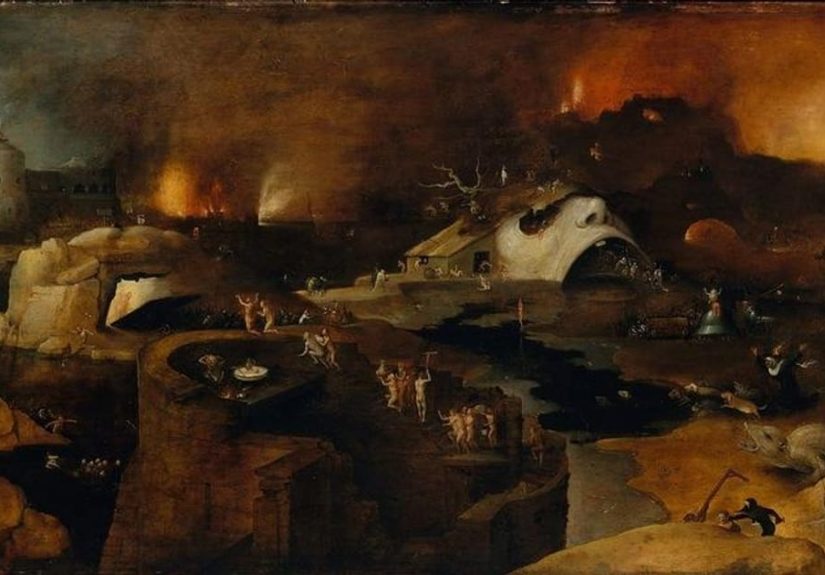
1) Hieronymus Bosch The Garden of Earthly Delights
If you’ve ever wondered what a medieval fever dream would look like after drinking three espresso shots and
listening to a concept album straight through, Bosch has you covered. This triptych is an epic visual saga:
paradise, temptation, and consequencestold through surreal creatures, impossible scenes, and symbols that still
spark debate today.
Metal factor: it’s basically apocalyptic art with boss-level imagination. Every corner feels like
a lyric you can’t unhear. It’s chaotic, specific, and strangely rhythmiclike the canvas itself is keeping time.
2) Francisco Goya Saturn Devouring His Son
This is one of the most famous “dark paintings” ever made, and it earns that reputation without needing a single
ounce of explanation. Inspired by myth, Goya delivers raw horror and psychological intensityless “storybook” and
more “nightmare you remember for years.”
Metal factor: pure doom. It’s a reminder that “brutal paintings” can be powerful because they confront fear and
obsession head-on. This isn’t gore for funit’s dread with purpose.
3) Henry Fuseli The Nightmare
Gothic before gothic was a brand. Fuseli’s scene is famous for its unsettling dream logicshadowy presence,
distorted calm, and that creeping “something is wrong” silence. It’s the visual equivalent of a slow, ominous
intro that suddenly drops into a heavy riff.
Metal factor: it’s a classic blueprint for gothic paintings and horror aesthetics. If your favorite
band has ever used the word “nightmare” in a chorus, this painting is basically their great-great-grandparent.
4) Artemisia Gentileschi Judith Slaying Holofernes
Artemisia Gentileschi didn’t paint timid heroines. Her Judith is determined, forceful, and unflinchingrendered
with dramatic lighting and a composition that feels like a stage scene frozen at the most intense moment.
Metal factor: the energy is fearless. It’s also a masterclass in how brutality in art can serve storytelling and
theme, not just shock. You don’t walk away thinking “wow, violence.” You walk away thinking “wow, resolve.”
5) Caravaggio Judith Beheading Holofernes (and the Caravaggio Method)
Caravaggio is basically the patron saint of “dramatic lighting goes hard.” His paintings often feel like spotlit
theater: deep shadows, bright highlights, faces caught mid-decision. In his take on Judith, the scene becomes a
tense psychological momentless fantasy, more human confrontation.
Metal factor: chiaroscuro that punches like a kick drum. Caravaggio’s influence is everywherefrom
cinema to photography to modern illustrationbecause it’s not just pretty light; it’s emotional pressure.
6) Théodore Géricault The Raft of the Medusa
A massive painting built on real tragedy, this work hits like a storm surge. You get desperation, hope, exhaustion,
and that unbearable suspense of “will anyone arrive?”all in one sweeping composition. Géricault studied bodies,
movement, and expression to make the scene feel painfully real.
Metal factor: it’s endurance art. The emotional crescendo is enormous, like a track that keeps building until your
chest feels tightin a good, cathartic way.
7) Eugène Delacroix The Massacre at Chios
Delacroix is known for romantic intensity, and here he delivers sorrow at scale. The painting confronts human suffering
in a way that’s somber rather than sensationalmore elegy than spectacle. The color and composition pull you into the
emotional weight of the scene.
Metal factor: it’s the “anti-war ballad” of paintingtragic, furious, and haunting long after you look away.
8) Francisco Goya The Third of May 1808
Another Goya entry because, frankly, the man understood darkness. This painting is famous for its clear moral focus:
it’s about fear, violence, and the cost of conflict. The central figure’s posture and the stark light make the moment
feel both intimate and historic.
Metal factor: it’s protest art with a spotlight. The drama is cinematic, the message is direct, and it still resonates
because it’s fundamentally about humanity.
9) Pablo Picasso Guernica
Guernica doesn’t need gore to be devastating. Its fractured shapes, stark palette, and distorted faces turn
chaos into a symbol of suffering that feels universal. The painting is a scream made visualanguish translated into
form, like soundwave-to-canvas.
Metal factor: this is the painting equivalent of a wall of sound. It’s enormous, relentless, and unforgettableproof
that “brutal” can mean emotionally overwhelming, not just visually dark.
10) Pieter Bruegel the Elder The Triumph of Death
Bruegel created a world where doom is everywhere: armies of skeletons, burning landscapes, panic and ruin. It’s a grim
panorama that reads like an entire album’s worth of songs packed into one image.
Metal factor: maximum apocalypse. This is dark art that practically invented the visual language of
“the end times” for countless artists who came later.
11) John Martin The Great Day of His Wrath
John Martin loved biblical scalecatastrophe painted like a blockbuster. In this work, nature itself becomes the
instrument of judgment: cliffs collapse, cities crumble, and the sky looks like it’s doing backing vocals.
Metal factor: theatrical destruction without cheapness. It’s grand, operatic doomlike symphonic metal, but with paint.
12) Caspar David Friedrich The Sea of Ice
No monsters. No battle. Just nature absolutely dominating everything. Jagged ice forms a broken cathedral of cold,
swallowing a ship and turning human ambition into a footnote. It’s quietbut not calm. It’s the kind of silence that
rings in your ears.
Metal factor: glacial doom. This is “post-apocalyptic” without explosionsproof that most metal paintings
can be brutal through atmosphere alone.
13) William Blake The Great Red Dragon series
Blake’s visionary work sits at the crossroads of spirituality, myth, and raw imagination. The Red Dragon images feel
like scripture filtered through an artist who never once asked permission to be intense. Muscular forms, cosmic scale,
and symbolic firepower everywhere.
Metal factor: prophecy-core. These paintings look like they were commissioned by the universe to headline a festival.
14) H. R. Giger Necronom IV
Yes, it’s modern. Yes, it’s famously connected to sci-fi horror aesthetics. And yes, it’s a painting that changed the
look of an entire genre. Giger’s biomechanical vision fuses flesh-and-machine ideas into something both elegant and
unsettlinglike a cathedral built out of nightmares and chrome.
Metal factor: industrial dread. This is the kind of image that makes you understand why some people call certain art
“heavy” even when it’s silent.
15) Frank Frazetta The Death Dealer
If you’ve ever seen a fantasy painting and thought, “This belongs on a battle jacket,” there’s a good chance the
artist owes something to Frazetta. The Death Dealer is iconic: shadowed figure, mythic menace, and a sense
that an entire story is about to explode off the canvas.
Metal factor: heroic darkness. It’s the visual equivalent of a riff you can’t stop hummingbold, primal, and legendary.
Why These “Brutal Paintings” Still Hit So Hard
Here’s the wild part: many of these paintings weren’t created to be “metal.” They were created to be honestabout
fear, faith, power, grief, obsession, survival, and the weird cosmic question mark of being alive. Metal music and metal
aesthetics love those themes because they’re universal. A good brutal painting isn’t trying to be edgy; it’s trying to say
something real at maximum volume.
And because they’re real, they age well. A meme fades. A hot take cools off. But a masterpiece that captures dread, awe,
or defiance? That thing keeps shredding for centuries.
How to Look at Metal Paintings Without Getting Lost
Some of these works are densepacked with symbols, history, and details. Here’s a quick way to “read” them like you’d
listen to a heavy song:
- Start with the hook: What’s the first thing your eye snaps to?
- Find the rhythm: Where does the composition lead you next?
- Identify the mood: Dread, awe, grief, fury, triumphwhat’s the dominant emotion?
- Catch the details: Symbols, gestures, background cluesthese are the “lyrics.”
- Zoom out again: What message does the whole scene leave you with?
Do that, and even the most chaotic apocalyptic art starts to feel strangely organizedlike a wall of sound you can
finally pick apart.
Extra : Experiences That Make These Paintings Feel Even More Metal
If you want “The Most Metal Paintings of All Time” to hit harder than a double-bass drumline, it’s not just about
looking at themit’s about how you experience them. The right setting can turn a famous canvas into a full-body moment.
First: try the museum-in-the-morning experience. Get there early, before crowds turn every room into a slow-moving
human traffic jam. Quiet galleries make the atmosphere sharper. A work like The Sea of Ice feels colder when the room is calm.
Guernica feels louder when you’re not competing with a dozen conversations. Give yourself time to stand there long enough for
your brain to stop labeling it (“Oh, that’s the famous one”) and start feeling it (“Oh… that’s what it’s doing to me”).
Second: do a two-pass viewing. On the first pass, you move quickly like you’re scanning a playlistjust vibe-checking.
On the second pass, you pick one painting and treat it like your favorite track on repeat. Look for the “riff” that anchors it:
Caravaggio’s lighting, Bosch’s details, Friedrich’s scale, Frazetta’s silhouette. When you return to the same image after seeing
others, your eye catches new layers. It’s the art version of hearing a song again and suddenly noticing a hidden harmony.
Third: bring a tiny notebook (or your phone notes) and do a 30-second review after each piece:
“Mood: ___ . Main image: ___ . Best detail: ___ . If this were a band name it’d be: ___.” It sounds sillybecause it isbut it also
forces you to translate emotion into words. That’s how you remember art. You’re building your own mental liner notes.
Fourth: if you can’t get to a museum, try a high-resolution deep dive. Many major museum and educational sites host
zoomable images and curatorial explanations. Instead of scrolling like you’re doom-scrolling (pun unavoidable), commit to one painting
and zoom in until you find a detail you’ve never noticed. Bosch’s worlds are basically endless. Bruegel is full of tiny stories.
Even minimalist-feeling works often have brushwork you can practically feel through the screen.
Fifth: make it social, but in a good way. Not “group selfie in front of tragedy” energymore like a small art hang with one
friend who’s willing to talk about what the work is doing. Ask each other: “What’s the emotion?” “Where does the light land?”
“Does this feel like doom metal, thrash, black metal, or something else?” You don’t need to be an expert. You’re just practicing
attentionone of the most metal skills in a world built to distract you.
Finally: try pairing the painting with a personal ritual. Not mysticaljust memorable. Maybe you always start with one
“anchor” painting and end with a “palette cleanser” (a landscape, a still life, something gentle). Maybe you set a rule: no photos,
only notes. Maybe you give yourself a challenge: find one detail that feels hopeful, even in the most brutal painting. That last one is
surprisingly powerful, because it teaches you why these works endure: the darkness is real, but so is the human need to face it and keep
going. And if that isn’t metal, what is?