Table of Contents >> Show >> Hide
- What “Money Strength” Actually Means
- Your Money Strength Scorecard (A Quick Self-Assessment)
- The Big Three “Quiet Killers” of Money Strength
- The Core Workout Plan: Make Every Dollar Get a Job
- Turn On the Investing Engine (Without Becoming a Stock-Picking Psychic)
- Compounding: The Most Boring Superpower
- Start with the “Free Money” Lever (If You Have It)
- Use Diversification and Asset Allocation to Manage Risk
- Rebalancing: The “Tune-Up” That Keeps Risk in Check
- Consider Broad, Low-Cost Index Funds (And Read the Expense Ratio)
- Dollar-Cost Averaging: Consistency Beats Drama
- Make Returns Stick: Taxes and “Financial Friction”
- Avoid These “Money Naps” (Common Ways People Unplug Their Money)
- A Practical 90-Day “Money Strength” Plan
- Conclusion: Strong Money Is Mostly Boring (And That’s the Point)
- Real-World Experiences Related to Money Strength (Composite Scenarios)
(Educational content only, not financial, tax, or legal advice.)
If money could talk, most of it would say something like: “I’d love to work harder for you… but you keep handing me
to your credit card company and letting me sit on the couch in a checking account.”
“Your Money Strength” is a simple idea: how effectively your dollars protect you, grow for you, and buy you freedom
laterwithout you needing to become a full-time spreadsheet wizard. Think of it like financial fitness. Some people
have big “money muscles” (strong savings, smart investing, low fees). Others have money that’s constantly out of
breath (high-interest debt, no emergency fund, lots of “I’ll start next month”).
The good news? Money strength is trainable. And unlike push-ups, you can automate most of it.
What “Money Strength” Actually Means
Your money is “working” when it’s doing at least one of these jobs:
- Protection: buffering emergencies so you don’t borrow at painful interest rates.
- Efficiency: avoiding leaks like high fees, unnecessary interest, and impulse spending.
- Growth: compounding over time through investing (not through “manifesting”).
- Stability: spreading risk through diversification and sensible asset allocation.
- Flexibility: giving Future You optionscareer changes, moving, helping family, retiring.
In the U.S., guidance from major regulators and consumer agencies (like the IRS, SEC, FINRA, CFPB, and FDIC) plus
big financial institutions consistently points to the same core principles: save for shocks, reduce high-cost debt,
invest long-term, diversify, keep costs low, and stay consistent.
Your Money Strength Scorecard (A Quick Self-Assessment)
Give yourself 0–2 points for each item (0 = “nope,” 1 = “kinda,” 2 = “yes, consistently”). Total possible: 20 points.
1) Cash Flow Control (0–4 points)
- I know where my money went last month (not “roughly,” but actually).
- I have a realistic system (budget, spending plan, or rules) that I can stick with.
2) Shock Absorbers (0–4 points)
- I have at least a starter emergency fund (even $1,000 changes decisions).
- I’m building toward 3–6 months of essential expenses in accessible savings.
3) Debt Drag (0–4 points)
- I’m not carrying high-interest revolving credit card debt month to month.
- I have an intentional payoff plan (not “I pay whatever and hope”).
4) Investing Engine (0–4 points)
- I invest regularly (automated counts!) rather than only “when I remember.”
- I’m diversified with a sensible mix of stocks/bonds/cash for my timeline and risk tolerance.
5) Friction & Protection (0–4 points)
- I pay attention to costs like expense ratios, account fees, and unnecessary interest.
- I’ve handled basics like insurance coverage and beneficiary updates.
Interpretation:
0–7: Your money is mostly “clocked out.”
8–14: Your money is working… but it’s skipping leg day (and probably paying too many fees).
15–20: Strong money habits. Keep it boring and consistentthe highest compliment in personal finance.
The Big Three “Quiet Killers” of Money Strength
1) High-Interest Debt: The Ankle Weights
If you’re investing while carrying high-interest credit card debt, it’s like trying to run a marathon while someone
gently (but firmly) holds your shoelaces together. Sure, it’s technically possible. But why?
Many consumer education sources describe two common payoff strategies:
the avalanche method (pay highest interest first) and the snowball method (pay
smallest balance first to build momentum). Mathematically, avalanche often saves more interest; behaviorally,
snowball can keep you motivated. The “best” plan is the one you’ll actually follow to the finish line.
2) Inflation: The Silent Pickpocket
Inflation gradually erodes purchasing power over time. That means cash sitting around for years can buy less later
even though the number in the account doesn’t change. Cash is great for short-term needs and emergencies; it’s
usually a weak long-term growth tool.
3) Fees: The Slow Leak That Becomes a Flood
Investing costsespecially ongoing fund expensescan compound against you. An expense ratio is essentially a yearly
percentage cost taken out of a fund’s returns. It may look tiny, but over decades, “tiny” can be the difference
between “nice retirement” and “I guess I’ll work forever, but with vibes.”
The Core Workout Plan: Make Every Dollar Get a Job
Step 1: Assign Roles to Your Money
Most financial stress comes from role confusion. One day your money is “rent money,” the next day it’s “surprise car
repair money,” and by Friday it’s “I deserved this” money. Instead, consider separating your dollars into simple
buckets:
- Spending: bills, groceries, life.
- Emergency: only for true unexpected hits.
- Near-term goals: moving, travel, car down payment (1–3 years).
- Long-term investing: retirement and wealth-building (10+ years).
You don’t need ten accounts. You do need clarity. When each dollar has a job, you stop “accidentally” using your
future as a coupon.
Step 2: Build an Emergency Fund (Your Financial Shock Absorbers)
Many mainstream U.S. personal finance recommendations start with a starter emergency fund (often
$1,000) and then build toward 3–6 months of essential expenses. Why? Because emergencies rarely
RSVP, and the worst time to borrow is when you’re already stressed.
Where to keep it? Typically somewhere liquid and boring: a savings account or money market option that earns some
interest but stays accessible. And because “safe” still matters, it helps to understand that FDIC deposit insurance
generally covers up to $250,000 per depositor, per insured bank, per ownership category.
Step 3: Remove Debt Drag with a Two-Rule System
- Rule A: Always pay minimums on everything.
- Rule B: Throw extra money at one target debt until it’s gone (avalanche or snowball).
Add one “cheat code”: reduce interest rates when possible. That can mean calling for a lower APR, consolidating
wisely, or refinancing eligible loans. Not every option fits every situation, but the principle is universal:
lower interest = money works harder for you instead of for the lender.
Turn On the Investing Engine (Without Becoming a Stock-Picking Psychic)
Compounding: The Most Boring Superpower
Compound interest is “interest on interest.” A simple example: if you have $100 earning 5% annually, you end year
one with $105. In year two, you earn interest on $105, not just the original $100. Over time, compounding becomes
less “cute math trick” and more “wow, time is doing heavy lifting.”
This is why consistency matters more than perfect timing. The longer your money has to compound, the stronger it
getslike a snowball rolling downhill, except with fewer faceplants.
Start with the “Free Money” Lever (If You Have It)
If your employer offers a retirement plan match (like a 401(k)), that match is often the closest thing to a
guaranteed return you’ll ever see. Ignoring it is like refusing a raise because you’re “not really into math.”
For 2026 specifically, the IRS announced the employee contribution limit for 401(k)-type plans is $24,500,
and the IRA limit is $7,500 (with additional catch-up contributions possible depending on age and rules).
You don’t need to max these out to benefit. You do need to be intentional.
Use Diversification and Asset Allocation to Manage Risk
Asset allocation is the mix of stocks, bonds, and cash you choose. Diversification means spreading investments
across and within those categories so one bad day in one corner doesn’t wreck your entire plan.
A simple way to think about it: stocks are generally the growth engine (but bumpy), bonds can add stability, and
cash covers short-term needs. Your best mix depends on your timeline and how much volatility you can stomach
without panic-selling at the worst moment.
Rebalancing: The “Tune-Up” That Keeps Risk in Check
Over time, markets shift your portfolio. If stocks rise a lot, your portfolio can become riskier than you intended.
Rebalancing brings you back to your target mix. It’s basically telling your portfolio: “Congrats on the gainsnow
get back to your job description.”
Consider Broad, Low-Cost Index Funds (And Read the Expense Ratio)
Many investors use index funds because they’re designed to track a market index rather than trying to beat it with
frequent trading. The key is to watch costs: expense ratios and other fees. Lower costs help keep more of your
returns compounding for you.
You don’t need to chase exotic, complicated products to build money strength. In fact, complexity often comes with
hidden costs: higher fees, trading spreads, tax surprises, and “Wait, what does this thing actually hold?”
Dollar-Cost Averaging: Consistency Beats Drama
Dollar-cost averaging is investing a fixed amount on a regular schedule regardless of market price. It doesn’t
guarantee profit and it won’t protect you from losses, but it can reduce the emotional temptation to time the
market. It turns investing from an anxiety hobby into a routine.
Make Returns Stick: Taxes and “Financial Friction”
Money strength isn’t just about gross returnsit’s about net results after taxes and costs. Two people
can own similar investments and end up with very different outcomes based on:
- Account choice: taxable vs. tax-advantaged retirement accounts.
- Fund costs: expense ratios and trading costs.
- Behavior: panic-selling, chasing trends, or “all-in” decisions.
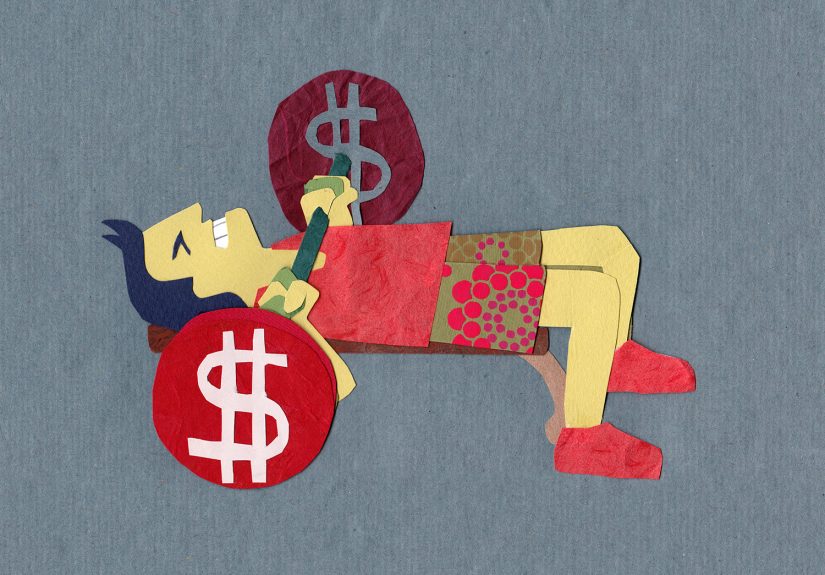
A useful mindset: treat taxes and fees like weight on the barbell. You can still lift, but you want unnecessary
weight off the bar so your effort actually moves you forward.
Avoid These “Money Naps” (Common Ways People Unplug Their Money)
1) Waiting for the “Perfect Time”
Many investors lose years to the fantasy of perfect timing. Markets move, headlines scream, and suddenly you’re
five years older with the same cash sitting there like it’s guarding the couch. A consistent plan is usually more
powerful than a perfect prediction.
2) Lifestyle Creep with No Plan
Raises are awesomeuntil your spending grows faster than your savings. If every raise becomes a subscription bundle
and a bigger car payment, your money strength stays the same. Consider a simple rule: whenever income rises, direct
a set percentage to savings/investing before upgrading lifestyle.
3) Ignoring Protection Basics
Money strength also includes keeping your financial progress from getting wiped out. That often means having
appropriate insurance (health, disability, auto, renters/homeowners) and updating beneficiaries. It’s not glamorous,
but neither is a financial disaster with no safety net.
A Practical 90-Day “Money Strength” Plan
Days 1–14: Stabilize
- List all debts with balances, rates, and minimums.
- Track spending for two weeks (no judgment, just data).
- Build a starter emergency fund goal and open/label the account if needed.
Days 15–45: Build Momentum
- Automate a weekly or biweekly transfer into emergency savings.
- Pick avalanche or snowball; set one “target debt.”
- Cut 1–3 recurring expenses you don’t value (keep the ones you lovethis isn’t a misery contest).
Days 46–90: Turn On Growth
- Increase retirement contributions by 1–2% if cash flow allows (small moves compound).
- Choose a diversified, low-cost investment approach aligned with your timeline.
- Set a monthly “money date” (15 minutes) to check progress and rebalance habits, not panic.
Conclusion: Strong Money Is Mostly Boring (And That’s the Point)
Your money doesn’t need to do backflips. It needs a job, a plan, and consistency. When you build an emergency fund,
reduce high-interest debt, invest long-term with diversification, and keep fees and taxes from quietly chewing your
returns, you create money strengththe kind that supports your life instead of stressing it out.
Start small if you have to. The first goal isn’t “perfect.” It’s “in motion.” Because money that’s moving with a
plan is money that’s working.
Real-World Experiences Related to Money Strength (Composite Scenarios)
To make the idea stick, here are a few “this totally happens in real life” experiencescomposite stories built from
common patterns people run into. If you recognize yourself in one, congratulations: you’re human, not broken.
Experience #1: The Emergency Fund That Prevented a Spiral
One person had been saving “a little whenever,” which mostly meant “never consistently.” After a minor medical bill
and a car repair landed in the same month, they put everything on a credit card “just for now.” The balance didn’t
look scary at first… until interest made it grow like it was training for the Olympics.
The turnaround wasn’t dramatic. They started with a starter emergency fund and automated a small weekly transfer.
A few months later, when another unexpected expense hit, it was annoyingbut it wasn’t a crisis. No new debt. No
panic. That’s money strength: not avoiding life, but absorbing it.
Experience #2: The “I Invested Once” Trap
Another person invested a lump sum once, watched the market dip, and decided investing was “a scam.” They didn’t
invest again for yearsmissing out on a long stretch of compounding because they judged a decades-long plan by a
few months of volatility.
When they restarted, the fix wasn’t finding a magic stock. It was switching to a consistent scheduledollar-cost
averagingso investing became routine instead of emotional theater. They still saw dips. They just stopped treating
dips like personal insults. Over time, the habit mattered more than the headlines.
Experience #3: The Fee Wake-Up Call
Someone else had multiple funds and accounts, chosen mostly because a friend said, “This one is good,” and because
the marketing sounded like it could bench-press the S&P 500. Years later, they realized they were paying higher fees
than they needed to, and the performance wasn’t delivering anything special in return.
They didn’t need a complete financial identity crisis. They simply learned to check expense ratios and understand
what they owned. The change was quiet but powerful: lower costs meant more of their returns stayed invested and kept
compounding. It felt boringand that’s exactly why it worked.
Experience #4: The Debt Payoff Plan That Finally Stuck
A common turning point happens when someone stops saying “I should pay off debt” and starts saying “Here’s my
strategy.” They pick avalanche or snowball, automate extra payments, and track only one thing: the next milestone.
The surprising part is psychological. Progress becomes visible. People who once felt ashamed about debt start
feeling in control. They realize money strength isn’t about never making mistakesit’s about building a system that
keeps moving even when motivation takes a day off.
Experience #5: The Raise That Didn’t Disappear
One of the most underrated money-strength experiences is the “raise split.” Instead of letting lifestyle expand to
swallow the entire raise, a person automatically sent a chunk to savings and investing on payday. The rest could be
enjoyedguilt-freebecause Future You was already paid.
Over time, this created a strange and wonderful feeling: stability. Not “I’m rich,” but “I’m not one surprise away
from chaos.” Their money worked harder without them working harder.
If you want to steal one idea from these experiences, make it this: systems beat willpower.
Automate the basics, keep costs low, stay diversified, and treat your plan like a long-term training program.
Your money doesn’t need motivation. It needs a schedule.