Table of Contents >> Show >> Hide
- What Exactly Is the MUJI Toaster Vertical Oven?
- Design: Minimalism Meets Everyday Toast
- Key Features & Technical Specs
- How Does the MUJI Vertical Toaster Perform?
- MUJI vs. Other Compact Japanese Toaster Ovens
- Pros and Cons of the MUJI Toaster Vertical Oven
- Who Is the MUJI Vertical Toaster Oven Best For?
- Care, Cleaning, and Safety Tips
- Real-World Experiences with the MUJI Toaster Vertical Oven
- Conclusion: Is the MUJI Toaster Vertical Oven Worth It?
If you’ve ever looked at your crowded kitchen counter and thought, “I own too many appliances, but I still want perfect toast,” the MUJI Toaster Vertical Oven might be your new favorite roommate. This slim, minimalist toaster oven stacks your toast vertically instead of spreading it sideways, turning the usual wide, boxy appliance into a compact tower of carb-toasting power.
Designed by MUJI, Japan’s cult-favorite brand known for calm, clutter-free products, this vertical toaster oven takes up a footprint of roughly 23 x 25.5 cm (about 9 x 10 inches) and stands around 32.5 cm (13 inches) tall. Inside, there are two shelves sized for standard slices of bread and small trays, plus three quartz heaters and four power levels ranging from 300W to 1000W. In other words, it’s tiny but mightylike a very disciplined, very stylish dragon that only breathes heat when you tell it to.
What Exactly Is the MUJI Toaster Vertical Oven?
The MUJI Toaster Vertical Oven (often sold under model numbers like MJ-OTL10A or MJ-OTL10B) is a compact, two-tier toaster oven designed primarily for the Japanese market. It runs on AC 100V power and uses three quartz heaters with adjustable wattage, allowing you to toast, reheat, and lightly bake without turning on a full-size oven.
Unlike traditional toaster ovens that stretch horizontally across your counter, this MUJI oven stacks its two shelves so you can toast two slices of breador two small traysat once while occupying about the same counter space as a large loaf of bread. Several design-driven retailers highlight it specifically as a “space-saving toaster allowing you to toast 2 pieces at once,” which is exactly the energy you want in a small apartment or dorm kitchen.
Although it’s not always easy to find in mainstream U.S. stores, it’s frequently available through specialty design shops, import sites, and marketplaces listing Japanese kitchen appliances, often advertised as a “vertical type” oven that’s compact, minimalist, and very, very MUJI.
Design: Minimalism Meets Everyday Toast
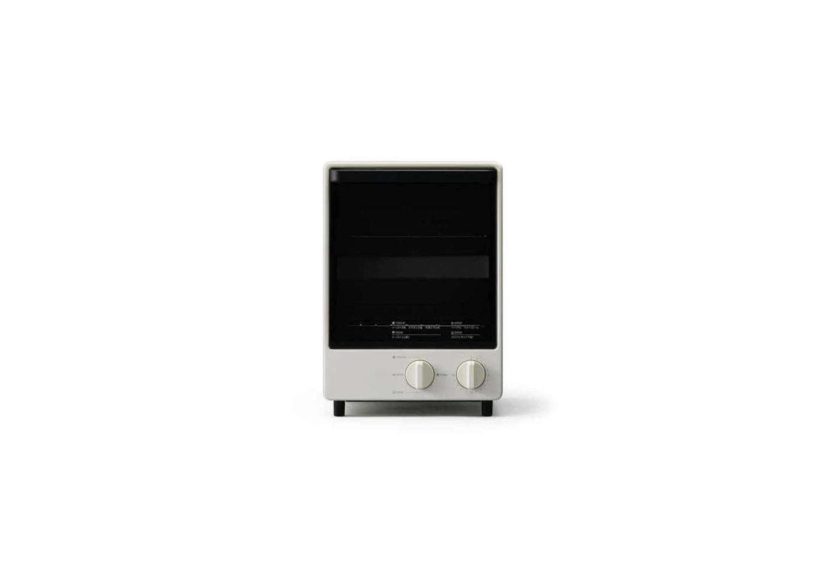
MUJI’s design language is all about “just enough” no extra decoration, no flashy chrome, no aggressive branding. The Toaster Vertical Oven follows that rule perfectly with a white housing, a large dark glass door, and two simple knobs on the front. It looks more like a tiny modern building model than an appliance.
Small Footprint, Vertical Thinking
Vertical toaster ovens are a quiet trend in Japanese design: they use a tall, narrow format to save counter space in tiny kitchens. Design sites that round up Japanese vertical ovens point out that these “compact, simple-looking toaster oven boxes” take up less width on the counter and are easier to tuck into corners than traditional models. The MUJI version fits right into this category, with its clean silhouette and no-nonsense controls.
The dimensions are roughly:
- External size: about 23 x 25.5 x 32.5 cm (9 x 10 x 13 inches)
- Upper shelf: 19.5 x 16.5 x 7 cm
- Lower shelf: 19.5 x 16.5 x 7.5 cm
- Weight: around 3.2 kg (about 7 lb)
These shelf dimensions are just right for standard sandwich bread, small bagels, English muffins, or a couple of slices of leftover pizza.
Functional, Not Fussy
The front panel is as straightforward as it gets: one knob for the timer and one knob for heat selection. No digital display, no multi-step modes, no app, no Wi-Fijust you, your bread, and a couple of clicks. For people who like tactile, analog control (and for anyone who is tired of scrolling through 13 modes just to warm a croissant), this is bliss.
Inside, three quartz heaters deliver even radiant heat. Users and product descriptions note that these elements don’t always glow bright orange, which is deliberate: it allows slower, more controlled toasting without scorching the surface immediately.
Key Features & Technical Specs
Here’s what makes the MUJI Toaster Vertical Oven more than just a cute box for bread:
- Power consumption: up to 1000W
- Heat/Power settings: 300W, 400W, 700W, and 1000W, with the ability to heat the upper shelf, lower shelf, or both, depending on the setting.
- Heaters: Three quartz or quartz/silica heating elements
- Configuration: Two shelves, each with its own tray
- Included accessories: Two metal trays sized to fit the interior perfectly
- Power supply: AC 100V (designed for the Japanese market)
- Cord length: about 1 meter (3.2 ft)
Compared with typical U.S. toaster ovens, which may use 1200–1800W and have multiple large heating elements, this MUJI model runs lean. It’s not meant to replace a full oven or a serious broiler, but it’s very capable for toasting and small-batch heating.
How Does the MUJI Vertical Toaster Perform?
Toast Quality
The most important test: can it make good toast? Short answer: yes. The combination of vertical design and quartz heaters delivers a surprisingly even result, especially if you give the oven a minute or so to preheat on the higher settings.
Because of the two-tier layout, you can toast two slices at once without crowding them. In practice, many users like to keep more delicate items (like pastries or thinner bread) on the upper shelf and denser items (like bagels or pizza slices) on the lower shelf, taking advantage of slightly different heat exposure.
The lower wattage options (300W or 400W) work nicely for slow toasting or warming bread that’s already baked but needs a gentle refresh. Crank it to 700W or 1000W and you get that crisp, golden surface with a still-soft centerespecially handy for thick Japanese shokupan or sourdough.
Beyond Toast: Everyday Cooking Tasks
While it’s not a substitute for a big convection oven, the MUJI Toaster Vertical Oven can manage a surprising range of small tasks:
- Reheating pizza slices: A couple of minutes at medium-high heat revives the crust without making the toppings rubbery.
- Cheese toast or open-faced sandwiches: Place them on the upper tray at higher power for quick, bubbly results.
- Frozen croissants or pastries: Start low to thaw, then bump up the wattage to crisp the outside.
- Roasting nuts or seeds: Use a tray and the lower wattage settings to avoid burning.
Where it falls short is in volume and height: don’t expect to roast a chicken or bake a tall cake. The interior height (around 7–7.5 cm per shelf) is fine for slices, flat items, and shallow ramekins, but not for tall dishes or large portions.
MUJI vs. Other Compact Japanese Toaster Ovens
Japanese toaster ovens have a fan club of their own, especially design-forward models from brands like BALMUDA, Vitantonio, Iris Ohyama, and others. Some of these use advanced features, like steam injection or multiple specialized modes, to deliver bakery-style toast.
Here’s how the MUJI Toaster Vertical Oven compares:
- Against steam toasters (e.g., BALMUDA): MUJI’s toaster is much simplerno water reservoir, no complex modes, and usually a lower price point. You don’t get that “steam-enhanced crumb,” but you do get a dependable, minimalist appliance.
- Against other vertical ovens: Vertical ovens from brands like Vitantonio, Koizumi, or Plus Minus Zero often lean heavily into stylized designs or extra features. MUJI’s model is more understated and straightforward, which some people prefer for long-term use.
- Against typical U.S. toaster ovens: Most U.S. models are wider, larger, and more powerful. They may bake a 9 x 13 pan or a frozen pizzabut they also hog counter space. MUJI’s vertical design is better suited to compact apartments and minimalist kitchens.
If you want a small appliance that quietly fits into your aesthetic and handles everyday toasting and light reheating, MUJI wins on simplicity. If you need more functionsair fry, convection, multi-rack bakingyou’ll probably want a bigger, Western-style toaster oven.
Pros and Cons of the MUJI Toaster Vertical Oven
Pros
- Extremely compact footprint: Vertical design frees up counter width and fits neatly near walls or corners.
- Minimalist, timeless look: It blends into modern, Scandinavian, Japandi, and MUJI-style interiors without shouting “kitchen gadget!”
- Two-tier interior: Toast or warm two items at once; great for couples or solo cooks who batch breakfast.
- Simple analog controls: Easy for anyone to useno learning curve for guests or kids.
- Efficient wattage: Up to 1000W is plenty for toast and small dishes while keeping energy use modest.
Cons
- Designed for 100V power: In North America (120V), you may need a step-down transformer to avoid stressing the appliance or voiding warranties. Many Japanese vertical ovens share this limitation.
- Limited capacity: Great for toast and small portions, not for big casseroles or large families.
- No advanced modes: If you like presets, digital timers, or convection, this ultra-simple design might feel too bare-bones.
- Availability and price: Often sold via importers or marketplaces, so prices and shipping can vary widely.
Who Is the MUJI Vertical Toaster Oven Best For?
This toaster oven is tailor-made for a certain type of cook and living situation:
- Studio and small-apartment dwellers: You get genuine oven functionality in a footprint that doesn’t dominate the counter.
- Minimalists and MUJI fans: If the words “clean, white, and quiet design” make your heart beat faster, you’re in the target audience.
- Solo cooks and couples: Perfect for 1–2 people who toast daily, reheat leftovers, and occasionally melt cheese on top of things (a very important food group).
- Design collectors: For people who treat appliances as design objects, this vertical toaster oven is an excellent functional sculpture.
Care, Cleaning, and Safety Tips
Because the MUJI Toaster Vertical Oven is compact, it’s relatively easy to keep cleanif you stay on top of crumbs and spills.
- Use the trays: The included trays are your first line of defense against drips from cheese, oil, or sugary glazes.
- Wipe the interior regularly: Once the oven is completely cool, wipe the interior with a slightly damp cloth and dry thoroughly.
- Mind the glass door: Fingerprints and smudges show up quickly on the dark glass; a glass-safe cleaner or diluted vinegar solution keeps it clear.
- Avoid foil contact with heaters: Because of the compact interior and quartz elements, never let foil touch the heating rods.
On the safety side, remember that this appliance was designed for 100V power. If you’re in the U.S., Canada, or another 120V region and you’re using an imported unit, plan on a quality transformer rated above 1000W and follow the manufacturer’s guidance.
Real-World Experiences with the MUJI Toaster Vertical Oven
Specs and design are great, but what is it actually like living with a MUJI Toaster Vertical Oven day after day? Imagine this as a highlight reel of small, very cozy kitchen moments.
Morning routine magic. The first week you bring it home, the morning ritual changes. Instead of juggling a pop-up toaster and a crowded countertop, you slide two thick slices of breadone on each shelfset the knob, and enjoy the satisfying click of an old-school timer. You quickly learn that the lower shelf runs a touch hotter, which becomes your go-to spot for “I overslept and need toast now.”
Learning the sweet spots. By week two, you’ve figured out your personal heat map. 700W is your default for everyday toast. 300W becomes your “gentle warm” setting for reviving yesterday’s bakery baguette without drying it out. 1000W is the emergency button for cheese toast, where shredded cheddar goes from “solid” to “molten and bubbling” in just a couple of minutes.
Small-apartment superpower. If your kitchen is tiny, the MUJI vertical oven pulls double duty as both tool and decor. Friends notice it immediately: “What is that cute little oven?” You open the door, reveal the stacked shelves, and suddenly you’re explaining vertical toaster philosophy like a proud museum guide. The best part: it lives quietly in one corner, leaving room for a dish rack, a coffee setup, or that one plant you keep trying not to kill.
The “I don’t want to turn on the big oven” moments. Maybe it’s summer, maybe you’re tired, or maybe your full-size oven lives at that awkward height where you have to fully squat to retrieve anything. For half a pita topped with leftovers or a single slice of lasagna, it feels ridiculous to preheat an entire oven. This is where the MUJI toaster shines: preheat for a minute, slide in your plate or tray, and you’re eating in less time than it would take a conventional oven just to beep.
Snack central. Over time, the MUJI toaster becomes the default destination for snack experiments. A handful of nuts tossed with a bit of oil and spice? Onto the tray at low heat. Garlic bread from leftover baguette ends? Upper shelf, high heat, watch closely. Frozen gyoza or dumplings? Lower shelf with a tiny drizzle of oil on the tray, flipping once. You start to think of it less as “the toaster” and more as “the mini-oven that lives on the counter and never complains.”
Cleaning rhythms. Because the oven is so small, you quickly notice any crumbs or spills. It nudges you toward good habits: empty crumbs, wipe trays, clear the glass. The payoff is a toaster oven that still looks showroom-worthy months in, which fits the MUJI philosophy of objects that age well instead of just surviving.
Living with its limits. Of course, there are times you wish it were bigger. Friends come over, and suddenly you’re doing toast in batches. That deep casserole you saw on social media? Not happening here. But once you accept that the MUJI toaster is more of a personal appliancelike a favorite mug or a kettleyou start planning meals around its strengths instead of resenting its size.
Long-term relationship. After several months of daily use, the MUJI Vertical Toaster Oven tends to fade into the background in the best possible way. It just works. The timer still ticks, the knobs still feel solid, and the design still makes your counter look tidy and intentional. You don’t gush about it every daybut you definitely notice the rare mornings when you’re away from home and stuck with floppy hotel toast.
All in all, the day-to-day experience is exactly what the design suggests: a calm, reliable helper that makes everyday meals a bit easier and your kitchen a lot more organized.
Conclusion: Is the MUJI Toaster Vertical Oven Worth It?
The MUJI Toaster Vertical Oven is not the most powerful or feature-packed toaster oven on the market. It won’t bake a whole chicken, air-fry a basket of fries, or sync to your phone. But that’s not its job.
Its job is to toast, warm, and lightly bake in a compact, beautifully designed package that respects your space and your eyes. If you live in a small home, love minimalist design, and want an appliance that quietly does its work without cluttering your counteror your brainthis MUJI toaster vertical oven is an excellent choice.
Think of it as the appliance version of a well-designed notebook: simple, reliable, and something you reach for every day without thinking.
SEO Summary & Metadata
meta_title: MUJI Toaster Vertical Oven Review & Buying Guide
meta_description: Discover the MUJI Toaster Vertical Oven a compact, minimalist Japanese toaster oven with two shelves and 1000W of power for perfect everyday toast.
sapo: The MUJI Toaster Vertical Oven is a slim, two-tier Japanese toaster oven that turns cramped countertops into efficient breakfast stations. With a compact vertical design, three quartz heaters, and four power levels up to 1000W, it toasts bread, reheats pizza, and warms pastries without dominating your kitchen. This in-depth review explores its specs, design philosophy, real-world performance, pros and cons, and what it’s like to live with this minimalist mini-oven day after dayso you can decide if it deserves a permanent spot on your counter.
keywords: MUJI Toaster Vertical Oven, MUJI vertical toaster, compact Japanese toaster oven, minimalist toaster oven, small kitchen appliances, vertical toaster oven, MUJI toaster review