Table of Contents >> Show >> Hide
- What You’ll Learn
- Before You Start: Safety + the “Don’t Get Squished” Rule
- Step 1: Think Like a Cow (Herd, Senses, and Prior Experience)
- Step 2: Start With Quiet Observation (Your Best Data Tool Is Your Eyeballs)
- Step 3: Read the BodyEars, Eyes, Head, Feet, Tail
- Step 4: Master SpaceFlight Zone and Point of Balance
- Step 5: Spot Stress Early (Before It Turns Into a Rodeo)
- Step 6: Practice Low-Stress Interaction and Build Trust
- Quick Cheat Sheet: Calm vs. Concerned vs. “We Should Leave”
- FAQ: Common Questions About Cow Behavior
- Field Notes: Real-World Experiences That Teach Cow Language (Extra)
- 1) The “mystery” balk that turns out to be a shadow
- 2) The day a flapping jacket became the monster
- 3) “Why did she kick?” (Answer: you appeared in the blind spot)
- 4) The calm cow who becomes spicy in the chute
- 5) The “one cow” who makes the whole pen feel harder
- 6) The best handling moment is usually boring
- 7) The “pressure-and-release” breakthrough
- 8) The tiny routine that builds trust
- 9) The underestimated power of pausing
- 10) Keeping a simple behavior log improves your eye fast
- Conclusion
Cows don’t speak English. They do, however, speak cow fluentlymostly through body language, spacing, and a few well-timed snorts that translate roughly to:
“Excuse me, human, you are standing in my personal bubble.”
If you’ve ever wondered why a calm-looking steer suddenly decides the gate is lava, or why a dairy cow “politely” pins her ears like she’s judging your life choices,
this guide is for you. We’ll break bovine behavior down into practical, low-stress steps you can use on farms, ranches, fairs, barns, and even a neighbor’s pasture
(with permissionbecause trespassing is not a stockmanship skill).
Before You Start: Safety + the “Don’t Get Squished” Rule
Cattle are generally not plotting your downfall. They’re just large, strong, and built like a four-legged forklift with feelings.
So rule #1 is simple: always prioritize safe handling.
Safety basics (non-negotiable)
- Never turn your back on unfamiliar cattle in close quarters.
- Give them an exitand give yourself an exit too. Corners are where “oops” happens.
- Extra caution with cows + calves. Protective moms are not impressed by your curiosity.
- Move calmly. Sudden gestures can flip “relaxed” to “launch sequence.”
- Use proper facilities and help for anything risky (loading, chute work, sorting).
[Picture idea] A handler standing at a safe angle, outside the animal’s space, with a clear escape route.
Step 1: Think Like a Cow (Herd, Senses, and Prior Experience)
Understanding bovine behaviour starts with one big truth: cattle are prey animals. Their default operating system is
“scan for danger, stay with the group, don’t get eaten.”
Key bovine instincts that shape behavior
- Herd motivation: Cattle feel safer with other cattle. Isolation often increases stress and resistance.
- Memory matters: A cow remembers scary handling, painful restraint, and that one time someone yelled and waved a jacket like a haunted flag.
- Senses drive decisions: Vision, sound, smell, and footing all influence movement and comfort.
Real-life example
If a steer balks at entering an alley, it may not be “stubborn.” It might see a shadow line on the ground, hear a rattling chain,
or notice a flapping sleeve in its peripheral vision. Your job is to ask: “What is the cow noticing that I’m ignoring?”
[Picture idea] A chute entrance with a harsh shadow line; a cow hesitates at the threshold.
Step 2: Start With Quiet Observation (Your Best Data Tool Is Your Eyeballs)
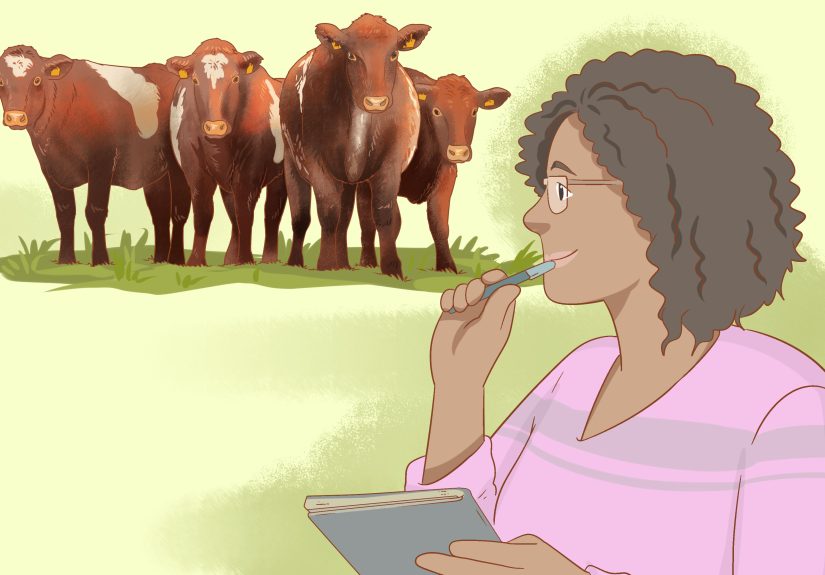
Before you interact, observe. Not from inside their personal space, but from a respectful distance where you can see the whole group.
Think of it like wildlife watching… except the wildlife may weigh 1,200 pounds and have opinions.
What to watch for (and why it matters)
- Group spacing: Are they loosely spread (relaxed) or tightly bunched (stress, flies, heat, or fear)?
- Flow: Do they move smoothly around obstacles, or stop-and-start?
- Who leads: Some cattle follow confidently; others trigger the “everybody panic” button.
- Baseline behavior: Calm chewing and normal posture is your “normal.” Anything else is “data.”
Mini exercise: The 60-second scan
- Stand still and breathe (yes, reallyyour energy affects the group).
- Pick one animal and note ears, head height, stance, and attention.
- Scan the environment: shadows, noise sources, slick floors, tight corners, dogs, people.
- Decide: do you need to change your approach or change the setup?
[Picture idea] A handler outside the fence observing a small herd; animals are spread out and calm.
Step 3: Read the BodyEars, Eyes, Head, Feet, Tail
Cattle communicate continuously. The trick is learning what “relaxed” looks like so you can spot “not relaxed” early.
Ears: the mood antenna
- Neutral/relaxed: Ears move casually, tracking normal sounds.
- Alert: Ears forward, attention locked. They’re gathering intel.
- Irritated: Ears pinned back (especially with a tense face). That’s a warning sign.
Eyes and head position
- Head low or level: often calmer (context matterswatch footing and feed too).
- Head high, neck tense: increased alertness; they may be deciding whether to flee.
- Wide eyes / constant staring: heightened stress, uncertainty, or fear.
Feet: where truth lives
- Square stance: balanced, calm.
- Shifting weight / pawing: agitation or impatience.
- Backing up repeatedly: pressure is too intense, or something ahead looks unsafe.
Tail: the underrated mood indicator
- Loose swish: flies, normal movement.
- Tucked or clamped: fear or discomfort.
- High tail + fast movement: arousal/stress; things can escalate quickly.
Specific example: The “about to bolt” checklist
If you see three or more of the followinghead high, tight neck, fixed stare, feet shifting, tail high/clamped, sudden silence in a group
treat it like a yellow light turning red. Back off, slow down, and remove pressure.
[Picture idea] Side-by-side: (1) relaxed cow with level head and neutral ears; (2) tense cow with raised head and pinned ears.
Step 4: Master SpaceFlight Zone and Point of Balance
This is the core of understanding bovine behaviour in motion. Cattle respond to pressure and releaseoften through how close you are and where you stand.
Flight zone: their personal space bubble
The flight zone is the distance at which a cow begins to move away from you. Tame cattle tend to have a smaller flight zone.
Less-handled or more reactive cattle usually have a larger one.
Point of balance: the “steering wheel” line
The point of balance is typically around the shoulder. In simple terms:
- Step into the flight zone behind the point of balance → the animal tends to move forward.
- Step into the flight zone in front of the point of balance → the animal tends to slow, turn, or move back.
How to use pressure-and-release without being dramatic about it
- Approach at an angle, not head-on.
- Enter the edge of the flight zone (don’t dive into the center like you’re trying to win a prize).
- When the cow responds, release pressure by stepping back or changing your angle.
- Repeat calmly until movement becomes smooth.
A practical chute example
In a single-file alley, many handlers get stuck pushing from behind. Often, it’s easier to encourage forward movement by walking
past the animal’s shoulder line in the opposite direction of travelcreating controlled pressure that says, “keep moving forward,”
then removing it as soon as the cow steps up.
[Picture idea] Simple diagram: a cow with a bubble around it (flight zone) and a line at the shoulder (point of balance).
Step 5: Spot Stress Early (Before It Turns Into a Rodeo)
Stress shows up in behavior, and behavior shows up in safety. The earlier you catch rising tension, the easier it is to fix.
Common cattle stress signals during handling
- Balking: stopping at entrances, shadows, or tight corners
- Bunching: crowding together tightly, often facing outward
- Vocalizing: sudden frequent calls can indicate distress or separation anxiety
- Restlessness: repeated turning, pacing, or inability to settle
- Explosive movement: sudden surges, jumping, or slamming into gates
What to do instead of “pushing harder”
When cattle won’t move, the best next step is often to troubleshoot the environment:
- Is there a shadow line, glare, or bright-to-dark transition?
- Is something rattling or flapping?
- Is the floor slick or uneven?
- Are you asking an animal to move where it thinks there’s no exit?
One more “human factor”
If your body is tense, your movements are sharp, and your voice is loud, cattle read that as, “Predator energy detected.”
Lower the volume, slow the motion, and give them a moment to process.
[Picture idea] A cow hesitating at a bright glare spot; handler reduces distraction (closing a gate panel or shifting position).
Step 6: Practice Low-Stress Interaction and Build Trust
The goal isn’t to “dominate” cattle. The goal is to create predictable, calm movement that’s safer for everyoneincluding the cow’s future self.
Low-stress handling is basically: clear communication, minimal fear, maximum flow.
Habits that build calmer cattle over time
- Work in small groups when possiblecattle move better with buddies.
- Use quiet tools (flags, sorting sticks, paddles) as guides, not weapons.
- Limit yelling and banging. Noise spikes stress and confusion.
- Reward the try: when cattle move correctly, release pressure immediately.
- Keep sessions efficient: long, chaotic handling teaches cattle that humans equal stress.
Concrete example: Sorting without the panic spiral
Instead of chasing a single cow around a pen (which teaches her cardio and teaches you regret),
position yourself at the edge of the flight zone and use angles to shape movement. Let the animal “choose”
the open paththen step back as soon as she commits. Sorting becomes a calm flow, not a wrestling match.
[Picture idea] A handler using a flag quietly at the edge of the flight zone while cattle move in a smooth line.
Quick Cheat Sheet: Calm vs. Concerned vs. “We Should Leave”
Calm / Comfortable
- Level head, relaxed jaw, normal chewing
- Loose tail movement
- Natural spacing in the group
- Smooth walking, no sudden stops
Concerned / Building Stress
- Head rising, neck tightening
- Ears locked forward or pinned back repeatedly
- Shifting feet, repeated turning
- Bunching or balking at a spot
High Risk / Escalation Likely
- Sudden explosive movement or repeated attempts to bolt
- Hard staring with tense posture, rapid tail movement or clamp
- Charging, head thrusts, or repeated pushing at barriers
- Handlers crowding the animal with no escape route
If you’re in the third category, the best “behavior tip” is: increase distance, reduce pressure, and reset the situation.
FAQ: Common Questions About Cow Behavior
Are cows naturally aggressive?
Most cattle are not aggressive by default, but fear, pain, protective instincts (especially with calves), and rough handling can trigger defensive behavior.
Bulls also require extra caution due to size and temperament variability.
Why do cattle balk at gates and chutes?
Often it’s environmental: shadows, glare, odd footing, loud noises, moving objects, or a feeling of being trapped. Fix the setup and the flow improves.
What’s the fastest way to improve cattle handling?
Learn flight zone and point of balance, then practice pressure-and-release. Add calm movement and consistent routines, and cattle typically respond quickly.
Do cattle “sense fear”?
They definitely notice tension, sharp movements, loud voices, and hurried energy. Whether you call it sensing fear or reading body language,
the solution is the same: slow down, soften posture, and handle with intention.
Field Notes: Real-World Experiences That Teach Cow Language (Extra)
Below are experience-based scenarios commonly described by stockpeople, veterinarians, extension educators, and dairy/beef handlers. You’ll notice a theme:
cattle are consistent. Humans are… creatively inconsistent. The good news is that once you recognize patterns, bovine behaviour becomes much easier to predict.
1) The “mystery” balk that turns out to be a shadow
A group walks toward an alley and suddenly stops like someone hit pause. One person blames stubbornness. Another blames the moon phase.
The fix is usually less magical: a sharp shadow line, a bright glare, or a dark doorway that looks like a cave. When handlers soften the lighting,
reduce contrast, or give cattle a moment to look down and judge footing, movement often restarts without force.
2) The day a flapping jacket became the monster
Cattle notice motion in their surroundingsespecially unexpected motion. A loose coat, a dangling plastic bag, or a chain tapping rhythmically can trigger
repeated stops. Experienced handlers “clean the visual field” before moving cattle: secure flapping items, remove clutter, and keep the alley visually quiet.
3) “Why did she kick?” (Answer: you appeared in the blind spot)
In tight quarters, stepping directly behind an animal can startle itespecially if it can’t clearly see you. A classic lesson from seasoned dairy hands:
approach with intention, stay visible when possible, and avoid sneaking into the zone where a cow suddenly realizes, “Something is behind me!”
That surprise is where kicks live.
4) The calm cow who becomes spicy in the chute
Some cattle appear calm in open pens but become reactive during restraint. That doesn’t mean they’re “bad.” It means restraint adds pressure:
noise, tight space, unfamiliar touch, and the feeling of losing control. The most effective handlers reduce stress by keeping the process smooth:
minimal yelling, no rushed slamming of gates, and immediate release of pressure once the animal is positioned correctly.
5) The “one cow” who makes the whole pen feel harder
Herd behavior is contagious. One anxious animal can raise the group’s alertness, especially if it bolts or spins. Skilled stockpeople often identify
the “reactor” early and plan around itmoving cattle in smaller groups, giving more space, and avoiding crowded corners that amplify panic.
6) The best handling moment is usually boring
When handling goes well, it’s almost anticlimactic. Cattle flow forward, heads level, pace steady. No running. No shouting. No interpretive dancing with a sorting stick.
Boring is the gold standard. If you’re exhausted afterward, the system or technique likely needs improvement.
7) The “pressure-and-release” breakthrough
Many people have a lightbulb moment the first time they intentionally step in, get a response, and step out. The cattle learn:
“When I move the right way, the pressure goes away.” The humans learn: “I don’t have to push harder; I have to time my release better.”
That timingpressure on, pressure offis one of the fastest ways to improve safety and reduce stress.
8) The tiny routine that builds trust
Repeated calm exposure matters. On operations where cattle are moved quietly, handled consistently, and not surprised with rough treatment,
animals often become easier to manage over time. They aren’t “tamed” in a pet sense, but they become more predictableand predictability is the heart of good stockmanship.
9) The underestimated power of pausing
A brief pause can reset a whole group. When cattle begin to bunch or balk, stepping back and waiting a moment often lowers tension.
This isn’t “doing nothing.” It’s strategic pressure reduction. Many experienced handlers describe it as letting cattle “think their way through” the situation.
10) Keeping a simple behavior log improves your eye fast
If you want to get good quickly, write down what you observe: weather, time of day, group size, handling location, and what changed right before stress increased.
Patterns appear. You’ll discover which gate position causes bottlenecks, which alley corner spooks cattle, and which approach angle creates smoother flow.
In other words: you become the person who fixes problems before they become stories.
Conclusion
Understanding bovine behaviour isn’t about memorizing a thousand signalsit’s about building a simple, repeatable habit:
observe first, read posture, respect space, use pressure-and-release, and reduce stress triggers in the environment.
When you do, cattle become easier to move, safer to work, and (bonus) less likely to turn your afternoon into an unexpected sprint.
Keep practicing. The cows are always giving feedback. The trick is noticing itbefore you’re holding a gate with one hand and your dignity with the other.