Table of Contents >> Show >> Hide
- Project at a glance
- From “jaded” to joyful: the design narrative
- Reviving the agrarian soul
- Strategies for sustainability (without the sermon)
- Fashion meets fieldwork: designing for two creative worlds
- Lessons for your own renovation (even if you don’t own a cascina)
- Why this farmhouse resonates now
- Keywords (naturally woven)
- Conclusion
- 500-word field notes: living and working in a reimagined Italian farmhouse
Two centuries old. Two clientsone with an eye for fashion, one with a love for the land. One British practice famous for weaving new architecture into old bones. That’s the elevator pitch for Cascina, a 19th-century farmstead in Italy’s Piemonte region that Jonathan Tuckey Design has transformed into a luminous home and working studio. The team peeled back a clumsy 1990s makeover, re-opened stone arches, and choreographed daylight so that the house once again feels rooted in the hillsides and orchards around it.
Project at a glance
- Location: Piemonte (Piedmont), Northern Italyset on a sloping rural site long used for agriculture.
- Building type: A historic farmsteadmultiple stone volumes including farmhouse, barn/hayloft, and an enclosed bridge.
- Age: ~200 years; the design restores 19th-century character.
- Clients: A fashion designer and a naturalisthence the dual program of studio and domestic life.
- Architect: Jonathan Tuckey Design, London, known for “building upon building”adding contemporary layers to heritage fabric.
- Photography: Francesca Iovene and Ståle Eriksenquiet, tactile imagery that underscores the project’s material logic.
From “jaded” to joyful: the design narrative
When the architects arrived, they found a farmstead dulled by late-20th-century finishestiles, plasterboard, and partitions that masked the original stone and timber. Their first move was subtractive: remove the noise, reveal the character, and let the building breathe. Remodelista called it the rescue of a “jaded” farm, and the description fitsthe house now reads like it remembers itself.
Setting and sequence
The complex steps down the hillside as a trio of volumes: a two-story farmhouse, a large barn with hayloft, and a covered bridge that stitches the ensemble together. This sectional choreography creates framed views to orchards and the Alps beyond while giving each wing a distinct moodlively studio here, contemplative living quarters there.
Material intelligence
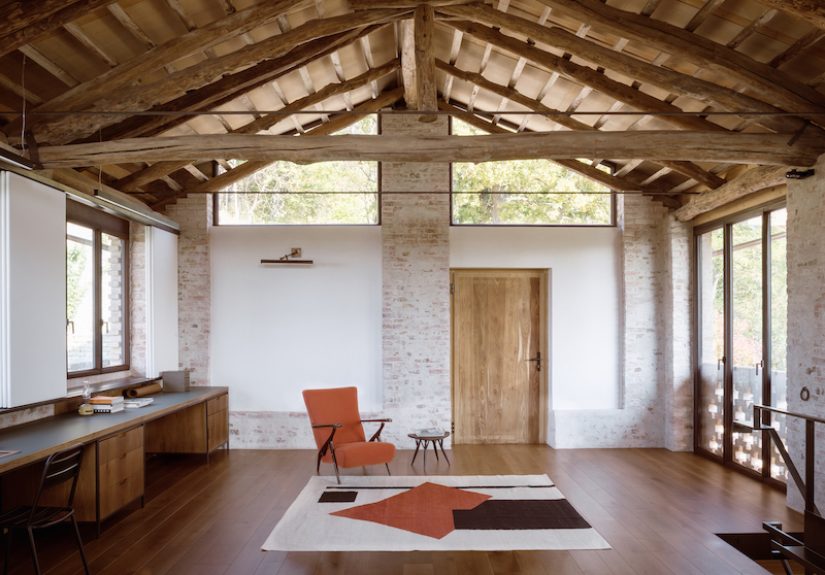
The palette is proof that “low-tech” can read as lux when handled with care. Local stone is left expressive, timber soffits and joists are retained where possible, and new interventions arrive as crisp, legible layerssteel, lime plaster, oak, and clay tilescomplementing rather than competing with the original fabric. (Think: a tailored jacket with immaculate top-stitching.)
Plan + program: life, work, landscape
Designing for a fashion professional and a naturalist means the house must perform theatrically without losing touch with the ground. The barn volume becomes a flexible workroom with generous spans and calibrated light; the farmhouse restores intimate rooms for cooking, reading, and sleeping. Circulation threads indoors to outloggias, terraces, and thresholds create microclimates for morning coffee, pattern-cutting, or cataloging wildflower specimens.
Light craft
In adaptive reuse, daylight is destiny. Here, old openings were re-found and tuned; new ones are set with a contemporary precision that reads as “now” yet feels inevitable. High-level slots pull sun deep into the plan, and large apertures frame the agrarian context so the interior becomes a living mood board for the clients’ practices.
Reviving the agrarian soul
Archello neatly summarizes the ambition: restore the farmstead’s “agrarian soul.” That meant stripping back the 1990s overlays, reusing salvaged materials, and re-opening agricultural geometriesarches, threshing bays, and hayloft voidsso the complex reads as a working rural organism again (even if its “crop” is now ideas, garments, and field notes).
Strategies for sustainability (without the sermon)
- Fabric first: Thermal upgrades respect breathabilitylime plasters and natural insulation improve comfort while letting masonry wick moisture as intended.
- Embodied-carbon common sense: Reuse > replacement. Keeping stone walls, timber structure, and roof geometry banks decades of embodied energy.
- Passive gains: Orientation, shading, and stack-effect ventilation are re-activated by reopening historical apertures and adding well-placed new ones.
- Systems that hide in plain sight: Underfloor heating and efficient glazing lift performance without visual fussbecause comfort should whisper, not shout.
Fashion meets fieldwork: designing for two creative worlds
The project’s charm lies in how it balances couture-level craft with muddy-boots pragmatism. Robust surfaces handle soil, specimens, and seasonal harvests; refined joinery and precise reveals satisfy a designer’s love of detail. The big barn doors roll open for natural light and ventilation during studio days; at night, the same space hosts dinners, fittings, or critiques, with the bridge volume acting as an anteroom and gallery.
Lessons for your own renovation (even if you don’t own a cascina)
- Demolition ≠ design. Start by editingremove the noise so original logic can speak.
- Let the plan remember its past life. Keep agricultural proportions; they’re naturally flexible for living, working, and gathering.
- New work should be time-stamped. Contemporary elements should look confidently “new,” not faux-historic.
- Choreograph light first, fixtures later. Once apertures are right, everything else tends to fall in line.
Why this farmhouse resonates now
Across U.S. design mediafrom Dwell’s coverage of European farm conversions to AD’s ongoing fascination with rural-modern hybridsthe appetite for “quiet radicalism” is strong: projects that respect heritage while creating bolder, better-performing homes. Cascina is a textbook example, and its cross-disciplinary clients make it feel thoroughly of the moment.
Keywords (naturally woven)
Main keywords: Italian farmhouse renovation; Jonathan Tuckey Design; Piedmont farmhouse; adaptive reuse architecture; historic farmstead.
Related LSI: stone barn conversion; sustainable retrofit; lime plaster; farmhouse restoration; contemporary rustic interior.
Conclusion
Cascina isn’t about nostalgia; it’s about continuity. By editing away the pastiche and re-tuning structure, light, and program, Jonathan Tuckey Design gives a 200-year-old farmstead a second life that suits a fashion designer’s precision and a naturalist’s patience. The result is quietly dramatic, materially honest, and, best of all, irresistibly livable.
SEO wrap-up
sapo: In Italy’s Piemonte, a timeworn cascina trades its 1990s disguise for honest stone, timber, and light. Jonathan Tuckey Design restores the agrarian rhythmbarn, bridge, farmhousewhile tailoring spaces for two creative lives: a fashion designer’s studio and a naturalist’s field-ready home. The makeover balances sustainability and craft: breathable lime plasters, salvaged structure, and calibrated openings that frame orchards and sky. It’s a model for adaptive reuse that’s equal parts rural poetry and contemporary precision.
500-word field notes: living and working in a reimagined Italian farmhouse
Spend a week at Cascina and you realize the renovation’s real triumph is rhythm. Morning sun slides across the hayloft floorboards like a spotlight on a runwayfitting, given the fashion pedigree in residence. The studio opens to the orchard, and the day’s work starts not with a mood board but with the weather: What are the clouds doing? What scent is the sage releasing after last night’s rain? This environmental “prelude” becomes creative fuel. The naturalist pulls plant presses and journals from a built-in cabinet; the designer unrolls patterns on a long oak table. With the bridge doors open, the space behaves like a covered streetair moves, voices carry, and there’s always a sense of being in conversation with the landscape.
Midday is for quiet industry. You notice the house asks very little to stay comfortable. The thick stone walls, re-plastered with lime, hold a stable temperature; high vents and deep reveals temper glare. There’s a tactile literacy to the details: a timber lintel with tool marks left in place; a steel handrail that meets your palm with a soft curve; a terracotta floor that clicks underfoot as you cross from kitchen to loggia. None of it screams “new.” Instead, the contemporary elements feel like well-chosen verbs in a sentence that was always there.
By late afternoon, the studio switches modes. Rolls of fabric give way to long platters of fruits and cheeses; neighbors arrive through the farmyard gate, and the bridge becomes an impromptu gallerytoday it hosts pinned sketches and pressed leaves, tomorrow it might display photographs or swatches. The architecture’s generosity shows up in these pivots: spans inherited from agricultural use become social infrastructure, while smaller rooms in the farmhouse embrace introspectionreading nooks, a desk placed to catch a square of west light.
Nights are about quiet theatrics. Light wells become lanterns; the stone absorbs the day’s warmth and releases it in a slow exhale. You hear crickets. Somewhere a fox moves along the lower field. In the kitchen, the naturalist talks about moth species drawn to the terrace lamp; the designer tests how a new hem reads under candlelight. This is the gift of the renovation: not just upgraded performance but a daily script that blends making, noticing, and belonging. A house that works this hard without calling attention to itself is rare. Cascina manages it because the architects resisted novelty for novelty’s sake and instead listened to what the building already knew how to dohold heat, frame views, gather people, give work a place to breathe.
If you’re contemplating your own farmhouse revival (or any heritage project), take a page from this one: start by subtracting, then set a few precise rulesmaterials that respect breathability; new insertions that read clearly as contemporary; and openings that prioritize sky, shade, and the tasks you love. In return you’ll get a home that supports your craft, expands your senses, and anchors you to a local ecology thatlike good designonly gets richer the more closely you look.