Table of Contents >> Show >> Hide
- Why Michael Cunningham’s Library Feels Like a Story You Can Walk Into
- The Remodelista Detail Everyone Remembers: The Bookshelf-Lined Bathroom
- Steal the Look: The Key Pieces Behind a Writer’s Library Vibe
- The Reality Check: How to Keep Books Alive in a Bathroom
- What a Writer’s Library Says About the Writing Life
- How to Create Your Own Writer’s Library (Even If You’re Not Michael Cunningham)
- 500 More Words: The Experience of Living With a Writer’s Library
- Conclusion: Build a Library That Feels Like You
Some people hang art in their bathroom. Some people hang towels. Michael Cunningham (Pulitzer-winning novelist, professional
time-bender, and occasional literary heartbreaker) basically said: “What if I hang books… and also put a bathtub in the middle
like it’s a reading chair that happens to get wet?”
That’s the delightful premise behind Remodelista’s peek into Cunningham’s home: a writer’s library so lived-in, so charmingly
un-precious, that it blurs the line between “collection” and “companion.” It’s not a showy, museum-style library meant to impress.
It’s a working, breathing ecosystem of paperbacks, hardcovers, magazines, and stacks that look like they were placed there by
someone who actually reads… and occasionally forgets where they left their book (because it’s everywhere).
In this article, we’ll tour the vibe, decode what makes it feel so right, steal a few design tricks you can use in a normal human
apartment, and talk about the big question a bathroom library raises: “Is this genius… or is this how mold starts a book club?”
(Spoiler: it can be genius if you do it smart.)
Why Michael Cunningham’s Library Feels Like a Story You Can Walk Into
Cunningham’s work is famously interested in interior lifehow ordinary moments carry emotional weight, how a single day can hold a
whole lifetime, how time loops back and forward like it has a key to your apartment. It makes sense, then, that his home library
isn’t staged like a catalog. It’s arranged like a narrative: layered, personal, occasionally messy, and very honest about what a
mind looks like when it’s been living with books for decades.
His most famous novel, The Hours, draws inspiration from Virginia Woolf’s Mrs. Dalloway, echoing the idea that one day can
reveal everythinglove, regret, hope, dread, all of it. More recently, he returned to that “day-structure” again, building a novel
around three versions of a single date across three different years. When a writer keeps coming back to time like that, you start
to see why his shelves aren’t only storage. They’re a kind of clock: pages marking where he’s been, what he’s thinking, and what
he can’t stop revisiting.
The Remodelista Detail Everyone Remembers: The Bookshelf-Lined Bathroom
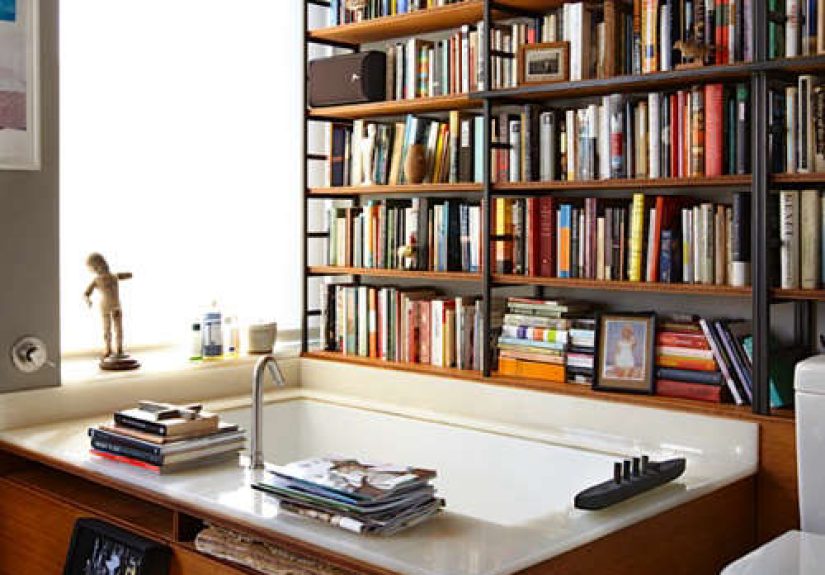
The headline detail is iconic for a reason: a bookshelf-lined New York City bathroom, with a custom bathtub surrounded by books and
magazines, plus those little design flourishes that make it feel both intentional and totally natural. It’s the kind of room that
makes readers feel seen. You know that fantasy where you could hide from the world and just read? This is that fantasy, but with
plumbing.
The magic isn’t simply “books in a bathroom.” It’s how the books live there: within arm’s reach, tucked near the sink, stacked
by the tub, arranged like the room expects you to pick one up at any moment. The space suggests a ritual: bathe, read, think, re-read,
repeat. It’s less “spa day” and more “quiet conversation with the universe, featuring bubbles.”
Design Lesson #1: Books Don’t Just Fill SpaceThey Give It Meaning
There’s a reason libraries feel calming. Books add visual texture (spines, paper edges, imperfect stacks), but they also add
psychological texture: they make a room feel inhabited by ideas. Even if you don’t read every book you own (no judgmentyour “to be read”
pile is a personality trait), the presence of books signals curiosity, memory, and a life in progress.
Cunningham’s bathroom library works because it doesn’t treat books like color-coordinated wallpaper. The variety of bindings and paper
tones creates a soft, organic palettewarm, human, and gently chaotic in the best way.
Design Lesson #2: Make the “Odd” Room the Most Personal Room
A bathroom library breaks the usual rules, which is exactly why it’s so compelling. Home design often saves personality for living rooms
(art wall), kitchens (fancy tile), bedrooms (linen flex). But the “in-between” spacesbathrooms, hallways, cornersare where you can
create the most surprise with the least square footage.
A small room with built-in shelves becomes an experience. And experiences are what people remember.
Steal the Look: The Key Pieces Behind a Writer’s Library Vibe
Remodelista’s feature highlights a few specific elements that help turn “a lot of books” into “a library that feels designed.” You can
borrow the concepts even if you don’t own a sun-flooded loft or a bathtub with main-character energy.
1) Go Vertical (Especially If You Live in a Real-Life Apartment)
When floor space is limited, the smartest library move is vertical storage. Think tall shelving, wall-mounted options, and narrow
book towers that use height instead of width. Vertical solutions also create that “surrounded by books” feeling without needing an entire
room devoted to shelving.
2) Mix “Built-In” Order With “Stacked” Life
The most inviting libraries usually combine two energies:
- Structure: shelves, consistent zones, books that actually have a home
- Life: stacks by a chair, a book left open on purpose, a pile that says “I was just here”
If your shelves are too perfect, they can feel like a display. If your stacks take over the entire room, it can feel like a paper avalanche
is plotting against you. The sweet spot is “curated but not sterile.”
3) Add One Unexpected Object That Feels Like a Signature
A writer’s library doesn’t need a million accessories. It needs one or two objects that feel personalsomething that says, “A human lives here,
and that human has taste, history, or at least a sense of humor.” In Cunningham’s case, the space blends books with small, memorable details
(including playful decor) that keep it from becoming “just shelving.”
The Reality Check: How to Keep Books Alive in a Bathroom
Let’s address the steamy elephant in the room: bathrooms are humid. Humidity is not a love language for paper.
If you want the bathroom library dream without accidentally inventing “mildew chic,” focus on stability and airflow.
Bathroom Library Rules That Save Your Books (and Your Nose)
- Use your exhaust fan like it’s on the payroll. Run it during showers and for at least 20–30 minutes afterward.
- Avoid splash zones. Keep books away from direct spray, drips, and the “I shake my hair like a golden retriever” radius.
- Put precious books elsewhere. First editions, signed copies, heirloomskeep them in a drier room and bring a reading copy in.
- Choose forgiving formats. Paperbacks, thrifted hardcovers, and “I love you but I can replace you” books are ideal.
- Consider semi-protection. A glass-front cabinet, a closed shelf, or even a simple curtain can reduce direct moisture exposure.
- Keep things clean. Dust holds moisture. A quick wipe-down and occasional shelf tidy helps more than you’d think.
- Aim for a stable environment. Big humidity swings are rough on paper and bindings. If your bathroom is constantly damp, reduce book volume.
The goal isn’t perfection. It’s risk management. You’re creating a space that feels like a library while respecting the laws of physics
and the ancient grudges of paper fibers.
What a Writer’s Library Says About the Writing Life
Readers love writer homes because they’re secretly hoping to find “the trick.” The lamp. The chair. The magical notebook. The
one weird object that makes sentences behave.
But writer libraries usually reveal something more interesting: the work is built out of attention. A writer collects language the way a
cook collects flavors. Books become a pantrysome are staples, some are guilty pleasures, some are experiments you tried once and now keep
around because you respect the chaos.
A Library Is Also an Audience
Cunningham has spoken about imagining specific readersreal people he knowswhile he writes. That idea pairs beautifully with a home full of books,
because books are like silent companions with opinions. A shelf can remind you: someone else solved this problem. Someone else wrote a perfect sentence.
Someone else made art out of ordinary life. Now it’s your turn.
Sentence-by-Sentence Craft, Shelf-by-Shelf Living
One of the most grounding (and slightly hilarious) truths about writing is that it’s rarely cinematic. It’s often a person sitting still,
pushing one sentence into place and then pushing another. That “sentence-by-sentence” mindset matches the way a real library gets built:
one book at a time, one stack at a time, one season of your life at a time.
How to Create Your Own Writer’s Library (Even If You’re Not Michael Cunningham)
You don’t need a loft. You don’t need built-ins. You don’t need a bathtub that looks like it gets interviewed by magazines.
You need a few intentional choices.
Step 1: Pick a Library “Anchor”
Choose one primary zone where books live on purpose:
a bookcase, a wall of shelves, a credenza with stacked books, or a dedicated corner. The anchor creates the feeling of “library”
even if the rest of your home is still negotiating with your laundry pile.
Step 2: Add a “Reading Ritual” Spot
Libraries feel magical when they connect to a habit. Add a chair, a lamp, a small table, or even a bath traysomething that says,
“Reading happens here.” The ritual is the design.
Step 3: Let Your Library Be Messy in One Place (Strategically)
The most charming libraries have one area that feels alive: the “currently reading” stack, the “research pile,” the “I swear I’m going to start this” tower.
Give that mess a boundary (a stool, a basket, a tray) so it looks intentional instead of accidental.
Step 4: Make It Personal, Not Performative
If you want the Cunningham-at-home vibe, remember what makes it appealing: it’s not trying to win the internet.
It’s trying to be a real place where someone actually reads.
500 More Words: The Experience of Living With a Writer’s Library
There’s a particular kind of quiet you only get in a home where books aren’t decorationthey’re residents. Not “guests who came over for
the holidays and never left,” but true residents who have opinions about everything, including your attention span. You feel it the moment
you walk in: the room has weight, not because it’s heavy with stuff, but because it’s heavy with thought.
The experience starts small. You begin with one shelf. Then you notice your shelves are either too neat (museum energy) or too crowded
(paper landslide energy), so you start making little adjustments. You slide a few titles forward. You stack a couple sideways. Suddenly,
you’ve created a tiny stage where books can act like they’re in conversation with each othermemoir leaning into poetry, a novel propped
against an essay collection, a cookbook peeking out like it wants to be invited to the intellectual party.
And then, if you’re brave (or simply out of space), your library starts migrating into places books aren’t “supposed” to go. A stack by the bed.
A pile under a side table. A paperback living on the kitchen counter because you read while your pasta water boils. The library stops being
a location and becomes a habitan ecosystem that follows you through the day.
This is why a bathroom library feels so strangely perfect. It’s not just quirky; it’s honest. The bathroom is one of the few places left where
you’re allowed to be offline, uninterrupted, and unproductive. Adding books turns that privacy into something richerless “escape” and more
“reset.” You take a bath, you open a book, and time loosens its grip for a little while. Even if you’re only reading three pages, your brain
remembers that it can move at a human pace.
If you try it yourself, you learn quickly that a bathroom library isn’t about stuffing shelves into a damp corner and hoping for the best.
It’s about choosing the right books for the right place. A sturdy paperback you can replace? Perfect. A treasured signed hardcover? Maybe
keep that one dry and bring it in only when the fan is humming and the steam has cleared. Over time, you develop a rotation“bath books,”
“bed books,” “kitchen books,” and the elite category: “books I hide from myself until I finish my deadlines.”
The best part of living with a writer’s library is that it changes how you see your own life. Books become markers of seasonswhat you read
when you were heartbroken, what you read when you moved, what you read when you finally had the courage to start over. A library is memory
you can reorganize. And that’s the secret: a writer’s library doesn’t just store stories. It stores versions of you.
Conclusion: Build a Library That Feels Like You
Remodelista’s glimpse of Michael Cunningham at home reminds us that the best libraries aren’t just “pretty.” They’re personal. They make space for
curiosity. They invite you to linger. Whether your books live in a dedicated room, a narrow tower, or (boldly) near the bathtub, the goal is the same:
create a place where reading feels naturallike breathing, but with better sentences.