Table of Contents >> Show >> Hide
- Why Denver Was a Natural Home for a Mini Maker Faire
- A Quick Timeline of the Denver Mini Maker Faire
- What Made the Denver Mini Maker Faire So Much Fun
- The Makerspaces Behind the Magic
- Why the Denver Mini Maker Faire Mattered
- What a Modern Reader Can Still Learn From It
- Experience the Denver Mini Maker Faire: A 500-Word Walkthrough
- Final Thoughts
Some events are easy to explain. A baseball game is a baseball game. A food festival is a food festival. But a maker faire? That is a little harder to sum up in one neat sentence, because it is part science fair, part art show, part county fair for curious people, and part “wait, is that a robot driving past a giant electric muffin?” kind of weekend.
That is exactly what made the Denver Mini Maker Faire so memorable. In its early years, Denver’s event captured the city’s love of engineering, art, DIY culture, and hands-on learning in one place. It was the kind of gathering where a family could wander in expecting a few gadgets and leave talking about art cars, pinball mechanics, wearable tech, sculpture contests, droids, rockets, and the strange but delightful fact that Colorado seems to produce tinkerers the way some places produce tomatoes.
This roundup looks back at what made the Denver Mini Maker Faire special, how it evolved, and why it mattered to the city’s maker culture. If you are interested in the history of the maker movement in Colorado, or you just enjoy stories about people who look at ordinary objects and think, “Yes, but what if this also breathed fire?”, Denver’s version of the Faire deserves a proper spotlight.
Why Denver Was a Natural Home for a Mini Maker Faire
The Maker Faire model has always been built around curiosity, invention, and resourcefulness. Denver turned out to be an ideal home for that mix. Colorado’s maker scene already had deep roots in science, engineering, fabrication, and outdoor-minded problem-solving. Add in artists, hackerspaces, educators, library makerspaces, and a healthy supply of people who own power tools for fun, and you have the ingredients for a seriously good Mini Maker Faire.
What made Denver stand out was not just the presence of individual makers. It was the network. The city and surrounding Front Range communities had makerspaces, schools, nonprofits, public library programs, and hobby groups that were all pushing in the same direction. That meant the event never felt like a one-off novelty. It felt like a public gathering point for an ecosystem that was already buzzing.
In other words, Denver was not pretending to have a maker culture for one weekend. It was simply throwing the doors open and saying, “Come see what we have been building in our garages, studios, libraries, workshops, and labs.”
A Quick Timeline of the Denver Mini Maker Faire
2014: The Debut Year
The first Denver Mini Maker Faire arrived in 2014 at the National Western Complex, and it immediately established the event’s personality. This was not a stiff conference with panels full of buzzwords and people saying “disruption” every seven seconds. It was a hands-on, multi-generational festival packed with speakers, demonstrations, workshops, challenges, and displays.
The early lineup showed off Denver’s wonderfully specific flavor of weird and wonderful. Reports from the time highlighted everything from sculpture challenges and rockets to sound-and-light experiences, ferrofluid demos, musical Tesla coils, a human-powered Ferris wheel, and an assortment of local inventors and creators. The first fair made it clear that Denver’s maker scene was not boxed into one category. It stretched across engineering, sculpture, fabrication, performance, and playful experimentation.
That broad mix became the event’s identity. You could walk in as an art lover, a teacher, a robotics nerd, a woodworker, a kid obsessed with LEGOs, or a grown adult who still secretly wants to build a spaceship in the garage. The Denver Mini Maker Faire had something for all of you, and probably something you did not expect, too.
2015: The Move to the Denver Museum of Nature & Science
By 2015, the event had found a venue that fit it almost absurdly well: the Denver Museum of Nature & Science. It is hard to imagine a more natural pairing. Museums are already built for curiosity, and the maker movement thrives on turning curiosity into action.
That year’s Mini Maker Faire had real momentum. Coverage described more than 100 makers, tinkerers, artisans, robot-builders, Daleks, droids, and assorted creative obsessives. The fair featured first-time attractions from around Colorado, including art cars, a synth petting zoo, and large-scale mechanical builds such as TrotBot, an SUV-sized walking sculpture that turned heads for all the right reasons.
There was also a strong interactive streak. One of the most memorable hands-on exhibits was Fun With Pinball, a project that used retired pinball machine parts to help visitors understand mechanics through direct play. That kind of exhibit captured the spirit of the event perfectly: educational, tactile, and just plain fun. No lecture required. Push the button, hear the chime, watch the mechanism move, and suddenly engineering feels less like homework and more like magic with wiring.
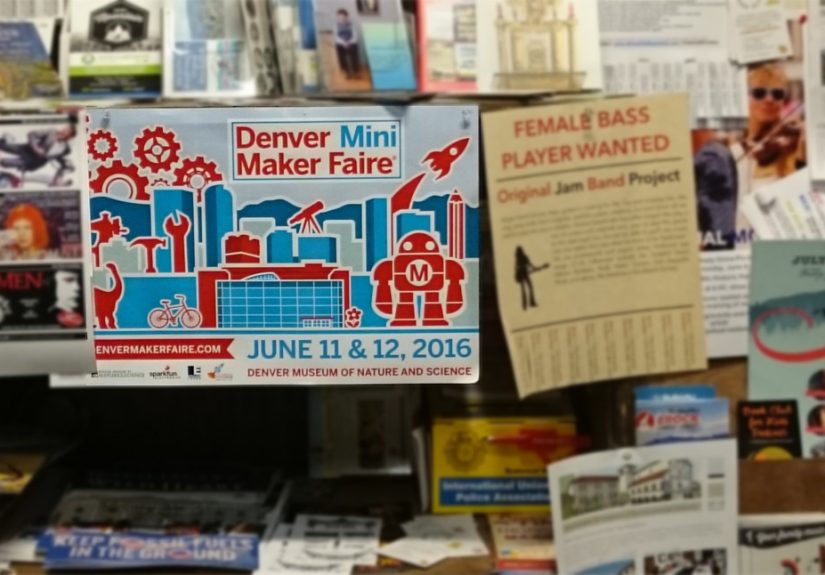
2016: “Building the Future” Without Losing the Fun
The 2016 edition leaned into the theme “Building the Future”, but thankfully did not become a sterile parade of buzzwords and plastic optimism. According to attendees and coverage, the best parts of the fair still came from the same formula that had worked from the beginning: hands-on education, immersive learning spaces, creative prototypes, and the kind of exhibits that make you stop mid-sentence and say, “Okay, that is ridiculously cool.”
The 2016 Mini Maker Faire doubled down on interactive experiences. Visitors could make music with motion, explore wearable technology, watch drones, join workshops, and see the overlap between art, engineering, and public participation. It was not “the future” in the abstract. It was the future as something you could touch, test, and occasionally accidentally bump into while chasing your kid toward the robots.
2017 and Beyond: When Mini Energy Became Big Energy
One of the most interesting parts of the Denver story is that the Mini Maker Faire years were not the finish line. They were the launch pad. By 2017, Colorado Maker Hub had grown the event into a full-scale Maker Faire Denver, featuring 136 makers and an unusually strong showing from makerspaces across the state.
That expansion mattered because it proved the Mini Maker Faire had done its job. It had helped build community, create collaborations, support local makers, and give the public a reason to care. What started as a smaller-format celebration became large enough to host major attractions like the SparkFun Autonomous Vehicle Competition and a growing lineup of immersive, inventive exhibits. That is not a bad arc for an event built on cardboard, solder, imagination, and glorious chaos.
What Made the Denver Mini Maker Faire So Much Fun
1. It Was Not Just a Tech Event
One of the biggest misconceptions about a maker faire is that it is only for hardcore tech people. Denver’s event happily destroyed that idea. Yes, there were robots, electronics, 3D printing, Raspberry Pi projects, and engineering demos. But there were also fabric artists, sculptors, costume makers, community mural projects, sound experiments, pinball restorers, and design-minded weirdos of every stripe.
The Denver Mini Maker Faire understood that making is not one narrow discipline. It includes sewing, welding, carving, coding, fabricating, painting, hacking, restoring, prototyping, and building nonsense for the sheer joy of seeing if the nonsense works. That wider lens helped the event feel welcoming instead of intimidating.
2. The Best Exhibits Invited You to Touch, Try, and Play
Passive events are forgettable. Denver’s Mini Maker Faire worked because it encouraged participation. If there was a giant foosball setup, you were supposed to play it. If there was a synth petting zoo, you were supposed to make weird noises and pretend you were composing the soundtrack for a sci-fi documentary. If there was a pinball mechanism on a table, you were supposed to push the button and watch it come alive.
This was a huge part of the fair’s appeal for families and educators. Kids were not being told to stand back and keep their hands in their pockets. They were being invited to experiment. Adults got the same invitation, which was excellent news for the many grownups who secretly wanted to spend the afternoon around droids and kinetic sculpture instead of pretending to be sophisticated.
3. The Event Showed Off Colorado’s Local Maker Identity
Denver’s event did not feel like a generic touring expo dropped onto a convention floor. It reflected Colorado’s maker identity. There were local makerspaces, homegrown inventions, regional collaborations, art collectives, student projects, and community organizations that gave the fair a distinctly Front Range character.
That local identity mattered. It meant the fair was not just entertaining; it was connective. Visitors could discover real places and programs where making continued after the weekend ended. The point was not only to admire cool stuff. The point was to realize that cool stuff was being built nearby by actual neighbors, teachers, students, artists, and volunteers.
4. It Helped Make STEAM Feel Human
There is a reason maker culture resonates so strongly with schools, museums, and libraries. It turns abstract subjects into lived experience. Engineering becomes a moving sculpture. Physics becomes a drone demonstration. Sound design becomes a synth table. Fabrication becomes a costume build. Coding becomes a robot that rolls up and steals the show from whatever else you were looking at.
The Denver Mini Maker Faire excelled at this. It gave STEAM education a pulse. Not a theoretical pulse. A real one, sometimes powered by batteries, solder, repurposed pinball parts, and the stubborn refusal of makers to leave well enough alone.
The Makerspaces Behind the Magic
One of the strongest threads running through Denver’s Maker Faire story is the role of makerspaces. These spaces are where community becomes durable. They provide tools, mentorship, access, and repetition, which is another way of saying they give people a place to fail, learn, fix things, and try again.
Colorado’s broader makerspace network was a major force behind the fair’s growth. TinkerMill in Longmont built a reputation as one of the largest makerspaces in Colorado and the Rocky Mountain region, offering everything from 3D printing and electronics to blacksmithing, welding, robotics, textiles, and glasswork. In Denver, denhac embraced the hackerspace model, centering education, experimentation, collaboration, and a DIY approach across science, technology, engineering, and art.
Public institutions were part of that story, too. The Denver Public Library ideaLABs opened up access to equipment like 3D printers, laser cutters, embroidery machines, and recording studios, bringing maker culture into civic space rather than leaving it tucked away behind private memberships. Up in Boulder, the public library’s BLDG 61 makerspace offered tools such as laser cutters, screen-printing access, and woodshop resources.
That ecosystem matters when you look back at the fair. A Maker Faire is exciting for a weekend, but a makerspace gives that excitement somewhere to live on Monday morning. Denver’s event was at its best when it acted as a bridge between public wonder and ongoing participation.
Why the Denver Mini Maker Faire Mattered
Plenty of events are fun. Fewer events leave infrastructure behind. That is one reason the Denver Mini Maker Faire still stands out. It did not just entertain visitors; it helped strengthen relationships across Colorado’s maker landscape.
Event organizers and participants repeatedly pointed to the fair as a catalyst for collaboration, education, and business growth. Makers met future partners. Young visitors got inspired to start building. Educators saw examples they could bring into classrooms. Community groups found new audiences. Some makerspaces even traced part of their origin story or momentum back to the connections and visibility that fairs created.
For Denver, the event also helped normalize the idea that making belongs in public life. It belongs in museums, libraries, schools, community workshops, and city culture. It is not a side hobby for a tiny niche. It is a practical, creative, deeply human way of learning and solving problems.
And yes, it is also a very good excuse to spend a Saturday staring at a giant walking robot.
What a Modern Reader Can Still Learn From It
Looking back, the Denver Mini Maker Faire offers a useful reminder for cities trying to build stronger innovation culture today. You do not start with slogans. You start with places, people, and participation. You make room for artists next to coders, students next to machinists, hobbyists next to entrepreneurs, and public institutions next to independent workshops.
Denver’s Mini Maker Faire worked because it was generous in spirit. It did not guard creativity behind velvet ropes. It invited people in. It made experimentation visible. It made learning playful. And it understood something many events forget: curiosity is contagious.
When a visitor sees a sculpture move, a robot wobble, a pinball relay click, or a costume turn into engineered art, they stop being just an audience member. They begin to imagine what they might make. That shift is the whole point.
Experience the Denver Mini Maker Faire: A 500-Word Walkthrough
Imagine stepping into the Denver Mini Maker Faire on a bright Saturday morning. Before you even figure out where to start, you hear three things at once: a burst of laughter from a hands-on game, the metallic clack of a machine doing something fascinating, and the sound of a parent saying, “No, seriously, that one is a robot.” That is the vibe. It is cheerful chaos, but the organized kind, the kind powered by curiosity instead of confusion.
You start walking and quickly realize this is not an event you can “do” in a straight line. Every few feet, something pulls you sideways. Maybe it is a table covered in pinball mechanisms where someone is demonstrating how a flipper works. Maybe it is a giant kinetic sculpture that looks like it escaped from a particularly ambitious garage. Maybe it is a row of makers explaining a project with the kind of enthusiasm that makes you think, “I did not know I cared about this five minutes ago, and now I absolutely do.”
The best part is that the fair never feels sealed off from regular people. You do not need an engineering degree to enjoy it. In fact, some of the strongest moments come from seeing kids and adults react the same way. A teenager stares at a robot with total concentration. A grandparent leans over a fabrication demo and starts asking sharp questions. A little kid slaps a giant button and beams when lights flash. Everyone looks equally delighted, which is honestly one of the more charming things about the entire experience.
Then there is the texture of the event itself. A Denver Mini Maker Faire is not polished into blandness. It feels handmade, which is exactly right. You notice improvised signage, booths packed with prototypes, projects that still show their screws and seams, and demonstrations that are a little scrappy in the best possible way. That visible process is part of the magic. You are not just seeing finished products. You are seeing ideas in motion.
As the day goes on, certain images stick with you: the glow of electronic projects, the odd elegance of wearable tech, the low mechanical thump of something kinetic, the grin on a maker’s face when a visitor suddenly understands how a project works. Even the venue contributes to the mood. In a museum setting especially, the fair feels like curiosity has spilled out of the exhibits and started building things in real time.
By the time you leave, you are carrying more than a few snapshots and clever observations. You leave with energy. Maybe you want to visit a makerspace. Maybe you want to learn laser cutting. Maybe you suddenly believe that fixing, building, modifying, or inventing something is not only possible but worth trying. That is why the Denver Mini Maker Faire lingered in people’s memories. It did not just show off creativity. It made creativity feel reachable. And that is a far bigger trick than any robot could pull off.
Final Thoughts
The Denver Mini Maker Faire succeeded because it understood that invention is not only about futuristic gadgets. It is about people gathering to share skills, test ideas, and make curiosity public. Denver brought its own character to that mission: more local collaboration, more artistic crossover, more educational energy, and more “you have to see this thing” moments than a sensible person should expect from one weekend.
From its 2014 debut to its museum-era growth and eventual expansion into a larger Maker Faire, the Denver story is a reminder that community innovation does not appear out of thin air. It is built, piece by piece, by people willing to make something and then show it to others. Preferably next to a robot, a sculpture, or an interactive pinball table.
If you want a clean summary, here it is: the Denver Mini Maker Faire was weird, welcoming, smart, loud, joyful, and deeply useful. Which is to say, it was exactly what a maker faire should be.