Table of Contents >> Show >> Hide
- Why CDs Make Surprisingly Great Lamp Material
- Safety First: Make This a Low-Stress, Low-Heat Project
- Tools & Supplies (Pick Based on the Design)
- Build #1: The “No-Cut” Stacked CD Tower Night Lamp (Beginner-Friendly)
- Build #2: The CD Mosaic Jar Night Lamp (The “Wow, That Was Fast” Option)
- Build #3: The CD “Halo” Wall Night Light (Small, Stylish, and Perfect for Hallways)
- Pro Tips for a Better Glow (and Fewer Regrets)
- Troubleshooting: When the Lamp Has Opinions
- Eco Note: What to Do With the Leftovers
- Real-World Maker Experiences (500+ Words): What It’s Like to Actually Build One
- Wrap-Up
You know that drawer. The one with mysterious cords, a lonely USB drive, and a stack of CDs that once held
the soundtrack to your entire personality. If you’re not exactly spinning Now That’s What I Call Music
anymore, good news: those shiny discs can still bring the vibesjust in a more “cozy night light” way.
This guide shows you how to upcycle old CDs into a night lamp using low-heat LEDs, simple tools, and
beginner-friendly techniques. We’ll keep it practical, safe, and actually cutebecause “DIY” should mean
“Do It Yourself,” not “Destroy It Yourself.”
Why CDs Make Surprisingly Great Lamp Material
CDs are basically tiny mirrors with commitment issues: they reflect light beautifully, but they’re also lightweight
and easy to stack, tile, or layer into patterns. That reflective coating and clear plastic structure can create
a shimmer effect that looks fancy even when your budget is “found in the junk drawer.”
What the light does (and why it looks so cool)
Point an LED into or near a CD surface and you’ll get bouncing highlights, rainbow-ish glints, and soft reflections
that can turn a plain night light into mood lighting. Think: “tiny galaxy,” “retro disco,” or “robot mermaid,”
depending on your design choices.
Bonus: Upcycling is a small win for less waste
CDs and DVDs aren’t always accepted in curbside recycling, so reusing a handful at home is an easy way to keep
them out of the trash while making something you’ll actually use.
Safety First: Make This a Low-Stress, Low-Heat Project
Because this is a lamp project, the safest approach is to use low-voltage, cool-running LEDs
and skip anything that involves wiring into household power. The goal: a night lamp that glows, not one that
turns your craft table into a science experiment.
Choose a light source that stays cool
- Battery-powered LED puck light (tap-on style): bright, simple, easy to hide.
- LED fairy lights (battery pack): flexible, great for filling a CD “tower.”
- LED tealight: perfect for small jar lamps and soft glow.
Avoid incandescent bulbs for CD lamps. They run hotter and heat is the enemy of adhesives, plastics, and your
peace of mind.
Protect your hands and eyes when cutting
CDs can crack or splinter when cut. If you plan to cut them, wear safety glasses and consider
cut-resistant gloves. If you’re making this with a teen or younger maker, an adult should handle
the cutting stepor choose a no-cut design (we’ve got one below).
Battery basics (quick but important)
If your light uses button/coin batteries, treat them like the tiny hazards they are: keep them secured, use a
light with a screw-closed battery compartment when possible, and store spare batteries out of reach
of small kids and pets. For most builds, AA/AAA battery packs are easier and safer to manage.
Tools & Supplies (Pick Based on the Design)
Common supplies for all builds
- Old CDs or DVDs (10–30 depending on design)
- Battery-powered LED puck light OR LED fairy lights OR LED tealight
- Rubbing alcohol + soft cloth (for cleaning discs)
- Hot glue gun or strong craft adhesive (E6000-style adhesives work well, but follow label ventilation guidance)
- Painter’s tape or masking tape (for temporary holds)
- Felt pads or foam sheet (for base stability and scratch protection)
Optional (only if you’re comfortable)
- Scissors or heavy-duty shears (for cutting discs into tiles/petals)
- Sandpaper or nail file (to smooth sharp edges)
- Dowel/rod + washers + nuts (for a neat stacked “tower” build)
- Glass jar or cylinder vase (for a fast lampshade body)
- Diffuser material: vellum paper, frosted plastic sheet, or white parchment (heat-safe and not touching LEDs)
Build #1: The “No-Cut” Stacked CD Tower Night Lamp (Beginner-Friendly)
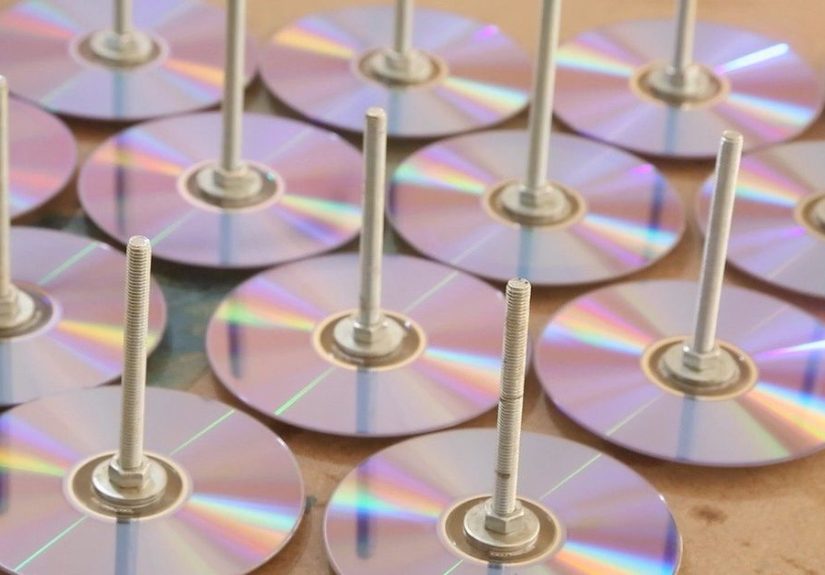
This is the easiest, least stressful way to get a real lamp look with minimal tools. You’ll use the existing
center holes in the CDs to create a vertical tower and hide LEDs inside.
What it looks like
A sleek column of CDs that glows from within. The edges catch the light and create a subtle sparklelike your
old music collection decided to become modern home decor.
What you’ll need
- 15–25 CDs
- Battery LED fairy lights or a small LED puck light
- A rod/dowel (optional but makes it sturdier)
- Cardboard or wood base (a 5–6 inch square works nicely)
- Hot glue or strong adhesive
Steps
- Clean the discs. Wipe fingerprints and dust off with rubbing alcohol. Clean discs reflect light better and glue sticks better.
- Plan the base. If using a puck light, center it on the base and trace around it. If using fairy lights, plan where the battery pack will hide (behind the tower or under the base).
- Create a stabilizer. The “pro” move is a vertical rod/dowel through the CD holes. If you don’t have one, you can still stack carefully and glue in stages.
- Stack and space. For more glow, don’t press discs tightly together. Add tiny spacers (foam dots, small cardboard rings, or even thick tape) every few discs so light can travel.
- Install the LEDs. Feed fairy lights up the center or mount a puck light at the base aiming upward. Test the glow before committing with glue.
- Lock it in. Glue the bottom few discs to the base. Then add discs in short “sets” (3–5 at a time), letting glue cool so the tower stays straight.
- Finish clean. Add felt pads under the base, hide the battery pack, and do a final light test in a dark room.
Make it look expensive (without actually being expensive)
- Go monochrome: use all silver CDs for a clean, modern look.
- Go nostalgia: alternate CD labels for a subtle collage effect (place labels facing inward to keep the outside sleek).
- Add a diffuser: place a frosted plastic sheet or vellum cylinder inside the CD tower to soften hotspots.
Build #2: The CD Mosaic Jar Night Lamp (The “Wow, That Was Fast” Option)
Want something that looks like it came from a boutique? Mosaic is your best friend. You’ll cut CDs into small
pieces and tile them onto a glass jar or cylinder vase, then light it from inside with a cool LED.
What you’ll need
- 3–6 CDs (more if your jar is large)
- Glass jar or cylinder vase (clear works best)
- Strong adhesive (mosaic-style glue or a strong craft glue)
- Battery LED tealight or a short LED fairy light strand
- Safety glasses + gloves (cutting step)
- Optional grout (only if you want a true tiled look)
Steps
- Pick your jar shape. Short and wide = more glow. Tall and slim = modern lantern vibe.
- Cut the CDs into tiles. Aim for small squares/triangles. Keep pieces consistent so the pattern looks intentional, not “I fought the scissors and the scissors won.”
- Dry-fit a pattern. Lay tiles on the table in a rough layout. Mixing sizes can look artsyif it’s balanced.
- Glue in sections. Work around the jar in bands. Use painter’s tape to hold slippery pieces while glue sets.
- Optional: grout it. If you want a real mosaic finish, grout between tiles (follow product directions). Wipe gently so you don’t scratch reflective surfaces.
- Light it safely. Use an LED tealight or battery fairy lights. Avoid any light source that heats up.
Design variations
- “Ice crystal” look: use tiny irregular shards and lots of spacing.
- Geometric: all triangles, arranged like a stained-glass pattern.
- Soft glow: line the inside of the jar with vellum so reflections become gentle, not blinding.
Build #3: The CD “Halo” Wall Night Light (Small, Stylish, and Perfect for Hallways)
If you want a night lamp that looks intentional (and not like a science project that gained sentience),
try a wall “halo.” It’s basically a CD-based reflective ring around a small puck lightgreat for
hallways, closets, or beside the bed.
What you’ll need
- 4–8 CDs (whole discs or cut into curved segments)
- Battery LED puck light (tap-on or remote)
- Foam board or thin wood for backing
- Command strips or wall-safe mounting tape
Steps
- Make the backing. Cut a circle or square that’s slightly larger than the puck light.
- Center the puck. Attach the puck light in the middle (make sure you can still access the battery compartment).
- Create the “halo.” Arrange CDs around the puck like petals. You can overlap whole discs for a bold look or cut arcs for a cleaner ring.
- Test in the dark. Turn it on and see where the light bounces. Adjust angles for a softer spread.
- Mount safely. Use removable strips so you can change batteries without tearing up the wall.
Pro Tips for a Better Glow (and Fewer Regrets)
Diffuse the light to avoid “laser eyeballs”
CDs reflect. That’s their whole personality. If your lamp looks too harsh, add a diffuser:
vellum, frosted plastic, or even a thin white fabric layer (kept away from the LEDs).
Hide the “tech” so it looks like decor
Battery packs and switches are the unglamorous truth of DIY lighting. Hide them:
under a base, behind a backing board, or inside a jar wrapped with a paper liner.
Make it stable
- Use felt pads under bases.
- Don’t make tall towers too skinnywider bases prevent wobble.
- Glue in stages so things set straight.
Troubleshooting: When the Lamp Has Opinions
Problem: It’s too dim
- Use a brighter puck light or add a second LED strand inside the tower.
- Reduce internal clutter so light can travel upward.
- Try a lighter diffuser (or remove it entirely).
Problem: The light has harsh hotspots
- Add a diffuser liner inside the structure.
- Point the LED at a white surface first so it bounces softly.
- Use more spacing between stacked discs.
Problem: The tower leans like it’s tired
- Rebuild with a center rod/dowel for alignment.
- Glue in smaller sets and let them cool fully.
- Widen the base and add weight (a thin wood base helps).
Eco Note: What to Do With the Leftovers
If you only use a few discs, keep the rest for future crafts (CD coasters, garden reflectors, mosaic frames),
donate working discs, or look for specialty recycling options in your area. Even a small upcycle project can
be a nice reminder that “trash” is sometimes just “materials waiting for better marketing.”
Real-World Maker Experiences (500+ Words): What It’s Like to Actually Build One
Most people start this project with the same energy: “This is going to be adorable,” followed closely by,
“Why are CDs so shiny and also so determined to slide off the table?” That’s normal. CDs have a way of making
you feel like you’re crafting inside a tiny disco ballespecially when overhead lights hit them and suddenly
the whole room looks like it’s auditioning for a dance scene.
The first “aha” moment usually happens during the lighting test. You switch on the LED and realize the glow
is either (1) magical and soft, or (2) concentrated like a beacon calling aircraft to land. This is where
DIYers learn the power of diffusion. Adding a simple vellum liner or frosted sheet often transforms a harsh
point of light into a calm, bedtime-friendly wash. It’s one of those satisfying fixes where you feel like you
just leveled up as a makerwithout buying any fancy tools.
If you build the CD tower, you’ll probably notice a rhythm to the stacking process: align, test, glue, adjust,
repeat. People often expect it to be a quick “stack and done,” but the neatest towers come from patience.
The experience is a little like making pancakes: the first one teaches you what not to do, and by the third
set you’re suddenly producing something that looks intentionally designed. The most common tweak makers report
is spacingadding tiny gaps between discs so light can travel. Once you see how much brighter the tower looks
with a little breathing room, you’ll never go back to the “squish everything together” method.
For the mosaic jar lamp, the experience shifts into “tiny tile artist mode.” People often enjoy this build
because it feels more creative than technical. You can freestyle patterns, mix shards, and create a look that
matches your roomcool-toned for a modern vibe, warmer and irregular for a handmade, artsy vibe. The main
challenge is sticking: glossy surfaces and small pieces can slide. The trick many DIYers learn is working in
sections and using painter’s tape as a temporary third hand. It’s not glamorous, but it’s effectiveand it
prevents the dreaded “gravity betrayal” where your perfect pattern slowly creeps downward while you watch in
disbelief.
One of the best parts people mention is the “night test.” You turn off the room lights and suddenly your
upcycled CDs stop looking like yesterday’s tech and start looking like intentional home decor. That moment
is oddly rewarding because it’s not just a craftit’s functional. You’re making something that helps with
nighttime navigation, adds ambiance, and feels personal. And because it’s made from materials you already had,
it often carries a little nostalgia: maybe those discs were old school projects, childhood movies, or music
that meant something. Upcycling turns that memory into a useful object instead of clutter.
Finally, makers usually end up with one unexpected takeaway: once you build one CD lamp, you start seeing
“lamp potential” everywhere. Old jars become lanterns. Broken acrylic turns into diffusers. Random leftover
LEDs become future projects. The CD night lamp is a gateway craftfun, approachable, and just fancy-looking
enough that someone will ask, “Where did you buy that?” and you get to say, with full confidence:
“I didn’t. I made it.”
Wrap-Up
A DIY CD night lamp is the perfect blend of practical and playful: it repurposes old discs, adds cozy lighting,
and gives your space a little sparkle without a big budget. Stick with cool-running, low-voltage LEDs, take
basic safety steps (especially during cutting), and don’t be afraid to test-and-tweak until the glow feels
just right. Your old CDs had their eranow they can have their afterparty.