Table of Contents >> Show >> Hide
- Why Halle Berry’s Dress Photo Went Viral So Fast
- What Fans Couldn’t Stop Talking About
- Halle Berry’s Risqué Style Isn’t a One-Off
- The Bigger Reason the Photo Resonated
- Celebrity Fashion, Social Media, and the Zoom-In Era
- Final Thoughts
- Extended Perspective: The Experience Behind a Viral Celebrity Fashion Moment
- SEO Tags
Some celebrity photos make a splash. Others create a full-on internet weather event. Halle Berry’s viral white-dress post landed firmly in the second category. One minute, the Oscar winner was twirling by the pool in a breezy, glamorous look; the next, social media was doing what social media does best: complimenting, comparing, overanalyzing, and acting like it had a magnifying glass where its common sense should be.
The moment was classic Halle Berry. It was playful without trying too hard, glamorous without looking stiff, and confident in that unmistakable way only a true movie star can pull off. The dress floated, the camera caught the perfect bit of movement, and the internet immediately started doing cartwheels. Fans praised her beauty, joked about the photo’s blink-and-you’ll-miss-it daring detail, and compared the pose to Marilyn Monroe’s most iconic windblown fashion moment. In other words, the post had everything the modern celebrity machine loves: style, nostalgia, controversy, confidence, and a comment section moving like it had three energy drinks before breakfast.
But the reason this image stuck around was not just that it was risqué. It was that it felt so on-brand for Berry’s current era. She has become one of the most interesting celebrities to watch online because she mixes glamour with humor, sensuality with control, and age-defying style with a refusal to apologize for taking up space. That combination turned a simple dress photo into a bigger conversation about image, confidence, fame, and the weird little habits of internet culture.
Why Halle Berry’s Dress Photo Went Viral So Fast
A white dress, a gust of wind, and one very online audience
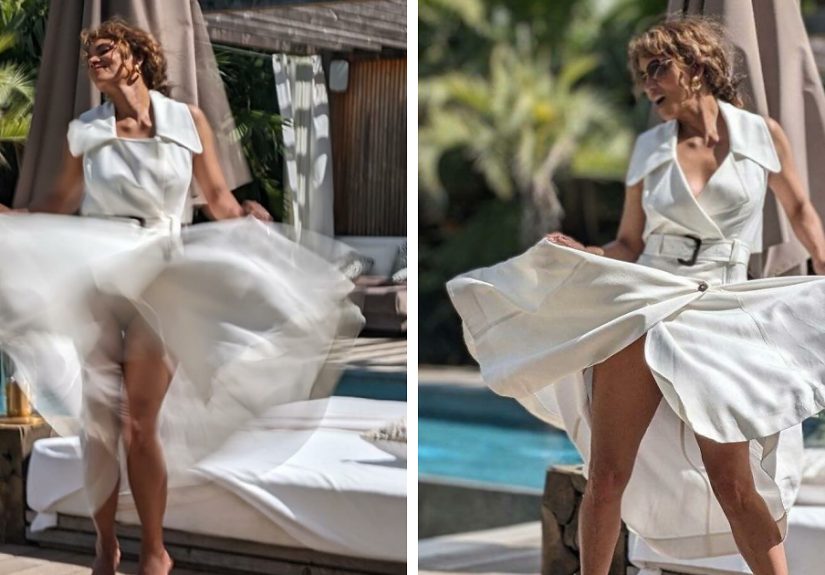
The photo itself was simple in the way only expertly curated celebrity content can be simple. Berry posed outdoors in a white wrap-style dress, black heels, and understated accessories, letting the movement of the fabric do most of the storytelling. She captioned the post with a playful line about causing “a little commotion for the dress,” which, as it turns out, was not an empty promise. The post instantly invited two reactions: fashion admiration and comment-section chaos.
Part of the appeal was visual. White dresses have a long Hollywood history. They read as classic, cinematic, and just a little dangerous when paired with wind, motion, and confidence. Berry leaned into all of that. She looked relaxed, amused, and fully aware that the image was flirting with old-school movie-star iconography. Fans quickly drew Marilyn Monroe comparisons, and honestly, they were not reaching. The pose, the movement, the tease of the fabric lifting in motionthis was absolutely a modern celebrity riff on a very old Hollywood visual language.
The Marilyn Monroe comparison was inevitable
Whenever a white dress meets a breeze, Marilyn Monroe enters the chat. That is just how pop culture works. Berry’s post triggered those comparisons almost instantly because it echoed the playful glamour associated with The Seven Year Itch, one of the most enduring images in entertainment history. The internet loves a reference point, and Monroe’s famous windblown dress scene is the kind of visual shorthand people recognize in half a second.
What made Berry’s version work, though, was that it did not feel like a costume. It felt like a wink. She was not trying to disappear into Monroe’s image; she was borrowing the vibe and translating it into her own grown, modern, self-aware style. That distinction matters. Berry’s best fashion moments rarely feel borrowed. Even when they nod to fashion history, they still read like Halle Berry first, inspiration second.
What Fans Couldn’t Stop Talking About
The reactions were equal parts admiration and detective work
The internet did what it always does when a star posts something slightly daring: it split into camps. One group focused on how stunning she looked. Another group made jokes about the photo’s revealing angle. A third group behaved like unpaid investigators, zooming in as if they were working a shift at the Department of Wardrobe Analysis. That is where the now-famous “don’t zoom in” style of reaction took off.
It was silly, but it was also revealing. The frenzy said less about a tiny visual detail and more about how audiences consume celebrity images now. People no longer just look at a photo. They inspect it. They meme it. They debate whether the star knew exactly what she was doing. In Berry’s case, the answer feels pretty obvious: of course she knew the image was provocative, and of course that was part of the fun. But the photo still managed to feel playful instead of desperate, which is a very tricky balance and one Berry understands better than most.
That balance is probably why the post read as flirty rather than forced. There was no obvious attempt to shock for the sake of shock. The energy was more, “I look fabulous, the dress is having a moment, enjoy yourselves,” than “Please validate me, strangers of the internet.” Those are not the same thing, and audiences can usually tell the difference in about three seconds.
Why the comment section actually helped the post
Celebrity posts go viral when they invite participation. Berry’s photo did exactly that. Fans did not just double-tap and move on. They brought jokes, comparisons, compliments, and enough dramatic energy to power a small city. In the language of social media, that is gold. A post becomes bigger when it gives people something to do with it, and this one offered several options at once: admire the outfit, laugh at the daring angle, invoke Marilyn Monroe, or praise Berry for looking fantastic at 57.
That last point matters. A huge amount of the praise centered on how confident and radiant she looked, not simply on the dress itself. The image became a celebration of Berry’s ease in her own skin. Even people who were joking about the photo were also acknowledging the same thing: she looked comfortable, amused, and completely in control of the moment.
Halle Berry’s Risqué Style Isn’t a One-Off
She has been building this image for a while
If the white-dress photo felt like a sudden “break the internet” moment, that is only because social media loves to act surprised by things that have actually been building for years. Berry has long embraced bold fashion, and more recent coverage has shown that she is especially comfortable in looks that flirt with transparency, cutouts, plunging necklines, and body-conscious silhouettes.
That matters because the viral photo did not come out of nowhere. It fit into a larger pattern: Berry choosing fashion that communicates confidence rather than caution. In later appearances and red-carpet moments, she continued to wear daring pieces with the same relaxed authority. That consistency is part of what makes her style so compelling. She does not wear revealing clothes as a one-time stunt. She wears them as part of a broader message about self-possession.
And yes, that message has humor. Earlier in 2024, she even laughed through a very relatable wardrobe malfunction while struggling to get out of a tight top after a shoot. That clip reminded fans that glamorous style is not always elegant behind the scenes. Sometimes it is just couture wrestling with bonus chaos. The mix of glamor and goofiness makes Berry’s public persona feel more humanand a lot more likable.
She wears confidence like it is tailored
Berry’s appeal has always gone beyond conventional beauty. Plenty of celebrities are beautiful. Fewer know how to communicate confidence without looking overly polished or calculated. Berry often does that by making the clothes feel secondary to her attitude. The outfit matters, sure. But the larger story is always the same: she is not asking for permission.
That is why the viral dress photo felt bigger than a standard “look what I wore” celebrity post. It carried the energy of someone who has decided she does not need to shrink, soften, or become invisible with age. In Hollywood, where women are often expected to fade politely into safer image management, that still feels disruptive in the best possible way.
The Bigger Reason the Photo Resonated
It landed in the middle of Berry’s outspoken midlife era
One reason the image struck a nerve is that it arrived during a period when Berry has been especially vocal about aging, women’s health, and refusing outdated expectations. In interviews and public appearances, she has spoken candidly about menopause, midlife, and the importance of changing how women are treated as they get older. She has argued that there is nothing wrong with being in midlife and that women deserve better information, better care, and a lot less shame.
That context changes how the dress photo reads. It is not just “look at this sexy picture.” It is also part of a larger public stance: women do not expire. They do not lose their glamour at a certain birthday. They do not need to act apologetic for still being visible, fashionable, flirtatious, or fully themselves. Berry has been making that point in interviews, activism, and business ventures focused on women’s health. The dress photo simply delivered the same message in a visual language the internet could not ignore.
That is also why so many reactions centered on admiration rather than scandal. Sure, there were jokes. There are always jokes. But underneath them was a stronger takeaway: Berry looked great, seemed happy, and projected a kind of ease that many people find genuinely aspirational. She was not performing youth. She was performing ownership.
Ageism is still everywhere, which made the moment feel sharper
Celebrity culture has a weird double standard. It celebrates women for “aging backward” while also quietly policing how much confidence, sensuality, or visibility they are allowed to express past a certain age. Berry keeps stepping over that line with a smile, and that is part of why her posts generate so much attention. They do not just show her looking good. They also challenge the expectation that women should get more modest, more apologetic, and less fun as they get older.
When fans praised her as “ageless,” they were trying to compliment her, but Berry’s real statement seems more interesting than that. She is not pretending age does not exist. She is saying age should not cancel style, sexuality, joy, or visibility. That is a much stronger message than the usual “she still looks amazing” headline formula.
Celebrity Fashion, Social Media, and the Zoom-In Era
We do not just watch celebrity style anymorewe dissect it
The “don’t zoom in” reaction says a lot about modern media habits. A celebrity photo used to live in a magazine, where readers flipped a page and moved on. Now it lives on platforms designed for replay, enlargement, screenshotting, and endless commentary. That changes everything. Fashion moments no longer belong just to stylists, photographers, and red carpets. They belong to the audience, tooespecially the audience armed with a phone, a joke, and enough free time to inspect a hemline like it contains state secrets.
Berry’s post became a perfect example of this new ecosystem. The image was stylish enough for fashion coverage, playful enough for entertainment blogs, and cheeky enough for social media jokes. That combination is incredibly effective online. It gives every corner of the internet a reason to care, even if for wildly different reasons.
And yet, the image still did what the best celebrity fashion moments do: it made people feel something instantly. That feeling might have been admiration, nostalgia, envy, amusement, or a mild desire to buy a white dress and stand near a fan. But it was immediate. In a crowded online world, that kind of instant emotional clarity is rare.
Final Thoughts
Halle Berry’s risqué dress photo went viral because it hit the sweet spot between glamour and playfulness. It nodded to old Hollywood, invited modern internet chaos, and showcased a star who knows exactly how to turn a simple pose into a conversation. Fans could not get over it because the photo was not just pretty. It was culturally legible. It had history, humor, and just enough mischief to keep everyone talking.
More importantly, the moment worked because Berry is in a phase of her public life where confidence is the headline. The dress was eye-catching, yes, but the real story was the attitude inside it. She looked amused by the attention, not overwhelmed by it. She looked glamorous, not anxious. And in an online world where celebrity content often feels overworked and underlived, that ease felt refreshing.
So no, fans could not get over Halle Berry’s dress photo. But maybe that is because the image was never only about the dress. It was about what the dress represented: confidence, control, humor, and the reminder that a true star does not need to shout to cause a commotion. Sometimes all she needs is a white dress, a little wind, and the internet doing what the internet does bestabsolutely losing its mind.
Extended Perspective: The Experience Behind a Viral Celebrity Fashion Moment
There is also something deeply familiar about the way people experienced this photo in real time. A celebrity posts an image. At first glance, it is just a glamorous fashion moment. Then the comments start rolling in. Someone notices a tiny detail. Someone else makes a joke. Another person references a classic movie scene. Within minutes, the post is no longer a single image; it becomes a collective event. That shared experience is part of why moments like Berry’s white-dress photo linger longer than the average celebrity upload.
For fans, the experience is almost ritualistic. You see the photo and think, “Wow, she looks incredible.” Then you scroll into the comments and realize everyone else is having their own version of the same reaction, just louder and funnier. Suddenly the experience is communal. It is not only about looking at Halle Berry. It is about participating in a pop-culture moment with thousands of other people who are simultaneously admiring the styling, cracking jokes, and arguing over whether the whole thing was intentional. That group reaction is half the entertainment now.
There is also a nostalgia factor at work. A lot of people did not merely respond to Berry’s beauty; they responded to what the image reminded them of. It evoked old Hollywood. It recalled the glamorous era when a photograph could feel cinematic instead of casual. Even on social media, where everything moves at lightning speed, audiences still respond to images that feel crafted, referential, and just a little larger than life. Berry’s photo offered that in a format that still felt modern and spontaneous.
Another layer of the experience is personal projection. People do not just watch celebrities; they use celebrity images as little tests for their own beliefs. How do I feel about a woman being boldly sensual in midlife? Do I read this as stylish, empowering, attention-seeking, funny, iconic, or all of the above? The reason comments become so intense is that people are often reacting to their own assumptions as much as the image itself. Berry’s post stirred conversation because it pushed on several hot buttons at once: age, beauty, sexuality, glamour, confidence, and internet oversharing. That is a powerful cocktail.
And then there is the humor, which should not be underestimated. Sometimes a post goes viral because it is beautiful. Sometimes it goes viral because it is scandalous. This one did both, but it also had a sense of play. The internet loves beauty, but it adores beauty with a punch line. “Don’t zoom in” is the kind of joking warning that turns an image into a meme-friendly event. It lets people flirt with the drama without turning the whole thing into moral panic. In that sense, the audience experience becomes less about outrage and more about collective amusement.
What people ultimately experienced in this moment was not just a famous actress in a breezy dress. They experienced the full modern cycle of celebrity culture: admiration, commentary, nostalgia, humor, discourse, and replay. And Berry, perhaps more than many stars, understands exactly how to stand at the center of that storm without looking rattled by it. That calm, amused control is probably the most memorable part of the whole episode. The dress may have started the commotion, but Berry’s confidence is what made people stay.