Table of Contents >> Show >> Hide
- What Is the Thoracolumbar Fascia (and Why Should You Care)?
- How Exercises “Work” Your Thoracolumbar Fascia
- Before You Start: Safety Notes (Seriously, Read This)
- Phase 1: Mobility and “Fascial Glide” Warm-Ups
- Phase 2: Core Stability and Anti-Rotation (The “TLF Tensioners”)
- Phase 3: Posterior Chain and Sling Strength (Where the Magic Feels “Real”)
- Phase 4: Carries and Locomotion (Fascia-Friendly “Real Life” Training)
- A Simple 15–20 Minute Routine (2–4 Days/Week)
- Common Mistakes (and How to Fix Them Fast)
- FAQ: Thoracolumbar Fascia Exercises
- Real-World Experiences Related to Thoracolumbar Fascia Training (About )
- Conclusion
If your lower back ever feels like it’s wearing a slightly-too-small hoodie (tight, cranky, and refusing to cooperate), you’ve probably blamed a muscle. Fair. But there’s another big player in that “why does my back feel like this?” story: the thoracolumbar fasciaa thick, layered sheet of connective tissue in your mid-to-lower back that helps link your trunk, hips, and even your shoulders into one coordinated system.
Here’s the twist: you can’t “isolate” fascia the way you isolate a biceps curl. Fascia doesn’t show up at the gym, grab a dumbbell, and ask for three sets of 10. What you can do is train the movements and muscles that load, tension, and glide across the thoracolumbar fasciaso it’s better supported, better conditioned, and less likely to complain during daily life, sports, or long homework/desk sessions.
This guide covers fascia-friendly mobility, core stability, and posterior-chain strength exercises (plus a simple routine) that “work” your thoracolumbar fascia by improving how your body transfers force and stabilizes your lumbar spine. Expect clear steps, smart progressions, and just enough humor to keep things from feeling like a textbook.
What Is the Thoracolumbar Fascia (and Why Should You Care)?
The thoracolumbar fascia (TLF) is a multi-layered connective tissue structure spanning the thoracic and lumbar regions. It helps organize and transmit forces between the spine, pelvis, and limbsespecially during bending, lifting, rotation, walking, and running. Think of it as part of your body’s “force-sharing network,” not just wrapping paper.
The TLF connects with key muscles that matter for posture and performancelike the latissimus dorsi, gluteus maximus, erector spinae, and deep abdominal muscles (including transversus abdominis). That’s why good training for the TLF looks like a mix of core control, hip strength, and cross-body coordination rather than “one weird stretch you do once and forget.”
Quick reality check: fascia isn’t a villain
Fascia is supposed to be strong and supportive. “Tightness” often reflects how your nervous system is protecting you, how you’re loading tissues, how you’re moving (or not moving), and how strong and coordinated your support system is. The goal isn’t to “break up” your thoracolumbar fasciait’s to make it feel safe and capable by building better movement options.
How Exercises “Work” Your Thoracolumbar Fascia
Most effective thoracolumbar fascia exercises do one (or more) of these:
- Improve glide and hydration through varied, gentle motion (think: controlled spinal movement and breathing).
- Create tension the smart way via deep-core bracing and anti-rotation (your trunk learns to stabilize without clenching).
- Load the posterior chain (glutes + hamstrings + back) with good mechanicsespecially hip hinging.
- Train force transfer across the body (cross-crawl patterns, carries, rows, and contralateral work).
You’ll notice a theme: these aren’t random. They’re the basic ingredients of “my back feels supported when I move.”
Before You Start: Safety Notes (Seriously, Read This)
- Pain rules: mild effort and stretching sensation are okay. Sharp pain, tingling, numbness, or pain shooting down the leg is a “stop and get checked” sign.
- Start light: especially if you’re new to training. Your fascia and muscles respond best to gradual, consistent loading.
- Form > intensity: a perfect “easy” bird dog beats a wobbly “hard” bird dog every day of the week (and twice on leg day).
- If you’re dealing with an injury or medical condition, talk with a qualified clinician or physical therapist for personalized guidance.
Phase 1: Mobility and “Fascial Glide” Warm-Ups
These moves help your spine and hips move more smoothly, which often reduces the urge to “guard” your lower back. Do 4–6 minutes before strength work or anytime you feel stiff.
1) Cat-Cow (Slow and Controlled)
Why it helps: Gentle flexion/extension encourages comfortable spinal motion and coordinated breathing.
- Start on hands and knees, hands under shoulders, knees under hips.
- Inhale: slowly arch your back (cow), lifting your chest slightly.
- Exhale: slowly round your spine (cat), letting your ribcage soften down.
- Dosage: 6–10 slow reps.
2) Child’s Pose with Side Reach
Why it helps: Adds a gentle stretch through the lats and back fascia without forcing your lumbar spine.
- Sit back toward your heels with arms extended forward.
- Walk hands slightly to the right, breathe 3 slow breaths.
- Walk hands slightly to the left, breathe 3 slow breaths.
- Dosage: 1–2 rounds.
3) Open Book Thoracic Rotation
Why it helps: Many “low back tight” feelings come from a stiff mid-back that forces the lumbar spine to rotate more than it wants.
- Lie on your side, knees bent, arms straight in front of you.
- Rotate your top arm open toward the floor behind you as you exhale.
- Keep knees stacked; rotate from your ribcage, not your low back.
- Dosage: 5–8 reps per side.
4) Half-Kneeling Hip Flexor Stretch with Overhead Reach
Why it helps: Hip flexor stiffness can tug on pelvis position and make your low back feel overworked.
- Half-kneel with one knee down, other foot forward.
- Gently tuck pelvis (think: belt buckle up), squeeze back-side glute.
- Reach the arm on the kneeling side overhead and slightly to the opposite side.
- Dosage: 20–30 seconds per side.
Phase 2: Core Stability and Anti-Rotation (The “TLF Tensioners”)
These exercises train the deep core system to create supportive tensionoften described as “bracing”which can help tension the connective tissue network around the lumbar area. The goal is steady, not “hold your breath and hope.”
5) Dead Bug
Why it helps: Builds trunk control while limbs moveexactly the kind of coordination your back loves.
- Lie on your back, knees and hips at 90 degrees, arms up.
- Gently brace your midsection so your low back stays neutral (not arched).
- Slowly lower opposite arm and leg (or one limb at a time), then return.
- Dosage: 6–10 reps per side, slow tempo.
Make it easier: Keep knees bent and move only the arms. Make it harder: Straighten the moving leg or pause at the bottom.
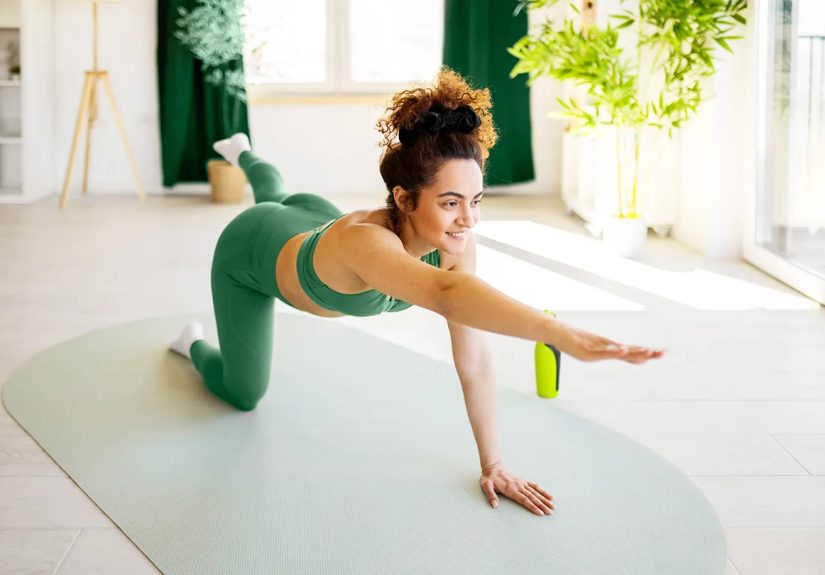
6) Bird Dog
Why it helps: Teaches spinal stability with contralateral (opposite arm/leg) extensionexcellent for “force transfer” patterns.
- Start on hands and knees in a neutral spine.
- Brace gently; imagine balancing a glass of water on your low back.
- Extend one leg back and the opposite arm forwardno twisting.
- Return slowly; switch sides.
- Dosage: 6–8 reps per side with 2–3 second holds.
Common mistake: Over-arching the low back. Keep ribs down and reach long.
7) Side Plank (Modified or Full)
Why it helps: Trains lateral core stability so your low back doesn’t do all the work when you shift weight or carry stuff.
- Start on your side with forearm under shoulder.
- Modified: knees bent. Full: legs straight.
- Lift hips, keep body in a straight line, breathe steadily.
- Dosage: 2–3 holds of 15–30 seconds per side.
8) Pallof Press (Band or Cable Anti-Rotation Press)
Why it helps: Your trunk learns to resist rotationhuge for athletic movement and spine comfort.
- Stand sideways to a band/cable anchored at chest height.
- Hold hands at chest, step away to create tension.
- Press hands straight out and hold 2–3 seconds without twisting.
- Return slowly; repeat.
- Dosage: 8–12 reps per side.
Phase 3: Posterior Chain and Sling Strength (Where the Magic Feels “Real”)
The thoracolumbar fascia is heavily involved when your glutes, lats, and trunk work togetherespecially in hip hinging and cross-body patterns. This is where you build the “my back feels supported when I lift my backpack” effect.
9) Glute Bridge (Progress to Bridge with Arm Reach)
Why it helps: Strengthens glutes and teaches your pelvis and trunk to work together.
- Lie on your back, knees bent, feet flat.
- Brace gently, squeeze glutes, lift hips without arching your back.
- Optional: while holding, reach both arms overhead to add trunk control demand.
- Dosage: 10–15 reps or 2–3 holds of 20 seconds.
10) Hip Hinge Drill (Wall Tap) → Romanian Deadlift Pattern
Why it helps: Hip hinging loads the posterior chain while teaching your lumbar spine to stay stable.
- Stand about 6–10 inches from a wall, feet hip-width.
- Push hips back to tap the wall with your glutesspine neutral.
- Return by squeezing glutes and driving hips forward.
- Dosage: 8–12 reps.
Progression: Add light dumbbells/kettlebell and perform a controlled Romanian deadlift (RDL). Start light and keep the weight close.
11) Single-Leg RDL (Supported)
Why it helps: Challenges hip stability and cross-body tensiongreat for the back-hip connection.
- Hold a wall/chair for balance.
- Hinge on one leg while the free leg reaches back, spine long.
- Keep hips level; return using glute/hamstring control.
- Dosage: 6–10 reps per side.
12) Row + Split Stance (Band or Cable Row)
Why it helps: Rows train lats that connect into the thoracolumbar fascia while your trunk resists twisting.
- Split stance (one foot forward), slight bend in knees.
- Row handles toward ribs while keeping shoulders down and spine tall.
- Don’t let your torso rotatestay square.
- Dosage: 8–12 reps per side.
Phase 4: Carries and Locomotion (Fascia-Friendly “Real Life” Training)
Fascia responds well to whole-body tasks that require organized tensionlike carrying, walking, and crawling. These also translate beautifully to sports and everyday movement.
13) Suitcase Carry (One-Sided Carry)
Why it helps: Anti-side-bending strength. Your trunk stays upright while one side is loaded.
- Hold a dumbbell/kettlebell on one side (start light).
- Stand tall, ribs stacked over pelvis, walk slowly.
- Dosage: 20–40 seconds per side, 2–3 rounds.
14) Cross-Crawl March (Low-Impact Coordination)
Why it helps: Reinforces contralateral patterns similar to walking/runninguseful for posterior sling coordination.
- Stand tall and march in place.
- Lightly touch opposite hand to opposite knee as it lifts.
- Keep it smooth and controlled (not frantic).
- Dosage: 30–60 seconds.
15) Bear Crawl (Beginner-Friendly Version)
Why it helps: Whole-body stability with cross-body coordinationlike bird dog, but moving.
- Start on hands and knees, then lift knees 1–2 inches off the floor.
- Take small steps forward/back, keeping hips level.
- Dosage: 10–20 seconds, 2–4 rounds.
Make it easier: Hold the hover only. Make it harder: Slow crawl with longer time.
A Simple 15–20 Minute Routine (2–4 Days/Week)
Want something you can actually stick with? Try this:
Warm-up (4–6 minutes)
- Cat-Cow: 8 reps
- Open Book: 6 reps/side
- Half-Kneeling Hip Flexor Stretch with Reach: 20 seconds/side
Stability Block (6–8 minutes)
- Dead Bug: 8 reps/side
- Bird Dog: 6 reps/side (2–3 second holds)
- Side Plank: 20 seconds/side
Strength/Transfer Block (6–8 minutes)
- Glute Bridge: 12 reps
- Hip Hinge Wall Tap (or light RDL): 10 reps
- Suitcase Carry: 30 seconds/side
If you’re new, keep everything “easy-medium” for 2–3 weeks. If you’re consistent, your back usually rewards you with smoother movement and less drama during the day.
Common Mistakes (and How to Fix Them Fast)
Mistake 1: Turning everything into a low back bend
Fix: Keep ribs stacked over pelvis. Brace gently. Move from hips for hinging patterns.
Mistake 2: “Bracing” by holding your breath
Fix: Exhale on effort. Think “tighten a little, breathe a lot.”
Mistake 3: Going hard on day one, disappearing on day two
Fix: Consistency beats intensity. Start with 2–3 sessions/week and build.
FAQ: Thoracolumbar Fascia Exercises
Can I foam roll my thoracolumbar fascia?
Gentle self-massage can feel good, but it’s not a replacement for strength and motor control. If you roll, keep it light, avoid direct pressure on the spine, and pair it with movement afterward.
Do I need “fascia-specific” workouts?
Not really. Fascia responds to smart, varied movement and progressive loading. A balanced routine with mobility, stability, and strength covers the bases.
How soon should I feel a difference?
Many people notice a short-term “looser” feeling after the warm-up immediately. Bigger changes (strength, endurance, better control) typically build over a few weeks of consistent practice.
Real-World Experiences Related to Thoracolumbar Fascia Training (About )
People’s experiences with thoracolumbar fascia-focused training tend to follow a familiar storylinekind of like a movie trilogy, but with fewer explosions and more “oh wow, my back feels better.”
Experience #1: The “I thought my back was tight, but it was my hips” moment. A lot of people start with the assumption that their lower back is the problem. Then they do a few days of hip flexor stretching (with the glute squeeze), controlled hip hinges, and glute bridgesand suddenly the back stops acting like it’s the main character. What’s happening is often a shift in load-sharing: hips start doing hip jobs again, and the lumbar area gets a break. The most common comment is something like, “I didn’t realize how much I was moving from my low back until I learned to hinge.”
Experience #2: Bird dog humility. Bird dog looks easyuntil you try to do it without twisting, arching, or wobbling like a shopping cart with one bad wheel. In the beginning, many people feel it more in their low back than their core. The improvement usually comes fast when they shorten the range, slow the movement down, and focus on reaching long (not high). After a week or two, the “work” tends to shift from the low back to the deep core and glutes, which is exactly the goal. People often describe it as “steadier” rather than “stronger,” like their torso has better internal support.
Experience #3: Anti-rotation feels surprisingly athletic. Pallof presses and suitcase carries don’t feel flashy, but they tend to create an “I’m put together” sensation through the trunkespecially for people who play sports, carry heavy backpacks, or spend hours sitting. One common observation is that daily tasks start to feel easier: carrying groceries, lifting a bag, picking something up from the floor, even standing longer without shifting around. That’s because anti-rotation training teaches the trunk to resist unwanted twisting and side bendingtwo patterns that often irritate the lumbar area when control is missing.
Experience #4: The “loose-but-supported” sweet spot. Some people chase looseness by stretching nonstop, only to feel tight again later. When they combine mobility with stability (cat-cow + dead bug + hinge), the stiffness tends to decrease without feeling floppy. That’s a big win. A helpful way people describe it is, “I feel more mobile, but also safer when I move.”
Experience #5: Consistency beats perfection. The biggest difference-maker isn’t the perfect exercise selectionit’s doing a small routine regularly. Many people report the most lasting improvement when they do 10–20 minutes, 2–4 times per week, and keep the intensity moderate. The thoracolumbar fascia (and the system around it) seems to respond best when training feels like practice, not punishment.
Conclusion
“Exercises that work your thoracolumbar fascia” really means exercises that train your body to stabilize, transfer force, and move smoothly through your mid-to-lower back region. Start with gentle mobility to reduce guarding, build deep-core control with dead bugs and bird dogs, then add posterior-chain strength and carries for real-life resilience. If you stay consistent and progress gradually, your thoracolumbar fascia will do what it does best: support you quietly in the backgroundlike a great friend who doesn’t need applause.