Table of Contents >> Show >> Hide
- The most honest short answer
- First, define “lost” (because words do heavy lifting here)
- What credible public reporting actually shows
- Why the internet can’t count armored vehicles (and keeps trying anyway)
- What Hamas uses against Israeli armored vehicles (and what tends to work)
- How Israel has adapted (and why that matters for “loss” counts)
- So… how many armored vehicles has Israel lost?
- How to read future headlines without getting played
- Real-World Experiences Around This Question (Why It Feels So Hard to Answer)
- Conclusion
If you came here hoping for a clean, single numberlike “42 armored vehicles, final answer”I have bad news:
modern wars do not come with receipts. They come with smoke, propaganda videos, battlefield repairs, and the
occasional hot take that treats a fireball as the same thing as a write-off.
Israel has not published a comprehensive, public inventory of armored vehicles lost (in the strict “destroyed and
not coming back” sense) during its fighting with Hamas in Gaza. What we do have is a patchwork: official
statements about incidents, credible reporting on catastrophic attacks, and open-source assessments that can
confirm a minimum number of lossesusually well below what social media claims.
The most honest short answer
No authoritative public total exists. But based on credible reporting and visual-confirmation
analysis discussed by U.S. outlets, the data points point to three practical takeaways:
-
Confirmed “hard losses” are at least in the single digits (and likely higher), because multiple
incidents describe armored vehicles being destroyed or catastrophically hit in Gaza. -
“Knocked out” (mission-killed) vehicles are higher than “destroyed”some sources described
roughly dozens of Israeli tanks being knocked out early in the war, a category that can include vehicles
later recovered and repaired. -
Damaged-and-repaired vehicles are likely the biggest bucketand the one most people accidentally
count as “lost,” because a dramatic blast looks final even when the vehicle rolls again after a depot visit.
So if your real question is, “How much Israeli armor has Hamas managed to stop, wreck, or burn?”the answer is:
more than the minimum confirmed destroyed count, less than the most viral claims, and far messier than a
single scoreboard number.
First, define “lost” (because words do heavy lifting here)
Destroyed (total loss)
The vehicle is burned out, blown apart, or damaged beyond economical repair. In accounting terms: it’s written off.
In battlefield terms: it’s not coming back with a fresh coat of paint and a motivational speech.
Mission-killed (knocked out)
The vehicle can’t fight or movemaybe the tracks are wrecked, the turret is jammed, sensors are destroyed, or the
crew is incapacitated. Mission-killed does not always mean permanently lost. Recovery vehicles,
engineering units, and repair depots exist for a reason.
Damaged (but repairable)
This is the most common outcome in a fight where an army has strong recovery and repair capability. A vehicle can be
hit, damaged, even towed away on videoand still return to service.
Captured or temporarily overrun
In the October 7 attacks, Hamas overran bases and border positions where armored vehicles were parked. Some vehicles
were photographed or filmed with Hamas fighters nearby. “Captured” in that context often means “overrun and
photographed,” not “driven away and added to Hamas’ armored corps like a new DLC unlock.”
What credible public reporting actually shows
1) A minimum confirmed baseline (visual evidence)
One of the clearest ways to avoid wishful thinking is to start with what can be visually confirmed: identifiable
vehicles that appear destroyed, abandoned, or heavily damaged in credible imagery.
A U.S. defense-leaning outlet noted that open-source counting based on visual evidence suggested proof of the
destruction of at least four Merkava tanks in October 2023 alone. That’s a “minimum confirmed”
numbernot a final tallybecause it only counts what can be proved publicly, not everything that happened.
2) Catastrophic attacks on armored vehicles (high-confidence “loss” signals)
While militaries may not publish equipment-loss tables, catastrophic incidents sometimes provide strong clues. When
an armored vehicle is described as destroyed, or when an explosion kills everyone inside, it is often a sign the
vehicle did not simply drive away for a quick pit stop.
For example, credible reporting in mid-2024 described an explosion in southern Gaza killing eight Israeli
soldiers inside an armored vehiclewidely characterized as a severe incident involving an armored carrier.
In mid-2025, reporting described another attack in which a bomb was attached to an armored vehicle, killing
seven Israeli soldiers. Incidents like these don’t automatically give you a full “vehicle-loss
ledger,” but they are meaningful markers that armored vehicles are being hit hard enough to cause catastrophic
outcomes.
3) “Knocked out” tank estimates (useful, but not the same as “destroyed”)
Some early reporting described about 20 Israeli tanks “knocked out” over roughly the first two
months of fighting. That phrasing is important: “knocked out” can include vehicles that are later recovered and
repaired. It does, however, suggest that Hamas was able to at least temporarily disable armored vehicles with
ambushes, mines/IEDs, RPGs, and anti-tank guided missiles (ATGMs).
In other words: even if “knocked out” overstates permanent losses, it still underlines the operational reality:
Israel’s armored corps has taken meaningful hits in Gaza.
Why the internet can’t count armored vehicles (and keeps trying anyway)
Big explosions don’t equal dead vehicles
Modern armored vehicles can produce fireworks-level visuals without being destroyed. Active protection systems and
reactive armor can create dramatic flashes when they intercept or deflect incoming munitions. A blast that looks
like a Hollywood “tank kill” might be a defensive system doing its job.
This is why “Hamas video shows a strike” often doesn’t answer “vehicle destroyed.” You may not see the aftermath:
the crew bailing, sustained internal fires, or the vehicle abandoned. Without that, the honest assessment is often:
unclear.
Battlefield recovery is a superpower (and it’s not cinematic)
If a vehicle is disabled but not in an impossible location, a military with recovery assets can tow it, repair it,
and reintroduce it. That means the same vehicle can appear “killed” on video, then reappear weeks later and ruin
someone’s narrative arc.
Operational security (OPSEC) keeps totals fuzzy
Even armies that acknowledge incidents may avoid publishing comprehensive equipment-loss totals during an ongoing
campaign. That’s not unique to Israel; it’s normal for militaries who don’t want adversaries to learn which units
are depleted, which systems are vulnerable, or which routes are riskier.
What Hamas uses against Israeli armored vehicles (and what tends to work)
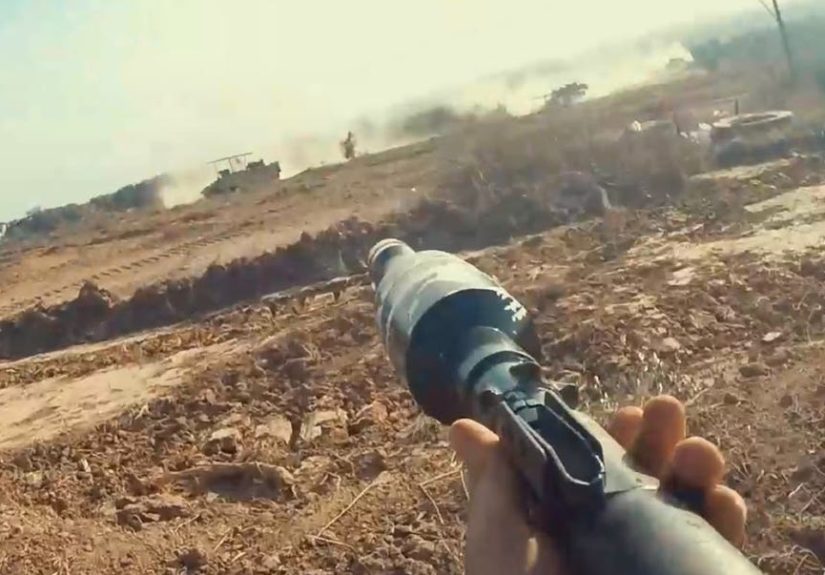
Anti-tank guided missiles (ATGMs)
ATGMs are among the most dangerous threats to armor in urban combat, especially when teams can shoot from covered
positions and vanish quickly. Hamas has displayed and used anti-armor weapons over time, and credible reporting has
described deadly ATGM strikes on Israeli armored vehicles.
Mines and IEDs
Improvised explosive devices don’t need to “pierce the turret” to be devastating. A large blast can flip, break, or
disable a vehicle, and it can kill or injure crew members even if the armor remains partly intact. Several of the
deadliest publicly reported incidents involved explosions affecting armored vehicles operating in southern Gaza.
RPGs and close ambush tactics
In dense neighborhoods, even a technologically advanced tank has a basic problem: it can’t see everywhere at once.
Close-range RPG shots, especially from angles that exploit vulnerabilities, can still cause damage or mission kills.
Drones and top-attack improvisation
One widely discussed shift in modern battlefields is the use of small drones to drop munitions from abovean angle
that can challenge traditional protection schemes. The Gaza war, like Ukraine’s war, has highlighted how quickly
low-cost drones can become a real threat to expensive platforms.
How Israel has adapted (and why that matters for “loss” counts)
Active protection and add-on defenses
Israel has relied heavily on active protection systems on some of its platforms, and reporting has discussed
upgrades aimed at addressing evolving threats (including drones). Add-on “cage” armor and other field adaptations
have also been observed and discussed as countermeasures.
Tactics: infantry-armor coordination
Tanks are strongest when paired with infantry and engineers who can screen for ambush teams, spot IED indicators,
and clear threats in tight terrain. When that coordination breaks downor when the battlefield forces separation
the risk of a successful close ambush rises.
Engineering and route clearance
A lot of armored survivability in Gaza comes down to the unglamorous work: route clearance, obstacle removal, and
counter-IED practices. This also shapes “loss counts,” because a vehicle that is protected by good engineering work
is less likely to become a permanent loss.
So… how many armored vehicles has Israel lost?
Here’s the most responsible way to frame it in January 2026:
-
Minimum confirmed destroyed tanks (early war): U.S. reporting discussing visual evidence cited
proof of at least four destroyed Merkava tanks in October 2023. -
Publicly reported catastrophic armored-vehicle incidents: multiple major attacks in 2024 and 2025
involved armored vehicles and resulted in large numbers of Israeli fatalities, strongly suggesting at least some
vehicles were destroyed or rendered total losses. -
Broader “knocked out” estimates: early reporting used language indicating roughly dozens
of tanks were “knocked out” within monthsuseful for understanding battlefield impact, but not interchangeable with
permanent losses.
If you need a single sentence: Israel’s publicly confirmable permanent armored-vehicle losses appear to be
far lower than viral claims but clearly non-zero, and the number of vehicles disabled or damaged is meaningfully
higher than the number written off.
If you need a single number anyway, the best practice is to publish a range with a clear definition
attached (e.g., “confirmed destroyed by visual evidence,” “reported knocked out,” “reported damaged”). Anything
else is how misinformation gets a driver’s license and starts doing donuts in your feed.
How to read future headlines without getting played
-
Ask what “lost” means. Destroyed? Disabled? Damaged? Abandoned? If the headline doesn’t say, the
answer is usually “it depends.” -
Look for aftermath evidence. Do you see sustained fire, crew evacuation, abandonment, or recovery?
A single explosion clip is not a receipt. -
Separate claims from confirmations. Hamas claims and Israeli claims can both be self-serving.
Cross-reporting and corroboration matter. -
Remember the repair pipeline. A vehicle hit today can be back next month. War is grimly
industrial.
Real-World Experiences Around This Question (Why It Feels So Hard to Answer)
There’s a strange, modern kind of “experience” that forms around questions like thisbecause in 2026, wars are
watched in near real-time by people who are nowhere near the battlefield. You see it in how conversations unfold:
someone posts a clip, someone else posts a screenshot, someone circles a pixelated shape and declares it a tank, and
suddenly the comment section is running a full-blown insurance assessment from three seconds of smoke.
People who track armored losses for a living (analysts, journalists, researchers) often describe a routine that’s
less “spy thriller” and more “careful librarian with a headache.” You compare angles. You check landmarks. You look
for identifiers. You ask whether the blast might be a defensive intercept. You try to figure out if the vehicle is
actually immobile, or if the footage conveniently ends right before it drives away. The experience is basically:
you learn humility or the internet teaches it to you the hard way.
On the military side, the “experience” of armored warfare in dense terrain is brutally practical. Crews operate in a
world where every street can be a funnel and every pile of rubble can hide a trigger man. Even with advanced
protection, the body still reacts the same way to danger: adrenaline, tunnel vision, the mental math of “keep moving,
don’t bunch up, don’t stop in the kill zone.” You don’t need to romanticize it to recognize the psychological load
of being inside a steel box that everyone on the other side wants to turn into a bonfire.
Then there are the mechanics and recovery teamsrarely the stars of viral clips, but essential to why “knocked out”
doesn’t always mean “lost.” Their world is the unglamorous miracle of modern militaries: damaged vehicles get hauled
back, assessed, stripped, rebuilt, and returned. The experience is long shifts, burned metal, replacement parts,
and the constant race between operational demand and what the industrial system can restore. When observers ask,
“Why don’t we see more destroyed vehicles?” one answer is: because a lot of damage disappears behind the curtain of
recovery and repair.
Finally, there’s the experience of the audiencepeople trying to understand the war without being manipulated by it.
It’s emotionally difficult to hold two thoughts at once: that armored vehicles are taking real hits and that
propaganda (from multiple sides) routinely exaggerates those hits. But that’s the honest posture. If you can keep
your balanceskeptical, careful, preciseyou’re already doing better than most of the internet. And yes, that is a
low bar. But it’s the bar we have.
Conclusion
The question “How many armored vehicles has Israel lost fighting Hamas?” sounds like a scoreboard question, but it’s
actually a definitions-and-evidence question. The best public information supports a minimum confirmed baseline of
destroyed vehicles, points to multiple catastrophic armored-vehicle incidents, and suggests a larger number of
vehicles have been knocked out or damagedsome of which likely returned to service.
If you publish this topic, do your readers a favor: define “lost,” give a minimum confirmed count where possible,
and explain why uncertainty is not ignoranceit’s intellectual honesty in a war where information is itself a
battleground.